Urd's Well Myth Meaning & Symbolism
At the roots of the world tree lies Urd's Well, where three sisters weave fate and the gods seek wisdom, revealing the deep connection between past and destiny.
The Tale of Urd’s Well
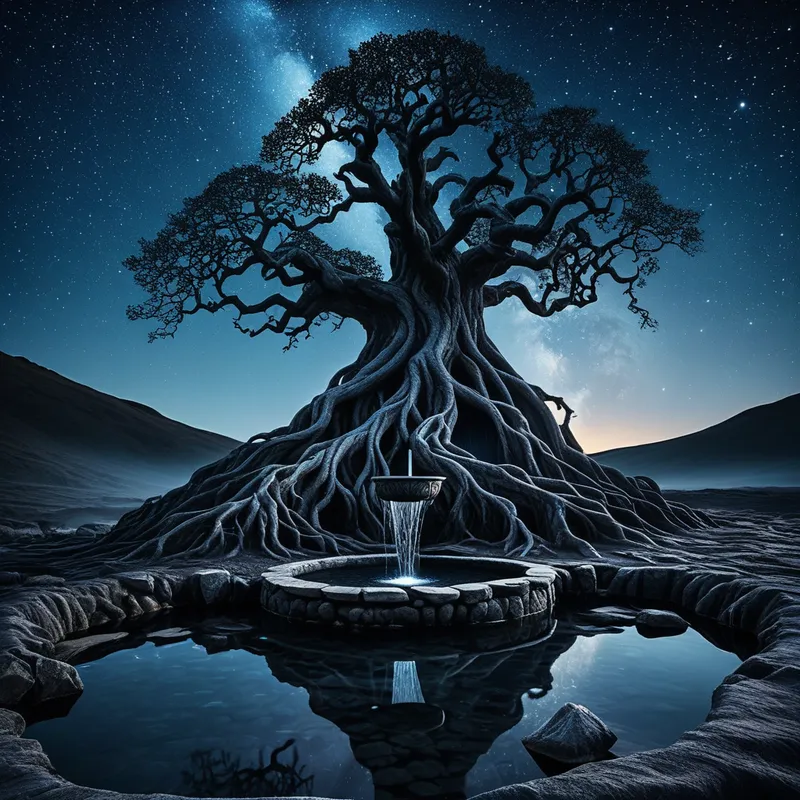
Beneath the groaning weight of the worlds, in a silence older than song, lies a place where time pools and gathers. Here, at the third and deepest root of the Yggdrasil, the great ash that groans under the burden of all that is, the air is thick with the scent of damp earth and ancient stone. This is no mere spring. This is Urd’s Well, a well so deep its waters touch the marrow of creation.
Listen. You can hear the drip, drip, drip of white water onto dark roots. And you can see them—three figures who are not quite women, not quite giants, but something as fundamental as gravity. They are the Norns. Urd, whose name means “What Once Was,” bends with the weight of millennia, her fingers tracing the grooves of past deeds in the bark. Verdandi, “What Is Coming Into Being,” holds a thread taut, her gaze fixed on the present moment as it crystallizes from future into past. Skuld, “What Shall Be,” stands shrouded, a sheathed sword at her side, her face turned toward the shadows beyond the well’s rim.
Every day, they draw water from the well—water that is not H2O but liquid time, liquid memory. They mix it with the rich, dark loam that cradles Yggdrasil’s root and pour it over the bark. This is their endless rite: to tend the tree, to keep it from rotting, to weave the threads of ørlög into its very fabric. The well’s surface is a perfect, dark mirror, showing not reflections, but the tangled roots of all actions and their inevitable fruits.
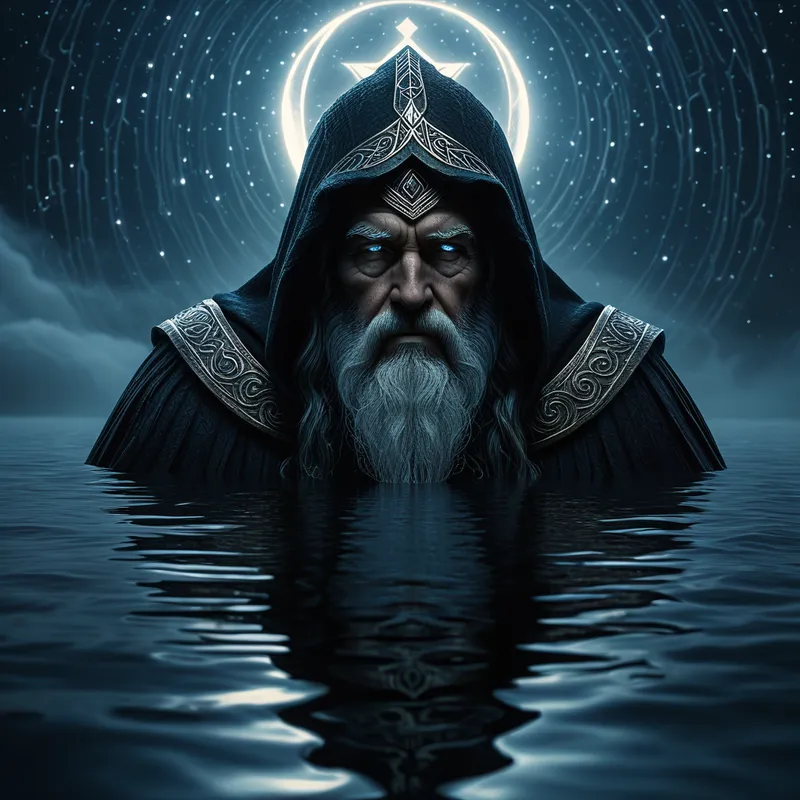
Into this sacred gloom comes a seeker, but not a humble one. He is Odin, the One-Eyed, the Raven-God, lord of the slain and master of secrets. Yet here, at the root of things, he is a supplicant. He has hung nine nights on the windswept branches of Yggdrasil, a sacrifice to himself, to gain the runes. But the runes are silent without context; they are keys, but Urd’s Well holds the map to the locks. He knows the price. The well does not give its wisdom for chants or boasts. It demands a token of utter sincerity, a sacrifice of one’s own limited perception.
Without a word, Odin approaches the still, dark water. The Norns do not pause in their weaving. He looks into the well, and in its depths, he sees the entirety of the Nine Worlds—the glorious rise of Asgard, the slow, grinding mills of the giants, the final, inevitable conflagration of Ragnarok. He sees his own fate, tangled and inescapable. And he makes his choice. With a hand that has thrown spears and bound wolves, he plucks from his own face his right eye—the eye that looks outward, that perceives the external world. He offers it, a gleaming, bloody jewel, and lets it fall into the well.
The water accepts it without a splash. The eye sinks, becoming a pale, watchful moon in the well’s perpetual night. In that moment of utter loss, the well’s secrets unfold for him. The runes in his mind blaze with meaning, connected now to the source of all becoming. He drinks deeply, not of water, but of understanding. He gains the terrible, boundless wisdom of Mimir, the guardian of the well. He sees the pattern, and he knows his part in it. He leaves the wellside not as a conqueror, but as a knowing participant in a story whose end he has already witnessed.
Cultural Origins & Context
This myth was not written in books but breathed into the smoky air of longhouses, spoken by skalds and elders as the fire died to embers. It is preserved primarily in the Poetic Edda, specifically in the Völuspá (The Seeress’s Prophecy) and Gylfaginning from the Prose Edda. These texts are our window into a worldview where fate was not a abstract concept, but a tangible, woven substance administered by powerful, non-divine entities.
The Norns existed outside the easy categories of friend or foe to the gods. They represented a law older than the pantheon itself. In a culture that valued personal honor (drengskapr) and the enduring fame of deeds, the concept of ørlög—the foundational layer of destiny laid down at birth—created a profound tension. One’s personal courage could shape one’s hamingja (luck or fortune), but the ultimate framework was set. Urd’s Well was the symbolic source of this framework. The myth served to explain the paradox of free will within a predetermined cosmos and to place even the gods under a higher, impersonal order. It was a story that fostered both humility (before the Norns) and a specific kind of courage: the resolve to meet one’s woven fate with dignity.
Symbolic Architecture
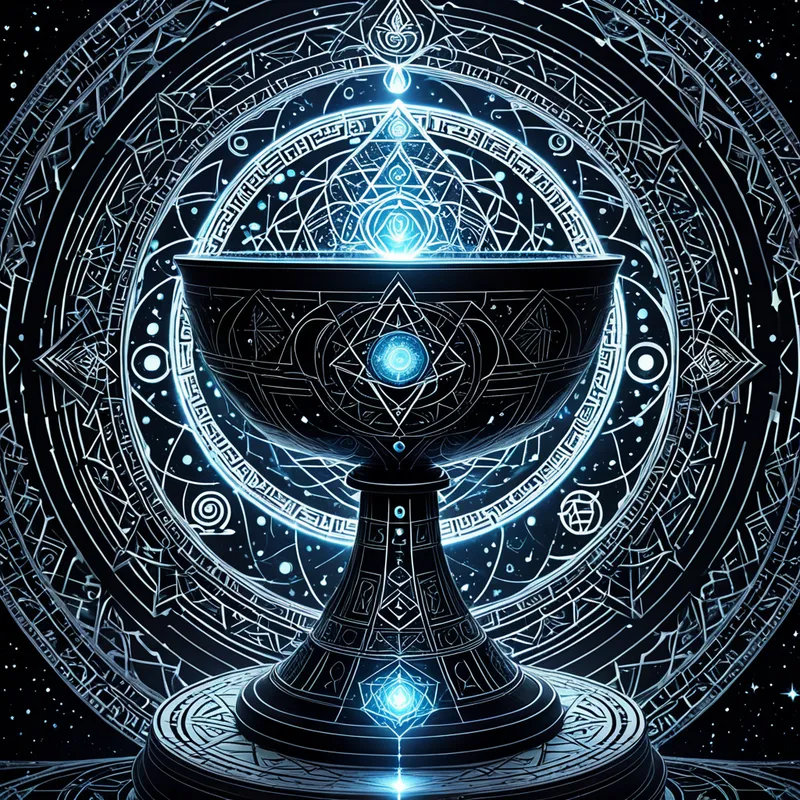
Urd’s Well is the mythic representation of the unconscious itself—not the personal unconscious, but the collective, transpersonal field where the archetypal patterns of existence are stored. It is the well of memory, where every event, every choice, every life is recorded and forms the basis for what will emerge.
The past is not dead history; it is the living soil from which the present moment grows. To ignore it is to let the world-tree rot.
The Norns symbolize the threefold process of time and causality. Urd is the Past as Cause, the immense, unchangeable weight of what has been done. Verdandi is the Present as Manifestation, the fleeting instant where potential becomes actual. Skuld is the Future as Debt or Consequence, the inevitable result that leans into the now from the horizon of time. Together, they are not linear time, but a simultaneous weaving, implying that the future is always pregnant in the past, and the past echoes endlessly into the future.
Odin’s sacrifice is the quintessential act for gaining depth wisdom. The eye he gives is the eye of literal, material perception—the ego’s tool for navigating the external world. To gain insight (in-sight) into the internal, causal realm, he must surrender his primary mode of external orientation. The price of true self-knowledge and knowledge of the world’s pattern is always a piece of the comfortable, familiar self.
The Dreamer’s Resonance
When this myth stirs in the modern psyche, it often surfaces in dreams of profound searching near water—a well, a deep pool, a basement flood. The dreamer may be trying to see something in the dark water, or may fear what lurks within. They may encounter three figures, often ambiguous (like three sisters, three guides, or three imposing authorities), who are engaged in a silent, purposeful activity that feels older than the dream itself.
Somatically, this can correlate with a feeling of being “rooted” in a heavy, perhaps burdensome past, or a sense of being pulled by invisible threads toward an unavoidable future. Psychologically, it signals a confrontation with one’s personal ørlög—the foundational patterns laid down in childhood, family history, or past traumas. The dream is an invitation from the deep psyche to approach the well of one’s own history, not to be doomed by it, but to understand its waters. The anxiety present is the ego’s resistance to seeing the full pattern, knowing that to see it may demand a sacrifice of a cherished self-image or a comfortable narrative.
Alchemical Translation
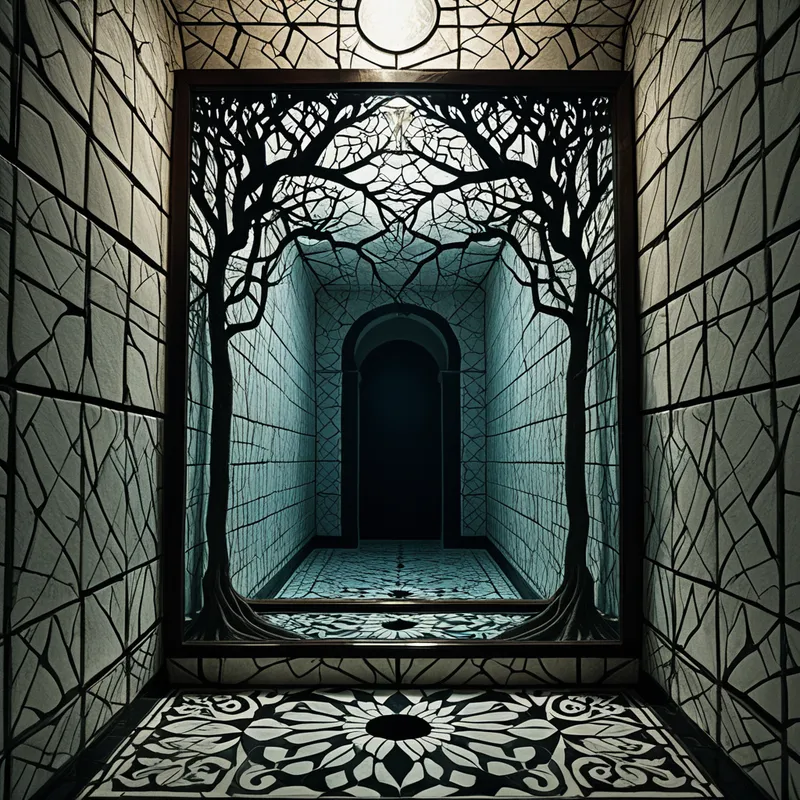
The journey to Urd’s Well is a map for the modern individuation process. It begins with the descent—turning away from the brightly lit world of persona and achievement (Asgard) to journey inward, toward the roots of one’s being. This is the nigredo, the darkening, where one confronts the tangled, often muddy history of the personal and ancestral past.
Individuation is not about becoming perfect, but about becoming whole. It requires paying the eye of our one-sided consciousness to drink from the well of our forgotten depths.
The three Norns represent the internal process we must engage. We must honor Urd: consciously remember, integrate, and accept our past without denial. We must fully inhabit Verdandi: be present to the reality of our current life, feelings, and choices. And we must acknowledge Skuld: take responsibility for the future consequences taking shape from our present actions and inactions.
Odin’s sacrifice is the critical alchemical operation. The “eye” we must be willing to offer is our cherished, one-sided conscious attitude. For the intellectual, it may be the pride in rationality; for the feeler, the identity in empathy; for the achiever, the mask of invulnerability. Giving this up feels like a mutilation, a loss of self. But it is the only coin the well accepts. In return, we gain the “eye of the well”—a new, profound mode of perception. This is the illuminatio, the gaining of Mimir’s wisdom. We see the patterns of our neuroses, our gifts, our relationships, not as random events, but as part of a coherent, if often painful, story. We drink the water of self-knowledge, which simultaneously nourishes our inner world-tree (the growing, integrating Self) and binds us to a reality larger than our ego. We return to our lives not freed from fate, but consciously aligned with it, able to meet our personal Ragnaroks with the dignity of one who has looked into the depths and understood.
Associated Symbols
Explore related symbols from the CaleaDream lexicon: