Urðarbrunnr Myth Meaning & Symbolism
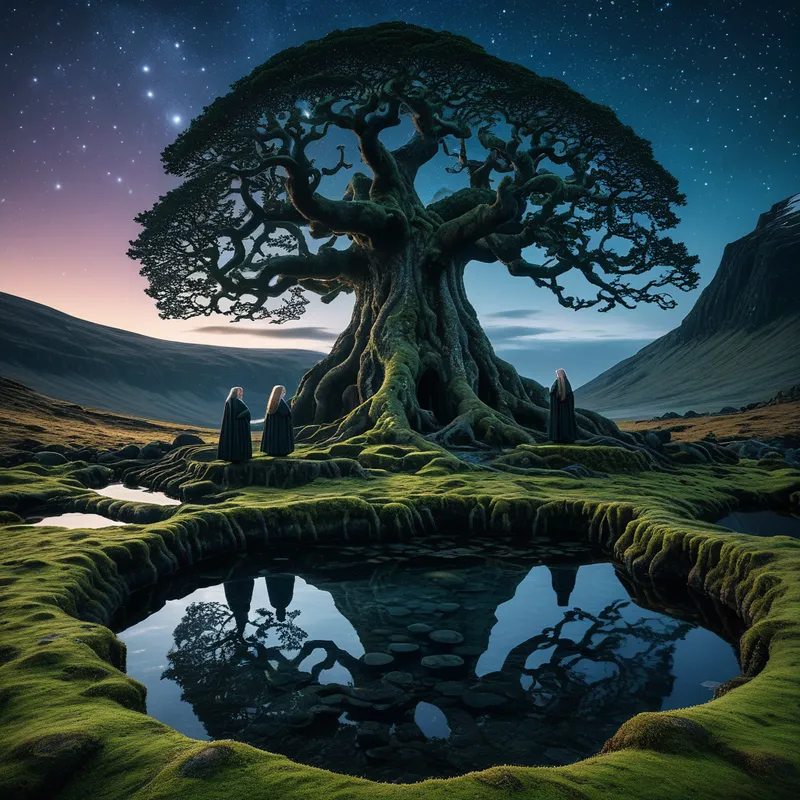
At the root of the world tree lies a well where three sisters weave fate, a sacred source of memory, law, and the inescapable flow of time.
The Tale of Urðarbrunnr
Hear now of the well that is not a well, but a mouth. A mouth that drinks the dew of the heavens and speaks in the slow, deep tongue of roots. It lies in the hidden dark, where the Yggdrasil plunges its three great anchors into the soil of worlds. And here, at the most ancient root, in a hallowed gloom that even the keen eyes of Odin must strain to see, bubbles the water of that which has become.
The air is thick with the scent of wet earth, of stone older than memory, and of the sweet, decaying leaves of countless ages. No bird sings here. The only sound is the soft, eternal drip… drip… from the well’s mossy lip, and the whisper of cloth that is not cloth.
For here sit the three who are one: the Norns. They are not gods of Asgard, nor giants from Jötunheimr. They are older, their origin a mystery sung only by the roots themselves. Urðr is her name, and the well is named for her, for she is its keeper, its memory. Her sisters are Verðandi, whose eyes are fixed on the swirling now, and Skuld, who is often seen veiled, holding a scroll yet unopened.
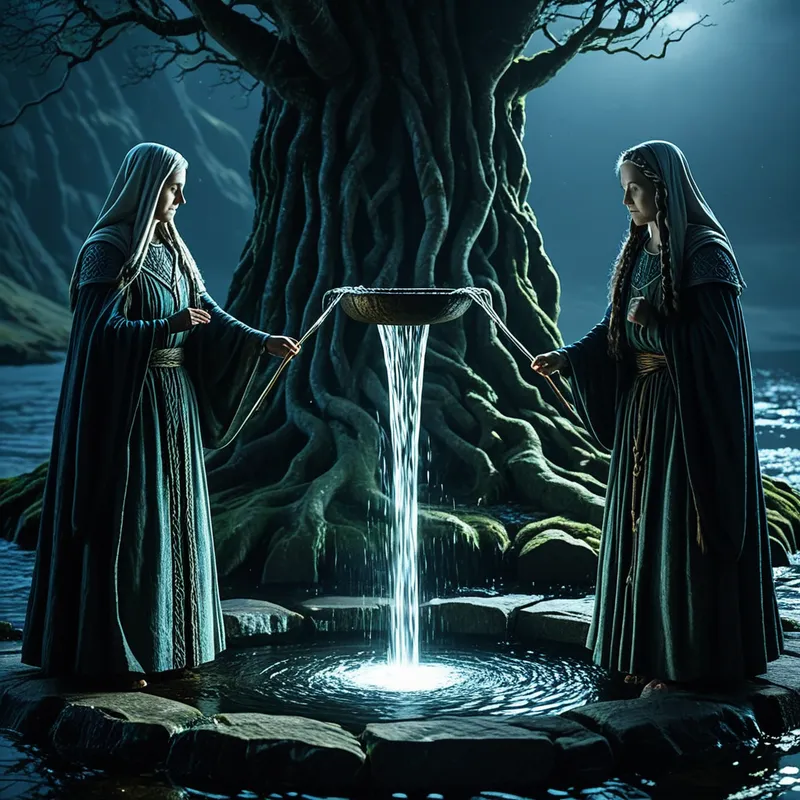
Each day, as the cosmic deer Eikþyrnir drips dew from his antlers high above, the sisters perform their solemn work. From the well’s profound depths, they draw water—water that is not merely water, but liquid time, condensed memory, the very sap of consequence. In heavy, clay jars they carry it, not to drink, but to pour. They pour it over the root of Yggdrasil that cradles their seat. They pour it to heal the great tree’s wounds, to wash clean the rot gnawed by the serpent Níðhöggr. This is their law, their ørlög: to tend the tree that holds all worlds, with the water of all that has happened.
And they weave. From the mist that rises from the well, from the light that filters through the tangled roots, they spin threads. Urðr provides the raw strand, long and full of twists, the thread of the past. Verðandi takes it, measures it against the now, and lays it straight. Skuld cuts it, her shears a flash of finality, or sometimes leaves it frayed, a debt to be paid. This is the tapestry of wyrd, of fate, and its loom is the rim of the well itself. Even the gods, even mighty Odin who gave an eye for wisdom, ride down the rainbow bridge to this silent place. They come not to command, but to listen. They come to hear the water’s whisper, to glimpse the pattern in the weave, to know the weight of what has been laid down. For here, at Urðarbrunnr, even a god must bow to the law of cause.
Cultural Origins & Context
The myth of Urðarbrunnr is preserved primarily in the Poetic Edda, specifically in the Völuspá (The Prophecy of the Seeress) and Grímnismál (The Sayings of Grímnir). These texts, compiled in 13th-century Iceland but containing far older oral traditions, offer only fragments—glimpses of the well through the fog of time. This was not a story for the feasting hall to incite battle-lust, but a profound cosmological truth passed down by skalds and seers.
Its societal function was foundational. It presented a universe governed not by capricious divine will alone, but by an underlying, impersonal principle of law and consequence (ørlög). The well was the source of this law. In a culture deeply concerned with honor, legacy, and the deeds that echo after death, Urðarbrunnr provided a metaphysical framework: the past is a tangible, liquid force that nourishes or poisons the present. One’s actions became part of that well-water, affecting the very roots of the world. The myth thus served as a powerful ethical anchor, connecting individual action to the cosmic order, emphasizing that all deeds sink into memory and shape what is to come.
Symbolic Architecture
Urðarbrunnr is the psyche’s deepest stratum, the well of the personal and collective past. It symbolizes the unconscious not as a chaotic void, but as a structured, aqueous archive. The water is the fluid medium of memory, experience, and trauma—everything that has “become” (Urðr) within us.
The past is not dead history; it is living water, seeping into the roots of our present being.
The three Norns represent the tripartite process of time as a psychological function. Urðr is the accumulated weight of personal history, the unalterable facts of our life. Verðandi is the conscious present moment, where we engage with that inheritance. Skuld is not merely “future,” but “debt” or “what is owed”—the inevitable consequences unfolding from past action, the psychological complexes and patterns that will come due. Their weaving signifies that our fate (wyrd) is not pre-written by external gods, but is actively woven from the threads of our own lived experience, choices, and neglected truths.
The act of pouring the well-water on Yggdrasil’s roots is the critical symbol of integration. It shows that the raw material of the past (memory, pain, joy) must be consciously drawn up and applied to nourish and heal the structure of the self. To ignore it is to let the serpent Níðhöggr—the force of psychic decay, resentment, and unexamined shadow—gnaw unimpeded.
The Dreamer’s Resonance
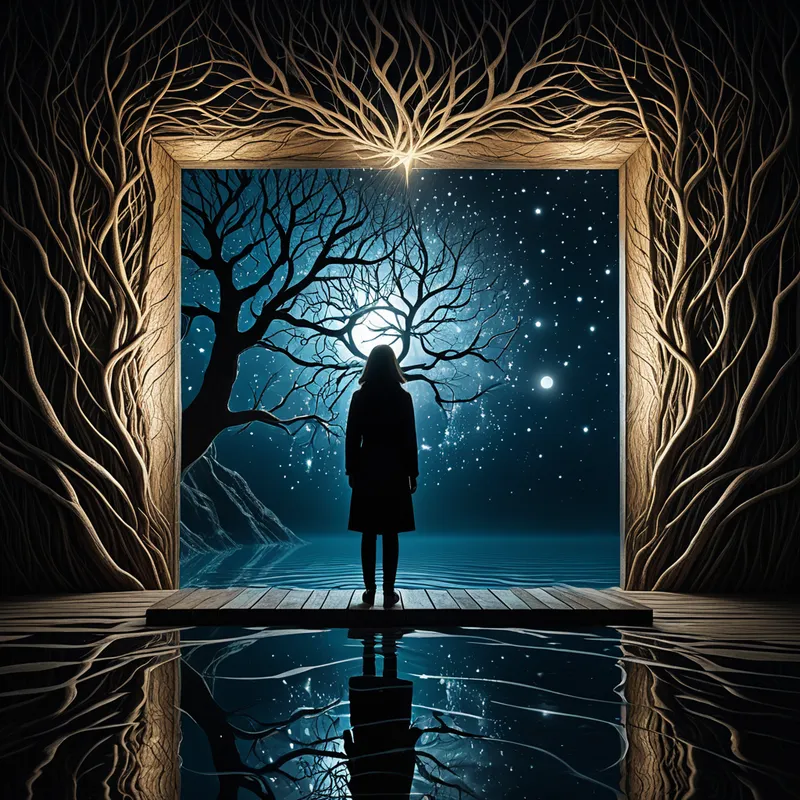
When Urðarbrunnr surfaces in modern dreams, it often appears not as a Norse well, but through its symbolic equivalents: a deep, dark pool in a forest; an ancient, clogged fountain; a forgotten basement cistern; or even a bathroom sink that drains into an infinite abyss. The dreamer is typically drawn to it with a mix of dread and fascination.
The somatic experience is one of gravitational pull—a feeling of being drawn down toward a source. Psychologically, this signals a process of confronting the personal ørlög. The dreamer is being called to “draw water,” to engage with the contents of their own psychic past. This may manifest as revisiting childhood memories, confronting a buried trauma, or simply acknowledging the weight of past decisions. If the water in the dream is clear and the dreamer drinks from it, it suggests a willingness to integrate this history into conscious understanding. If the water is murky, stagnant, or if a monstrous shape lurks within (the dream-version of Níðhöggr), it points to a repressed complex that is festering and requires attention. The dream is an invitation to perform the Norns’ work: to draw up, examine, and use the waters of what has been to nourish the tree of who you are.
Alchemical Translation
The alchemical process modeled by Urðarbrunnr is the solutio—dissolution into the primal water—followed by a sacred coagulatio—a re-forming into a more conscious whole. The journey of individuation requires a pilgrimage to this inner well.
First, one must descend to the root. This is the often painful work of introspection, therapy, or shadow work, moving past the persona to the foundational wounds and joys that shape us. We find our personal Urðarbrunnr.
Second, we must draw the water. This is the act of remembering, not with passive nostalgia, but with active, curious retrieval. We bring unconscious material—the “water of Urðr”—into the light of consciousness.
The goal is not to change the past, but to change its relationship to the roots of your present.
Third, we pour it on the roots. This is integration. We ask: How does this memory affect me now? How can this pain, once acknowledged, teach me resilience? How can this joy become a lasting source of strength? We use the past to nourish and stabilize our being, healing the gnawed roots of our identity.
Finally, we acknowledge the weaving sisters within. We accept that Urðr (our past) sets the thread, Verðandi (our present attention) weaves it, and Skuld (our future obligation) will cut the pattern we create. We become conscious participants in our own wyrd, understanding that while the past is fixed, its meaning and its power to shape the future are mediated by the conscious choices we make at the well’s edge in the eternal now. In this act, we transmute blind fate into responsible destiny.
Associated Symbols
Explore related symbols from the CaleaDream lexicon: