Upper Room Myth Meaning & Symbolism
A sacred, hidden chamber where a community awaits, receives a divine wind, and is transformed into vessels of a new, universal voice.
The Tale of the Upper Room
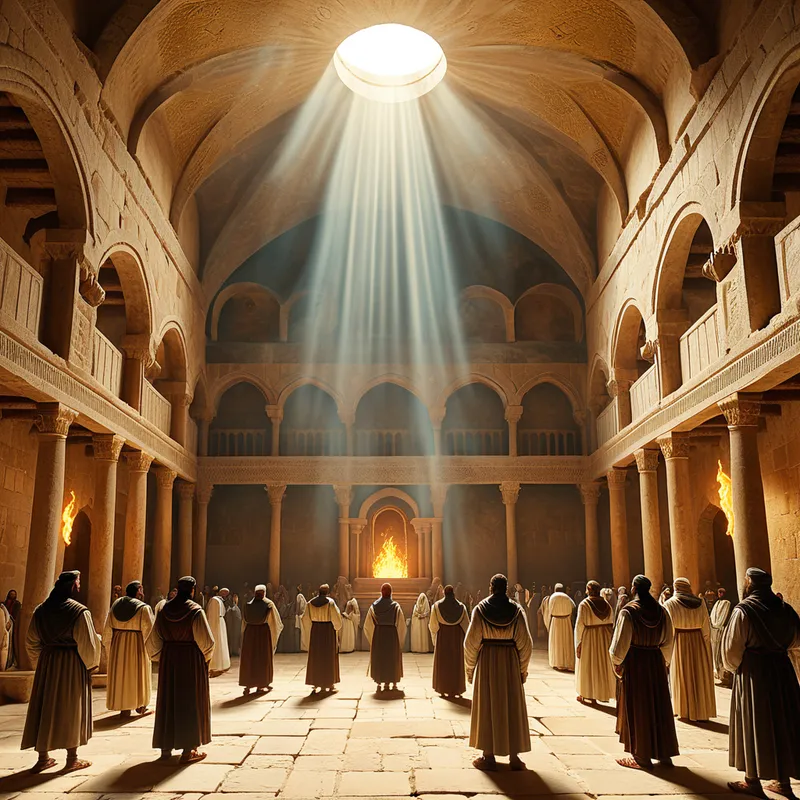
The city was hushed, wrapped in the strange silence that follows a cataclysm. The air, once thick with the cries of a mob and the scent of blood and myrrh, now hung heavy with unanswered questions and a grief so vast it had its own weather. In its heart, a small band moved like ghosts through the narrow streets. Their world had shattered three days prior, and then been impossibly reassembled in a form they could scarcely comprehend. He had returned, spoken of a Spirit, and then vanished from sight, leaving only a mandate and a terrifying promise.
They sought a door, a specific one, known only to them. It led not to a grand temple or a public square, but upwards, to a rented room on the top floor of a nondescript house. This was their sanctuary, the Upper Room. The space was simple: worn carpets, the lingering scent of old wood and lamp oil, walls that had absorbed years of whispered prayers and now held the echo of a final meal shared with their master. Here, they gathered—the eleven who remained, the women who had witnessed [the empty tomb](/myths/the-empty-tomb “Myth from Christian culture.”/), his mother, his brothers. A community bound by trauma, hope, and a bewildering command: to wait.
Days bled into one another. The room became their entire world—a womb of shared memory and anxious anticipation. They broke bread, remembering his hands. They prayed, their voices a tangled chorus of doubt and yearning. They argued, then fell silent, listening to the street sounds below that spoke of a life moving on without them. The tension was a living [thing](/myths/thing “Myth from Norse culture.”/), a collective held breath. They were waiting, but for what? A king? An army? A sign?
Then it came, on the day the city was swollen with pilgrims for the Feast of Weeks. Not with a knock, but with a sound. A sound from nowhere and everywhere at once, a roaring, rushing wind that tore through the stillness of the house without disturbing a single dust mote on the floor. It filled the Upper Room, this divine gale, and with it came light. Not one light, but many—tongues, as of fire, that separated and rested on each one of them.
And they were filled.
The internal dam broke. The grief, the fear, the locked-away wisdom, the unspeakable joy—it all found a voice at once. But not their own familiar voices. From their lips poured praises to the Most High in languages they had never learned: the rough dialects of Mesopotamia, the elegant phrases of Egypt, the lyrical tongues of Rome and Libya and Crete. The Upper Room, once a sealed chamber of private sorrow, erupted into a symphony of universal address. [The wind](/myths/the-wind “Myth from Various culture.”/) had entered, and now it spoke through them, spilling out the windows and into the streets, drawing a stunned and questioning crowd. The waiting was over. The speaking had begun.
Cultural Origins & Context
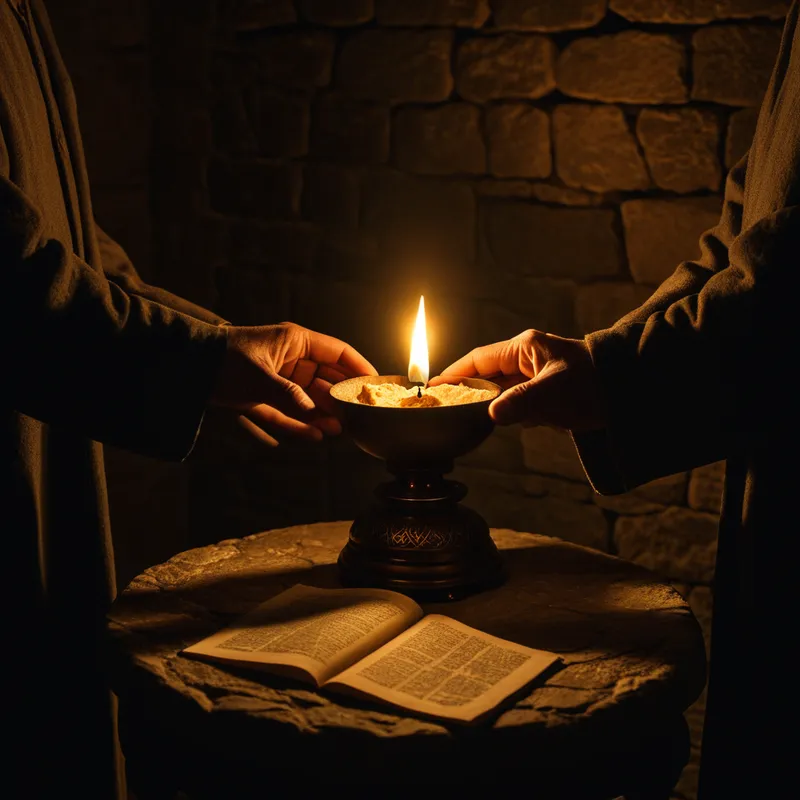
The narrative of the Upper Room is found in the Acts of the Apostles, a text composed in the 1st century CE that chronicles the early days of the movement that would become Christianity. It exists at a precise and potent historical junction: the Jewish world of Second Temple [Jerusalem](/myths/jerusalem “Myth from Biblical culture.”/), under the watchful eye of the Roman Empire.
This was a culture deeply familiar with the concept of sacred, set-apart space—[the Temple](/myths/the-temple “Myth from Jewish culture.”/), the synagogue, the home during Passover. The Upper Room subverts this expectation. It is not an official, consecrated location, but a rented, domestic space. Its significance is not inherent, but bestowed by the events that transpire within it. The story was passed down within the early Christian communities as their foundational myth of origin, explaining how a frightened, insular group of disciples was transformed into the public, evangelizing body of the Church.
Its societal function was multifaceted. For a persecuted minority, it served as an etiological myth, justifying their missionary zeal and charismatic practices (like glossolalia, or “speaking in tongues”). It anchored their authority in a direct, divine encounter. Furthermore, by setting the event during Shavuot ([Pentecost](/myths/pentecost “Myth from Christian culture.”/)), a festival commemorating the giving of [the Law](/myths/the-law “Myth from Biblical culture.”/) to [Moses](/myths/moses “Myth from Biblical culture.”/), it created a powerful theological parallel: just as the Law was given on Sinai amid fire and sound (Exodus 19:18-19), so now the Spirit was given in Jerusalem, transforming the written law into a living, internal voice for all nations.
Symbolic Architecture
The Upper [Room](/symbols/room “Symbol: A room in a dream often symbolizes the self, representing personal space, mental state, or aspects of one’s identity.”/) is a master [symbol](/symbols/symbol “Symbol: A symbol can represent an idea, concept, or belief, serving as a powerful tool for communication and understanding.”/) of the [psyche](/myths/psyche “Myth from Greek culture.”/) in transition. It represents the [temenos](/myths/temenos “Myth from Greek culture.”/)—the sacred, protected container where the most profound inner work occurs.
The Upper Room is the cranium of the soul, the vault where private thought prepares to become public revelation.
Its physical position—upper, set apart from the ground-level bustle of ordinary [life](/symbols/life “Symbol: The symbol of ‘Life’ represents a journey of growth, interconnectedness, and existential meaning, encompassing both the joys and challenges that define human experience.”/)—symbolizes a state of elevated [consciousness](/symbols/consciousness “Symbol: Consciousness represents the state of awareness and perception, encompassing thoughts, feelings, and experiences.”/), of retreat and introspection necessary for [integration](/symbols/integration “Symbol: The process of unifying disparate parts of the self or experience into a cohesive whole, often representing psychological wholeness or resolution of internal conflict.”/). It is the psychological [space](/symbols/space “Symbol: Dreaming of ‘Space’ often symbolizes the vastness of potential, personal freedom, or feelings of isolation and exploration in one’s life.”/) one enters after a great [death](/symbols/death “Symbol: Symbolizes transformation, endings, and new beginnings; often associated with fear of the unknown.”/) (of a [relationship](/symbols/relationship “Symbol: A representation of connections we have with others in our lives, often reflecting our emotional state.”/), an [identity](/symbols/identity “Symbol: Identity represents the sense of self, encompassing personal beliefs, cultural background, and social roles.”/), a dream), where the shattered pieces of [the self](/myths/the-self “Myth from Jungian culture.”/) are gathered to await reanimation.
The waiting [period](/symbols/period “Symbol: Periods in dreams can symbolize cyclical patterns, renewal, and the associated emotions of loss or change throughout life.”/) is not passive; it is the essential [gestation](/symbols/gestation “Symbol: A period of development and preparation before a significant birth or emergence, symbolizing potential, transformation, and the journey toward manifestation.”/). It is the [analysis](/symbols/analysis “Symbol: The process of examining something methodically to understand its components or meaning. In dreams, it represents the mind’s attempt to break down complex experiences.”/) of the dream, the contemplation of the [trauma](/symbols/trauma “Symbol: A deeply distressing or disturbing experience that overwhelms the psyche, often manifesting in dreams as unresolved emotional wounds or psychological injury.”/), the communal sharing of [memory](/symbols/memory “Symbol: Memory symbolizes the past, lessons learned, and the narratives we construct about our identities.”/) that prevents the individual from disintegrating into [isolation](/symbols/isolation “Symbol: A state of physical or emotional separation from others, often representing a need for introspection or signaling distress.”/). The rushing wind, the [pneuma](/myths/pneuma “Myth from Greek culture.”/), symbolizes the influx of libido—psychic [energy](/symbols/energy “Symbol: Energy symbolizes vitality, motivation, and the drive that fuels actions and ambitions.”/)—from the unconscious. It is the inspiring [breath](/symbols/breath “Symbol: Breath symbolizes life, vitality, and the connection between the physical and spiritual realms.”/) that fills the vacuum left by [loss](/symbols/loss “Symbol: Loss often symbolizes change, grief, and transformation in dreams, representing the emotional or psychological detachment from something or someone significant.”/).
The “tongues of fire” are the archetypal symbol of transformative enlightenment and purification. Fire illuminates and consumes. Here, it descends individually upon each person, signifying that the collective experience simultaneously ignites the unique potential within the individual. The resulting multilingual speech is the myth’s crowning symbol: the transcendence of the personal complex. The private wound (their [grief](/symbols/grief “Symbol: A profound emotional response to loss, often manifesting as deep sorrow, yearning, and a sense of emptiness.”/), their [confusion](/symbols/confusion “Symbol: A state of mental uncertainty or disorientation, often reflecting internal conflict, lack of clarity, or overwhelming choices in waking life.”/)) is alchemized into a [capacity](/symbols/capacity “Symbol: A measure of one’s potential, limits, or ability to contain, process, or achieve something, often reflecting self-assessment or external demands.”/) to connect with the “other”—to speak the [language](/symbols/language “Symbol: Language symbolizes communication, understanding, and the complexities of expressing thoughts and emotions.”/) of the [stranger](/symbols/stranger “Symbol: A stranger in dreams can represent unfamiliar aspects of the self or new experiences.”/), the foreigner, the parts of oneself and [the world](/myths/the-world “Myth from Tarot culture.”/) that were previously incomprehensible.
The Dreamer’s Resonance
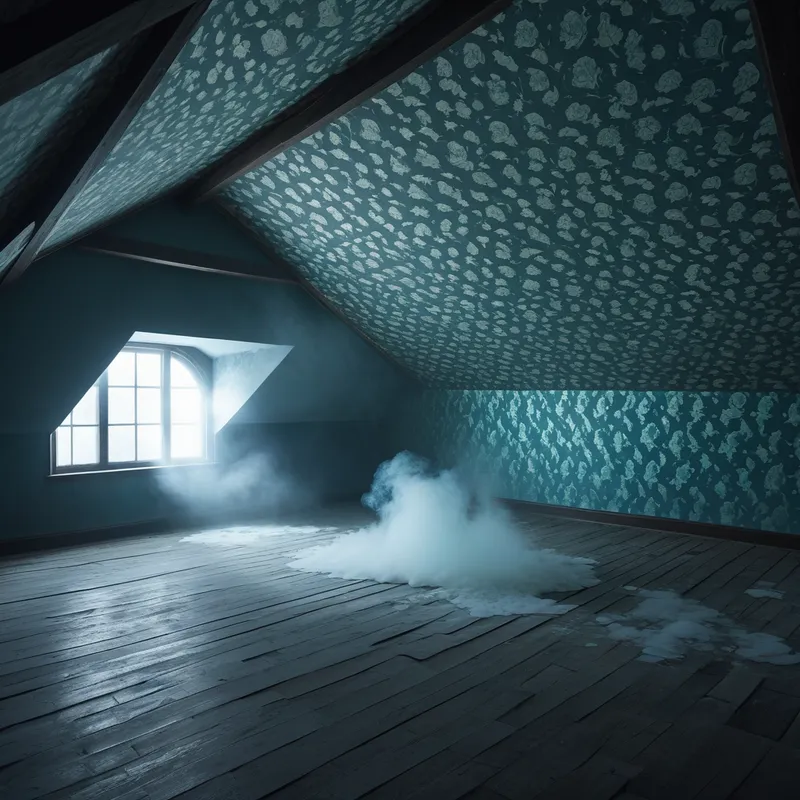
To dream of an upper room, an attic, or a secluded top-floor space is to encounter this myth in [the personal unconscious](/myths/the-personal-unconscious “Myth from Jungian Psychology culture.”/). The dreamer is likely in a phase of conscious withdrawal, processing a significant ending or a surge of unconscious material that feels too potent for daily life.
Somatically, the dream may be preceded by feelings of constriction in the chest or head—a literal “pressure” seeking release. The dream room itself may feel charged, silent yet pregnant with possibility, or it may be cluttered with the artifacts of the past (symbols of old identities). The appearance of a group in this room points to the dreamer’s internal community—the various subpersonalities, instincts, and inherited familial patterns that are in council.
If the dream features a sudden, awe-inspiring phenomenon in this space—a wind, a light, a voice—it marks a critical moment of psychic invasion from the Self, the central archetype of wholeness. This is not a gentle nudge but a revolutionary event. The dreamer may awaken with a sense of expansion, anxiety, or a sudden, clear knowing about a path forward. The myth manifests as the psyche’s blueprint for moving from paralyzed introspection to empowered expression.
Alchemical Translation
The process modeled by the Upper Room myth is the alchemical [solve et coagula](/myths/solve-et-coagula “Myth from Alchemical culture.”/)—dissolve and coagulate—applied to the psyche. It is a map for individuation.
First, dissolution: The death of the old dominant consciousness (the loss of the physical leader, [Jesus](/myths/jesus “Myth from Christian culture.”/)) forces the group (the psyche) into retreat. Old structures of meaning and authority are dissolved. This is the [nigredo](/myths/nigredo “Myth from Alchemical culture.”/), the dark night.
The gathering and waiting in the room is the albedo, the whitening. It is the careful, often painful, work of sorting through the remains—acknowledging grief, confronting doubts, and holding the tension of opposites (hope and despair, memory and promise) without fleeing into premature certainty.
The infusion of Spirit is the moment the transcendent function emerges, synthesizing the conscious and unconscious into a new, third position.
Then comes the fiery descent, the citrinitas or yellowing. This is the influx of transcendent energy that does not destroy the individual but ignites their core essence. The personal ego is not erased; it is set aflame with a transpersonal purpose.
Finally, the multilingual speech is the [rubedo](/myths/rubedo “Myth from Alchemical culture.”/), the reddening, the culmination. The newly formed consciousness is now “public.” It can engage the world in its full complexity. The private insight gained in isolation becomes a communicative force. The individual who has undergone this process is no longer merely a bearer of personal history but a vessel through which the archetypal, the universal, can speak into specific human contexts. They have moved from being students in a closed room to interpreters on a global stage, their personal transformation granting them the keys to a thousand locked doors within and without.
Associated Symbols
Explore related symbols from the CaleaDream lexicon: