Unkulunkulu Zulu Creator Myth Meaning & Symbolism
The story of the Great One who grew from the reeds, broke them open, and brought forth the first people and the laws of life.
The Tale of Unkulunkulu Zulu Creator
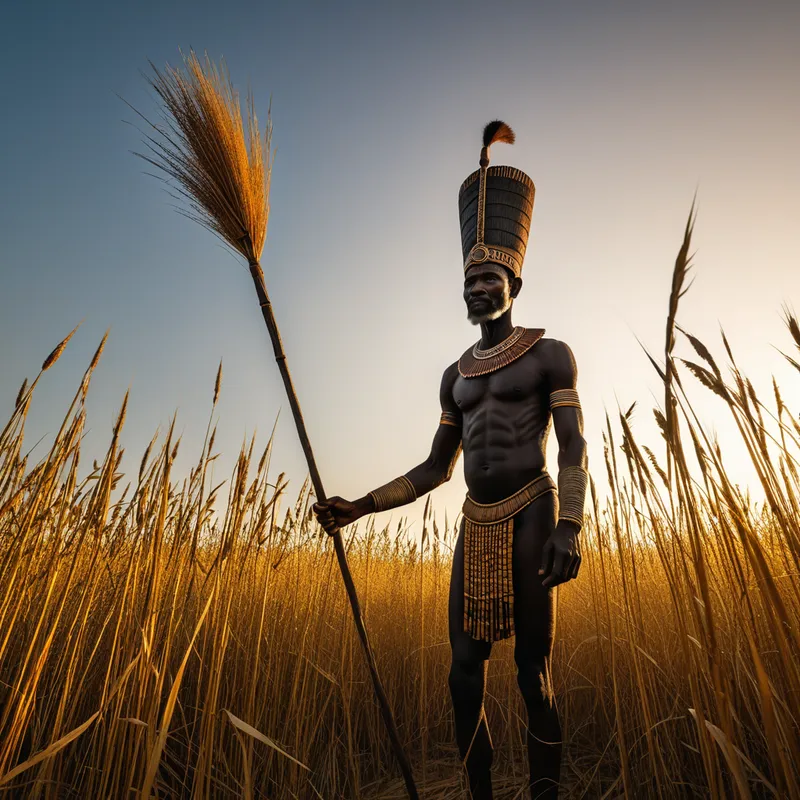
In the time before time, there was only the Uhlanga, the vast and endless bed of reeds. There was no up or down, no before or after. There was only the whisper of the stalks in a wind that had no source, and the dark, fertile mud from which they grew.
From this mud, from the very heart of the Uhlanga, something began to stir. Not a birth, but a becoming. He grew, as the reeds grew, but with a knowing in his growth. He was Unkulunkulu, the Great-Great-One, the Ancient of Days. He did not fall from a sky, for there was no sky. He simply was, emerging into consciousness from the primal unity.
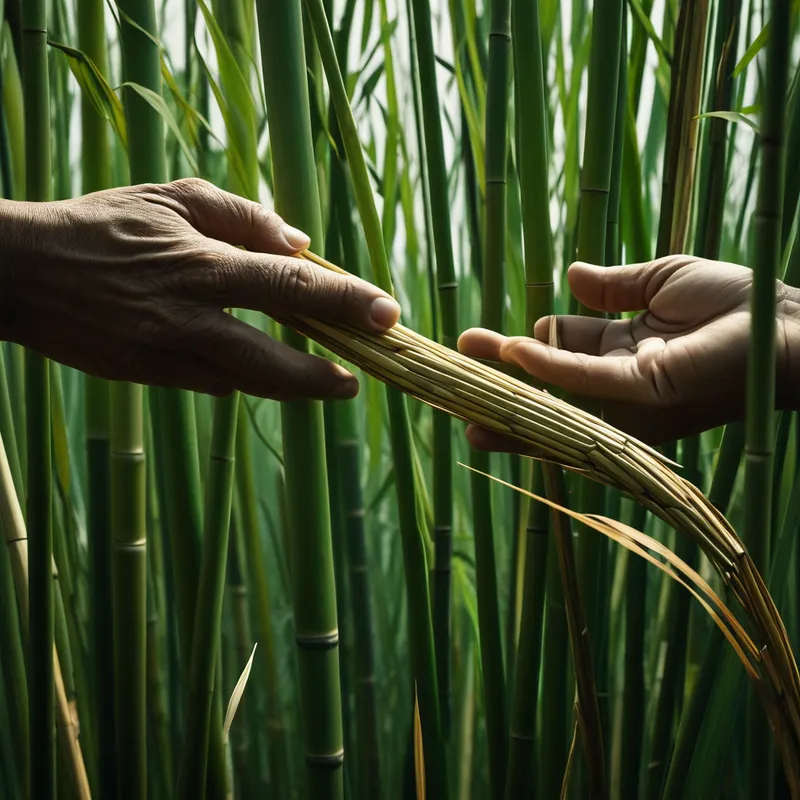
He stood, this first being, and looked upon the sameness. And in his standing, a first separation was made. He took hold of the reeds around him. With hands that understood purpose, he began to break them. He split them open at their joints.
And from the hollows within, from the damp, sweet darkness of the broken stems, they came. First the people—men and women, blinking, breathing the first air that was not the air of the reed. Then the animals, each from their own kind of stalk: the lion with its low growl, the cattle with their soft lowing, the swift antelope. He brought them all forth, naming them as they emerged, giving each its nature.
But Unkulunkulu was not finished. He showed these new beings how to live. He gave them fire, teaching them to cook and to ward off the night’s chill. He pointed to the plants and showed them which were food and which were medicine. He taught them the words for things: for love, for anger, for hunger, for kinship.
He spoke of the rules of life. “You will honor your fathers and mothers,” he said, his voice the sound of deep water over stone. “You will know that death comes, and after it, you will join the Amadlozi. This is the way.”
And then, having planted the seed of the world and watered it with knowledge, Unkulunkulu did the final, most profound thing. He stepped away. He withdrew to a distant place, becoming more spirit than form. He left his children to tend the garden he had opened from the reeds. He was the first ancestor, now watching, always present, but never again intervening as he did in that first, sacred breaking. The world was born not with a shout, but with the quiet, decisive crack of a stem, and the gentle guidance of the one who grew from the mud.
Cultural Origins & Context
This is the story of origins as held by the amaZulu, a people of powerful oral tradition. It was not written in a sacred text but carried on the breath of izimbongi (praise poets) and grandmothers by the evening fire. The telling was an act of memory and identity, linking each listener directly back to that first emergence from the Uhlanga.
The myth functioned as the foundational layer of Zulu cosmology. It established a worldview that is profoundly relational and hierarchical, rooted in the principle of Ubuntu (“I am because we are”). Unkulunkulu is not a remote, omnipotent god in a heavenly court; he is the First Ancestor. This frames creation as an act of lineage. The universe is familial. The laws he gives are not arbitrary commandments but the essential rules for maintaining harmony within this great family, which includes humans, animals, and the ancestral spirits (Amadlozi).
His withdrawal is critical. It places responsibility squarely on humanity. He provides the tools (fire, knowledge, social law) and then entrusts the ongoing act of creation—the building of society, the tending of cattle, the raising of families—to his descendants. The myth thus legitimizes social structure, elder authority, and ritual practice (like animal sacrifice and ancestor veneration) as the proper means of sustaining the world he initiated.
Symbolic Architecture
At its core, the myth of Unkulunkulu is a profound map of [differentiation](/symbols/differentiation “Symbol: The process of distinguishing or separating parts of the self, emotions, or identity from a whole, often marking a developmental or psychological milestone.”/) emerging from unity. The Uhlanga represents the unconscious, undifferentiated state—the cosmic [womb](/symbols/womb “Symbol: A symbol of origin, potential, and profound transformation, representing the beginning of life’s journey and the unconscious source of creation.”/) or the primal psyche where all potentials exist but nothing is distinct.
The first act of consciousness is not to create something from nothing, but to distinguish something from the everything.
Unkulunkulu himself symbolizes the emerging ego-[consciousness](/symbols/consciousness “Symbol: Consciousness represents the state of awareness and perception, encompassing thoughts, feelings, and experiences.”/), the first “I” that stands apart from the unconscious [mass](/symbols/mass “Symbol: Mass often symbolizes a gathering or collective experience, representing shared beliefs, burdens, or the weight of emotions within a community.”/). His act of breaking the reeds is the archetypal act of [analysis](/symbols/analysis “Symbol: The process of examining something methodically to understand its components or meaning. In dreams, it represents the mind’s attempt to break down complex experiences.”/), [division](/symbols/division “Symbol: Represents internal conflict, separation of self, or unresolved emotional splits. Often indicates a need for integration or decision-making.”/), and naming—the very process by which the mind creates a knowable world. Each broken [reed](/symbols/reed “Symbol: A flexible plant symbolizing resilience, adaptability, and vulnerability. It bends without breaking, representing survival through yielding.”/) is a category split from the whole: [human](/symbols/human “Symbol: The symbol of a human represents individuality, complexity of emotions, and social relationships.”/) from animal, this clan from that, the edible from the poisonous.
The gifts he bestows—fire, [language](/symbols/language “Symbol: Language symbolizes communication, understanding, and the complexities of expressing thoughts and emotions.”/), social law—represent the structures of culture and consciousness that make human [life](/symbols/life “Symbol: The symbol of ‘Life’ represents a journey of growth, interconnectedness, and existential meaning, encompassing both the joys and challenges that define human experience.”/) possible. They are the tools for transforming raw, primal existence (Uhlanga) into an ordered, meaningful world. His subsequent withdrawal mirrors the necessary psychological process where the conscious ego, once firmly established, must recede from total control to allow for [relationship](/symbols/relationship “Symbol: A representation of connections we have with others in our lives, often reflecting our emotional state.”/) with the larger Self (the ancestral/[collective unconscious](/symbols/collective-unconscious “Symbol: The Collective Unconscious refers to the part of the unconscious mind shared among beings of the same species, embodying universal experiences and archetypes.”/)) and for autonomous [life](/symbols/life “Symbol: The symbol of ‘Life’ represents a journey of growth, interconnectedness, and existential meaning, encompassing both the joys and challenges that define human experience.”/) to flourish.

The Dreamer’s Resonance
When this mythic pattern stirs in the modern dream, it often speaks to a profound moment of emergence and self-authorization. You may dream of being trapped in a dense, featureless thicket (the Uhlanga) of sameness—a dead-end job, a stifling relationship, a depressive fog where everything feels merged and meaningless. The somatic sensation is one of constriction, of being part of a mass with no individual outline.
The turning point is the dream of breaking open. It could be literally breaking a shell, opening a sealed door in a wall of vegetation, or finally speaking a truth that splits a stagnant situation in two. This is the Unkulunkulu moment. It is the psyche’s instinct to differentiate, to bring a new aspect of the self out of the unconscious and into the light of day. Following such a dream, one might feel tasked with “naming” what has emerged—giving it identity, purpose, and a place in one’s personal cosmology. The dream may also carry a tone of solemn responsibility, the understanding that with this new emergence comes the duty to care for it and integrate it according to inner law.

Alchemical Translation
The individuation journey modeled here is not one of heroic conquest, but of sacred distinction and responsible stewardship. The alchemical prima materia is the Uhlanga—the chaotic, fertile mud of our unlived lives, our fused complexes, and our unconscious potentials.
The work is not to invent a self, but to discover the distinct shapes already growing within the unified field of your being.
The first stage (nigredo) is the murky existence within the reed, the feeling of being undifferentiated. The Unkulunkulu archetype activates as the impulse to consciousness (albedo). This is the “breaking” phase—the difficult, often painful act of analysis, of setting boundaries, of saying “this is me, and that is not.” It is leaving the family’s fused identity, ending an enmeshed relationship, or distinguishing your own values from the cultural soup.
The gifts bestowed represent the citrinitas—the illumination of building a conscious life. You gather your inner “fire” (passion, will), develop your “language” (your unique mode of expression), and establish your inner “laws” (personal ethics and structure). The final, crucial stage (rubedo) is Unkulunkulu’s withdrawal. This is the ego’s humility. It is realizing that after you have built your conscious citadel, you must open its gates to the wider, ancestral psyche—the Amadlozi within. You move from being the sole creator to being a wise elder in your own psyche, in dialogue with the deeper, transpersonal forces. The creation is complete not when you control everything, but when you have set a self-sustaining order in motion and taken your rightful place as a respectful part of a much larger, living whole.
Associated Symbols
Explore related symbols from the CaleaDream lexicon:
- Reed — The primordial substance of existence, representing the undifferentiated unconscious and the womb-like container from which all distinct forms of life and consciousness emerge.
- Creator — The archetypal force of differentiation and order, the first consciousness that acts to bring forth latent potentials into manifest reality.
- Ancestor — The foundational source of identity and law, representing the deep, guiding structures of the psyche and culture that inform present existence.
- Earth — The fertile, dark mud of the Uhlanga, symbolizing the raw, material potential and grounded origin of all things.
- Fire — The gift of transformation, technology, and spirit; the tool that allows humanity to alter its state and defend against the chaos of the undifferentiated night.
- Order — The principle of structure, law, and relationship imposed upon chaos; the necessary rules for sustaining the world once it has been created.
- Separation — The fundamental, sacred act of breaking unity to create distinction, which is the prerequisite for consciousness, relationship, and life itself.
- Spirit — The essential nature of Unkulunkulu after his withdrawal, representing the ongoing, non-interfering presence of the foundational source in all aspects of creation.
- Tree — A symbol of lineage, growth, and connection, mirroring the familial structure of creation where all beings emerge from a single, ancient root-stock.
- Water — The element of the primordial, often associated with the Uhlanga’s marsh; it represents the fluid, unconscious state from which solid forms crystallize.
- Journey — The path from undifferentiated being within the reed to differentiated existence in the world, and ultimately to the status of an ancestral spirit.
- Seed — The latent potential contained within the Uhlanga, which Unkulunkulu does not plant but rather discovers and activates through the act of breaking it open.