Underground Rivers Myth Meaning & Symbolism
A universal myth of hidden waters flowing beneath the world, carrying forgotten truths and the potential for profound psychic renewal from the depths.
The Tale of Underground Rivers
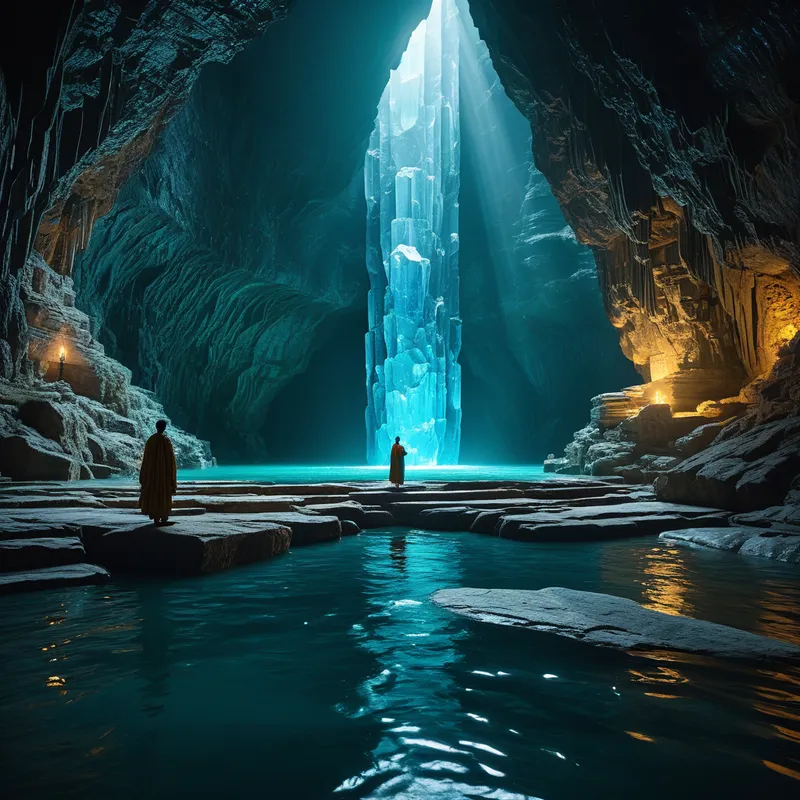
Listen. Beneath the skin of [the world](/myths/the-world “Myth from Tarot culture.”/), beneath the roots of the great trees and the foundations of the mightiest mountains, there is a secret. It is not a silence, but a song—a deep, resonant hum that is the sound of [water](/myths/water “Myth from Chinese culture.”/) moving through stone. This is the realm of the Underground Rivers.
In the beginning, the world was dry and full of echoes. The sun was a tyrant, and the rain was a fickle, distant god. The people lived on the surface, their lives as brittle as sun-baked clay. But the shamans and the dreamers, those who pressed their ears to [the earth](/myths/the-earth “Myth from Hindu culture.”/), heard it. A whispering promise. A liquid murmur in the dark.
They spoke of a being, not a god of the bright sky, but a deity of the deep earth. Some called it the Water-Holder, a patient entity of immense age, whose body was [the labyrinth](/myths/the-labyrinth “Myth from Greek culture.”/) of the crust and whose blood was the hidden flow. It was said this being had woven a network of secret channels in the world’s youth, when the rock was still soft and dreaming. These channels became the arteries of the deep, carrying not just water, but memory, fate, and the souls of the unborn.
The conflict was a great drought. The sun leached the color from the land. The rivers of the surface shrank to dusty scars. The people despaired, their prayers rising like smoke and scattering on [the wind](/myths/the-wind “Myth from Various culture.”/). The elders gathered and remembered the old whispers. A hero was chosen—not the strongest warrior, but the one who could listen to silence. Often a youth, or a seeker marked by visions, they were tasked with a descent. Not to conquer, but to petition. To find the source of the whisper and ask the Water-Holder for mercy.
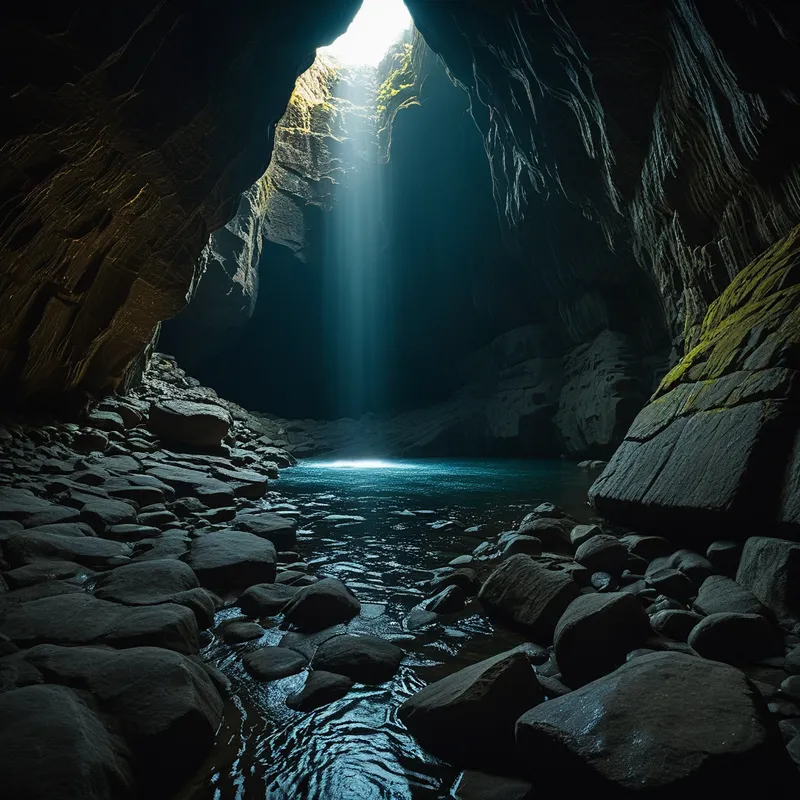
The journey was an inversion. They left the world of light and open sky for a realm of perpetual twilight, guided only by the growing sound of the hum and the cool, damp breath from fissures in the stone. They navigated tunnels that felt like the insides of a giant beast, past pools of still water that showed not reflections, but scenes from forgotten times. The darkness pressed in, a physical weight. The fear was not of monsters, but of becoming forever lost in the endless, branching dark, of forgetting the sun entirely.
And then, they would find it. Not a spring, but a presence. A cavern so vast its ceiling was lost in gloom, and through its center, a river of impossible power. It did not babble like a surface stream; it thundered in a low, relentless roar, a black ribbon of water moving with silent, muscular force. On its banks might sit the Water-Holder, appearing as an ancient figure carved from flowstone, or merely as a consciousness in the sound and the spray. There was no battle. Only a confrontation with the immense, timeless patience of the deep.
The hero would make their plea, offering a token—a story of the suffering above, a tear, a sacred song. The response was never words. Sometimes, a new spring would bubble at the hero’s feet. Sometimes, they would be given a vessel of the dark water and instructions to pour it into a specific, dry place on the surface. The resolution was the return, the arduous climb back to the world of light, carrying the secret of the depths within them. Upon their emergence, often at the very spot they were instructed, life would return. A new river would break forth from the hillside, or the rains would finally come, washing the dust from the world. The hidden had been made manifest. The deep song had answered the surface cry.
Cultural Origins & Context
The myth of the Underground Rivers is not the property of a single culture, but a profound archetypal narrative found across continents. It appears in the lore of the Aboriginal Australians, where Dreaming tracks often follow subterranean water sources. It flows through Maya cosmology, where the cenotes were sacred portals to Xibalba. It resonates in the rivers of [Hades](/myths/hades “Myth from Greek culture.”/)—the Styx, Cocytus, and Phlegethon. It is present in countless Native American traditions and in the European folk beliefs of hidden rivers that determine the fate of kingdoms.
This universality speaks to a shared human experience of the landscape. Before hydrology, people observed that rivers often emerged fully formed from caves or vanished into sinkholes. This literal mystery gave birth to the metaphysical one. The myth was transmitted by shamans, elders, and storytellers, often as part of initiation rites or explanations for the vital, inexplicable sources of water. Its societal function was multifaceted: it was a map of the sacred landscape, a theological explanation for sustenance, and a narrative framework for understanding the unseen forces that govern visible life. It taught that survival depends on engaging with the hidden, not just managing the apparent.
Symbolic Architecture
Psychologically, the Underground [River](/symbols/river “Symbol: A river often symbolizes the flow of emotions, the passage of time, and life’s journey, reflecting transitions and movement in one’s life.”/) is a master [symbol](/symbols/symbol “Symbol: A symbol can represent an idea, concept, or belief, serving as a powerful tool for communication and understanding.”/) of the unconscious itself. Its waters are the hidden flow of psychic [life](/symbols/life “Symbol: The symbol of ‘Life’ represents a journey of growth, interconnectedness, and existential meaning, encompassing both the joys and challenges that define human experience.”/): instincts, memories, complexes, and the primordial [source](/symbols/source “Symbol: The origin point of something, often representing beginnings, nourishment, or the fundamental cause behind phenomena.”/) of creativity and renewal that lies beneath [the ego](/myths/the-ego “Myth from Jungian culture.”/)’s “surface” world.
The river does not care for the maps of the conscious mind; it follows the gravity of the soul’s own topography.
The descent represents the necessary and perilous [journey](/symbols/journey “Symbol: A journey in dreams typically signifies adventure, growth, or a significant life transition.”/) into one’s own [depths](/symbols/depths “Symbol: Represents the subconscious, hidden emotions, or foundational aspects of the self, often linked to primal fears or profound truths.”/), a voluntary confrontation with what has been repressed or ignored. The darkness is the [shadow](/symbols/shadow “Symbol: The ‘shadow’ embodies the unconscious, repressed aspects of the self and often represents fears or hidden emotions.”/), the totality of the unknown within. The [Water](/symbols/water “Symbol: Water symbolizes the subconscious mind, emotions, and the flow of life, representing both cleansing and creation.”/)-Holder is the archetypal [guardian](/symbols/guardian “Symbol: A protector figure representing safety, authority, and guidance, often embodying parental, societal, or spiritual oversight.”/) of this [realm](/symbols/realm “Symbol: The symbol of ‘Realm’ often signifies the boundaries of one’s consciousness, experiences, or emotional states, suggesting aspects of reality that are either explored or ignored.”/), the [Senex](/symbols/senex “Symbol: The wise old man archetype representing spiritual authority, ancestral wisdom, and the integration of life experience into transcendent knowledge.”/) or [Earth](/symbols/earth “Symbol: The symbol of Earth often represents grounding, stability, and the physical realm, embodying a connection to nature and the innate support it provides.”/) [Spirit](/symbols/spirit “Symbol: Spirit symbolizes the essence of life, vitality, and the spiritual journey of the individual.”/) who represents the deep, structuring intelligence of the unconscious—not personal, but transpersonal. The [hero](/symbols/hero “Symbol: A hero embodies strength, courage, and the ability to overcome significant challenges.”/)’s petition symbolizes the ego’s need to relate to these [depths](/symbols/depths “Symbol: Represents the subconscious, hidden emotions, or foundational aspects of the self, often linked to primal fears or profound truths.”/) with humility, not [dominance](/symbols/dominance “Symbol: A state of power, control, or influence over others, often reflecting hierarchical structures, authority, or social positioning.”/). The resulting spring or renewed surface river is the [integration](/symbols/integration “Symbol: The process of unifying disparate parts of the self or experience into a cohesive whole, often representing psychological wholeness or resolution of internal conflict.”/) of unconscious content into conscious life, a process that brings vitality, meaning, and healing to a “dried-up” conscious existence.
The Dreamer’s Resonance
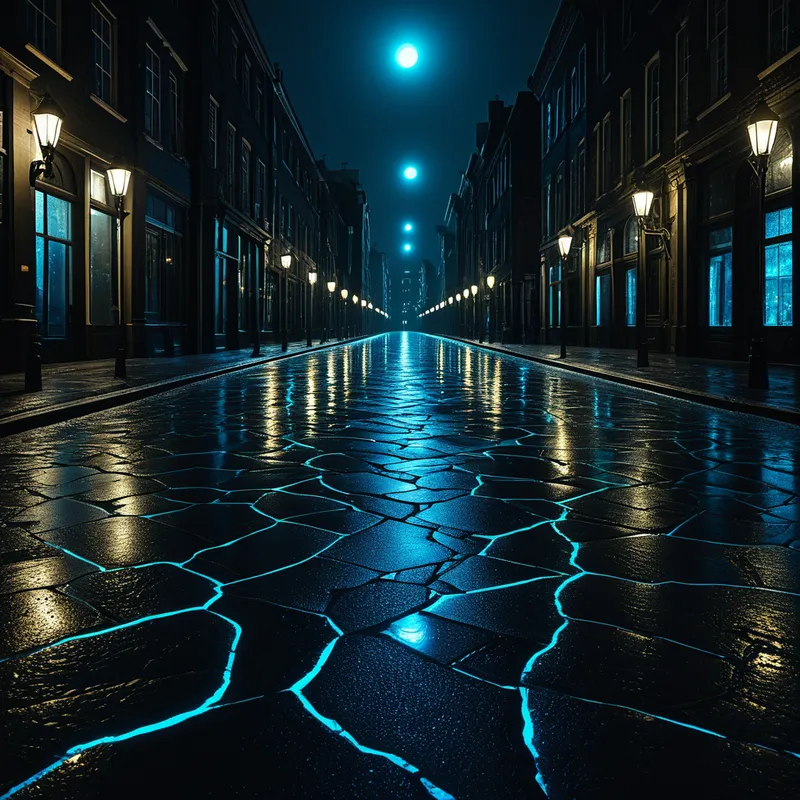
When this myth pattern activates in modern dreams, the dreamer is often at a point of psychic drought. Conscious resources feel exhausted; life has become arid, repetitive, or devoid of meaning. To dream of discovering a hidden river in a basement, a cave, or beneath city streets signals a profound somatic and psychological process: the unconscious is announcing its presence and its potential to nourish.
The somatic experience can be one of awe, chilling dampness, or the terrifying thrill of the descent. The dreamer might feel the rumble of the water in their bones. This is the [psyche](/myths/psyche “Myth from Greek culture.”/) initiating its own “hero’s journey,” compelling the individual to pay attention to what flows beneath the surface of their daily awareness. It is an invitation to explore the hidden currents of emotion, intuition, and forgotten memory. Resistance to this call can manifest as dreams of being lost in the tunnels, afraid of the water’s power, or being unable to find [the way](/myths/the-way “Myth from Taoist culture.”/) back—symbolizing a fear of being overwhelmed by the unconscious or losing one’s familiar identity.
Alchemical Translation
The myth models the alchemical [solve et coagula](/myths/solve-et-coagula “Myth from Alchemical culture.”/)—dissolve and coagulate—applied to the psyche. The conscious personality (the dry, surface world) must first be dissolved through a descent into the [prima materia](/myths/prima-materia “Myth from Alchemical culture.”/) of the unconscious (the dark river). This is the [nigredo](/myths/nigredo “Myth from Alchemical culture.”/), the blackening, where old certainties are lost in the dark.
The treasure you seek is not gold, but the current itself. To be reshaped by the flow is the transmutation.
The confrontation with the Water-Holder is the stage of albedo, where the ego encounters the objective, non-personal psyche. By offering its authentic need (the tear, the song), the ego aligns itself with the deeper Self. The return to the surface with the gift of water is the citrinitas and [rubedo](/myths/rubedo “Myth from Alchemical culture.”/). The hidden, psychic energy is integrated, leading to a renewal of life and purpose. The once-brittle ego is now irrigated by a continuous, sustaining connection to the depths. The individual is no longer just a surface-dweller but a conscious participant in the eternal, hidden flow of their own being, achieving a state of greater wholeness—the alchemical gold of individuation.
Associated Symbols
Explore related symbols from the CaleaDream lexicon: