
Umi-bōzu Myth Meaning & Symbolism
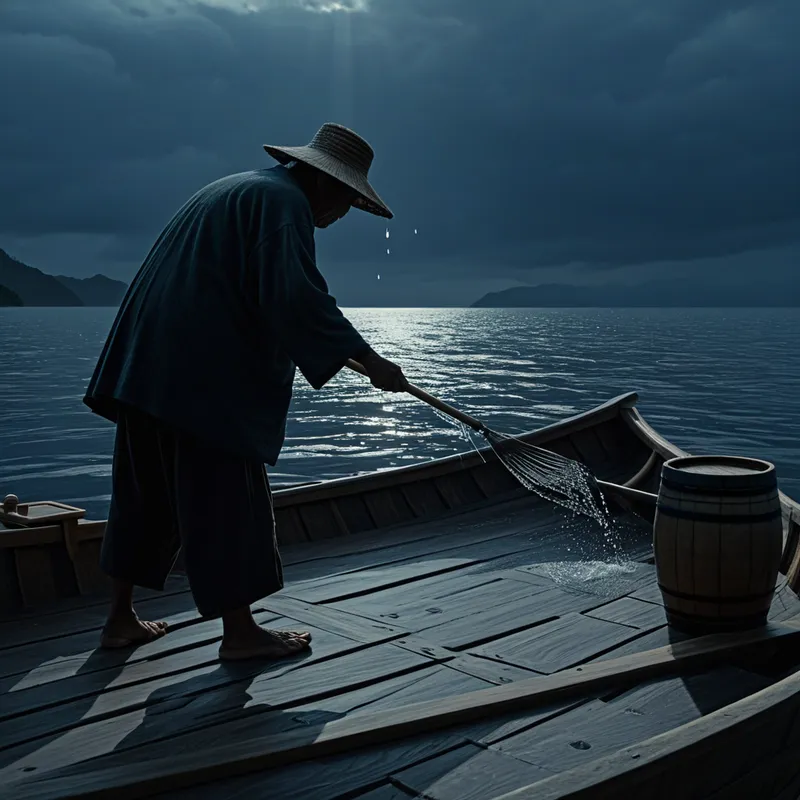
A monstrous, faceless sea spirit rises from a calm ocean, demanding a barrel. The sailor's offering becomes a vessel for the unnameable terror of the deep.
The Tale of Umi-bōzu
Listen, and hear a tale not of the sun-dappled shore, but of the deep, silent places where [the sea](/myths/the-sea “Myth from Greek culture.”/) holds its breath. It begins on a night so still it feels like a held secret. The ocean is a sheet of polished obsidian, mirroring a sky empty of stars. A lone fishing boat, its wood groaning softly, drifts in this vast, breathless calm—a calm that is not peace, but a waiting.
The sailor feels it first in his bones, a hollow dread that has nothing to do with storm or wave. Then, the [water](/myths/water “Myth from Chinese culture.”/) before the bow begins to stir, not with foam, but with a deep, internal upheaval. From the profound blackness, it rises. A dome, vast and slick, breaches the surface. Water cascades from a smooth, bald head, larger than the boat itself. It keeps rising, a pillar of darkness, until it looms over [the vessel](/myths/the-vessel “Myth from Alchemical culture.”/)—a giant monk of [the abyss](/myths/the-abyss “Myth from Kabbalistic culture.”/), cloaked in the sea itself. This is the Umi-bōzu.
It has no face. No eyes to plead with, no mouth to reason with. Only the immense, blank curve of its head, a void that absorbs the dim light. A voice, if it can be called that, echoes not through the air but through the water and the planks of the ship, a sound like a sinking stone in a deep well. “Give me a barrel.”
The demand is absurd, simple, absolute. The sailor’s mind reels. Gold? His catch? His life? No. A barrel. An empty vessel. In that moment of paralyzing terror, instinct or forgotten lore takes hold. He seizes not a new barrel, but an old one, worn and used. With hands that feel like another man’s, he offers it.
The great, dripping hand—or is it merely a mass of shaped water?—envelopes the offering. For a heartbeat, [the world](/myths/the-world “Myth from Tarot culture.”/) is silent. Then, the Umi-bōzu begins to pour seawater into the barrel. It pours and pours, a torrent from the deep, far more than the barrel could ever hold. Yet it does not overflow. The spirit fills the given vessel with the very essence of its domain, until the task is done. With a final, ground-shifting motion, it sinks backwards, dissolving into the black water from whence it came. The unnatural calm breaks. The sailor is left alone, the weight of the impossibly full barrel on his deck, the taste of salt and miracle on his lips.
Cultural Origins & Context
The myth of the Umi-bōzu is a folkloric creation born from the visceral, lived experience of Japan’s coastal and fishing communities. As an island nation, the sea was both provider and profound threat, a capricious deity that demanded respect. These tales were not formalized jinja scripture, but oral history passed between sailors on night watches and villagers in port-side inns. They functioned as both warning and psychological tool.
The name itself is telling: Umi (sea) and Bōzu (a Buddhist monk), painting the entity as a [sinister](/myths/sinister “Myth from Roman culture.”/), clerical figure of the deep. This reflects a syncretic blend of indigenous animism—where natural forces are alive—and Buddhist imagery, perhaps representing the spirits of drowned monks or a perversion of sacred forms. The stories served a critical societal function: to codify the rules of engagement with the unknowable sea. They taught that when confronted with the formless terror of the deep, one must not fight, nor flee, but offer. The specific, irrational demand for a barrel became a piece of folk wisdom, a ritual action that could potentially appease the chaos.
Symbolic Architecture
At its core, the Umi-bōzu is the archetypal embodiment of the Formless Unknown. It is not a [shark](/symbols/shark “Symbol: A shark embodies primal instincts, danger, or the necessity to confront fear.”/) (a known [danger](/symbols/danger “Symbol: The symbol of ‘Danger’ often indicates a sense of threat or instability, calling for caution and awareness.”/)) nor a storm (a visible process). It is the [terror](/symbols/terror “Symbol: An overwhelming, primal fear that paralyzes and signals extreme threat, often linked to survival instincts or deep psychological trauma.”/) that arises from perfect calm, the monstrous shape given to the subconscious fear of the [abyss](/symbols/abyss “Symbol: A profound void representing the unconscious, the unknown, or a spiritual threshold between existence and non-existence.”/), both oceanic and psychic. Its facelessness is its most potent feature—it is a blank screen upon which we project our deepest, most wordless [dread](/symbols/dread “Symbol: A profound, anticipatory fear of impending doom or catastrophe, often without a clear external threat. It manifests as a heavy, paralyzing emotional state.”/).
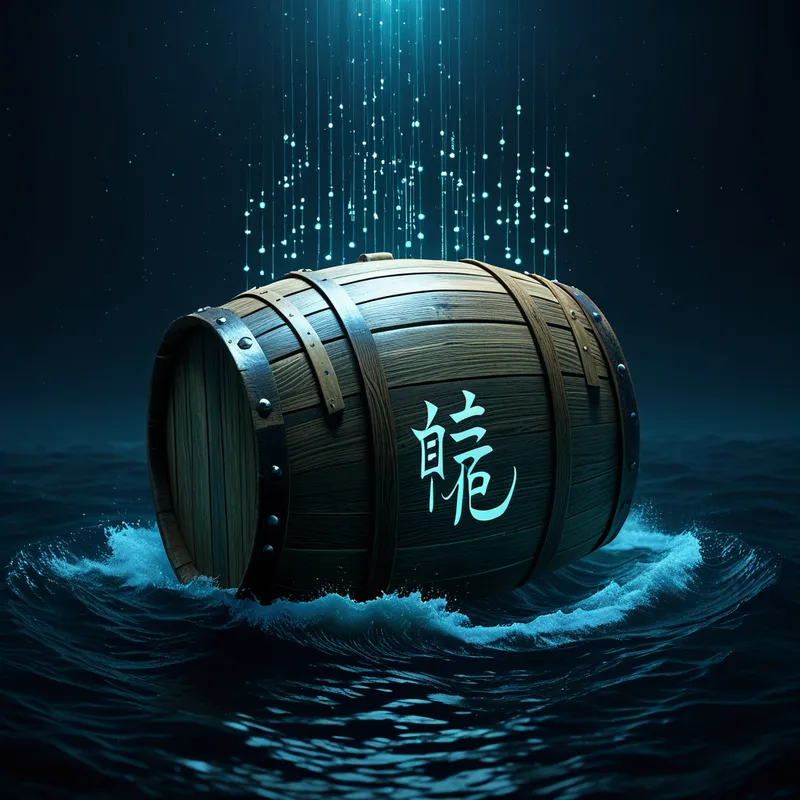
The offering of the barrel is the myth’s alchemical heart. One does not offer the spirit what it wants, for its want is incomprehensible. One offers a container.
The [barrel](/symbols/barrel “Symbol: A barrel often symbolizes containment, storage, and the preservation of resources, representing both abundance and potential loss.”/) is a [symbol](/symbols/symbol “Symbol: A symbol can represent an idea, concept, or belief, serving as a powerful tool for communication and understanding.”/) of the conscious [vessel](/symbols/vessel “Symbol: A container or structure that holds, transports, or protects something essential, representing the self, emotions, or life journey.”/), the bounded self ([the ego](/myths/the-ego “Myth from Jungian culture.”/)). The old, used [barrel](/symbols/barrel “Symbol: A barrel often symbolizes containment, storage, and the preservation of resources, representing both abundance and potential loss.”/) suggests this is not about offering something perfect or new, but about offering one’s own humble, weathered [capacity](/symbols/capacity “Symbol: A measure of one’s potential, limits, or ability to contain, process, or achieve something, often reflecting self-assessment or external demands.”/) to hold experience. The Umi-bōzu’s act of filling it with seawater represents the [inundation](/symbols/inundation “Symbol: A flood or overwhelming deluge, often representing emotional overwhelm, cleansing, or uncontrollable forces.”/) of the conscious mind by the contents of the unconscious—the salty, primal, emotional waters of the [psyche](/myths/psyche “Myth from Greek culture.”/). The miracle is that the [vessel](/symbols/vessel “Symbol: A container or structure that holds, transports, or protects something essential, representing the self, emotions, or life journey.”/) holds. [The ego](/myths/the-ego “Myth from Jungian culture.”/), by willingly providing itself as a container, survives the inundation and is transformed by it. The terror is not destroyed; it is processed, contained, and integrated.
The Dreamer’s Resonance
When the pattern of the Umi-bōzu arises in modern dreams, it seldom appears as a literal sea monster. It manifests as the quality of the encounter: a formless, looming anxiety that arises during a period of apparent calm in the dreamer’s life. It might be a towering, featureless shadow at the end of a hallway; a silent, overwhelming presence in a quiet room; or a vast, smooth wall that blocks one’s path.
Somnatically, the dreamer often reports a feeling of paralysis, a choked voice, or the chilling “calm before the storm” in their body. Psychologically, this signals a critical moment of confrontation with the shadow or a complex that has been dormant. The unconscious is presenting a content so vast and unfamiliar that the conscious mind cannot yet give it a face or a name. The dream is the rising of the spirit. The question posed to the dreamer is the same as to the sailor: What vessel can you provide? What part of your conscious self can you offer to hold this rising, terrifying unknown?

Alchemical Translation
The myth models a precise sequence for psychic transmutation, a roadmap for the individuation process when faced with overwhelming, non-negotiable aspects of [the self](/myths/the-self “Myth from Jungian culture.”/).
First, The Calm & The Rise: Individuation often begins not in crisis, but in a strange, hollow stillness after a period of growth or adaptation. This is the deceptive calm sea. The rise of the Umi-bōzu is the eruption of a new, terrifying depth of the psyche that demands attention.
Second, The Faceless Demand: The emerging content does not arrive with clear instructions. It feels irrational, absurd (“give me a barrel”). In life, this may be a depression, an inexplicable rage, or a profound sense of meaninglessness that makes no “sense” to the conscious mind. The ego wants to label it, but it is faceless.
Third, The Offering of the Vessel: This is the active step of consciousness. Instead of fleeing (repression) or attacking (inflating the ego against it), one must find a way to “offer a barrel.” In psychological terms, this is creating a container: beginning to journal about the feeling without understanding it, engaging in art, or simply holding the anxiety in mindful awareness. It is saying, “I do not know what you are, but I will make space for you.”
The final, transformative act belongs to the unconscious itself. By filling the offered vessel, it performs the integration. The ego’s job is not to fill the barrel, but to provide it and remain steady.
The sailor does not fill the barrel; the spirit does. In our process, once we consciously make space for the unknown, the unconscious begins to pour its contents—memories, emotions, insights—into that space. The ego that endures this flooding is no longer the same. It is heavier, salted with wisdom, and has witnessed the deep. It has translated formless terror into a contained, if mysterious, part of its cargo. One sails on, not untouched by the abyss, but having given it a shape and a place within the ship of the self.
Associated Symbols
Explore related symbols from the CaleaDream lexicon: