Ulguen Creator God Altai Myth Meaning & Symbolism
A myth of the creator god Ulguen who brings cosmic order from primal chaos, establishing the sacred world-mountain and the first human.
The Tale of Ulguen Creator God Altai
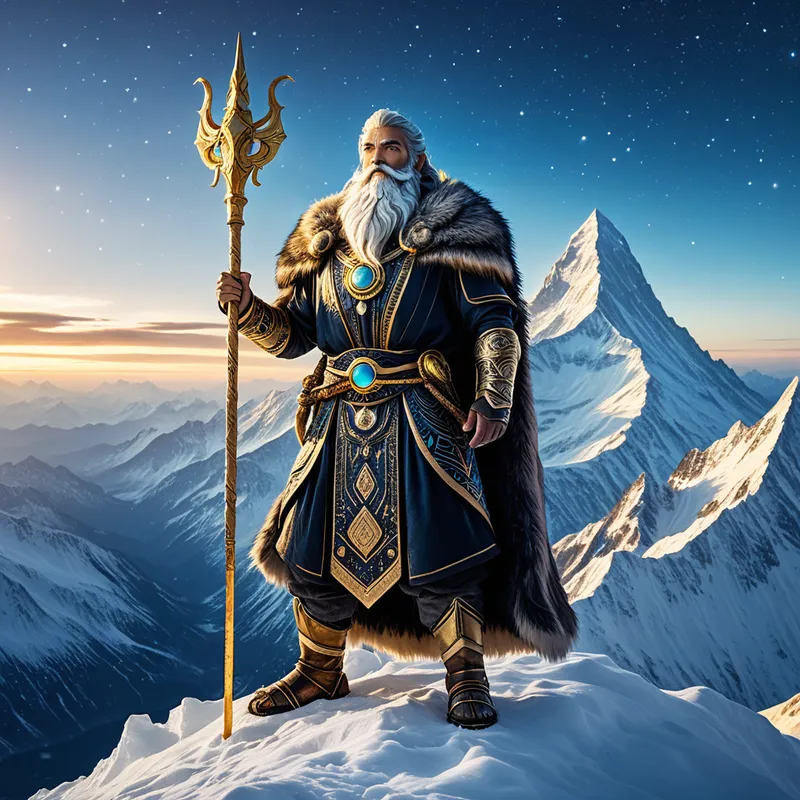
In the beginning, there was no beginning. There was only Erlik, a boundless, churning, and dark ocean. No sky arched above, no earth lay below. Only the cold, deep waters, moving without wind, and a thick, formless mist that was not yet air. From within this endless, dreaming chaos, a thought took shape. A presence stirred. This was Ulguen, the First Thinker, the One Who Is Awake.
He rose from the abyssal waters, a being of immense and silent power. He looked upon the featureless void and knew it was not enough. A great longing for form, for distinction, grew within him—a longing that became a command. He spoke a word that was not a sound but a vibration through the very substance of chaos. “Let there be a foundation.”
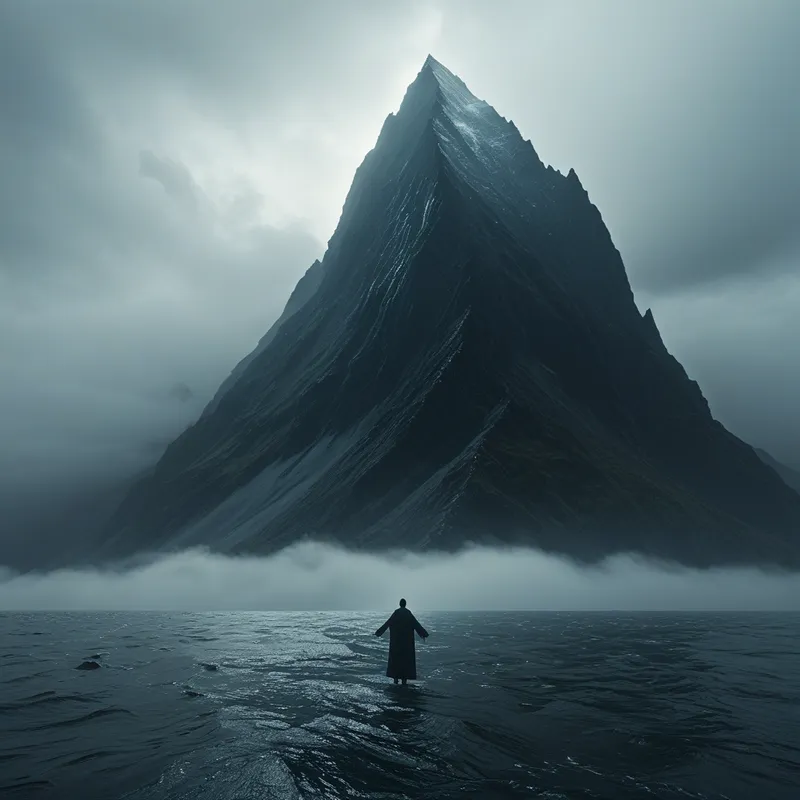
And from the depths of the dark sea, a single, mighty peak began to rise. It pushed through the waters, stone grinding against the formless, rising and rising until it pierced the misty heavens. This was the first Altai, the golden mountain, the navel of the world. Ulguen stepped upon its summit, and his footfall sent ripples of stability through the cosmos. He lifted his hands, and with a sweeping gesture, he parted the mist. The lighter vapors ascended, becoming the vault of the sky, Tengri. The heavier vapors settled, becoming the firm earth.
But the world was empty and silent. Ulguen took a piece of the mountain’s heart—a clay of gold and earth—and from it, he fashioned the first man. He breathed into the figure of clay, and the breath was Kut, the divine spark. The man awoke, blinking at the first light of the first sun, which Ulguen now kindled in the sky. Yet, the man was alone. So, from the same sacred clay, Ulguen fashioned the first woman. He set them at the foot of the golden mountain, in a lush valley sprung from his will, where a clear river flowed from Altai’s slopes.
He gave them a single law, a sacred charge: “This mountain is the pillar of the world. Honor it. Live from it. Protect its order.” But from the depths of the remaining chaotic waters, Erlik Khan watched with envy. He saw the order, the light, the life, and he desired to corrupt it, to drag a piece of that perfection back into his dark realm. Thus, the stage was set, not for a battle of armies, but for a perpetual tension—the ordered world of the mountain against the ever-present, encircling chaos of the deep.
Cultural Origins & Context
The myth of Ulguen is central to the spiritual worldview of the Turkic-speaking peoples of the Altai Mountains in Southern Siberia. It is not a single, canonical text but a living oral tradition, passed down through generations by storytellers and shamans (Kam). The myth functioned as a cosmic map and a social charter. It explained the origin of the sacred landscape—the Altai mountains were not just a home, but the literal body of the primordial creation, the stable center in a potentially chaotic universe.
The recitation of this myth was likely a part of seasonal rituals and initiations, serving to reaffirm the community’s place within the divine order. By telling of Ulguen’s act of creation, the people reinforced their connection to Tengri and the sacred land, and reminded themselves of their duty to maintain the cultural and spiritual order against the entropy represented by Erlik Khan. The shaman, in his ecstatic journeys, would spiritually ascend this world mountain to commune with Ulguen, replicating the primal act of establishing connection between heaven and earth.
Symbolic Architecture
At its [heart](/symbols/heart “Symbol: The heart symbolizes love, emotion, and the core of one’s existence, representing deep connections with others and self.”/), this is a myth about the [emergence](/symbols/emergence “Symbol: A process of coming into being, rising from obscurity, or breaking through a barrier, often representing birth, transformation, or revelation.”/) of [Consciousness](/symbols/consciousness “Symbol: Consciousness represents the state of awareness and perception, encompassing thoughts, feelings, and experiences.”/) from the Unconscious, of Form from the Formless. Ulguen represents the archetypal principle of ordering intelligence. The primordial [ocean](/symbols/ocean “Symbol: The ocean symbolizes the vastness of the unconscious mind, representing deeper emotions, intuition, and the mysteries of life.”/) of Erlik is the undifferentiated, potential-filled, but chaotic state of the psyche before the ego-complex forms.
The first act of creation is not making something from nothing, but drawing a distinction within the everything. A mountain is not created; it is separated from the sea.
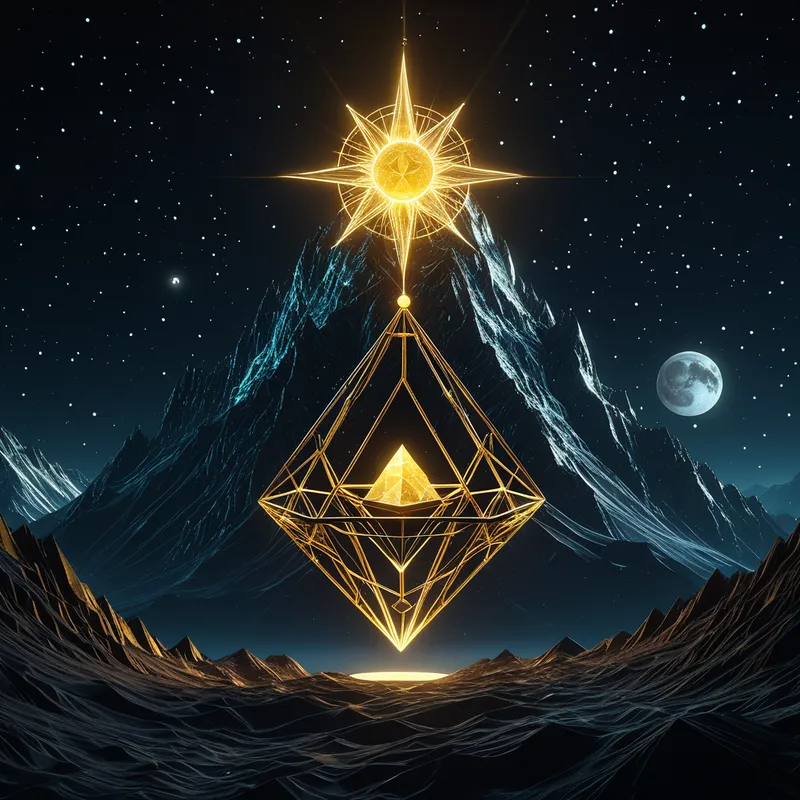
The Altai [mountain](/symbols/mountain “Symbol: Mountains often symbolize challenges, aspirations, and the journey toward self-discovery and enlightenment.”/) is the ultimate [symbol](/symbols/symbol “Symbol: A symbol can represent an idea, concept, or belief, serving as a powerful tool for communication and understanding.”/) of the [axis](/symbols/axis “Symbol: A central line or principle around which things revolve, representing stability, orientation, and the fundamental structure of reality or consciousness.”/) mundi. Psychologically, it represents the nascent Self—the central, organizing principle of the [personality](/symbols/personality “Symbol: Personality in dreams often symbolizes the traits and characteristics of the dreamer, reflecting how they perceive themselves and how they believe they are perceived by others.”/) that begins to rise from the [unconscious depths](/symbols/unconscious-depths “Symbol: The hidden, primordial layers of the psyche containing repressed memories, instincts, archetypes, and collective wisdom beyond conscious awareness.”/). It is the “I” that stands firm. The [breath](/symbols/breath “Symbol: Breath symbolizes life, vitality, and the connection between the physical and spiritual realms.”/) of Kut is the infusion of psychic [energy](/symbols/energy “Symbol: Energy symbolizes vitality, motivation, and the drive that fuels actions and ambitions.”/) and [purpose](/symbols/purpose “Symbol: Purpose signifies direction, meaning, and intention in life, often reflecting personal ambitions and core values.”/) into mere substance (the [clay](/symbols/clay “Symbol: Clay symbolizes malleability, creativity, and the potential for transformation, representing the foundational aspect of life and the ability to shape one’s destiny.”/) of habit and instinct), animating it into a living [soul](/symbols/soul “Symbol: The soul represents the essence of a person, encompassing their spirit, identity, and connection to the universe.”/). The creation of humans last signifies that a stable, structured inner world (the [mountain](/symbols/mountain “Symbol: Mountains often symbolize challenges, aspirations, and the journey toward self-discovery and enlightenment.”/), the sky, the [earth](/symbols/earth “Symbol: The symbol of Earth often represents grounding, stability, and the physical realm, embodying a connection to nature and the innate support it provides.”/)) must exist before a conscious [identity](/symbols/identity “Symbol: Identity represents the sense of self, encompassing personal beliefs, cultural background, and social roles.”/) can safely inhabit it.
The Dreamer’s Resonance
When this mythic pattern stirs in the modern dreamer, it often signals a profound process of internal reorganization. One might dream of being in a featureless, grey landscape or a vast, dark ocean—a somatic experience of existential drift or depression where nothing has shape or meaning. The emergence of a mountain, a tower, or any stable, central structure in such a dream marks the psyche’s attempt to create a new point of orientation.
This can correspond to a life phase where one is building a new identity after a period of chaos (a loss, a major transition). The dreamer may feel themselves “sculpting” their life, breathing intention (Kut) into daily routines (clay). The shadow aspect, Erlik Khan, may appear as self-sabotaging thoughts, old addictions, or fears that threaten to dissolve newly formed boundaries and pull one back into chaotic patterns. The dream is an enactment of the primal creative act: the ego, aligned with the Ulguen archetype, laboring to bring sustainable order to the inner world.
Alchemical Translation
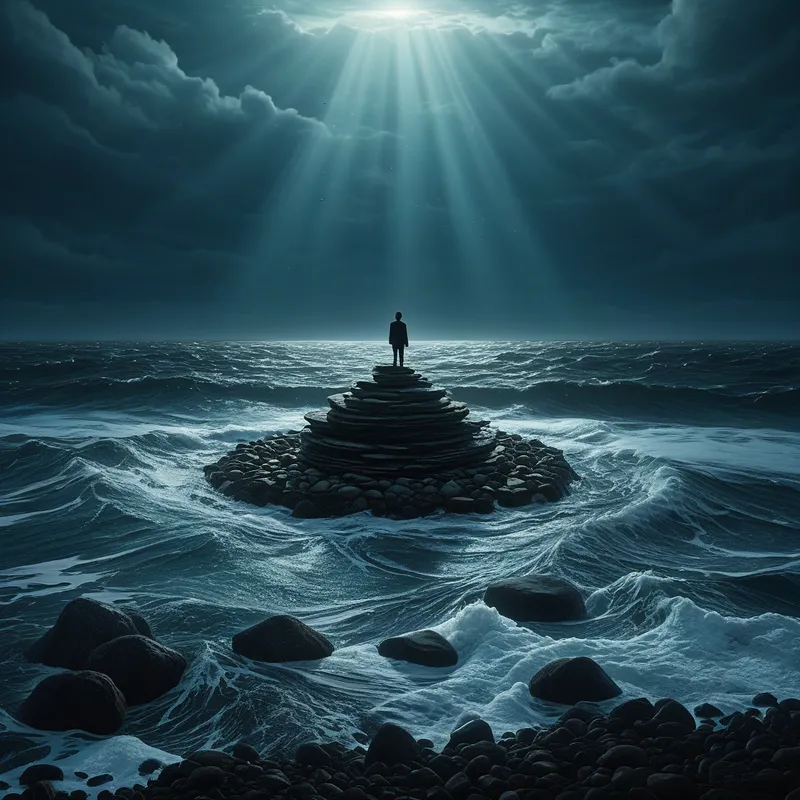
The individuation process mirrors Ulguen’s creative act. It begins in the massa confusa, the chaotic mix of unlived life, complexes, and potential—the psychic sea of Erlik. The work of analysis and self-reflection is the word Ulguen speaks: it is the act of attention that begins to differentiate and name what was previously undifferentiated.
To individuate is to become the Ulguen of your own psyche: to stand upon the mountain of the Self you are building, and from that vantage, consciously order your inner cosmos.
Building the mountain is the hard, gradual work of forming a coherent personality—establishing values (the sky), grounding in the body and reality (the earth), and finding one’s central purpose (the peak). The “clay” is the raw material of our experiences, memories, and instincts. The “breath” is the conscious, loving attention we must give to shape this material into an authentic life. The final stage is not perfection, but the acceptance of the ongoing tension. Erlik, the chaotic underworld, is not destroyed; it is held at bay. It represents the irreducible mystery of the unconscious, which must be acknowledged but not allowed to overwhelm the created order. The mature individual lives at the foot of their own inner Altai, honoring its order while respecting the deep, creative chaos from which it—and they—ultimately arose.
Associated Symbols
Explore related symbols from the CaleaDream lexicon:
- Mountain — The central symbol of the myth, representing the emergent Self, stability, the axis mundi, and the sacred center established from chaos.
- Creator — The archetype embodied by Ulguen, representing the primal ordering intelligence that differentiates and structures existence from formlessness.
- Water — The primordial, chaotic ocean of Erlik, symbolizing the undifferentiated unconscious, potential, and the formless state before consciousness.
- Sky — The ordered realm of Tengri, brought forth by Ulguen’s division, representing spirit, law, consciousness, and the higher principles of order.
- Earth — The firm ground formed from the settled vapors, representing the material world, the body, grounding, and the realized manifestation of creation.
- Spirit — The Kut, or divine breath, that Ulguen instills in the first humans, symbolizing animating life force, soul, and the infusion of purpose into form.
- Chaos — The essential nature of the pre-creation state and the domain of Erlik Khan, representing entropy, the unknown, and the unformed aspects of the psyche.
- Order — The principle enacted by Ulguen, representing structure, distinction, law, and the cosmic and psychological need for a stable center.
- God — The supreme, conscious agency of Ulguen, representing the transcendent function that can mediate between chaos and order within the psyche.
- Stone — The fundamental substance of the first mountain, Altai, representing permanence, foundation, and the irreducible core of being.
- Light — The illumination brought by the first sun, kindled by Ulguen, representing consciousness, understanding, and the revelation of what has been created.