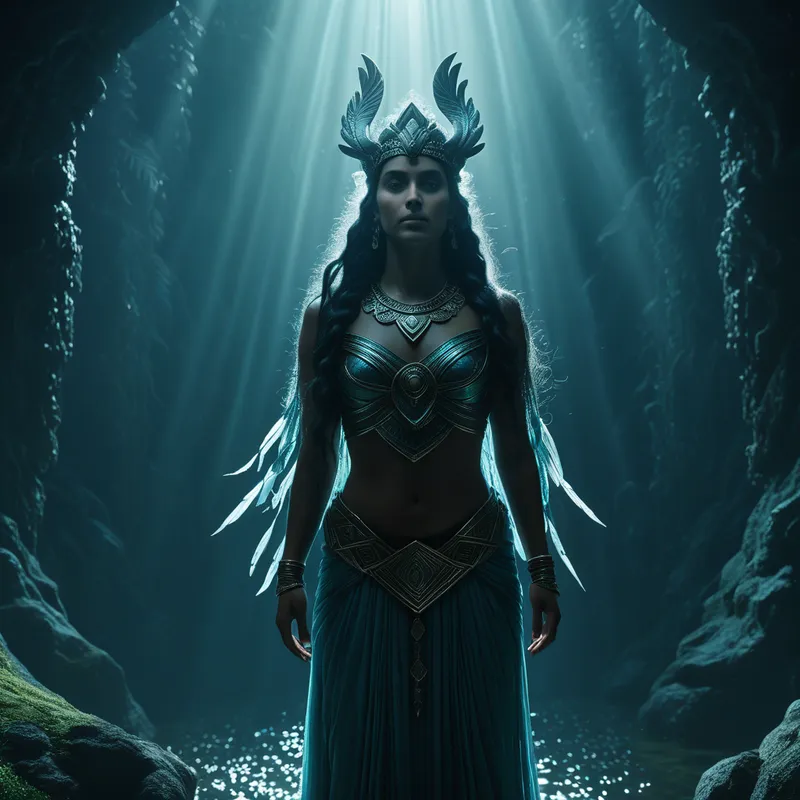
Tzimtzum the Contraction of God
A foundational Kabbalistic concept where God contracts divine light to allow creation, balancing infinite presence with finite existence.
The Tale of Tzimtzum the Contraction of God
Before the Beginning, there was only the Infinite, the [Ein Sof](/myths/ein-sof “Myth from Kabbalistic culture.”/). It was not an empty void, but a plenitude so absolute, a light so pure and undiluted, that nothing other than itself could possibly exist. There was no “outside,” no “other,” no space for creation. The Divine filled all, was all, in a state of perfect, boundless unity.
Yet within this endless light, a thought arose—a desire for relationship, for an Other to know and be known by. A yearning for a world. But how could a world be, when the Infinite left no room? To create a vessel, one must first make space upon the workbench. So, the Unfathomable performed the primordial, paradoxical act: [Tzimtzum](/myths/tzimtzum “Myth from Kabbalistic culture.”/).
It was not a retreat to a distant corner, for there were no corners. It was a profound, inward concentration, a withdrawal of the divine essence from a central point within Itself. Imagine the breath of the universe being held. Imagine a light so intense it draws back into its own core to create a circle of shadow. Into that newly formed, conceptual hollow—a chalal, an empty space—the Infinite directed a single, thin ray of its light. This ray, the Kav, the Line, was not the undiluted essence of Ein Sof, but a filtered, attenuated light capable of forming vessels: the Sefirot.
Into this arena flowed the divine energy, shaping [the ten Sefirot](/myths/the-ten-sefirot “Myth from Kabbalistic culture.”/) into the structure of all reality. But the light was too potent, too effulgent for its nascent containers. In a cosmic shattering—the Shevirat ha-Kelim—the vessels fractured. Sparks of [divine light](/myths/divine-light “Myth from Christian culture.”/) fell, scattered, and were encased in the shards of the broken vessels, forming the raw material of the physical and spiritual universe, a realm now imbued with both holiness and concealment.
Thus, creation was born not from an expansion, but from a sacred contraction. [The world](/myths/the-world “Myth from Tarot culture.”/) exists within the space God vacated. Every atom, every soul, every moment of time pulses within that primordial withdrawal, sustained by the thin, constant ray of the Kav, the thread of divine grace that connects the finite back to the Infinite. The cosmos is not God abandoned, but God lovingly making room.
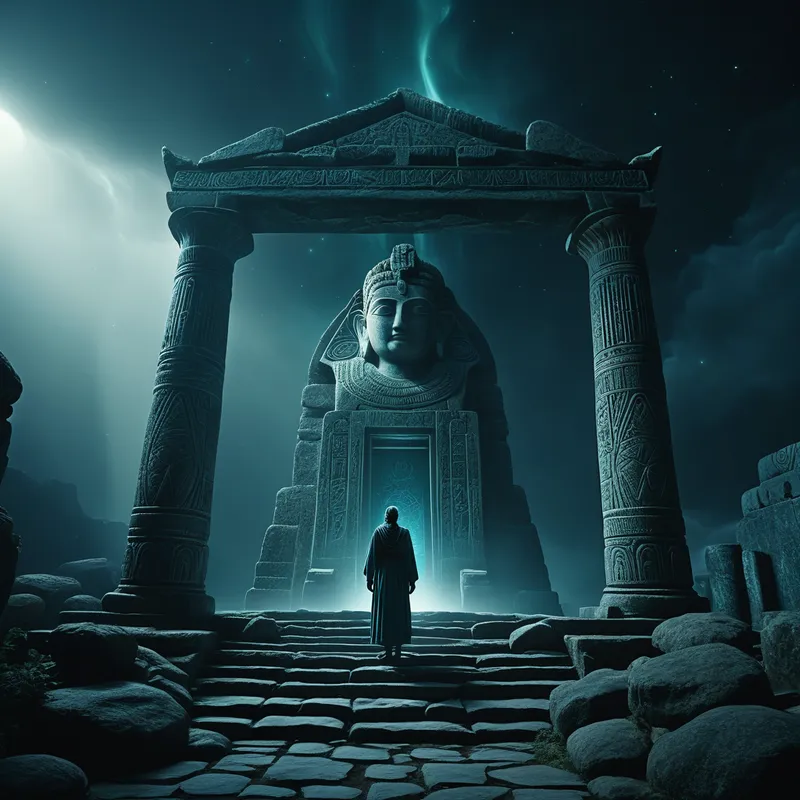
Cultural Origins & Context
The myth of Tzimtzum is [the cornerstone](/myths/the-cornerstone “Myth from Biblical culture.”/) of Lurianic Kabbalah, the revolutionary mystical system developed by Rabbi [Isaac](/myths/isaac “Myth from Biblical culture.”/) Luria (the Ari) in 16th-[century](/myths/century “Myth from Biblical culture.”/) Safed. It emerged from a profound cultural crucible: the trauma of the Jewish expulsion from Spain in 1492. A people who had experienced a violent, literal contraction from their homeland sought a theological framework to explain exile, fragmentation, and the hiddenness of God in a world filled with suffering.
Lurianic Kabbalah provided this map. Tzimtzum offered a breathtaking answer to the oldest of theological dilemmas: How can an infinite, incorporeal God create a finite, physical world? Medieval philosophy struggled with this; Tzimtzum embraced the paradox. It moved the divine drama from a single, completed act of creation into an ongoing, dynamic process involving withdrawal, [emanation](/myths/emanation “Myth from Neoplatonic/Gnostic culture.”/), catastrophe, and the urgent human task of repair (Tikkun Olam). This was not dry theology but a living, psychological cosmology that gave profound meaning to Jewish historical experience and individual spiritual struggle, framing exile as a fundamental condition of creation itself, awaiting redemption.
Symbolic Architecture
Tzimtzum is the ultimate architectural myth. It describes the metaphysical [blueprint](/symbols/blueprint “Symbol: A blueprint represents the foundational plan or design for something, often symbolizing potential, structure, and the mapping of one’s inner self or future.”/) of existence. The act of [contraction](/symbols/contraction “Symbol: A symbolic process of compression, reduction, or inward movement, often representing preparation, transition, or the tension between opposing forces.”/) establishes the fundamental conditions of [reality](/symbols/reality “Symbol: Reality signifies the state of existence and perception, often reflecting one’s understanding of truth and life experiences.”/): [separation](/symbols/separation “Symbol: A spiritual or mythic division between realms, states of being, or consciousness, often marking a transition or loss of connection.”/), [relationship](/symbols/relationship “Symbol: A representation of connections we have with others in our lives, often reflecting our emotional state.”/), and the potential for love, which cannot exist without an “other.” The empty [space](/symbols/space “Symbol: Dreaming of ‘Space’ often symbolizes the vastness of potential, personal freedom, or feelings of isolation and exploration in one’s life.”/) (Chalal) is not a true vacuum of divinity, but a space prepared for otherness, a [womb](/symbols/womb “Symbol: A symbol of origin, potential, and profound transformation, representing the beginning of life’s journey and the unconscious source of creation.”/) for the independent.
The myth structures a [universe](/symbols/universe “Symbol: The universe symbolizes vastness, interconnectedness, and the mysteries of existence beyond the individual self.”/) of dynamic [tension](/symbols/tension “Symbol: A state of mental or emotional strain, often manifesting physically as tightness, pressure, or unease, signaling unresolved conflict or anticipation.”/). The withdrawn Infinite and the emanating Ray create a cosmic polarity—the hidden and the revealed, the boundless and the bounded. The shattered vessels teach that creation is inherently fragile, a broken world where divine light is imprisoned in [material](/symbols/material “Symbol: Material signifies the tangible aspects of life, often representing physical resources, desires, and the physical world’s influence on our existence.”/) shells. This imbues all of existence with a sacred [purpose](/symbols/purpose “Symbol: Purpose signifies direction, meaning, and intention in life, often reflecting personal ambitions and core values.”/): to locate and elevate those scattered sparks.
Tzimtzum reveals that the first act of creation is not an expression, but a restraint. The foundation of love is not presence, but the conscious making of absence so that the beloved may come into being.
The broken vessels signify that no structure, whether a cosmos, a soul, or a society, can initially contain the full force of the divine intention. Fracture is part of the process, and the fragments become the very ground of our labor.
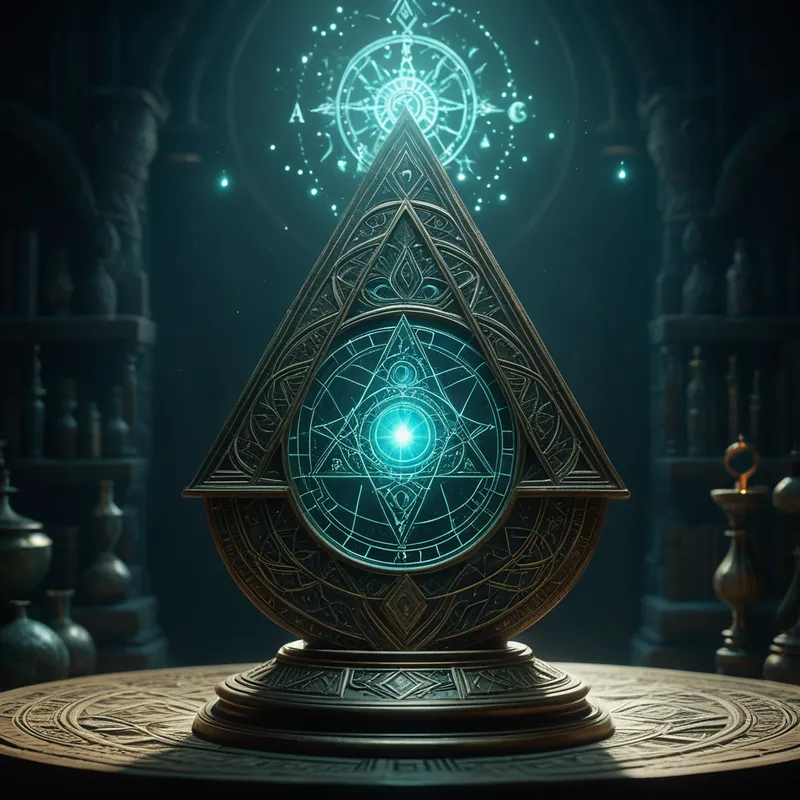
The Dreamer’s Resonance
To the depth psychologist, Tzimtzum is a myth of the [psyche](/myths/psyche “Myth from Greek culture.”/)’s own genesis. It mirrors the process of consciousness emerging from the unconscious. The undifferentiated, oceanic state of the infant (the Ein Sof) must recede to allow for the formation of an ego, a separate “I” that can engage with the world. This is a necessary contraction of the total self to create psychic space for identity, relationship, and life.
The myth speaks directly to the experience of depression, withdrawal, and emptiness. What feels like a terrifying abandonment by life or meaning can be reframed through this lens as a sacred chalal—a painful but necessary clearing, making room for a new structure of [the self](/myths/the-self “Myth from Jungian culture.”/) to form. The “shattering of the vessels” resonates with personal trauma, neurosis, and fragmentation—events where the light of our wholeness seems scattered and lost in the shards of painful experience. The Kabbalistic mandate of Tikkun, gathering the sparks, becomes the therapeutic journey of integration, of gathering the disowned and wounded parts of the self back into a more resilient whole.
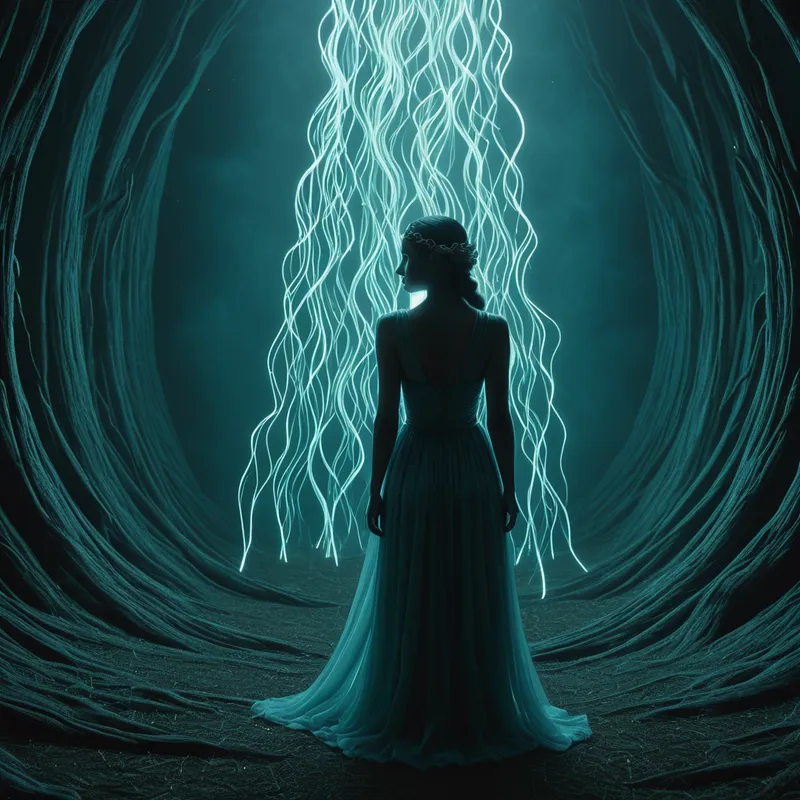
Alchemical Translation
In the alchemy of the soul, Tzimtzum is the solve—the dissolution, the withdrawal, the negredo or darkening that must precede the coagula, the new formation. It is the stage of incubation, where the old, crowded fullness must recede so the new work can find its form. [The alchemist](/myths/the-alchemist “Myth from Various culture.”/), like [the Ein Sof](/myths/the-ein-sof “Myth from Kabbalistic culture.”/), learns that creation requires not only the application of heat and force but also the wisdom of containment, patience, and the creation of a [vas hermeticum](/myths/vas-hermeticum “Myth from Alchemical culture.”/)—a sealed, empty space where transformation can occur.
The ray of the Kav is the focused intention, the attenuated spirit that guides the work without overwhelming it. The shattering is the inevitable [putrefactio](/myths/putrefactio “Myth from Alchemical culture.”/), the decomposition of the initial, imperfect compound. The gathering of sparks is the slow, meticulous labor of distillation and reunion, producing the [lapis philosophorum](/myths/lapis-philosophorum “Myth from Alchemical culture.”/)—the redeemed and integrated self.
The alchemical vessel is the human soul itself, formed in the empty space of God’s withdrawal. Our spiritual work is to withstand the influx of divine light without shattering, to become a vessel that can contain the paradox of the finite and the infinite.
Associated Symbols
Explore related symbols from the CaleaDream lexicon:
- Contraction — The primordial act of withdrawal that creates the possibility of space, relationship, and independent existence from a state of undifferentiated unity.
- Light — The divine essence in its pure, boundless state and its attenuated, creative ray that structures and sustains the cosmos after the contraction.
- Circle — The empty space (Chalal) formed by the divine withdrawal, representing the arena of creation, [the womb](/myths/the-womb “Myth from Various culture.”/) of potential, and the boundary between the Infinite and the finite.
- Vessel — [The Sefirot](/myths/the-sefirot “Myth from Kabbalistic culture.”/) and all created things, designed to contain divine light but prone to shattering, symbolizing fragility, structure, and the need for repair.
- Act — The dynamic, ongoing process of Tzimtzum, emanation, and Tikkun, emphasizing that creation and redemption are not past events but continuous divine and human actions.
- Shadow — The space vacated by the withdrawn light, not as evil but as the necessary condition for otherness, autonomy, and the hiddenness that makes discovery possible.
- Root — The hidden, primordial source in the Ein Sof, from which all existence ultimately derives and to which the gathered sparks seek to return.
- Seed — The concentrated potential within the contraction, containing the entire blueprint of creation within the infinitesimal point from which the Kav emerges.
- Mirror — The created universe, which reflects the divine light in a fragmented, refracted manner, requiring the seeker to look through the cracks to perceive the source.
- Door — [The threshold](/myths/the-threshold “Myth from Folklore culture.”/) between the Infinite and the finite realm, opened by the act of Tzimtzum, through which the divine ray passes and through which the soul seeks return.
- Jewish Star — The interlocking triangles representing the descent of divine light into the world and the ascent of creation back to its source, mirroring the dynamic of withdrawal and emanation.