Tzimtzum Myth Meaning & Symbolism
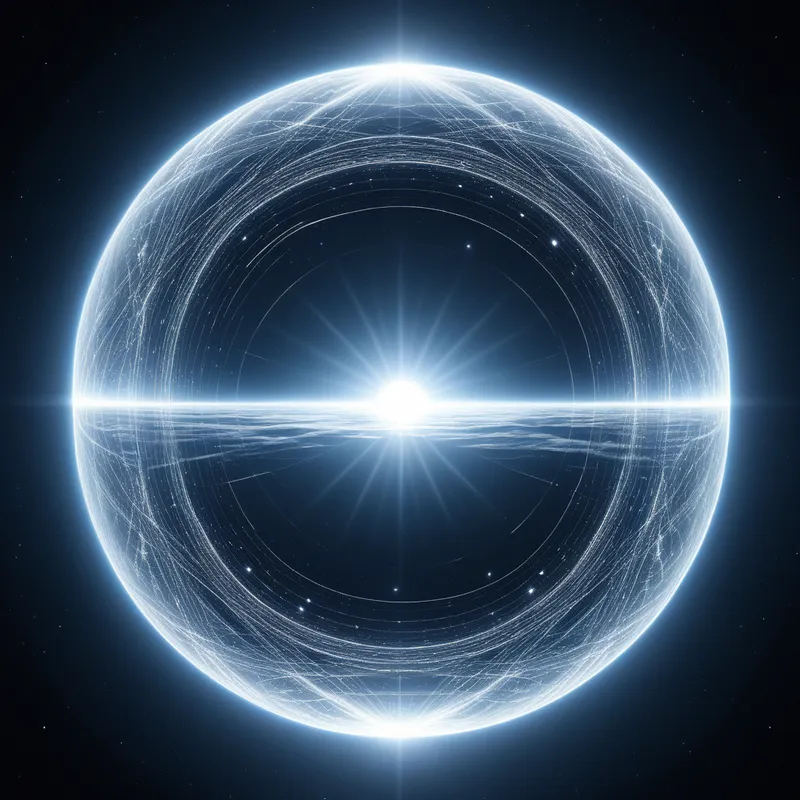
Before creation, the Infinite Light withdrew into itself, creating a primordial void. Into this sacred emptiness, a single line of divine light descended to weave all worlds.
The Tale of Tzimtzum
Listen. In the beginning, there was no beginning. There was only the All, the No-[Thing](/myths/thing “Myth from Norse culture.”/) that was Everything. A boundless, infinite ocean of pure, undifferentiated light—so absolute, so complete, that nothing else could be. No space, no time, no otherness. Only the silent, radiant presence of the Ein Sof, the One Without End.
But within the heart of this endless light, a thought arose. A yearning. A desire not to be only One, but to be known. To be a Creator. To love. Yet how can the All create, when its very fullness leaves no room for anything else? There was no vessel, no chamber, no empty place where a world could be born. The light was everywhere, and so, paradoxically, there was nowhere for creation to begin.
And so, the Unthinkable happened. The Infinite performed the first, most profound act of love: it withdrew. Not a retreat, but a sacred contraction. Tzimtzum. From a central point within its own endless being, the light gathered itself in, receded, pulled back. Imagine the sun drawing all its rays back into its core, not to vanish, but to make space. A sphere of pure potential void was carved out within the Infinite—a womb of absolute, receptive darkness.
Into this primordial emptiness, this chalal panui, a single, focused ray of the original light extended. A line, a channel, a thread of divine emanation. This was the Kav. It descended into [the void](/myths/the-void “Myth from Buddhist culture.”/), not to fill it, but to structure it. From this line, vessels were formed—Kelim—to receive and shape the flowing light. Worlds upon worlds were woven from this delicate balance: the giving light and the receiving vessel. But the light was too pure, too potent. The first vessels, unable to contain the intensity, shattered—Shevirat HaKelim. Sparks of holiness fell, scattered into the darkness, buried within the shells of brokenness.
And so, from the first contraction, the stage was set. Not for a perfect, static universe, but for a dynamic, living cosmos born from relationship: the tension between the withdrawn light and the emanating light, between the void and the form, between the hidden and the revealed. The work of gathering the sparks, of repair—Tikkun—had begun.

Cultural Origins & Context
The myth of Tzimtzum is the central cosmological drama of Kabbalah, most fully articulated in the 16th century by the mystic [Isaac](/myths/isaac “Myth from Biblical culture.”/) Luria in the Galilean town of Safed. It emerged not as a philosophical treatise for the few, but as a vital, living narrative for a community in trauma—the exiled Jews of Spain. Passed down orally and through esoteric texts like the Etz Chaim ([The Tree of Life](/myths/the-tree-of-life “Myth from Kabbalistic culture.”/)), it was a story told by masters to disciples in the twilight, a secret map of the cosmos that also mapped the soul’s exile and the path to redemption. Its societal function was profound: it transformed catastrophe (the Shattering) into sacred purpose (the Gathering), offering a mystical framework where human action directly participated in healing a broken God and world.
Symbolic Architecture
At its core, Tzimtzum is not a literal [physics](/symbols/physics “Symbol: Physics in dreams represents the desire to understand life’s fundamental rules, patterns, and predictable outcomes through playful exploration.”/) but a profound metaphysics of [consciousness](/symbols/consciousness “Symbol: Consciousness represents the state of awareness and perception, encompassing thoughts, feelings, and experiences.”/). It symbolizes the primordial act that makes [relationship](/symbols/relationship “Symbol: A representation of connections we have with others in our lives, often reflecting our emotional state.”/) possible.
To create, the Infinite must first become finite. To give, one must first create space to receive.
The Ein Sof represents the undifferentiated totality of the [psyche](/myths/psyche “Myth from Greek culture.”/), the unconscious plenum where all potentials exist but nothing is distinct. Tzimtzum is the necessary act of ego-formation—the [contraction](/symbols/contraction “Symbol: A symbolic process of compression, reduction, or inward movement, often representing preparation, transition, or the tension between opposing forces.”/) of this totality to create a conscious “I” with boundaries. The void is not [emptiness](/symbols/emptiness “Symbol: Emptiness signifies a profound sense of void or lack in one’s life, often related to existential fears, loss, or spiritual quest.”/), but the sacred [space](/symbols/space “Symbol: Dreaming of ‘Space’ often symbolizes the vastness of potential, personal freedom, or feelings of isolation and exploration in one’s life.”/) of relationship, the [temenos](/myths/temenos “Myth from Greek culture.”/) where [life](/symbols/life “Symbol: The symbol of ‘Life’ represents a journey of growth, interconnectedness, and existential meaning, encompassing both the joys and challenges that define human experience.”/) happens. The Kav is the thread of [attention](/symbols/attention “Symbol: Attention in dreams signifies focus, awareness, and the priorities in one’s life, often indicating where the dreamer’s energy is invested.”/), [intention](/symbols/intention “Symbol: Intention represents the clarity of purpose and direction in one’s life and can symbolize motivation and commitment within a dream context.”/), and focused consciousness that structures our experience from the [chaos](/symbols/chaos “Symbol: In Arts & Music, chaos represents raw creative potential, uncontrolled expression, and the breakdown of order to forge new artistic forms.”/) of potential. The shattered vessels are our failed attempts to contain insights or energies too great for our current [structure](/symbols/structure “Symbol: Structure in dreams often symbolizes stability, organization, and the framework of one’s life, reflecting how one perceives their environment and personal life.”/), leaving behind fragments of [trauma](/symbols/trauma “Symbol: A deeply distressing or disturbing experience that overwhelms the psyche, often manifesting in dreams as unresolved emotional wounds or psychological injury.”/), neurosis, and “holy sparks” buried in our complexes.

The Dreamer’s Resonance
When this myth stirs in the modern dreamer, it often manifests as dreams of vast, overwhelming light or energy that suddenly recedes, leaving one in a silent, empty space. One might dream of a room that expands by its walls moving inward, or of a powerful presence (a parent, a leader, a god-figure) stepping back to give you room. There is a somatic sense of release followed by profound emptiness, which can feel either terrifyingly lonely or peacefully receptive.
Psychologically, this signals a process of decentering. [The ego](/myths/the-ego “Myth from Jungian culture.”/), which had been flooded with contents (anxiety, another’s personality, a fanatical ideal), is experiencing a divine contraction. The All is pulling back so that the individual space—the void—can be acknowledged. This is the prelude to true self-differentiation. The dreamer is in the chalal panui, the empty space where their own Kav—their unique thread of life and purpose—must now descend and begin to build.
Alchemical Translation
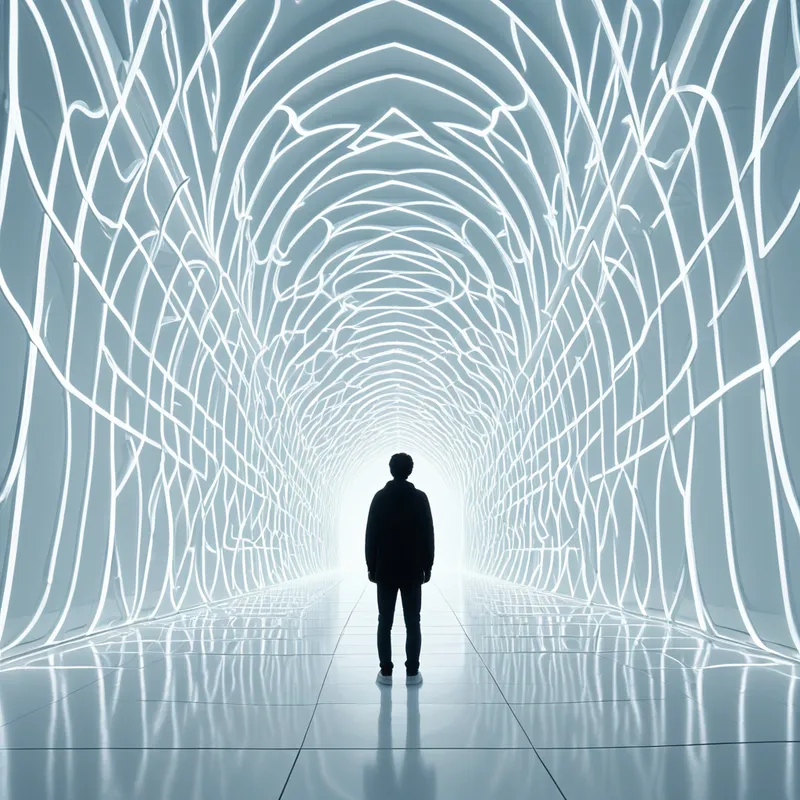
The alchemical journey modeled by Tzimtzum is the foundation of individuation. It begins with the negatio—the withdrawal. For the modern individual, this is the courageous act of pulling back: from compulsive doing, from toxic relationships, from identification with roles and masks. It is creating interior space through meditation, solitude, or setting boundaries.
The first creation is an act of holy absence. We must empty the vessel before it can hold its destined wine.
Into this cultivated void, the focused light of consciousness (Kav) can descend. This is the work of analysis, reflection, and conscious choice—structuring the void with meaning. But the process includes Shevirat HaKelim: the inevitable breaking of old containers—beliefs, self-images, life plans—when a new level of psychic energy or truth emerges. This shattering is not failure, but a necessary dispersal of sparks. The final, lifelong labor is Tikkun: gathering those sparks from the fragments of our experiences, our wounds, and our shadows. It is realizing that our wholeness is not a return to the undifferentiated All, but a [sacred marriage](/myths/sacred-marriage “Myth from Alchemy culture.”/) between the light we channel and the unique, receptive vessel of our own, once-empty space. We become co-creators, healing [the world](/myths/the-world “Myth from Tarot culture.”/) by first allowing the Divine to withdraw, so that we may truly begin.
Associated Symbols
Explore related symbols from the CaleaDream lexicon: