Tyche/Fortuna Myth Meaning & Symbolism
The goddess who spins the wheel of fortune, casting mortals between sudden windfall and ruin, embodying the terrifying grace of pure chance.
The Tale of Tyche/Fortuna
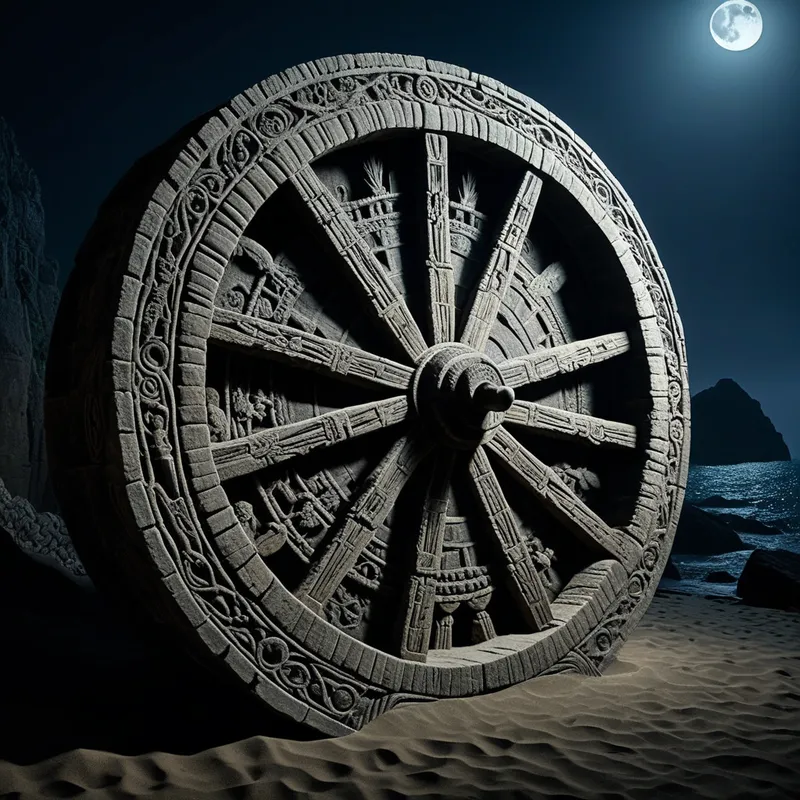
Listen. Can you hear it? The sound is not of wind or water, but of a great, groaning axle turning against the weight of the world. It is the sound of the wheel.
In the beginning, there was only the deep, humming order of the cosmos. The Fates, the Moirai, spun, measured, and cut the threads of life with unerring precision. But from the churning of primordial waters, from the laughter of the gods and the tears of mortals, a new presence coalesced. Her name was Tyche. She was not born of a grand union, but emerged from the very breath of uncertainty that escapes even the most perfect plan.
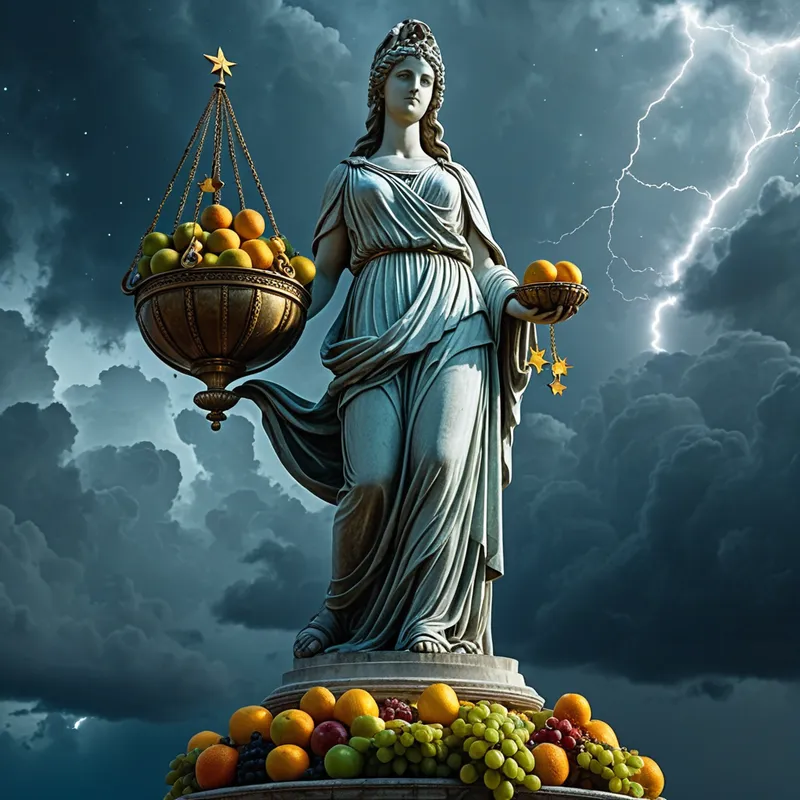
She was beautiful, but her beauty was of a terrifying kind. Sometimes she appeared crowned with a city’s walls, a stern protector. Other times, she danced on a great, unstable sphere, a reminder that all foundations can roll away. In one hand, she bore a cornucopia, spilling gold, grain, and ripe fruit in a careless, glorious cascade. In the other, she held a ship’s rudder, not to steer a steady course, but to swing it wildly, dashing vessels against rocks or guiding them to unimagined shores with a single, capricious gesture.
Her eyes were often veiled. She did not look upon merit, virtue, or prayer. She moved through the world of men like a sudden gust through a field of wheat. Here, a humble farmer’s plow would strike a buried king’s ransom, and he would rise, dizzy with gold. There, a proud monarch, at the zenith of his power, would feel the sphere beneath his feet lurch, and his palace would become his tomb in the space of a single, gasping breath. She was the lottery of the gods, the divine gamble. A merchant would pray to Poseidon for safe passage, and receive it, only to have Tyche’s wind fill his sails and drive his ship onto the very rocks he avoided. A warrior, blessed by Athena with skill, would find Tyche’s stone rolling beneath his foe’s stumbling feet, granting a victory he did not earn.
There is no single battle, no quest to win her favor, for she has no favor to give. Her story is the sum of a million moments: the chance meeting, the missed step, the found coin, the lost heir. Her narrative is written in the gasps of crowds and the silence of empty halls. She is the resolution to every plan that went awry and the conflict in every assured victory. Her wheel turns, its creak the soundtrack to human history, lifting the lowly to the heights and casting the mighty into the abyss, not with malice, but with the profound, indifferent grace of pure possibility.
Cultural Origins & Context
Tyche’s worship grew not in the bright, confident dawn of the Classical era, but in its twilight and aftermath. During the heights of city-state power, when order, reason, and civic virtue (embodied by gods like Athena) were paramount, Tyche was a minor, almost fringe figure. She represented the unsettling truth that reason had its limits.
Her prominence soared in the Hellenistic period (323-31 BCE). As Alexander’s empire fractured and the world became vast, interconnected, and politically unstable, the individual felt small against the tides of history. Wars, shifting kingdoms, and sudden social mobility made life feel unpredictable. In this climate, Tyche evolved from a personification of chance into a major goddess of fate. Cities adopted her as their Tyche Protector, minting coins with her image, hoping to harness her fickle power for civic fortune. She became the divine expression of an era’s anxiety and hope—a acknowledgment that despite all planning, the rudder of destiny could be wrenched away by forces beyond comprehension or control.
Symbolic Architecture
Tyche is the archetypal embodiment of the irrational factor, the x in every human equation. She symbolizes the part of reality that is fundamentally non-linear, unpredictable, and sovereign in its randomness.
She is the psychological truth that not everything that happens to us is about us. Some winds blow simply because the atmosphere is in motion.
Her symbols form a perfect symbolic architecture. The cornucopia and the rudder represent the dual potential of chance: immense, unearned abundance and drastic, uncontrollable redirection. The sphere she stands upon is the world itself, inherently unstable, refusing to provide a fixed footing. The blindfold (a later Roman addition as Fortuna) is the most potent symbol: it represents the utter impartiality and opacity of chance. Fortune is blind; it does not see our resumes, our prayers, or our sufferings.
Psychologically, Tyche represents the autonomous complex of “Luck” or “Fate” in the personal and collective unconscious. She is the personification of everything that interrupts the ego’s narrative of control, meritocracy, and just deserts. To encounter Tyche is to confront the limits of the ego’s dominion and to acknowledge the existence of a transpersonal, amoral force that shapes lives.

The Dreamer’s Resonance
When Tyche spins her wheel in the modern dreamscape, she rarely appears as a classical goddess. Her presence is felt in the texture of the dream. It is the dream of finding a room in your house you never knew existed, overflowing with treasure or haunting emptiness. It is the dream of missing a crucial flight, only to see it crash, or of catching it and arriving in a city of gold. It is the sudden, inexplicable windfall or loss that changes the entire landscape of the dream narrative.
Somatically, these dreams are often accompanied by sensations of vertigo, sudden lifting, or falling—a direct bodily resonance with her unstable sphere. Psychologically, the dreamer is processing an encounter with the irrational in waking life. This could be a sudden job loss, an unexpected inheritance, a chance meeting that alters their path, or a diagnosis that comes “out of the blue.” The dream is the psyche’s way of personifying this shock to the system, moving it from an abstract “bad break” or “lucky strike” into a relational event with an archetypal power. The dreamer is not just experiencing fortune or misfortune; they are standing in the presence of Tyche, and the dream asks: How will you relate to what you cannot control?

Alchemical Translation
The alchemical work modeled by the Tyche myth is not one of conquering or winning her favor—that is the hero’s hubris. The transmutation she demands is one of relationship and interpretation.
The first, base stage is identification with the wheel’s victim or victor. We are either cursed by bad luck or blessed by good, and our identity fuses with that state. The alchemical fire is the suffering or the inflation that this causes. The nigredo, or blackening, is the crushing realization of our true powerlessness in the face of her spin.
The opus is to hold the cornucopia and the rudder in the same mind, to stand upon the sphere without demanding it become a plinth.
The transformation begins when we cease railing against her blindness and start to develop our own inner vision. This is the development of meaning. Tyche deals in raw events—the lottery win, the accident, the random encounter. The individual’s sacred task is the opus of spinning that raw event into the gold of significance. Why this chance? Why now? What path is this rudder, however violently turned, now pointing toward? This is not about finding a “reason” in a causal sense, but about forging a meaningful response. It is the shift from “Why is this happening to me?” to “What is this happening for me?”
To integrate Tyche is to acknowledge the reality of chaos and chance without being dissolved by it. It is to build an ego strong enough to withstand her gusts, yet flexible enough to adjust its sails. The individuated self is not one who controls fortune, but one who can stand in its gale, hold the tension of opposites (windfall and ruin), and from that tension, craft a life that is resilient, deeply meaningful, and curiously free—because its value is no longer contingent on the spin of the wheel.
Associated Symbols
Explore related symbols from the CaleaDream lexicon: