Twrch Trwyth Myth Meaning & Symbolism
A king transformed into a monstrous boar, hunted across the land for the treasures between his ears, embodying a primal confrontation with the untamed self.
The Tale of Twrch Trwyth
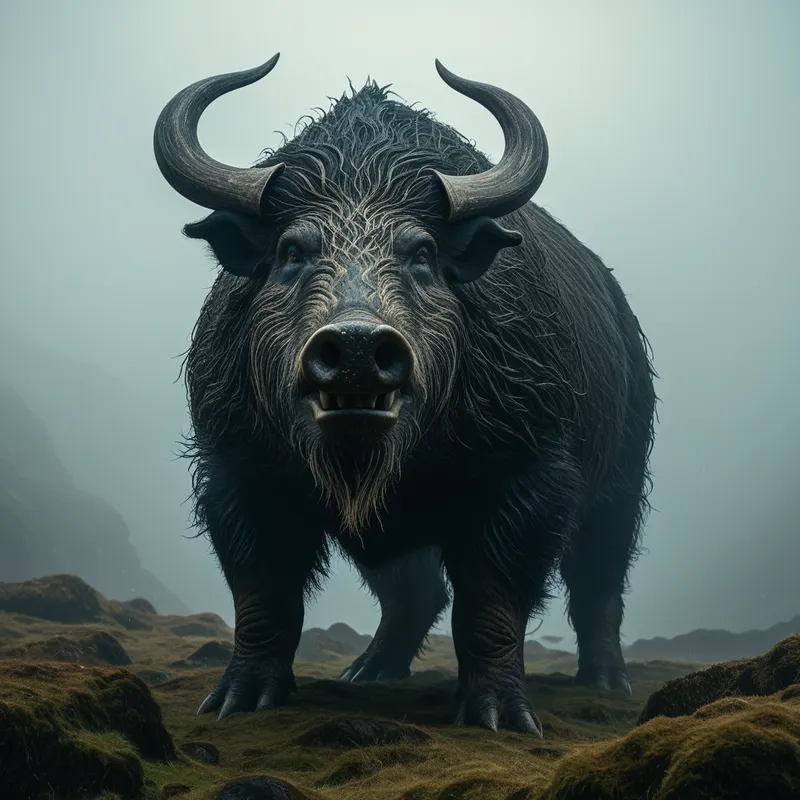
Hear now a tale not of gentle gods, but of a king cursed and a hunt that shook the bones of the land. In the time when [the world](/myths/the-world “Myth from Tarot culture.”/) was younger and the boundaries between man and beast were thin as mist, there lived a king named Taredd Wledig. For his pride and his sins, a divine wrath fell upon him. He was not slain, but transformed. His crown became a ridge of bristling hair, his sceptre a pair of tusks that could gut an oak, his royal mind a furnace of bestial rage. He became Twrch Trwyth, a boar of such monstrous size and power that [the earth](/myths/the-earth “Myth from Hindu culture.”/) trembled where he trod.
He came to Dyfed, a terror unleashed, laying waste to the kingdom. But his hide was more than flesh; it was a casket. Between his ears and behind his head were treasures of impossible power: a comb, a pair of shears, and a razor. These were no mere trinkets, but talismans of sovereignty and grooming, symbols of civilization wrested from chaos. To tame the beast, one must claim these prizes.
The cry went out, and it reached the ears of the High King, Arthur. This was a task for no ordinary hunter. Arthur gathered the champions of Britain—Gwalchmai, Cei, and the mighty [Mabon](/myths/mabon “Myth from Celtic culture.”/) ap Modron, freed from his mystical prison for this very purpose. Thus began the Great Hunt, a chase that would weave a scar across the land from the south of Wales to the Severn Sea.
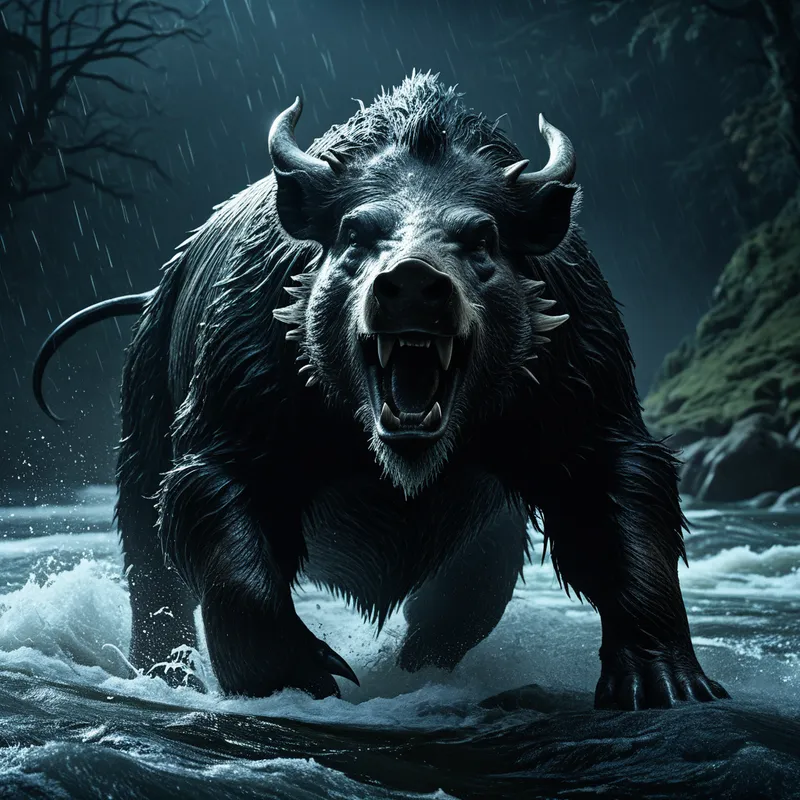
The hunt was not a battle but a harrowing. Twrch Trwyth was a force of nature, a rolling storm of tusks and fury. He slaughtered men by the score at Glyn Nyfer. He fought them in the rushing torrents of the River Nyfer and the Hafren. Arthur and his men did not fight a beast; they wrestled a cataclysm. They harried him, cornered him, and paid in blood for every inch. One by one, the treasures were won through cunning and courage, torn from the living fortress of the boar’s body. The final prize, the razor, was taken only after a titanic struggle in the waves of the Severn estuary.
With the treasures claimed, the great boar, his purpose spent, plunged into [the sea](/myths/the-sea “Myth from Greek culture.”/) at Cernyw. He did not die as men die. He was simply gone, returned to the deep mystery from which all monsters are born. The land bore the scars of his passing, and the heroes bore the memory of a fury that was once a king.
Cultural Origins & Context
This epic is preserved in the Llyfr Gwyn Rhydderch and Llyfr Coch Hergest, within the tale “Culhwch ac Olwen.” It is a masterpiece of the later Brythonic storytelling tradition, where the older, wilder gods of the Celtic world begin to be harnessed into the heroic framework of the Arthurian cycle. The storyteller was likely a bard, performing for a chieftain’s hall, using the tale to explore profound themes of kingship, curse, and the proper relationship between human order and the untamed world.
Societally, it functioned as more than entertainment. It was a mythic map of the land, naming real rivers and fords, binding the legend to the geography of Wales. It also served as a narrative of integration. The hunt for Twrch Trwyth is the central, defining task of Arthur’s early kingship—a metaphor for the heroic struggle to establish civilization (trefn) by confronting and incorporating the raw, destructive, yet potent chaos (annwn) that forever surrounds it.
Symbolic Architecture
Twrch Trwyth is not merely a [monster](/symbols/monster “Symbol: Monsters in dreams often symbolize fears, anxieties, or challenges that feel overwhelming.”/); he is a [shadow](/symbols/shadow “Symbol: The ‘shadow’ embodies the unconscious, repressed aspects of the self and often represents fears or hidden emotions.”/) of epic proportions. He is the incarnate result of a [king](/symbols/king “Symbol: A symbol of ultimate authority, leadership, and societal order, often representing the dreamer’s inner power or external control figures.”/)’s fall—pride, sin, or [imbalance](/symbols/imbalance “Symbol: A state of disharmony where opposing forces are unequal, often representing internal conflict or external instability.”/) made flesh. His transformation speaks to a core Celtic belief in the fluidity of forms and the terrifying potential for the [human](/symbols/human “Symbol: The symbol of a human represents individuality, complexity of emotions, and social relationships.”/) [psyche](/myths/psyche “Myth from Greek culture.”/) to regress into a bestial state.
The treasures he carries are the key. The comb, shears, and razor are instruments of grooming, of ordering the wild. They represent the very faculties of culture, refinement, and self-mastery that the cursed king has lost but still physically harbors. They are the latent potential for order trapped within [chaos](/symbols/chaos “Symbol: In Arts & Music, chaos represents raw creative potential, uncontrolled expression, and the breakdown of order to forge new artistic forms.”/).
The greatest treasures are often guarded by our most feral selves. To reclaim them, we must embark on a hunt that risks utter annihilation.
Arthur’s hunt, then, is [the ego](/myths/the-ego “Myth from Jungian culture.”/)’s necessary, perilous engagement with [the shadow](/myths/the-shadow “Myth from Jungian culture.”/). It is not a battle of extermination, but a harrowing process of reclamation. The goal is not to kill the boar, but to retrieve the civilized tools from him. The boar himself, his [purpose](/symbols/purpose “Symbol: Purpose signifies direction, meaning, and intention in life, often reflecting personal ambitions and core values.”/) fulfilled, returns to the oceanic unconscious. The myth suggests that [the shadow](/myths/the-shadow “Myth from Jungian culture.”/) cannot be destroyed, only confronted, its [energy](/symbols/energy “Symbol: Energy symbolizes vitality, motivation, and the drive that fuels actions and ambitions.”/) integrated, and its guarded treasures won back for the psyche’s use.
The Dreamer’s Resonance
When this myth stirs in the modern unconscious, it manifests not as a literal boar, but as a pattern of immense, untamed pressure. To dream in the rhythm of Twrch Trwyth is to feel pursued by, or to be pursuing, a force that is destructive, unstoppable, and intimately tied to one’s own history—a past failure, a buried rage, a denied aspect of the personality that has grown monstrous through neglect.
Somatically, it may feel like a churning in the gut, a tension in the jaw, or a restless, aggressive energy with no clear outlet. Psychologically, the dreamer is in the phase of the hunt. They are being called, often reluctantly, to track a disruptive truth about themselves across the landscape of their life. Each confrontation with the “boar”—be it an addiction, a repressed trauma, or a grandiose pride—is a battle at a new ford, demanding more courage and costing more comfort. The dream’s resolution comes not with the death of the feeling, but with the hard-won retrieval of a personal “treasure”: a lost sense of dignity, a capacity for self-care (the comb and shears), or a clear boundary (the razor).
Alchemical Translation
The alchemy of Twrch Trwyth is the transmutation of cursed [prima materia](/myths/prima-materia “Myth from Alchemical culture.”/) into sovereign tools. The myth models the individuation process with brutal clarity. The starting point is the [nigredo](/myths/nigredo “Myth from Alchemical culture.”/), the blackening: King Taredd, through his flaw, becomes the black, chaotic boar. The conscious personality is subsumed by its shadow.
Arthur’s gathering of his men represents the albedo, the whitening, where the conscious ego (Arthur) must call upon all available psychic resources (the knights, or specialized inner capacities) to begin the work. The long, bloody hunt across the land is the arduous process of citrinitas, the yellowing or fermentation, where the material is repeatedly broken down and tested.
The chase itself is the crucible. We are not transformed by the insight, but by the relentless, wearying, dangerous process of gaining it.
The retrieval of each treasure marks a stage of integration. Finally, the boar’s departure into the sea symbolizes the [rubedo](/myths/rubedo “Myth from Alchemical culture.”/), the reddening or completion. The raw, monstrous energy is not gone; it has returned to the depths of the psyche, no longer an autonomous, terrorizing complex, but a source of potent, instinctual power that has yielded its gifts. The individual who completes this hunt does not become a harmless innocent. They become a sovereign like Arthur, one who has faced the beast that was once a king and now holds the tools to rule a more complete, more terrifying, and more authentic self.
Associated Symbols
Explore related symbols from the CaleaDream lexicon: