Tubal-cain Myth Meaning & Symbolism
The enigmatic descendant of Cain who mastered fire, metal, and craft, becoming the archetypal patron of civilization's transformative and dangerous gifts.
The Tale of Tubal-cain
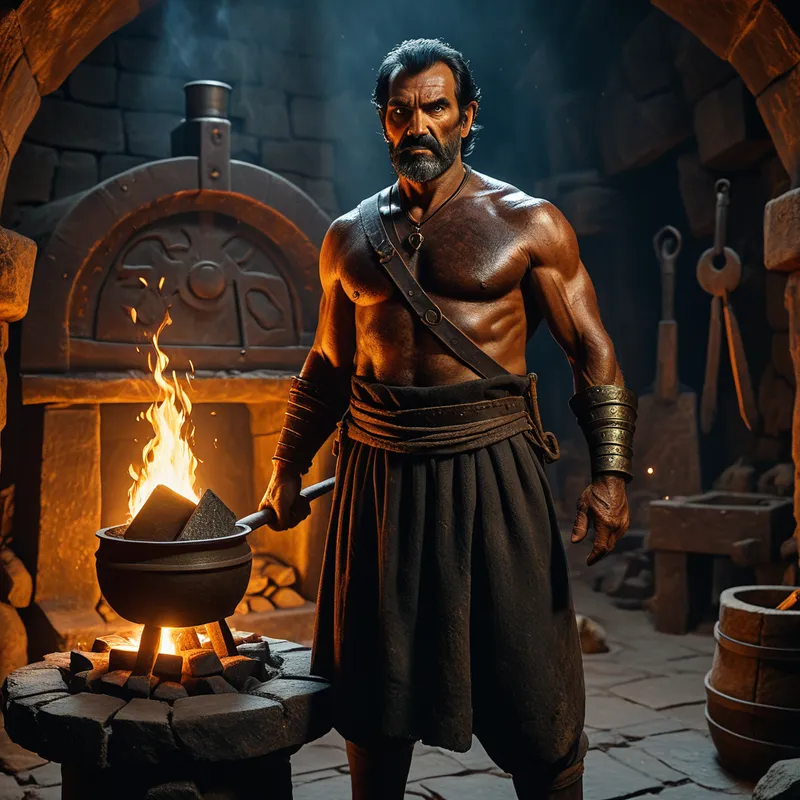
Listen, and hear the tale of the one who stole the second fire. In the gray dawn after the first murder, when the blood of Abel still cried out from the ground, the line of the wanderer Cain walked a hard earth. They were marked, not just on the brow, but in the soul—exiles from the garden, bearing the weight of a knowledge too terrible to name.
Among them was a boy who did not look at the stars with longing for a lost home, but at the stones beneath his feet. His name was Tubal-cain. While his brothers learned the song of the herd and the rhythm of the tent, Tubal-cain heard a different music. It was the crackle of lightning-scorched earth, the groan of rock against rock in the river’s bed, the whisper of wind through a dry thorn bush. He was a quiet child, his hands always busy, turning flint, testing wood, his mind a furnace of silent questions.
The turning point came not in a vision, but in an accident. A campfire, built against a curious black rock, burned hotter and longer than any before. In the morning, amidst the ashes, Tubal-cain found not charcoal, but a strange, dull bead that had bled from the stone. It was heavy. It was cold. But when he thrust it back into the heart of a new fire, a miracle occurred. The bead wept a slow, bright tear—a liquid sun, pooling in the embers.
His breath caught. This was not like shaping wood or knapping flint. This was a pact with the earth’s hidden blood. He built a pit of clay, a womb for a hotter flame. He fed it with breath and the right stones. And from that primal forge, he drew his first prize: a lump of bronze, stubborn and promising.
The first hammer he fashioned from stone shattered. The second, from the horn of a great beast, burned. But the third… the third he made from the bronze itself. With a tool born of its own substance, he began to teach the metal to sing. He forged a blade that held its edge against the world’s hardness. He crafted a cup that did not leak. He shaped a tip for a spear that flew true and pierced deep.
His family watched, first in fear, then in awe. The fire was no longer just a guard against beasts or a maker of meals. It was a maker of worlds. Tubal-cain’s anvil became the heart of their wandering tribe. The clang-clang-clang was a new heartbeat for humanity, a rhythm of dominion and danger. He became the instructor of every artificer in brass and iron. He did not just make things; he midwifed a new age from the womb of the earth, his hands stained with soot and salvation, his legacy written not in scrolls, but in the very bones of civilization.
Cultural Origins & Context
The figure of Tubal-cain is a brief, brilliant spark in the genealogical records of Genesis (4:22). His story is not narrated but listed, embedded within the lineage of Cain. This placement is profoundly significant. In the ancient Near Eastern and Biblical worldview, genealogies were not mere family trees; they were maps of cultural and spiritual inheritance, establishing the origins of tribes, professions, and societal roles.
Tubal-cain’s mention is a foundational etiological myth—a story explaining the origin of a fundamental human craft. He is presented as the fountainhead of all metallurgy. In a culture transitioning from nomadic pastoralism to settled agriculture and urban life, the control of metal represented a quantum leap in power, warfare, and art. The Biblical scribes, likely compiling these traditions during or after the Bronze Age, are pinpointing the moment civilization crossed a crucial threshold. The telling is stark and unsentimental, characteristic of Pentateuchal style. There is no divine sanction or condemnation noted for his work; it is recorded as a simple, monumental fact. The knowledge resides in the tainted, brilliant line of Cain, suggesting an ambivalence toward this transformative power—it is a gift born from a cursed lineage, a blessing with a shadow.
Symbolic Architecture
Tubal-cain is the archetype of the Shadow as creator. He does not work with the given materials of Eden—soft clay, growing plants—but with the hidden, hardened depths of a fallen world. His domain is the subterranean fire, the ore buried in darkness. He represents the human capacity to take what is base, heavy, and chaotic (raw ore, random stone) and subject it to a transformative process (fire, force, will) to produce something of utility and beauty (the tool, the vessel).
The first alchemist was not in a laboratory, but at a forge, learning that transformation requires both the heat of the flame and the shock of the hammer.
His craft embodies the ultimate duality. The same bronze that makes a plowshare to nurture life can make a sword to take it. The fire that warms the hearth can raze the city. He is the patron of both the artisan and the armorer, a living symbol of technology’s moral ambiguity. Psychologically, he represents the harnessing of raw, instinctual energy—often aggressive or primal (the line of Cain)—and channeling it into a structured, creative output. He is the sublimation of the murderous impulse into the constructive act.
The Dreamer’s Resonance
To dream of Tubal-cain’s forge is to dream of a profound somatic and psychic process of transmutation. The dreamer may find themselves in a dark, hot place, laboring over something stubborn and unyielding. They may feel the intense heat of a personal conflict or a buried passion. The act of hammering in the dream is not violence; it is focused application, the repeated effort to shape an intractable part of the self or one’s life circumstances.
Dreams of molten metal, of glowing ingots, or of primitive, powerful tools speak to a phase where raw emotional material—grief, rage, ambition—is in a liminal state. It has been heated by the fires of experience or crisis and is now pliable, ready to be formed. The anxiety in such dreams often revolves around the fear of being burned by this process or of creating something dangerous. The dream asks: What heavy, base element within you is being subjected to the fire? What new tool is your psyche attempting to forge from this ordeal? The resonance is in the labor itself, the gritty, physical reality of change.
Alchemical Translation
The myth of Tubal-cain is a precise blueprint for the individuation process, specifically the opus of working with the shadow. The journey begins with recognizing the base material: the inherited flaws, the “cursed” lineage of our personal and familial history—our anger, our envy, our primal drives. This is the ore in the earth, the part of ourselves we exile.
The next stage is the application of the fire: conscious suffering, introspection, the heat of psychological conflict that melts our rigid defenses. This is the painful but necessary dissolution of the old, unrefined state.
Individuation is not a peaceful gardening; it is a smithing. It requires the willing descent to the forge, the tolerance of tremendous heat, and the courage to strike while the iron is hot.
Then comes the hammering: the disciplined, repeated work of integration. This is the practice of therapy, of mindfulness, of honest relationship—the blows that shape the molten potential into a functional form. Finally, we achieve the tempering: the quenching in the waters of feeling and relatedness, which sets the new structure, making it resilient and useful.
The forged “tool” is the new capacity of the ego. It might be a forged will (a blade), a container for spirit (a cup), or a means to reach a goal (a spear-point). Tubal-cain teaches that our most feared and buried elements contain the essential alloys for our strength. We do not transcend our shadow; we mine it, smelt it, and craft with it. The civilized self is not the opposite of the primal self; it is its most sophisticated and responsible creation.
Associated Symbols
Explore related symbols from the CaleaDream lexicon: