Tsukimi Myth Meaning & Symbolism
The celestial tale of the Moon Goddess, her exile, and the annual ritual of viewing that reconciles distance with devotion, illuminating the human heart.
The Tale of Tsukimi
Listen, and let the night grow still. The world holds its breath, for the Jugoya has come. The air is crisp with the scent of ripening rice and the faint perfume of autumn grasses. In villages and upon quiet verandas, people gather in hushed reverence. They offer steamed dumplings, pour clear sake, and arrange sprays of susuki. They are not merely looking at the moon. They are awaiting a visitation. They are remembering a story written in silver light upon the dark scroll of the sky.
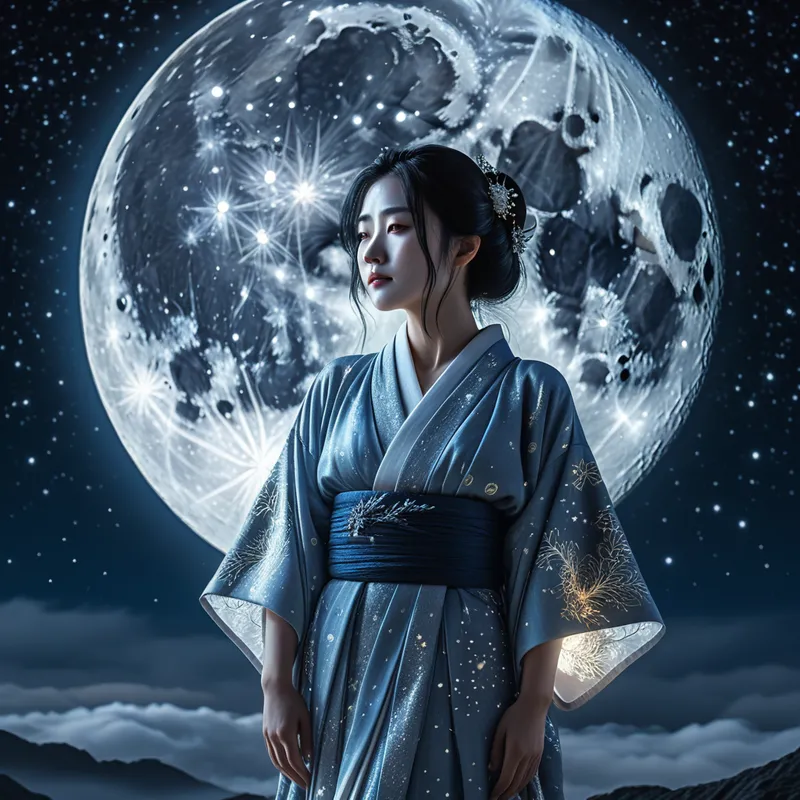
In the High Plain of Heaven, <abbr title=“The primordial deity, the “God Who Invites"">Izanagi purified himself after a descent into darkness. From the washing of his right eye was born a being of such radiant, cool beauty that she illuminated the shadows: Amaterasu, the Sun. From the washing of his left eye was born her brother, Tsukiyomi no Mikoto, whose light was a softer echo, a contemplative mirror to her blazing glory. To Amaterasu, Izanagi gave dominion over the day. To Tsukiyomi, he gave the realm of the night. They were to rule in turn, a perfect, balanced dance across the heavens.
But harmony is a fragile vessel. Amaterasu, concerned for the nourishment of the world, sent Tsukiyomi to visit Uke Mochi, who dwelt on the Central Land of Reed Plains. To honor the celestial guest, Uke Mochi began a solemn feast. She turned to the ocean and coughed forth fish. She faced the forest and vomited game. She looked to the fields and spewed forth bowls of rice. To Tsukiyomi, this act of creation was not sacred provision, but a defilement, a monstrous and unclean ritual. In a surge of divine wrath and purity, he drew his sword and struck Uke Mochi down.
When Amaterasu heard of this violence, of the murder of her messenger and the spurning of her offered bounty, her grief turned to icy fury. She looked upon her brother, the Moon, and declared, “You are a wicked deity. I shall never look upon you again.” With those words, the perfect celestial pair was shattered. She turned her face from him forever, banishing him to a separate orbit, a lonely path across the night sky. No longer would they share the sky in peaceful succession. Day and night were divorced, sun and moon eternally parted by a chasm of misunderstanding and wrath.
And so, Tsukiyomi, now a solitary ruler, casts his gentle, sorrowful light upon the sleeping world. And once a year, when his face is fullest and brightest, the children of Amaterasu—the people of the rice fields she nourishes—remember. They do not turn away. They gather, they offer the fruits of the earth that Uke Mochi once provided, and they gaze up. In that silent, communal act of viewing, they bridge the divine rift with human sight. They whisper, through the offering of a dumpling, a message to the lonely moon: “We see you. We remember. You are not forgotten.”
Cultural Origins & Context
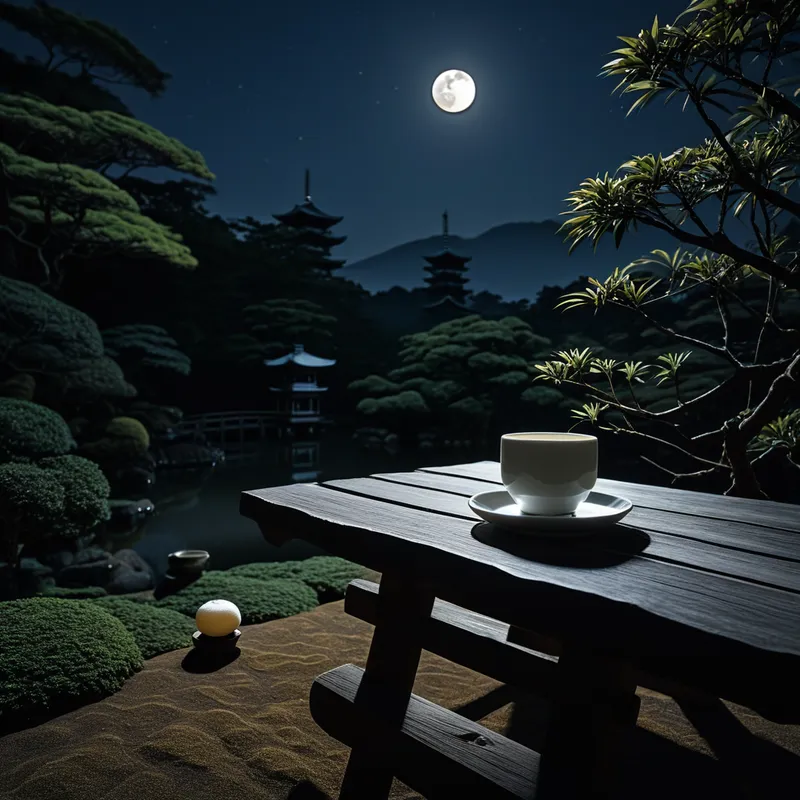
The practice of Tsukimi is a profound cultural palimpsest. Its roots are tangled in the rich soil of East Asian lunar calendar traditions, particularly the Mid-Autumn Festival from China, which entered Japan during the Heian period (794-1185 CE). The aristocratic court of Heian-kyō transformed it into an aesthetic and poetic event, a kū (an elegant gathering) where participants would compose waka poetry, play music, and float cups of sake down streams in the moonlight.
Yet, beneath this layer of courtly refinement lies the older, animistic heart of Japan’s indigenous Shinto</ab title=“The indigenous spirituality of Japan”>Shinto worldview. Here, the moon is not merely a celestial body but a kami—Tsukiyomi no Mikoto. The myth, recorded in the ancient texts <abbr title=“The “Record of Ancient Matters”, Japan’s oldest chronicle, compiled in 712 CE”>Kojiki and <abbr title=“The “Chronicles of Japan”, the second-oldest history of Japan, compiled in 720 CE”>Nihon Shoki, provides the sacred narrative that justifies the ritual. The offerings of tsukimi dango (round white dumplings) and susuki grass are not mere decoration; they are shinsen (food offerings) to the kami, acts of appeasement and connection. The ritual functioned on a societal level as an expression of gratitude for the harvest (linked to Uke Mochi’s bounty) and a plea for protection and clarity in the coming darker months, mediated through the cool, discerning light of the lunar kami.
Symbolic Architecture
The myth of Tsukimi is a celestial map of a fundamental psychic fracture: the separation of complementary opposites. The Sun and Moon represent more than day and night; they are the archetypal pair of active and receptive, conscious and unconscious, outward expression and inward reflection.
The tragedy is not in their difference, but in the irreversible judgment that makes their separation absolute. The Sun’s light becomes a rejecting glare; the Moon’s light becomes the melancholy of eternal reflection.
Amaterasu’s act of turning away is the ego’s rejection of what it deems impure, shadowy, or emotionally complex (symbolized by Tsukiyomi’s violent disgust). Tsukiyomi’s crime is a failure of integration; he cannot stomach the messy, embodied, sometimes grotesque process (Uke Mochi’s creation) by which raw sustenance—physical and psychological—is generated. He prefers sterile distance to participatory engagement. The result is a cosmos out of joint, a psyche where consciousness and the unconscious no longer communicate, only alternating in a lonely, mechanical cycle.
The ritual of Tsukimi, then, is a symbolic act of repair performed by the human community. The gazing is an act of attention, the most basic form of love. The round dango mirror the full moon, a sympathetic magic that says, “We make ourselves whole to honor your fractured wholeness.” The susuki grass, with its slender, receptive form, acts as an antenna for the moon’s light. Humanity becomes the mediating third, the child who still looks upon both estranged parents with unconditional regard.
The Dreamer’s Resonance
When the pattern of Tsukimi stirs in the modern dreamer, it often manifests as a profound sense of beautiful distance. One might dream of a loved one seen through glass or across an uncrossable ravine, illuminated by moonlight but utterly unreachable. The dream landscape may be one of serene, achingly perfect loneliness—a pristine white room, a silent forest path under a full moon. There is no monster here, only the exquisite pain of separation.
Somatically, this can feel like a coolness in the chest, a quiet ache of longing without a specific object. Psychologically, it signals a process of reconciling with a part of the self or a relationship that has been “turned away from.” It is the psyche’s moon, the reflective, intuitive, emotional self, calling out for recognition from the blazing, busy, daytime ego that has banished it in the name of purity, productivity, or a refusal to engage with life’s more ambiguous, “unclean” nourishment. The dream is an invitation to stop, to view, to offer a gesture of acknowledgment to that exiled inner figure.

Alchemical Translation
The individuation process modeled by Tsukimi is not one of heroic conquest, but of reconciling gaze. The alchemical coniunctio (sacred marriage) it seeks is not a fusion, but a restored relationship between opposites that retain their distinct natures.
The first step is Lunar Exile: acknowledging the part of ourselves we have judged and banished—our emotional reactivity, our solitude, our “impure” creative processes, our need for contemplation. This is our inner Tsukiyomi, ruling a night kingdom we rarely visit.
The second is Solar Judgment: recognizing the part of us that did the banishing—our rigid ideals, our need for control and purity, our fear of the messy, generative dark. This is our inner Amaterasu, whose light can blind as well as illuminate.
The transmutation occurs in the Ritual Act of Viewing: the conscious ego, representing the human realm, must create a sacred space (the Jugoya of the soul). Here, we deliberately turn our attention toward the exiled element. We offer it the “white dumplings” of our non-judgmental attention and the “autumn grasses” of our receptive patience. We do not seek to fix it or merge with it immediately. We simply look, with respect and awe, at its inherent beauty and its necessary place in our psychic ecology.
In doing so, we do not force the sun and moon to meet in the sky. We become the bridge itself. We hold the tension of their separation within our own aware consciousness, and in that holding, a third, transcendent position emerges: the integrated self who can appreciate the blaze of day and the depth of night, who can engage with the world’s bounty without disgust and reflect on its meaning without eternal sorrow. We become the ritual ground where the fractured myth is, moment by moment, made whole again through the alchemy of sacred attention.
Associated Symbols
Explore related symbols from the CaleaDream lexicon: