Tsuki no Usagi Myth Meaning & Symbolism
A celestial rabbit pounds mochi on the moon, born from a selfless sacrifice that reveals the alchemy of compassion and the soul's eternal work.
The Tale of Tsuki no Usagi
Listen, and let your spirit travel to a time when the world was young and the gods walked among us, cloaked in the rags of mortals to test the mettle of all living things.
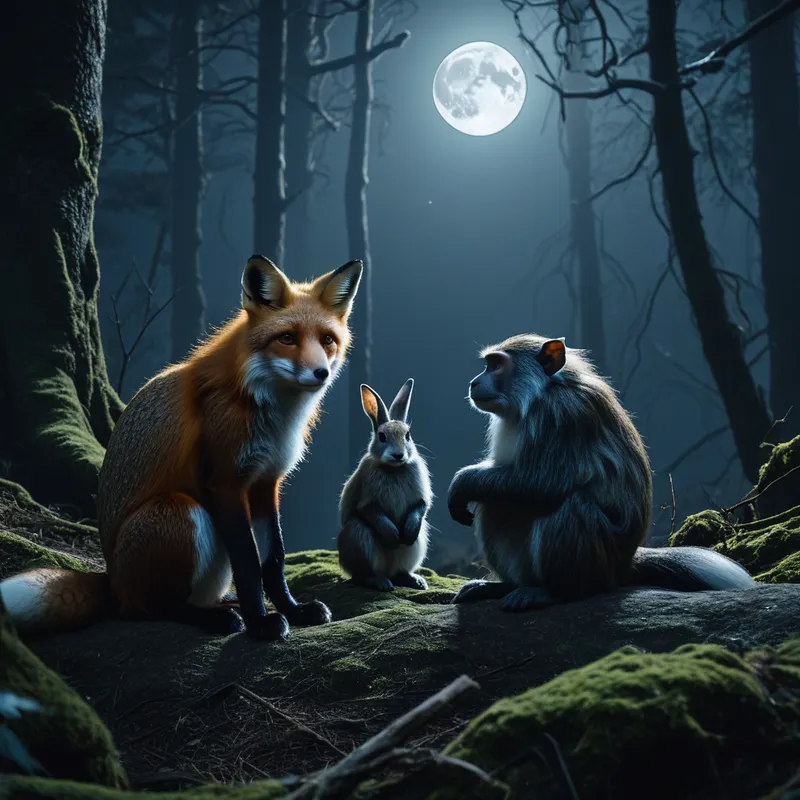
The night was deep, the air sharp with the scent of pine and cold earth. An old man, bent with age and hunger, stumbled into a clearing. His clothes were tattered, his face etched with the lines of a long, weary journey. He collapsed at the foot of a great, ancient tree, his breath a pale mist in the moonlight. From the shadows, three pairs of eyes watched him: the cunning kitsune, the agile saru, and the gentle usagi.
Moved by pity, the animals vowed to find food for this desperate soul. The fox, swift and clever, darted into the darkness and returned with a fine river fish, glistening in the lunar light. The monkey scrambled up the towering trees and gathered sweet, ripe fruits and nuts from the highest branches. But the rabbit, who knew only the taste of grass and leaves, searched and searched. It found nothing a human could eat. It returned to the clearing empty-pawed, its heart heavy with a sorrow deeper than hunger.
As the fox and monkey presented their bounty to the grateful traveler, the rabbit sat in quiet despair. Then, a resolve, fierce and pure, kindled within its small breast. It turned to its companions and the old man, its voice soft but unwavering. “I have nothing to give but myself. Please, kind traveler, eat of me.”
Before any could react, the rabbit leaped into the crackling fire the others had built. It offered its own body as a meal.
But the fire did not burn. It grew cold and silent. The old man shed his ragged disguise, his form expanding with a light that was not of the sun or the stars, but of something older. He was Tsukuyomi-no-Mikoto, the Lord of the Moon, who had descended to walk the earth. With a touch, he lifted the rabbit from the ashes, unharmed.
“Your compassion is the truest offering,” the god’s voice echoed, a sound like distant chimes. “No creature who gives so completely of its essence shall be forgotten. Little one, you shall live forever, not here, but with me. You will be a light in the night, a reminder to all who gaze upward of what it means to truly give.”
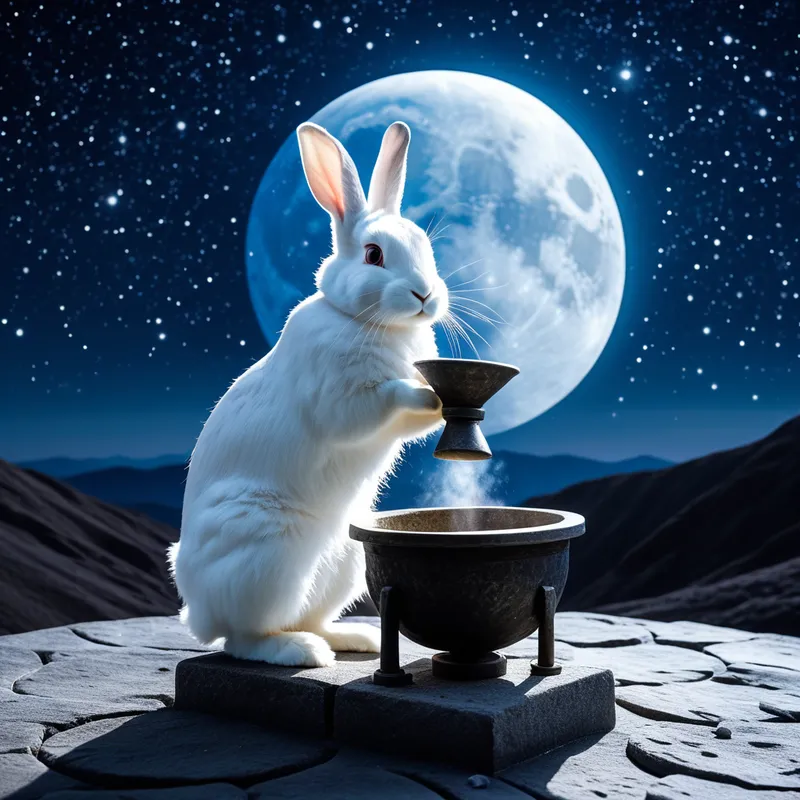
And with that, he stroked the rabbit’s fur, which began to glow with a soft, silver luminescence. Then, he swept the rabbit up into the heavens, pressing its image into the very face of the full moon for all eternity. There, the Tsuki no Usagi remains, forever pounding mochi in its mortar, a silent, sacred labor against the infinite dark.
Cultural Origins & Context
The tale of the Tsuki no Usagi is not a singular story with one author, but a living narrative that seeped into the Japanese archipelago through the ancient channels of cultural exchange, primarily from China and the Indian subcontinent, where similar Jataka tales of a “hare in the moon” exist. It found fertile ground in the animistic soil of Shinto, where nature itself is imbued with spirit (kami). The moon, as Tsukuyomi, was a powerful deity, and the story provided a mythic explanation for the familiar shadow patterns on its surface—a phenomenon every culture seeks to name and understand.
It was passed down orally for generations, a mukashibanashi told to children during Otsukimi, the moon-viewing festivals. Its societal function was multifaceted: it was a moral fable teaching selflessness, a cosmological story explaining a celestial mystery, and a piece of spiritual comfort. It linked the everyday act of looking at the moon with a profound ethical lesson, embedding values of compassion and sacrifice into the very fabric of the night sky.
Symbolic Architecture
At its core, the myth is an alchemical drama of essence. The rabbit does not merely give an object; it offers its very substance, its being, in an act of radical empathy. This is the ultimate kenosis—an emptying of the self for the other.
The fire that refuses to consume is the crucible of the true self. It does not destroy; it reveals. What is burned away is not the body, but the illusion of separation.
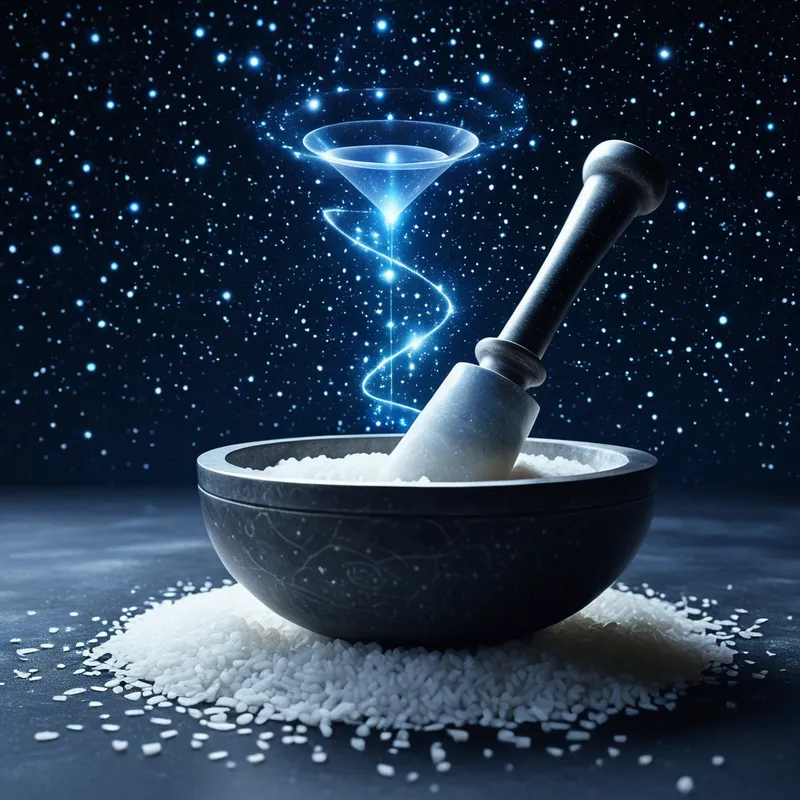
The three animals represent a hierarchy of offerings. The fox offers skill (hunting), the monkey offers labor (gathering)—both are gifts of doing. The rabbit, having nothing to do, offers its state of being. Its sacrifice transcends the transactional. The moon, in turn, is not a reward but a translation. The rabbit’s earthly, mortal compassion is transmuted into a celestial, eternal symbol. The act of pounding mochi is endlessly creative, a symbol of making something nourishing and cohesive (mochi is sticky, binding) from the raw, scattered ingredients of existence. It is the soul’s perpetual work of meaning-making.
The Dreamer’s Resonance
When this myth stirs in the modern unconscious, it often surfaces in dreams of futile labor, sacred tasks, or profound self-offering. You may dream of working tirelessly on a project that has no end, of feeding others while you yourself feel empty, or of willingly stepping into a frightening situation for the sake of someone else.
Somatically, this can feel like a hollow ache in the chest—not a painful emptiness, but a receptive one. Psychologically, this is the process of confronting the shadow of the caregiver archetype: the fear that you have nothing of value to give, or that giving will annihilate you. The dream is an invitation to examine the quality of your giving. Is it from a place of abundance and wholeness, or from a place of lack and self-negation? The moon rabbit’s fire is the dream’s test: will your offering consume you, or will it reveal your indestructible essence?

Alchemical Translation
For the individual on the path of individuation, the myth of the Tsuki no Usagi models the final, most terrifying stage of psychic transmutation: the sacrifice of the ego.
We begin like the fox and monkey, building our identity through our skills, our achievements, our curated offerings to the world. This is necessary work. But the journey demands more. It asks us to become the rabbit in the clearing, to reach a point where all our acquired gifts feel meaningless in the face of genuine need—the need for authentic connection, for unconditional love, for a purpose beyond the personal.
The leap into the fire is the conscious surrender of the persona—the mask we show the world—to a higher principle. It is the moment we stop performing compassion and become it, even at the perceived cost of the self.
The miracle is that this “death” is an initiation. The cold fire of Tsukuyomi represents the objective, mirror-like gaze of the Self (the total, integrated psyche). It does not burn the true essence; it burns away only the fear that the essence is not enough. What is lifted from the ashes is the eternal, individual spirit, now aligned with a transpersonal reality (the moon). Your unique, pounding labor—your art, your relationships, your inner work—becomes a permanent, celestial fixture. It is no longer a chore for survival, but a sacred, creative act that nourishes the cosmos itself. You are not working on the moon; you have become the light in the dark, the pattern others look to and wonder about, finding in your eternal labor a reflection of their own potential for selfless becoming.
Associated Symbols
Explore related symbols from the CaleaDream lexicon: