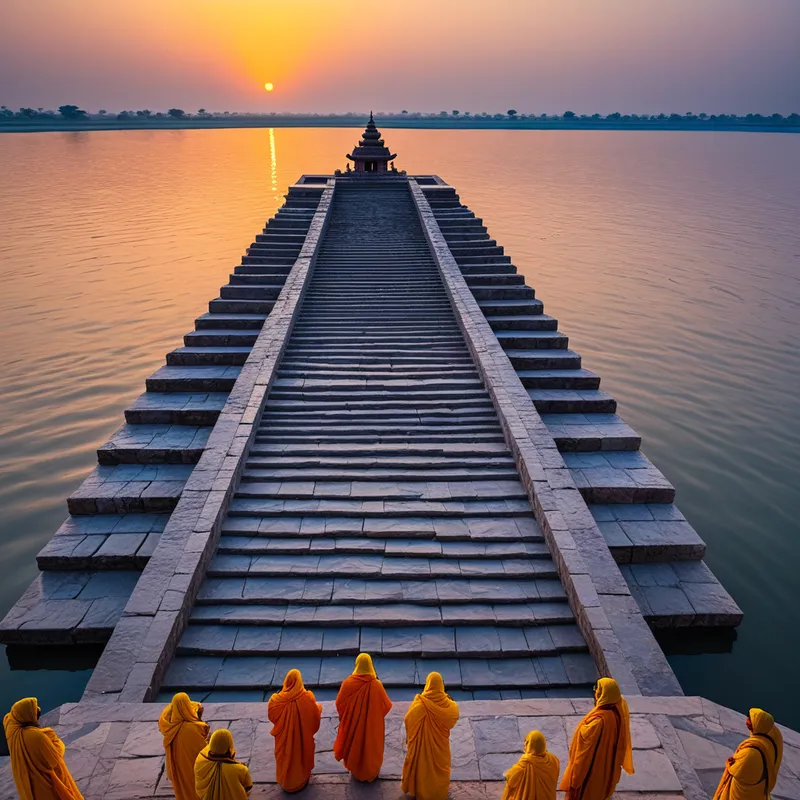
Triveni Sangam Myth Meaning & Symbolism
The sacred confluence of three rivers, born from divine conflict and penance, representing the ultimate union of body, mind, and spirit.
The Tale of Triveni Sangam
Listen. This is not merely a story of rivers. This is a tale of descent and ascent, of a curse that scorched the earth and a prayer that split the heavens.
In a time when the world was younger and the gods walked closer, there existed a king, mighty and proud. His name was Sagara. He sought to perform the Ashwamedha Yagna, a rite to claim universal sovereignty. But the gods, wary of such ambition, conspired. They stole the sacrificial horse and hid it. King Sagara sent his sixty thousand sons to scour the earth. They searched with fury, tearing the world apart, until they found the horse grazing peacefully in a quiet corner of the netherworld, near where the great sage Kapila sat in deep meditation.
Blinded by arrogance, the princes accused the sage of theft. Their clamor shattered the profound silence of his samadhi. Kapila opened his eyes. His gaze was not of anger, but of pure, incandescent truth. That look was a fire. In an instant, the sixty thousand princes were reduced to ashes, their souls trapped, unable to find peace.
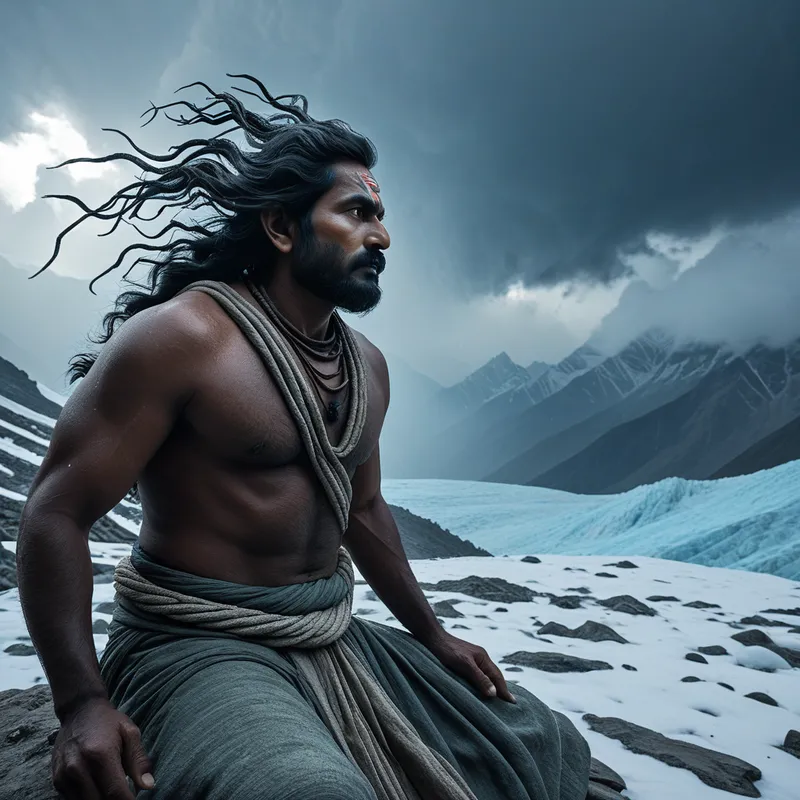
Generations wept. The kingdom was haunted by the unquiet ashes of its heirs. Then arose a descendant, a king named Bhagiratha. His heart held not ambition, but a terrible, beautiful burden of duty. He renounced his throne. He walked into the frozen, whispering silence of the Himalayas. There, upon a rock, he stood on one leg. He raised his arms to the indifferent sky. For centuries, he prayed. He performed tapasya so severe that his body became a skeleton clad in skin, his will a blade piercing the celestial realms.
The heavens trembled. The lord of lords, Brahma, appeared, pleased. “Ask,” he said. And Bhagiratha, his voice a dry wind, spoke: “Let the sacred Ganga descend. Let her waters touch the ashes of my ancestors and grant them liberation.”
Brahma agreed, but warned: “The earth cannot bear the force of Ganga’s fall. Only Shiva can break her descent.” So Bhagiratha prayed again, until Shiva, the great ascetic, the lord of dissolution, looked down. As the mighty river goddess plunged from the toe of Vishnu, Shiva raised his matted locks. Ganga crashed into the tangled wilderness of his hair, was caught, tamed, and split into a million gentle streams. She followed the patient footsteps of Bhagiratha across the length of Bharat, until she reached the ashes of the sons of Sagara. At her touch, the curse was washed away; the souls ascended, purified.
But the tale does not end there. For at the ancient city of Prayag, Ganga, the river of celestial origin, met Yamuna, the river of the mortal world. And there, joining them, was a third, invisible river: Saraswati, the stream of pure knowledge, lost to the visible world but present in essence. Three became one. This was the Triveni Sangam—a swirling, timeless vortex where heaven, earth, and the hidden underworld of wisdom embraced in a single, sacred flow.
Cultural Origins & Context
The myth of the Triveni Sangam is woven into the very hydrological and spiritual geography of India. Its primary literary sources are the great epics, the Mahabharata and the Puranas, particularly the Bhagavata Purana and the Ganga Mahatmya. It was not a story confined to courts but was carried by pilgrims, sadhus, and storytellers along the riverbanks themselves. The physical site of Prayag (modern Prayagraj) became the living theater for this myth, with the annual Maha Kumbh Mela representing its grand, cyclical re-enactment.
Societally, the myth functioned on multiple levels. It explained the origin of the life-giving Ganges plains. It established a profound theology of ancestor worship (shraddha) and liberation (moksha), making Prayag the paramount site for performing last rites. It also encoded a model of righteous kingship: Bhagiratha is the archetype of the self-sacrificing ruler whose penance (tapas) benefits his entire lineage and land, transforming royal duty into a spiritual quest.
Symbolic Architecture
At its heart, the Triveni Sangam is a supreme symbol of confluence—not just of waters, but of cosmic principles and psychological streams.
The three rivers are a trinity. Ganga represents the transcendent, the divine grace that descends from above (heaven, superconsciousness). Yamuna represents the manifest, tangible world of form, emotion, and relationship (earth, consciousness). Saraswati, invisible, represents the subterranean current of intuitive wisdom, memory, and the hidden roots of culture (the underworld, the unconscious).
The Sangam is where the torrent of grace meets the flow of life, and both are channeled by the unseen stream of ancestral wisdom. It is the psychic point where what is given, what is lived, and what is known deep within become one.
Bhagiratha’s ordeal symbolizes the immense human effort required to invite the transcendent into one’s personal and collective history. His penance is the focused concentration of the ego, willingly mortified, to create a vessel strong enough to receive a transformative force. Shiva’s role is critical: he is the transformer. He does not stop the divine force but breaks its catastrophic potential, allowing it to become a nourishing, integrative flow. The ashes of the ancestors represent the burnt-out, unresolved karma of the past—the psychic burdens and traumas that haunt a family, a people, or an individual soul.
The Dreamer’s Resonance
When this myth stirs in the modern unconscious, it often manifests in dreams of powerful convergence. One might dream of three roads meeting, three voices speaking as one, or three colors blending into white light. There is a somatic sensation of release, of a long-held tension dissolving in a fluid moment.
Psychologically, this signals a process of profound synthesis. The “three rivers” may appear as three conflicting life domains (work, love, self), three warring internal voices (critical parent, adaptive child, striving adult), or three core aspects of identity that have remained separate. The dream of confluence indicates that the psyche is ready to move beyond fragmentation. The “ashes” being washed away are the calcified regrets, old identities, and emotional debts the dreamer has been carrying. The dream is an internal snan, a baptism announcing that the arduous, Bhagiratha-like work of focused attention on a deep problem is now culminating in a graceful, transformative inflow.

Alchemical Translation
The myth of Triveni Sangam is a precise blueprint for the alchemical process of individuation. It models the transmutation of a cursed, fragmented state into a state of liberated wholeness.
The initial condition is one of “scorched earth”—the ego-driven ambition (Sagara’s sons) that leads to a catastrophic burnout, leaving behind only the dead weight of the past (the ashes). The first alchemical stage, nigredo, is this state of blackened, trapped matter. Bhagiratha’s penance is the albedo, the whitening. It is the purification of intention, the disciplined withdrawal of libido from the outer world to focus it inward with laser-like precision. This focused will creates the “vessel” for the next stage.
The descent of Ganga is the influx of the Self, the transcendent function, which always feels like a grace from beyond the ego. But in its raw form, it is overwhelming—it would shatter the conscious mind. Shiva represents the necessary cognitive and emotional structure (the matted locks, symbolizing complex, accepted thoughts and experiences) that must receive and temper this influx. This is the citrinitas, the yellowing, where the divine light is broken into assimilable insights.
The final confluence is the rubedo, the reddening, the creation of the philosophical gold. It is the lasting integration where the divine insight (Ganga), the lived human experience (Yamuna), and the deep, instinctual wisdom of the body and ancestral soul (Saraswati) cease to be separate streams. They form a single, flowing consciousness.
For the modern individual, this means that healing and wholeness are not found by rejecting any part of our being. It is found at our own inner Prayag, where our highest ideals, our grounded reality, and our hidden intuitive knowledge are allowed to meet, swirl, and become one. It is the moment we stop trying to dam one river to favor another, and instead, build our inner life at the sacred sangam where all waters are holy.
Associated Symbols
Explore related symbols from the CaleaDream lexicon: