
Triton's Trumpet Myth Meaning & Symbolism
A myth of the sea god's conch shell, whose roar commands the waters and calls the soul to navigate the depths of the unknown.
The Tale of Triton’s Trumpet
Hear now the tale of the sound that shaped [the sea](/myths/the-sea “Myth from Greek culture.”/).
In the time before memory, when [the world](/myths/the-world “Myth from Tarot culture.”/) was raw and the gods walked the waves, there existed a power not of stone or spear, but of breath and shell. It belonged to [Triton](/myths/triton “Myth from Greek culture.”/), whose form was the marriage of man and ocean—a torso of mighty sinew, a tail of glistening scales, and a beard forever wet with salt spray. His home was the sunless halls of his father, [Poseidon](/myths/poseidon “Myth from Greek culture.”/), but his true domain was [the threshold](/myths/the-threshold “Myth from Folklore culture.”/), the foaming line where the known world met [the abyss](/myths/the-abyss “Myth from Kabbalistic culture.”/).
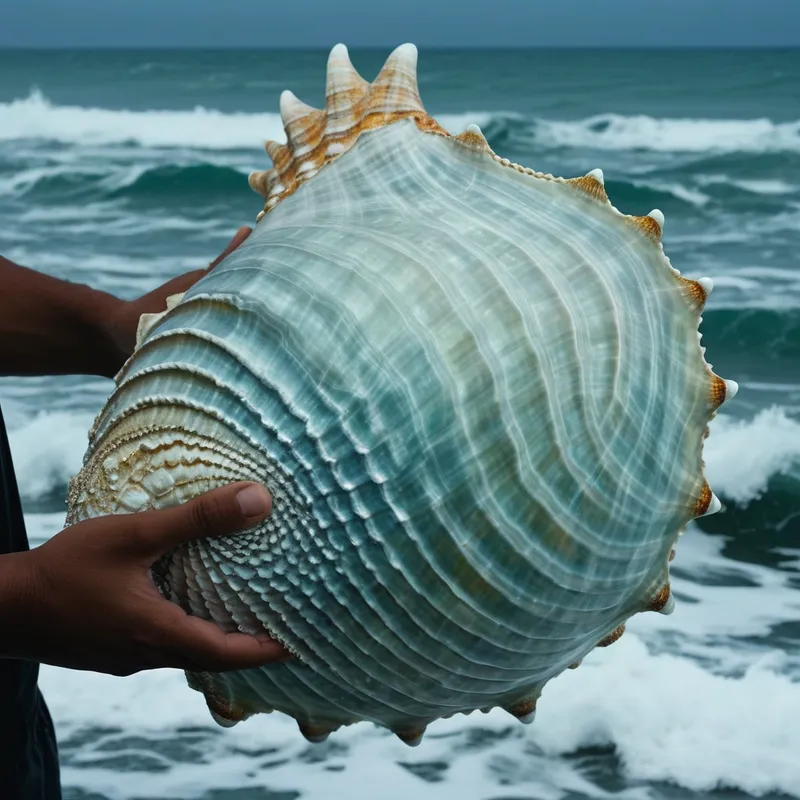
His instrument was no crafted [thing](/myths/thing “Myth from Norse culture.”/) of mortal hands. It was a conch, a great, spiraled horn born from the heart of the deep, its interior holding the echo of the world’s first waters. When the seas grew restless, when storms brewed from the wrath of gods or the confusion of men, Triton would rise from the waves. The air would grow heavy, charged with the scent of ozone and dying plankton. He would lift the shell, its surface gleaming like a wet [pearl](/myths/pearl “Myth from Chinese culture.”/) in the fractured light, and set his lips to its aperture.
The sound was not music. It was a command.
It began as a low groan, the voice of the continental shelf grinding against itself. It swelled into a roar that shook the hulls of ships and vibrated in the bones of coastal dwellers—a sound older than language. At its call, the raging waves would kneel, flattening into placid glass. Hurricanes would unravel, their furious eyes going quiet. The sea monsters of the deep, the Cetea, would cease their turmoil and sink back into the blackness, obedient. It was the voice of absolute authority over the formless, chaotic deep. When the Argonauts, lost in a pall of fog, heard that blast, [the mist](/myths/the-mist “Myth from Celtic culture.”/) tore asunder, revealing a path of safe passage—a sonic road carved through uncertainty. The trumpet did not request; it announced a new reality. It was the sound of order imposed upon chaos, of a path carved through the formless void, and then, its duty done, it would fade, leaving only the obedient whisper of the pacified waves in its wake.
Cultural Origins & Context
The myth of Triton and his trumpet resonates from the layered depths of Greek engagement with the sea. For a culture whose lifeblood was maritime trade, exploration, and fishing, the ocean was both provider and profound terror—a capricious, trackless wilderness bordering their world. Triton, as a figure, likely has origins older than the Olympian [pantheon](/myths/pantheon “Myth from Roman culture.”/), a pre-Greek daimon of the deep absorbed into the newer order as Poseidon’s [herald](/myths/herald “Myth from Greek culture.”/).
His stories are not found in a single, canonical epic but are scattered, like shells on a beach, across the works of poets like Hesiod and the later mythographers such as Apollonius of Rhodes in his Argonautica. This fragmentation suggests a folkloric, oral tradition—a tale told by sailors and coastal villagers to explain the sudden, awe-inspiring calms that could follow a storm, or the strange, booming sounds sometimes heard from sea caves or during earthquakes. The trumpet gave a face and a will to the terrifying and beneficent power of the sea itself. Societally, it functioned as a narrative anchor. It transformed the arbitrary violence of nature into a dialogue, however one-sided. The sea had a voice one could, in myth, appeal to or recognize. It reinforced the cultural idea that even the most chaotic forces could be subject to a higher, intelligible order, embodied by the gods and their instruments.
Symbolic Architecture
The [symbol](/symbols/symbol “Symbol: A symbol can represent an idea, concept, or belief, serving as a powerful tool for communication and understanding.”/) of Triton’s [trumpet](/symbols/trumpet “Symbol: The trumpet signifies power and confidence in expression, often associated with leadership and celebration.”/) is an intricate map of the [psyche](/myths/psyche “Myth from Greek culture.”/)’s [relationship](/symbols/relationship “Symbol: A representation of connections we have with others in our lives, often reflecting our emotional state.”/) with the unconscious. The conch [shell](/symbols/shell “Symbol: Shells are often seen as symbols of protection, transition, and the journey of personal growth.”/) itself is a perfect natural [mandala](/symbols/mandala “Symbol: A sacred geometric circle representing wholeness, the cosmos, and the journey toward spiritual integration.”/)—a spiraling [journey](/symbols/journey “Symbol: A journey in dreams typically signifies adventure, growth, or a significant life transition.”/) from a wide, open mouth to a hidden, unseen apex. It represents the [structure](/symbols/structure “Symbol: Structure in dreams often symbolizes stability, organization, and the framework of one’s life, reflecting how one perceives their environment and personal life.”/) of the deep [psyche](/myths/psyche “Myth from Greek culture.”/), where conscious [awareness](/symbols/awareness “Symbol: Conscious perception of self, surroundings, or internal states. Often signifies awakening, insight, or heightened sensitivity.”/) (the opening) narrows into the mysteries of the personal and [collective unconscious](/symbols/collective-unconscious “Symbol: The Collective Unconscious refers to the part of the unconscious mind shared among beings of the same species, embodying universal experiences and archetypes.”/) ([the spiral](/myths/the-spiral “Myth from Celtic culture.”/)’s end).
The trumpet is not an instrument of creation, but of command. It does not make the water; it tells the water how to be.
Triton, as the blower, symbolizes the [aspect](/symbols/aspect “Symbol: A distinct feature, quality, or perspective of something, often representing a partial view of a larger whole.”/) of [the Self](/myths/the-self “Myth from Jungian culture.”/) that can engage with the unconscious without being drowned by it. He is the [mediator](/symbols/mediator “Symbol: A figure who resolves conflicts between opposing parties, representing balance, communication, and the integration of differences.”/), [the psychopomp](/myths/the-psychopomp “Myth from Various culture.”/) of the oceanic [depths](/symbols/depths “Symbol: Represents the subconscious, hidden emotions, or foundational aspects of the self, often linked to primal fears or profound truths.”/). The chaotic sea represents the untamed, affective, and often terrifying contents of the unconscious—the storms of [emotion](/symbols/emotion “Symbol: Emotion symbolizes our inner feelings and responses to experiences, often guiding our actions and choices.”/), the monsters of repressed [memory](/symbols/memory “Symbol: Memory symbolizes the past, lessons learned, and the narratives we construct about our identities.”/) or instinct, the fog of [confusion](/symbols/confusion “Symbol: A state of mental uncertainty or disorientation, often reflecting internal conflict, lack of clarity, or overwhelming choices in waking life.”/). The trumpet’s blast is the act of conscious focus and will applied to that [chaos](/symbols/chaos “Symbol: In Arts & Music, chaos represents raw creative potential, uncontrolled expression, and the breakdown of order to forge new artistic forms.”/). It is the [moment](/symbols/moment “Symbol: The symbol of a ‘moment’ embodies the significance of transient experiences that encapsulate emotional depth or pivotal transformations in life.”/) of [clarity](/symbols/clarity “Symbol: A state of mental transparency and sharp focus, often representing resolution of confusion or attainment of insight.”/) in a panic attack, the naming of a buried [trauma](/symbols/trauma “Symbol: A deeply distressing or disturbing experience that overwhelms the psyche, often manifesting in dreams as unresolved emotional wounds or psychological injury.”/) that begins to drain its power, the firm [decision](/symbols/decision “Symbol: A decision in a dream reflects the choices one faces in waking life and can symbolize the pursuit of clarity and resolution.”/) that stills a [whirlwind](/symbols/whirlwind “Symbol: A whirlwind often symbolizes chaos, change, or intense emotion that disrupts stability and brings transformation.”/) of [anxiety](/symbols/anxiety “Symbol: Anxiety in dreams reflects internal conflicts, fears of the unknown, or stress from waking life, often demonstrating the subconscious mind’s struggle for peace.”/). The resulting calm is not the eradication of the deep, but its ordered [integration](/symbols/integration “Symbol: The process of unifying disparate parts of the self or experience into a cohesive whole, often representing psychological wholeness or resolution of internal conflict.”/). The [path](/symbols/path “Symbol: The ‘path’ symbolizes a journey, choices, and the direction one’s life is taking, often representing individual growth and exploration.”/) cleared for [the Argonauts](/myths/the-argonauts “Myth from Greek culture.”/) is the emergent [insight](/symbols/insight “Symbol: A sudden, deep understanding of a complex situation or truth, often arriving unexpectedly and illuminating hidden connections.”/), the [solution](/symbols/solution “Symbol: A solution symbolizes resolution, clarity, and the overcoming of obstacles, often representing a sense of accomplishment.”/) that appears when one faces the internal fog with [authority](/symbols/authority “Symbol: A symbol representing power structures, rules, and control, often reflecting one’s relationship with societal or personal governance.”/) rather than fear.
The Dreamer’s Resonance
When the motif of Triton’s trumpet sounds in the modern dreamscape, it heralds a critical phase of engagement with the unconscious. The dreamer may not see Triton, but they may hear a profound, low-frequency sound—a horn, a deep bell, a vibration that shakes the dream landscape. They may find themselves holding or searching for a large, significant shell.
Somatically, this dream pattern correlates with a process of gathering one’s internal resources to face a looming emotional or psychological tumult. It is the psyche’s preparation for a “command performance.” The dreamer is likely in a life situation where they feel overwhelmed by formless pressures—a career change, a relational crisis, a creative block that feels like an impenetrable fog. The sounding of the trumpet in the dream marks the unconscious activation of the “magician” archetype: the innate capacity to change states of consciousness and conditions of life. The psychological process is one of moving from a state of passive suffering under internal chaos to active, authoritative dialogue with it. The dream is a rehearsal for finding one’s own voice to still the storm.
Alchemical Translation
The alchemical journey mirrored in this myth is the opus of bringing order to the [prima materia](/myths/prima-materia “Myth from Alchemical culture.”/)—the chaotic, base substance of the unexamined life. The first matter is the stormy, undifferentiated sea of our complexes, drives, and shadow elements. Triton’s descent and return with the trumpet is the difficult, often solitary work of diving into that sea to retrieve the tool of transformation. The conch is the [lapis philosophorum](/myths/lapis-philosophorum “Myth from Alchemical culture.”/), the philosopher’s stone, but in sonic form; it is the discovered inner authority, the unique and resonant truth of the individual Self.
Individuation is not the silencing of the inner sea, but learning the command that allows you to sail upon it.
The act of blowing the trumpet is the culmination of the work: the conscious application of this hard-won inner authority. It is the coniunctio where the conscious ego aligns with the power of the Self. The resulting calm waters are the aqua permanens, the permanent [water](/myths/water “Myth from Chinese culture.”/)—a symbol of the achieved equilibrium where the conscious and unconscious minds are in a dynamic, flowing relationship, no longer at war. For the modern individual, the myth models the path from being tossed by every wave of emotion or circumstance to becoming the navigator. It teaches that the power to calm our inner storms does not come from outside, but from within, forged in the depths and sounded with our own breath. We are called not to escape the deep, but to find the voice that can speak its language and command its respect.
Associated Symbols
Explore related symbols from the CaleaDream lexicon: