Triton Myth Meaning & Symbolism
The merman herald of the sea, Triton bridges divine command and primordial chaos, a psychopomp of the watery unconscious.
The Tale of Triton
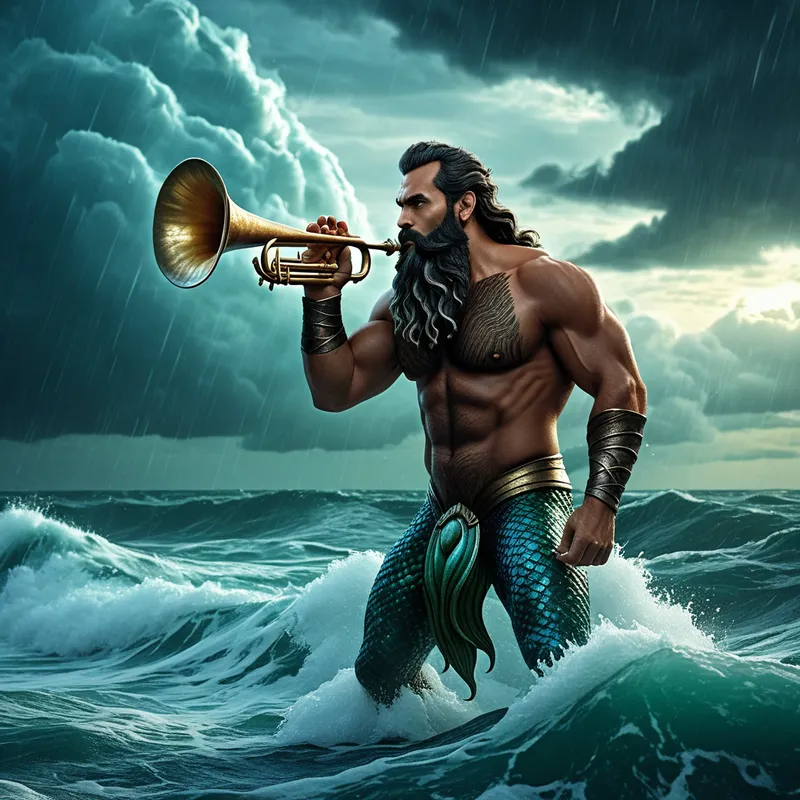
Hear now the voice that rides the salt-spray and the gale, the sound that stills the riot of the wine-dark sea. It begins not with a hero, but with a [herald](/myths/herald “Myth from Greek culture.”/). In the abyssal halls of [Poseidon](/myths/poseidon “Myth from Greek culture.”/), where light is a memory from a world above, there moves a figure both of the deep and of [the threshold](/myths/the-threshold “Myth from Folklore culture.”/). His name is Triton, son of [the Earth](/myths/the-earth “Myth from Hindu culture.”/)-Shaker and [the sea](/myths/the-sea “Myth from Greek culture.”/)-nymph Amphitrite. From the waist up, he is a god, muscled and bearded, with eyes that hold the patience of the continental shelf. From the waist down, he is [the sea](/myths/the-sea “Myth from Greek culture.”/)’s own creature, a great, coiling tail of a dolphin or a serpent, scaled and powerful enough to churn the very foundations of the deep.
His instrument is a shell—a great, spiraled conch, hollowed by time and tide. When the will of Poseidon must be proclaimed across the restless plains of ocean, Triton lifts this horn to his lips. The sound that issues forth is not a melody, but a command woven into vibration. It is a roar that calms the waves with its authority, a blast that can raise new tempests from a placid surface. The sea monsters hear it and dive to darker trenches; [the Nereids](/myths/the-nereids “Myth from Greek culture.”/) pause in their dance; the very winds attend its call.
One tale sings of the Argo and her weary crew, heroes lost in a [labyrinth](/myths/labyrinth “Myth from Various culture.”/) of [water](/myths/water “Myth from Chinese culture.”/), their ship becalmed in a Libyan sea that had become a desert of sand. Parched and despairing, they carried their vessel on their backs, a wooden burden under a pitiless sun. Then, from a lake that shimmered like a mirage, Triton rose. He did not come with a host, but alone, a giant of the inland waters. To the hero [Jason](/myths/jason “Myth from Greek culture.”/), he offered not a draught of [water](/myths/water “Myth from Chinese culture.”/), but a clod of earth. A simple gift, yet within it lay a map, a promise, a connection to the solid world. He guided them, this [psychopomp](/myths/psychopomp “Myth from Greek culture.”/) of the shore, showing the passage back to the living sea, then vanished beneath the waves, leaving only the memory of his presence and the gift of terra firma.
Another whisper tells of a contest. The mortal Misenus, a trumpeter of great renown, dared to boast that his skill could out-blast the herald of the sea himself. He stood on the shore and sent his challenge ringing across the waves. Triton heard the impious noise. He emerged, silent, took up his conch, and blew a single, profound note. It was the sound of the ocean’s soul—deep, ancient, and terrifyingly vast. The mortal’s trumpet was silenced forever, his life claimed by the very element he sought to challenge, a reminder that the herald’s call is not entertainment, but a manifestation of divine, elemental power.

Cultural Origins & Context
The figure of Triton emerges from the Greek poetic imagination as a personification of the sea’s voice and its liminal boundaries. Unlike the [Nereids](/myths/nereids “Myth from Greek culture.”/) or Oceanids, who represent specific qualities of the sea’s bounty or beauty, Triton embodies its announcement and its interface. His myths are not grand epics of love or war but localized etiological tales and heroic vignettes, found in the corners of works by poets like Hesiod in his Theogony and the epic cycles surrounding [the Argonauts](/myths/the-argonauts “Myth from Greek culture.”/).
He served a crucial societal function as a symbol of mastered chaos. The sea was the ultimate unknown for the Greeks, a realm of chaos (Chaos itself) adjacent to ordered civilization. Triton, by carrying his father’s will, represented the imposition of a kind of order upon that chaos. His conch shell was a technology of sovereignty, making the unruly deep comprehensible through sound. He was often depicted in art and described in lore as a guide for sailors in specific, perilous places—like the Libyan coast—acting as a divine pilot who knew the secrets of the thresholds between the known and the unknown world. In this, he was a folk deity of navigation and safe passage, a benevolent, if awe-inspiring, face given to the perils of the deep.
Symbolic Architecture
Triton is not the [king](/symbols/king “Symbol: A symbol of ultimate authority, leadership, and societal order, often representing the dreamer’s inner power or external control figures.”/), but the king’s voice. He is not the [ocean](/symbols/ocean “Symbol: The ocean symbolizes the vastness of the unconscious mind, representing deeper emotions, intuition, and the mysteries of life.”/)’s [depth](/symbols/depth “Symbol: Represents profound layers of consciousness, hidden truths, or the unknown aspects of existence, often symbolizing introspection and existential exploration.”/), but its signal. This positions him as a supreme [archetype](/symbols/archetype “Symbol: A universal, primordial pattern or prototype in the collective unconscious that shapes human experience, behavior, and creative expression.”/) of the Herald and the Liminal [Guardian](/symbols/guardian “Symbol: A protector figure representing safety, authority, and guidance, often embodying parental, societal, or spiritual oversight.”/).
The herald does not own the message, but the message cannot be delivered without the herald. He is the necessary intermediary between the sovereign will and the listening world.
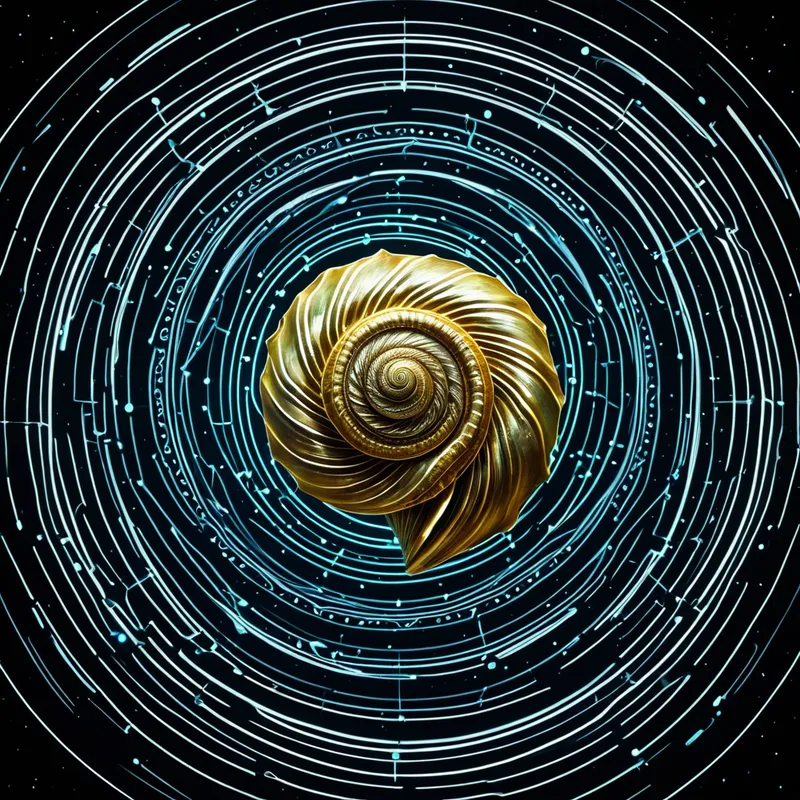
Psychologically, Triton represents the function within the [psyche](/myths/psyche “Myth from Greek culture.”/) that delivers commands from the deeper, unconscious sovereignty (Poseidon) to the conscious mind. His conch [shell](/symbols/shell “Symbol: Shells are often seen as symbols of protection, transition, and the journey of personal growth.”/) is the [symbol](/symbols/symbol “Symbol: A symbol can represent an idea, concept, or belief, serving as a powerful tool for communication and understanding.”/) of this [transmission](/symbols/transmission “Symbol: A symbol of communication, transfer, or passage of energy, information, or influence between entities or states.”/). It is not a crafted [instrument](/symbols/instrument “Symbol: An instrument symbolizes creativity, communication, and the means by which one expresses oneself or influences the world.”/), but a found object of [nature](/symbols/nature “Symbol: Nature symbolizes growth, connectivity, and the primal forces of existence.”/), shaped by the element it commands. This signifies that the call from the deep Self is not intellectual, but instinctual and organic—a resonant [frequency](/symbols/frequency “Symbol: In dreams, frequency often represents rhythm, cycles, patterns, or the rate of occurrence of events, thoughts, or emotions.”/) that can calm inner turmoil or summon necessary, if disruptive, energies.
His merman form is the ultimate symbol of liminality. He belongs wholly to neither land nor sea, but exists at their fraught and fertile meeting point. He is the embodied threshold. His gift to Jason—a clod of [earth](/symbols/earth “Symbol: The symbol of Earth often represents grounding, stability, and the physical realm, embodying a connection to nature and the innate support it provides.”/) in the middle of a watery ordeal—is profoundly symbolic. It represents the essential, grounding [insight](/symbols/insight “Symbol: A sudden, deep understanding of a complex situation or truth, often arriving unexpectedly and illuminating hidden connections.”/) offered by the unconscious during a [period](/symbols/period “Symbol: Periods in dreams can symbolize cyclical patterns, renewal, and the associated emotions of loss or change throughout life.”/) of disorientation and psychic “[drought](/symbols/drought “Symbol: Drought signifies a period of emotional scarcity, lack of resources, or feelings of deprivation leading to anxiety or intense longing.”/).” It is the core [truth](/symbols/truth “Symbol: Truth represents authenticity, honesty, and the quest for knowledge beyond mere appearances.”/), the [piece](/symbols/piece “Symbol: A ‘piece’ in dreams often symbolizes a fragment of the self or a situation that requires integration, reflection, or understanding.”/) of solid [reality](/symbols/reality “Symbol: Reality signifies the state of existence and perception, often reflecting one’s understanding of truth and life experiences.”/), that allows the [journey](/symbols/journey “Symbol: A journey in dreams typically signifies adventure, growth, or a significant life transition.”/) to continue.
The Dreamer’s Resonance
When the figure of Triton or his symbols surface in modern dreams, it often signals a process of navigation through a deep, unconscious transition. The dreamer may be in a literal or psychological “liminal space”—between jobs, relationships, identities, or stages of life.
Dreaming of hearing a deep, resonant horn or sound over water suggests the unconscious is issuing a important call. It may be a call to order inner chaos, to attend to a deep-seated message that is trying to break through. The sound itself is not the message, but the announcement that a message from the depths is imminent.
To dream of a powerful, ambiguous figure at the water’s edge—especially one that is both compelling and slightly terrifying—points to an encounter with a guiding aspect of [the Self](/myths/the-self “Myth from Jungian culture.”/) that knows the passageways through the current emotional or psychic turmoil. This is not the gentle guide, but the authoritative one. The figure may offer a simple, seemingly mundane object (like the clod of earth). In dream logic, this object is the key—the grounding idea, the practical step, the core feeling that will provide orientation.

Alchemical Translation
The alchemical journey is one of dissolution and coagulation, of navigating the Mare Magnum of the unconscious to find the philosopher’s stone of the integrated Self. Triton’s myth models a critical phase in this psychic transmutation: the reception of guidance from the deep during the stage of [Nigredo](/myths/nigredo “Myth from Alchemical culture.”/), or despair.
The Argonauts, carrying their ship, are in a state of profound Nigredo. Their medium (the sea) has turned against them, becoming a desert. They are burdened, parched, and lost. Triton’s appearance is the archetypal intervention. He does not solve their problem for them, but he provides the crucial piece—the terra firma—that allows for reorientation. In individuation, this is the moment when, in the midst of a psychic crisis, a clear, authoritative insight emerges from the unconscious. It is often simple, concrete, and grounding.
The alchemical gift is never the gold itself, but the catalyst that makes the transformation of base material possible. Triton’s conch is that catalyst—the sound that rearranges the elements of the soul.
To integrate Triton’s energy is to develop the capacity to hear and heed the herald’s call from one’s own depths. It is to learn to sound one’s own conch—to find the authentic, resonant voice that can command one’s inner chaos and announce one’s true will. It is to become comfortable dwelling at the threshold, not as a confused wanderer, but as a knowledgeable guardian of the passage between the conscious ego and the vast, sovereign realm of the unconscious sea. The [triumph](/myths/triumph “Myth from Roman culture.”/) is not conquering the deep, but learning its language and allowing its authoritative voice to guide [the vessel](/myths/the-vessel “Myth from Alchemical culture.”/) of the self to the next shore.
Associated Symbols
Explore related symbols from the CaleaDream lexicon: