Triptolemus Myth Meaning & Symbolism
A mortal hero, gifted a divine chariot by Demeter, becomes the sacred sower who brings the art of agriculture and civilization to a hungry world.
The Tale of Triptolemus
Hear now the tale not of a god, but of a mortal touched by the divine, a story whispered in the rustling fields and celebrated in the secret rites of Eleusis. In a time when [the world](/myths/the-world “Myth from Tarot culture.”/) was young and men knew only hunger, when [the earth](/myths/the-earth “Myth from Hindu culture.”/) lay hard and unyielding beneath a grieving sky, there lived a prince of Eleusis named Triptolemus.
His story is woven into a greater tapestry of loss. The great goddess Demeter, her heart shattered by the abduction of her daughter [Persephone](/myths/persephone “Myth from Greek culture.”/), wandered the earth in human guise, a veil of sorrow upon her. She came to Eleusis, and in the kindness of the royal house—of Queen Metaneira and the young prince—she found temporary shelter. She was hired to nurse the queen’s infant son, Demophon. In her divine grief, she sought to make [the child](/myths/the-child “Myth from Alchemy culture.”/) immortal, anointing him with ambrosia and holding him in [the hearth](/myths/the-hearth “Myth from Norse culture.”/)’s [sacred fire](/myths/sacred-fire “Myth from Various culture.”/) by night. But a mother’s fear is sharp. Queen Metaneira discovered the rite, screamed in terror, and broke the magic. The goddess, revealed in her terrible glory, cast off her mortal disguise. The house trembled.
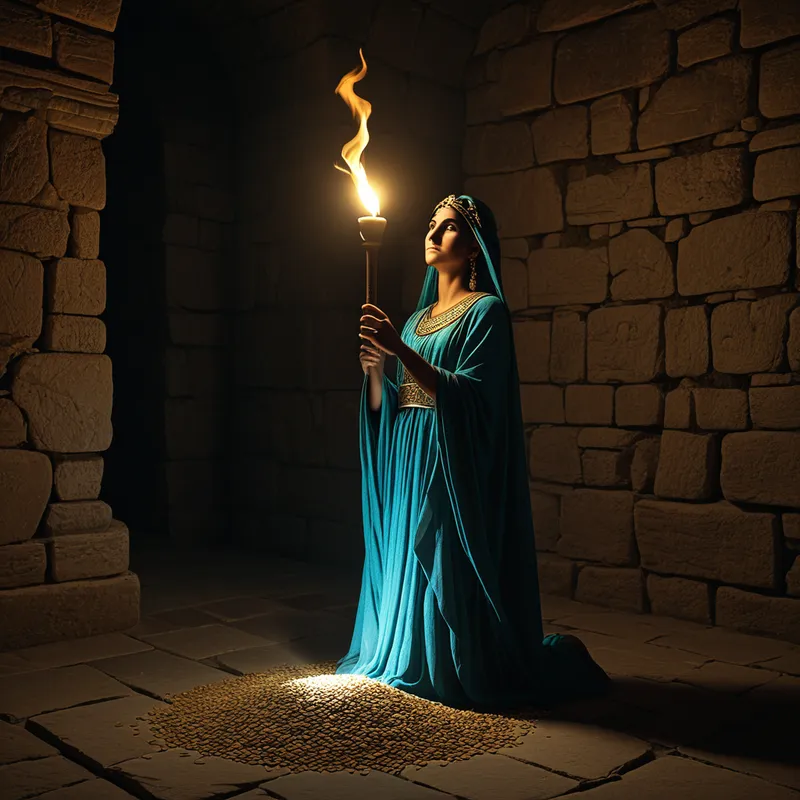
Yet, from this rupture, a new thread was spun. Demeter did not curse the house for its mortal fear. Instead, her gaze fell upon Triptolemus, the other prince. He had borne witness to her sorrow and her power. In the hallowed, torch-lit darkness of the newly commanded Telesterion, she drew him close. She taught him her sacred rites, the Eleusinian Mysteries, that promised solace beyond the fear of death. And then, she gave him a greater task.
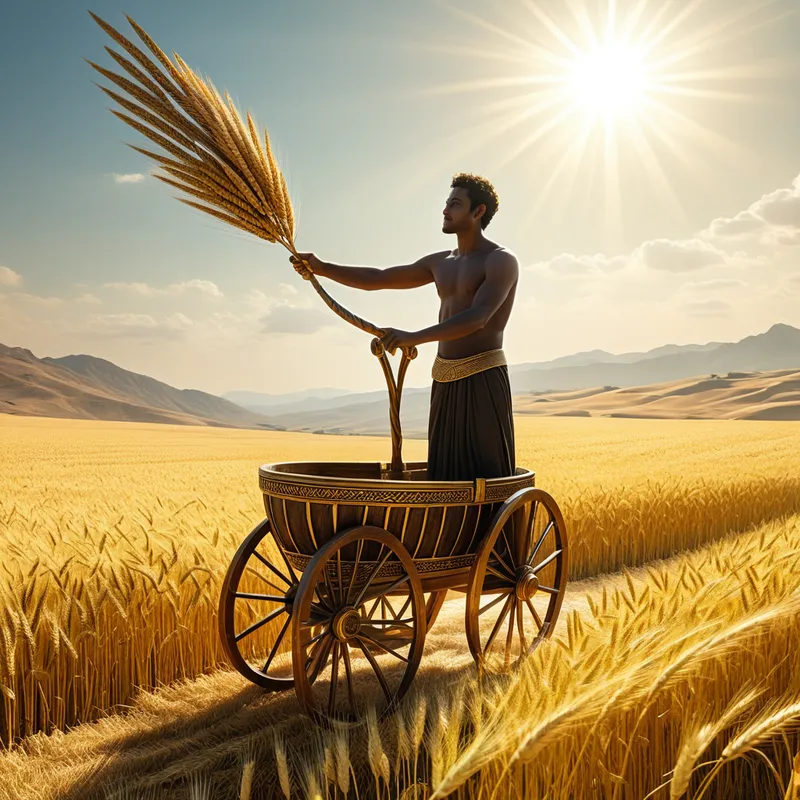
She gifted him a chariot unlike any other: drawn not by horses, but by winged serpents, creatures of the earth and the air. Into his hands she placed seeds of cultivated grain—wheat and barley—the very essence of her divinity. “Go,” her voice echoed with the promise of seasons. “Travel the wide world. Teach all mortals the sacred art of the plough, the sowing, and the reaping. Let the wild earth become a field. Let hunger give way to harvest.”
And so Triptolemus ascended. The serpent-chariot lifted him into the dawn, and he became a sower of destiny. He flew over mountains and across seas, scattering the divine seeds, instructing kings and commoners in the rhythms of agriculture—the tilling, the waiting, the gathering. He brought not just food, but the foundation of settled life, of community, of civilization itself. He faced resistance—a jealous king here, a stubborn tribe there—but the gift was irreversible. Where he passed, wilderness receded, and the golden promise of bread took root in the soil of human hope.
Cultural Origins & Context
The myth of Triptolemus is inextricably bound to the Eleusinian Mysteries, the most revered and well-guarded religious rites of the ancient Greek world. For nearly two thousand years, initiates from all strata of society—from slaves to emperors—made the pilgrimage to Eleusis to undergo a secret experience that promised a blessed lot in the afterlife. Triptolemus was not merely a hero of this cult; he was its archetypal initiate and its primary evangelist.
His story functioned on multiple cultural levels. Historically, it served as an aetiological myth for the Neolithic transition from hunter-gatherer societies to agrarian civilization, a foundational shift credited to divine intervention. Politically, for Athens (which controlled Eleusis), it was a powerful narrative of cultural imperialism, framing the spread of Athenian-style agriculture and, by extension, Athenian civilization, as a sacred, god-sanctioned mission. The myth was passed down through the Homeric Hymn to Demeter, through art—countless vases depict him in his chariot—and through the oral traditions of the Mysteries themselves, making him a ubiquitous symbol of the blessings of Demeter.
Symbolic Architecture
At its core, the myth of Triptolemus is a profound map of sacred [initiation](/symbols/initiation “Symbol: A symbolic beginning or transition into a new phase, status, or awareness, often involving tests, rituals, or profound personal change.”/) and the civilizing of the inner [wilderness](/symbols/wilderness “Symbol: Wilderness often symbolizes the untamed aspects of the self and the unconscious mind, representing a space for personal exploration and discovery.”/). He is the [human](/symbols/human “Symbol: The symbol of a human represents individuality, complexity of emotions, and social relationships.”/) [vessel](/symbols/vessel “Symbol: A container or structure that holds, transports, or protects something essential, representing the self, emotions, or life journey.”/) for a divine gift, the intermediary between the [realm](/symbols/realm “Symbol: The symbol of ‘Realm’ often signifies the boundaries of one’s consciousness, experiences, or emotional states, suggesting aspects of reality that are either explored or ignored.”/) of the gods and the world of mortals.
The gift of grain is not merely food; it is the symbol of conscious cultivation, of imposing sacred order on chaotic nature, both in the field and in the soul.
His [journey](/symbols/journey “Symbol: A journey in dreams typically signifies adventure, growth, or a significant life transition.”/) begins in the [katabasis](/myths/katabasis “Myth from Greek culture.”/) (descent) of Demeter’s [grief](/symbols/grief “Symbol: A profound emotional response to loss, often manifesting as deep sorrow, yearning, and a sense of emptiness.”/), a confrontation with [loss](/symbols/loss “Symbol: Loss often symbolizes change, grief, and transformation in dreams, representing the emotional or psychological detachment from something or someone significant.”/) and the [underworld](/symbols/underworld “Symbol: A symbolic journey into the unconscious, representing exploration of hidden aspects of self, transformation, or confronting repressed material.”/) (represented by Persephone’s abduction). Triptolemus is present in this [space](/symbols/space “Symbol: Dreaming of ‘Space’ often symbolizes the vastness of potential, personal freedom, or feelings of isolation and exploration in one’s life.”/) of profound darkness and does not look away. This qualifies him for the gift. The winged [serpent](/symbols/serpent “Symbol: A powerful symbol of transformation, wisdom, and primal energy, often representing hidden knowledge, healing, or temptation.”/)-drawn [chariot](/symbols/chariot “Symbol: The chariot signifies control, direction, and power in one’s journey through life.”/) is a masterful [symbol](/symbols/symbol “Symbol: A symbol can represent an idea, concept, or belief, serving as a powerful tool for communication and understanding.”/): the [serpent](/symbols/serpent “Symbol: A powerful symbol of transformation, wisdom, and primal energy, often representing hidden knowledge, healing, or temptation.”/), a [creature](/symbols/creature “Symbol: Creatures in dreams often symbolize instincts, primal urges, and the unknown aspects of the psyche.”/) of the chthonic [earth](/symbols/earth “Symbol: The symbol of Earth often represents grounding, stability, and the physical realm, embodying a connection to nature and the innate support it provides.”/), is given wings, representing the spiritualization of earthly instincts and the [ability](/symbols/ability “Symbol: In dreams, ‘ability’ often denotes a recognition of skills or potential that one possesses, whether acknowledged or suppressed.”/) to traverse different realms—[heaven](/symbols/heaven “Symbol: A symbolic journey toward ultimate fulfillment, spiritual transcendence, or connection with the divine, often representing life’s highest aspirations.”/), [earth](/symbols/earth “Symbol: The symbol of Earth often represents grounding, stability, and the physical realm, embodying a connection to nature and the innate support it provides.”/), and, by implication, [the underworld](/myths/the-underworld “Myth from Greek culture.”/) of the unconscious. He becomes a [psychopomp](/myths/psychopomp “Myth from Greek culture.”/) of culture, not souls.
His [mission](/symbols/mission “Symbol: A mission in dreams represents one’s aspirations and goals, often linked to a sense of purpose or commitment.”/)—to scatter seeds to all—symbolizes the democratization of divine [knowledge](/symbols/knowledge “Symbol: Knowledge symbolizes learning, understanding, and wisdom, embodying the acquisition of information and enlightenment.”/). The Mysteries were secret, but their [fruit](/symbols/fruit “Symbol: Fruit symbolizes abundance, nourishment, and the fruits of one’s labor in dreams.”/), the knowledge of agriculture (and by [allegory](/symbols/allegory “Symbol: A narrative device where characters, events, or settings represent abstract ideas or moral qualities, conveying deeper meanings through symbolic storytelling.”/), spiritual sustenance), was for everyone. He faces [resistance](/symbols/resistance “Symbol: An object or tool representing opposition, struggle, or the act of pushing back against external forces or internal changes.”/), often from figures like [King](/symbols/king “Symbol: A symbol of ultimate authority, leadership, and societal order, often representing the dreamer’s inner power or external control figures.”/) Lyncus, who tries to kill him and steal his [mission](/symbols/mission “Symbol: A mission in dreams represents one’s aspirations and goals, often linked to a sense of purpose or commitment.”/). This represents [the ego](/myths/the-ego “Myth from Jungian culture.”/)’s [resistance](/symbols/resistance “Symbol: An object or tool representing opposition, struggle, or the act of pushing back against external forces or internal changes.”/) to transformation and the [shadow](/symbols/shadow “Symbol: The ‘shadow’ embodies the unconscious, repressed aspects of the self and often represents fears or hidden emotions.”/)’s desire to possess, rather than properly integrate, a divine gift.
The Dreamer’s Resonance
When the pattern of Triptolemus stirs in the modern dreamer, it speaks to a process of profound psychic initiation and the call to disseminate a hard-won inner knowledge. To dream of being given a sacred, living seed or tool by a powerful, maternal, or earthy figure suggests the unconscious is conferring a new potential, a germ of consciousness that requires cultivation.
Dreaming of a vehicle that is both earthly and airborne, like a chariot with animal guides, points to the integration of instinctual drives (the serpents) with a higher, guiding purpose (the wings). The dreamer may be in a phase where a deep, perhaps painful, insight (the Demeter grief) is now ready to be translated into purposeful action in their waking life.
Conversely, dreams of trying to sow seeds on barren or hostile ground, or of a figure trying to steal one’s unique gift, mirror the Triptolemean struggle against internal and external resistance. The somatic feeling is often one of frustration mixed with a sense of sacred duty—a tightness in the chest, a feeling of being “charged” with a mission. The [psyche](/myths/psyche “Myth from Greek culture.”/) is working through the vulnerability of carrying and sharing its most valuable inner resources.
Alchemical Translation
For the individual on the path of individuation, Triptolemus models the complete alchemical cycle: [nigredo](/myths/nigredo “Myth from Alchemical culture.”/), albedo, citrinitas, [rubedo](/myths/rubedo “Myth from Alchemical culture.”/).
The nigredo, the blackening, is witnessed in the initial scene—the grief of Demeter, the shattered immortality of Demophon. It is the necessary encounter with loss, failure, and the limits of the mortal condition. Triptolemus does not flee this darkness; he endures it within his own home. This is the dissolution of the old, naive self.
The albedo, the whitening, is his election and instruction in the Telesterion. He is purified and prepared by direct contact with the divine (Demeter). He receives the sacred doctrine (the Mysteries) and the physical agent (the seeds/chariot). This is the illumination phase, where the new consciousness is received.
The true alchemy begins not with receiving the gift, but with the courage to leave the sacred precinct and journey into the unknown world to plant it.
The citrinitas, the yellowing, is his flight in the golden chariot under the sun. It is the active, expansive phase of the work—applying the insight, practicing the new skill, facing the trials of dissemination (the jealous kings). It is the “civilizing” of one’s own inner chaos, turning raw emotion and instinct into cultivated, life-sustaining patterns.
Finally, the rubedo, the reddening, is the harvest he enables. It is the realized, enduring transformation in the world and in [the self](/myths/the-self “Myth from Jungian culture.”/). He does not become a god; he becomes a fulfilled human, a sage, whose life work has altered the landscape of reality. For us, this translates to the moment when a deeply integrated personal truth becomes a sustainable, generative force in our lives, offering nourishment—whether through creativity, relationship, or work—to both ourselves and the world around us. We become sowers of our own hard-won grain.
Associated Symbols
Explore related symbols from the CaleaDream lexicon: