Trinity Sun Dogs Myth Meaning & Symbolism
A celestial myth where a fractured sun, embodied as three hounds, is hunted and redeemed by a divine archer to restore cosmic balance.
The Tale of Trinity Sun Dogs
Listen, and hear the tale of the Sundering, when [the world](/myths/the-world “Myth from Tarot culture.”/) was young and the light was whole. In the beginning, the Sun Unmarred hung in the vault of heaven, a perfect, silent coin of gold. Its light was a single, unwavering note that sang life into the soil, wisdom into the minds of men, and order into the paths of the stars. But pride, that old serpent, coiled in the heart of a jealous Archon of the Dawn. With a spear forged from the cold of [the abyss](/myths/the-abyss “Myth from Kabbalistic culture.”/), he struck the Sun Unmarred, not to destroy it, but to claim its core for his own throne.
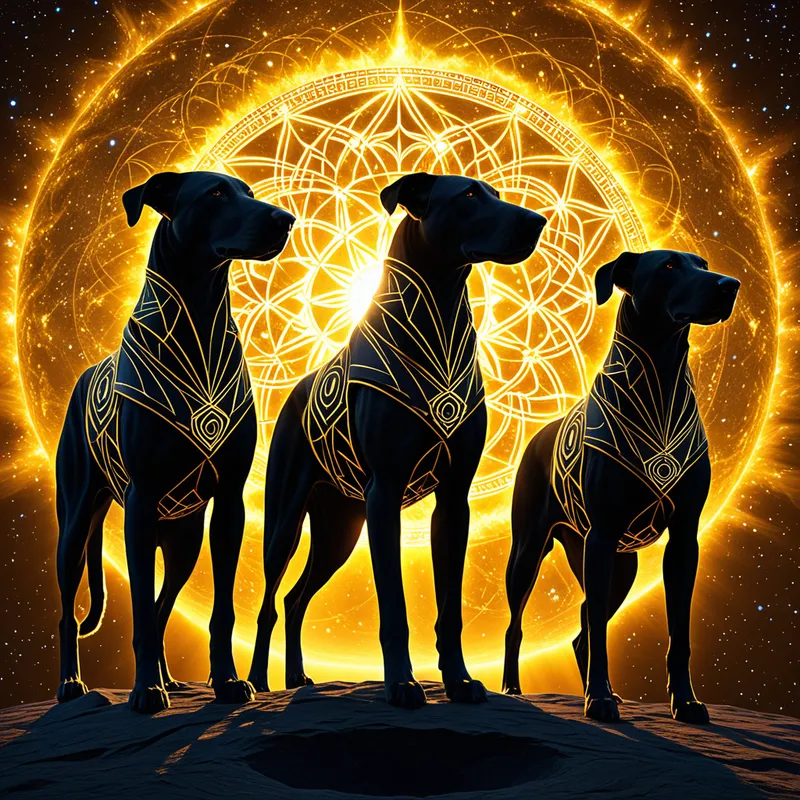
A sound like a universe shattering filled [the void](/myths/the-void “Myth from Buddhist culture.”/). The Sun did not go dark; it broke. From the fracture poured not light, but three torrents of feral, blazing essence. They coalesced, howling, into the Trinity Sun Dogs. No longer a single source, they became Cerberus of [the Sky](/myths/the-sky “Myth from Persian culture.”/): Solifax, the Hound of Fury, whose light burned crops and minds; Lumeniel, the Hound of Sorrow, whose dim glow brought only despair and chill; and Ignarius, the Hound of Madness, who danced with erratic, blinding flares that broke all rhythm.
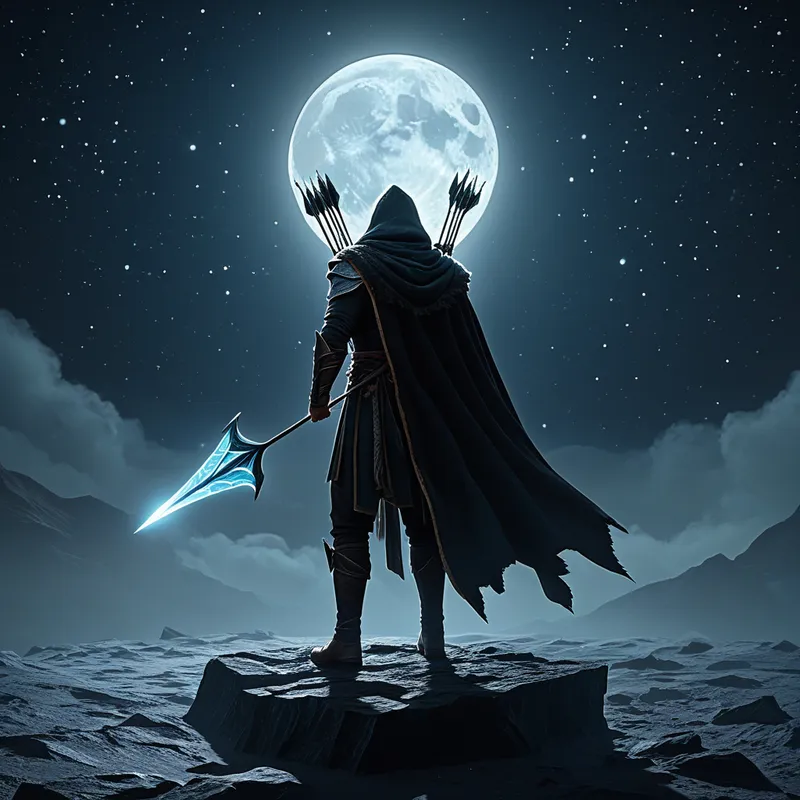
The world below fell into a terrible triplicity. Days were either scorching wrath, grey hopelessness, or chaotic, strobing panic. The people cried out to the silent heavens. And from beyond the fractured sky, the Archer of the Unbroken Chord heard their lament. He descended not on wings, but on a path of resolve. His bow was made from the memory of the first dawn; his quiver held but three arrows: one of Forgotten Mercy, one of Sacred Sorrow, and one of his own Anima, plucked from his breast, a shaft of living moonlight.
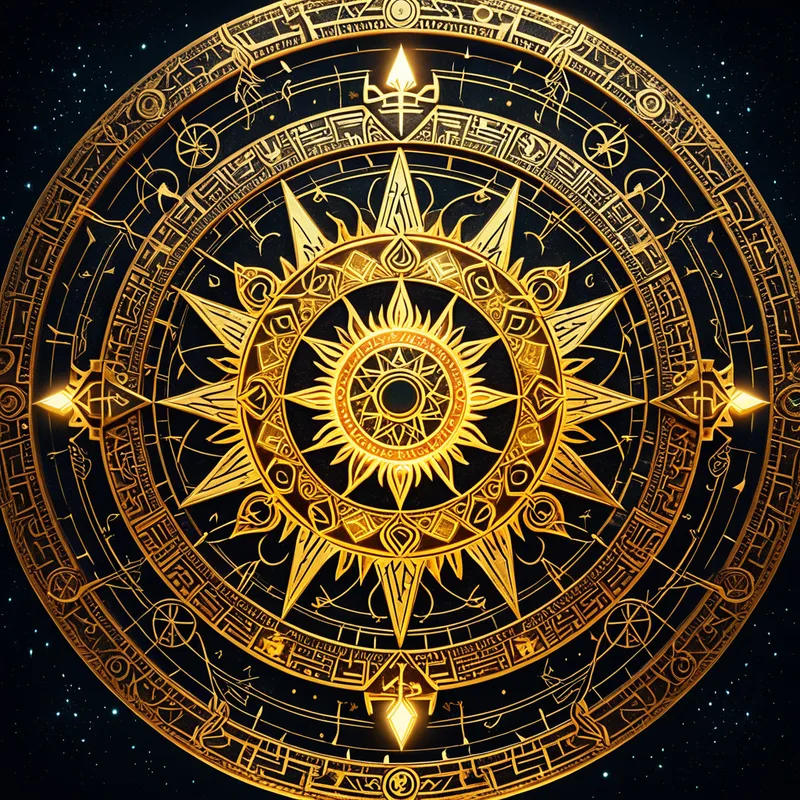
The hunt was an age. He tracked Solifax across deserts of glass, letting the Hound of Fury exhaust its rage until, in a moment of spent stillness, he loosed the Arrow of Forgotten Mercy. It struck not to kill, but to remember, and Solifax’s fire softened to a warm, constant glow. He found Lumeniel weeping in frozen canyons, and with the Arrow of Sacred Sorrow, he shared its grief, transforming its dimness into the gentle, silver light of [the moon](/myths/the-moon “Myth from Tarot culture.”/). Finally, he faced Ignarius in the chaotic storm of its own making. There was no cunning here, only sacrifice. He nocked the final arrow, the one forged from his own essence, and let it fly into the heart of the madness. The act unmade the Archer, but as his form dissolved, the three lights—the tempered sun, the sorrowful moon, and the stabilizing sacrifice—swirled together. They fused not back into a solitary coin, but into a new, triune sun: a central orb of gold, cradled by two lesser lights, a dance of distinct aspects held in perfect, sacrificial harmony.
Cultural Origins & Context
The myth of the Trinity Sun Dogs is not found in canonical scripture, but in the rich loam of parabolic folklore that flourished in late medieval and early Renaissance Europe, particularly within monastic and artisan communities. It functioned as a theological cipher, a way to grapple with the paradox of the [Holy Trinity](/myths/holy-trinity “Myth from Christian culture.”/) and the problem of evil in a created world. Told by traveling preachers and illustrated in the margins of psalters, it served a dual purpose: to explain celestial phenomena (the parhelia, or “sun dogs,” optical halos that appear as bright spots beside the sun) and to model a process of cosmic redemption that mirrored the individual soul’s journey from sin (fracture) to salvation (harmonious reunion).
Its societal function was one of profound reassurance. In an era of plague, schism, and social upheaval, the myth taught that chaos and suffering—the “sundering”—were not the final state of creation. It placed the responsibility for restoration not solely on a distant God, but on a participatory, sacrificial principle within the divine itself, offering a narrative where brokenness is a prelude to a more complex, integrated wholeness.
Symbolic Architecture
At its core, the myth is a profound map of psychic [disintegration](/symbols/disintegration “Symbol: A symbol of breakdown, loss of form, or fragmentation, often reflecting anxiety about personal identity, control, or stability.”/) and reintegration. The Sun Unmarred represents the original, unconscious state of wholeness—[the Self](/myths/the-self “Myth from Jungian culture.”/) before the [dawn](/symbols/dawn “Symbol: The first light of day, symbolizing new beginnings, hope, and the transition from darkness to illumination.”/) of ego-[consciousness](/symbols/consciousness “Symbol: Consciousness represents the state of awareness and perception, encompassing thoughts, feelings, and experiences.”/), which inevitably brings [differentiation](/symbols/differentiation “Symbol: The process of distinguishing or separating parts of the self, emotions, or identity from a whole, often marking a developmental or psychological milestone.”/) and conflict.
The fracture is not a fall from grace, but the necessary cost of consciousness itself. The One must become Many to be known.
The three Hounds are the autonomous psychic complexes that rule a fractured [psyche](/myths/psyche “Myth from Greek culture.”/): untamed Anger (Solifax), paralyzing [Melancholy](/symbols/melancholy “Symbol: A deep, lingering sadness often associated with introspection and a sense of loss or longing.”/) (Lumeniel), and chaotic, undirected Potential (Ignarius). They are not “evil,” but aspects of vital [energy](/symbols/energy “Symbol: Energy symbolizes vitality, motivation, and the drive that fuels actions and ambitions.”/) severed from their unifying [source](/symbols/source “Symbol: The origin point of something, often representing beginnings, nourishment, or the fundamental cause behind phenomena.”/), now acting out destructively. The Archer symbolizes the emerging conscious ego, specifically the heroic function of the [psyche](/myths/psyche “Myth from Greek culture.”/) that must engage with these wild forces. His arrows represent the specific qualities of consciousness needed to redeem each complex: Mercy to temper rage, empathetic Sorrow to alchemize depression, and ultimate Self-sacrifice to integrate chaotic potential.
The final, triune sun is the achieved state of individuation. It is not a return to the original, undifferentiated One, but the creation of a new, conscious unity—a “trinity” where previously warring aspects are acknowledged, transformed, and held in dynamic, cooperative balance.
The Dreamer’s Resonance
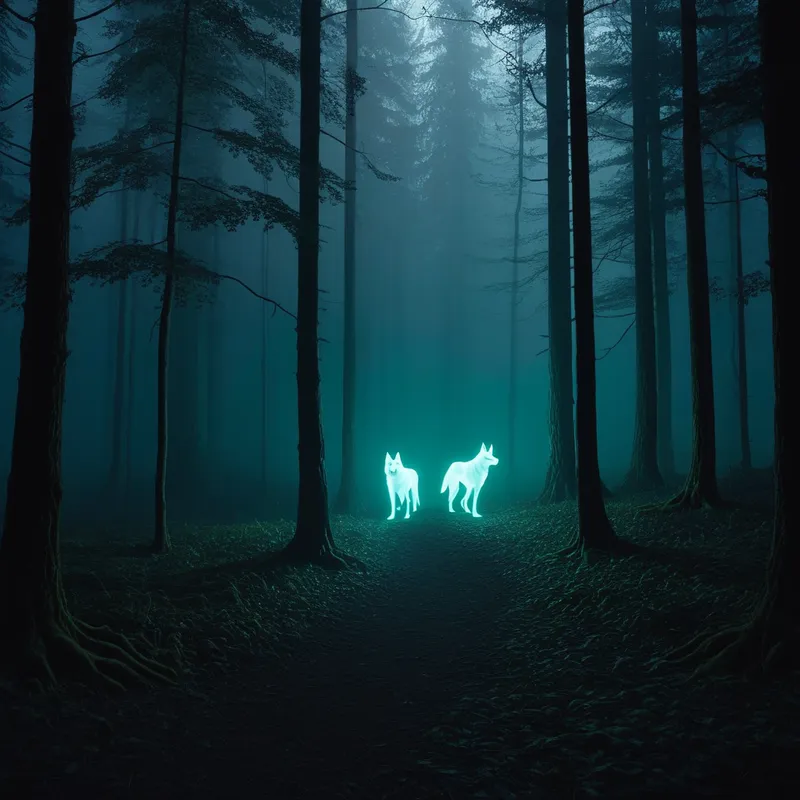
When this myth stirs in the modern dreamscape, it signals a critical phase of shadow-work. To dream of being chased or observed by three dogs, especially if they are luminous, mismatched, or embodying elemental forces (one fiery, one watery/icy, one electric), indicates that powerful, autonomous complexes have been activated. The dreamer may be experiencing life as a chaotic oscillation between outbursts of fury, periods of numb despondency, and fits of frantic, unproductive activity.
The somatic resonance is often a feeling of being “torn apart” or “scattered.” The psyche is enacting the “sundering.” The appearance of an Archer figure, a weapon of precision, or the act of aiming in the dream points to the nascent emergence of the conscious will needed to engage this inner civil war. The dream is not presaging literal doom, but illustrating the internal fragmentation that precedes a major synthesis. The hounds must be faced, not fled, for they carry the very energy needed for the dreamer’s renewal.
Alchemical Translation
The myth’s narrative is a perfect allegory for the alchemical opus. The Sundering is the [Nigredo](/myths/nigredo “Myth from Alchemical culture.”/), the blackening, the dissolution of the old, rigid personality. The three Hounds represent the chaotic [Prima Materia](/myths/prima-materia “Myth from Alchemical culture.”/), the base, conflicted matter of the soul.
The Archer’s hunt is the Albedo, the whitening, where conscious discernment separates and purifies the warring elements. Each arrow is a specific coniunctio, a sacred marriage of consciousness with a shadow element.
The final sacrifice of the Archer, offering his own Anima (his connecting principle to life) to tame madness, is the [Rubedo](/myths/rubedo “Myth from Alchemical culture.”/), the reddening. This is the supreme sacrifice of [the ego](/myths/the-ego “Myth from Jungian culture.”/)‘s total claim to sovereignty. The ego (Archer) must die as the sole ruler to be reborn as the steward of a greater, unified Self.
For the modern individual, this translates to a grueling but sacred process. One must first identify the “sun dogs” within—the repetitive, overwhelming patterns of emotion and behavior that feel alien yet powerful. Then, one must “hunt” them with the specific antidote: confronting rage with conscious compassion (Mercy), meeting sorrow with honored grief (Sacred Sorrow), and engaging chaotic life-force not by trying to control it, but by offering one’s own directed purpose and vulnerability (Self-sacrifice) as a vessel for it. The outcome is not a peaceful, static perfection, but a vibrant, resilient wholeness—a psyche that, like the triune sun, can contain its own multiplicities in a state of graceful, dynamic tension.
Associated Symbols
Explore related symbols from the CaleaDream lexicon: