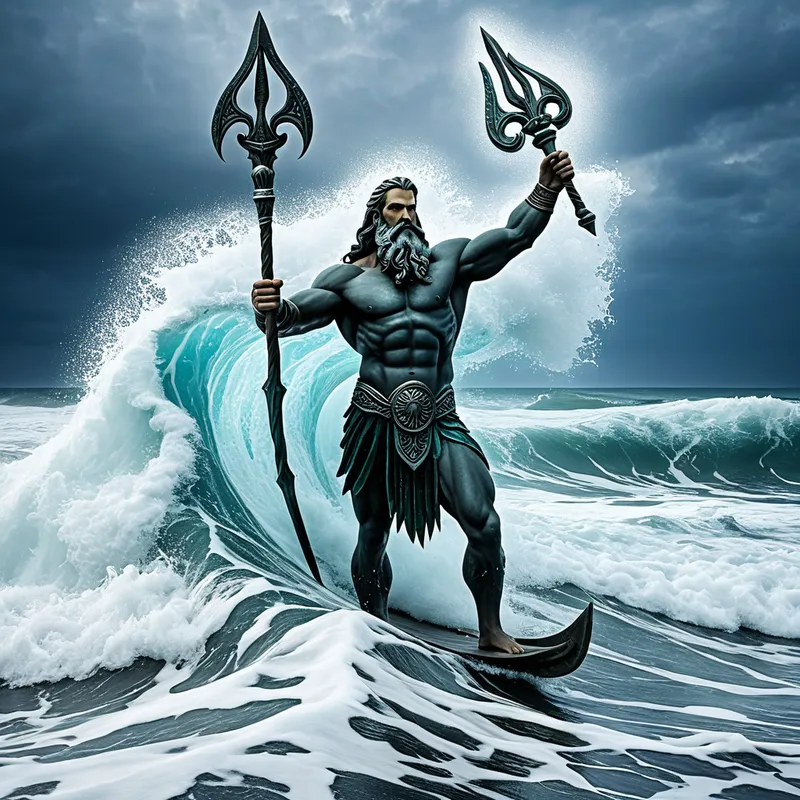
Trident of Poseidon Myth Meaning & Symbolism
The story of the divine weapon forged for the God of the Sea, a symbol of primordial power, sovereignty over chaos, and the depths of the soul.
The Tale of the Trident of Poseidon
Hear now the tale of the weapon that shakes the world, born not of war, but of cosmic necessity. In the beginning, there was chaos, and from chaos, the Titans. But their reign was one of brute force, a crushing weight upon the earth and sky. From their dark prison, the Cyclopes—Brontes, Steropes, and Arges—hammered in the forges of the underworld, their single eyes seeing the true shape of power.
When the young gods, led by mighty Zeus, rose against the old order, they knew they needed arms to match their destiny. To the deep earth they went, to the smithy of fire and shadow. The Cyclopes did not speak; they forged. For Zeus, they crafted the thunderbolt, a spear of fractured sky. For Hades, they fashioned the Helm of Darkness, a crown of oblivion.
And for Poseidon, they wrought the Trident.
It emerged from their anvil not as mere metal, but as a convergence of elements. Its shaft was the spine of the deepest trench, cold and unyielding. Its three prongs were forged from the fury of the first storm, the patience of continental stone, and the relentless pull of the tide. When Poseidon’s hand closed around it, the very substance of the world recognized its master. The oceans heaved in their basins. Subterranean rivers changed course. A low tremor, the first earthquake, sighed through the bones of Gaia.
With this weapon, Poseidon claimed his domain. He did not merely rule the sea; he was its tempest and its calm. A strike of the Trident upon a wave could raise a mountain of water to drown fleets. A gentle tap upon a barren rock could unleash a freshwater spring, a gift of life to a parched land. He drove it into the seabed to summon his chariot, drawn by hippocampi with manes of seafoam. In the great war, his blows against the land made continents tremble, proving that the earth itself rested on a foundation of fluid, unstable power.
The Trident was his scepter and his spear, the instrument of his terrible generosity and his fathomless wrath. It was the key that unlocked the latent, chaotic potential of the world, allowing the god to shape it, for good or ill, according to his vast and inscrutable will.
Cultural Origins & Context
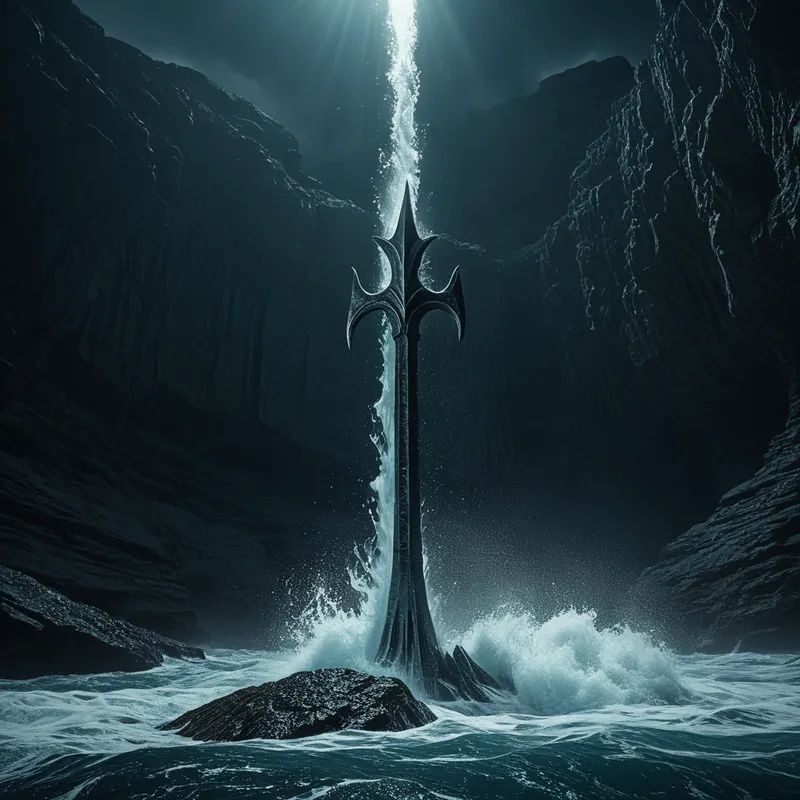
This myth is not a single story from one scroll, but a foundational truth woven through the entire tapestry of Greek thought, from the epic verses of Homer to the hymns and plays performed for the city-state. The Trident’s origin in the Titanomachy, as recounted in Hesiod’s Theogony, roots it in the very architecture of cosmic order. It marks the moment raw, elemental power (Cyclopes) was harnessed and directed by a conscious, sovereign intelligence (the Olympians).
For a maritime culture like ancient Greece, the sea was the ultimate source of bounty and the ever-present face of annihilation. Poseidon, with his Trident, personified this profound ambivalence. The myth functioned as a religious explanation for natural phenomena—earthquakes, storms, springs—and as a social contract. Cities built harbors and offered sacrifices to appease the god’s temper, hoping to earn the Trident’s creative strike that brought forth water and safe passage, rather than its destructive one that brought tsunami and ruin. The Trident was a symbol of the terrifying, non-negotiable power one had to respect and engage with to survive and thrive.
Symbolic Architecture
The Trident is an emblem of triune, sovereign power. It is far more than a fishing tool magnified to divine scale; it is a geometric key to understanding a particular kind of mastery.
The Trident does not create the wave; it commands the potential already present within the boundless sea.
Its three prongs symbolize a fundamental triad of dominion. First, Depth: the hidden, unconscious, and emotional underworld of the soul. Second, Surface: the conscious mind and the manifest world of action and relationship. Third, Height: the aspirational spirit, the storm of inspiration or divine fury. Poseidon, standing at the nexus, holds all three realms in dynamic tension. He can stir up the depths to crash upon the shore, or draw from the heights to fertilize the deep.
Psychologically, the Trident represents the ego’s necessary tool for engaging the unconscious. The unconscious, like the sea, is vast, fertile, and dangerously chaotic. Without a directing principle—a Trident—one is either drowned by its contents (psychosis, overwhelming emotion) or left stranded on a barren shore of arid consciousness. The Trident is the symbol of a centered will capable of “fishing” insights from the deep, “striking” the earth of the psyche to release life-giving springs of creativity, and weathering the internal storms it inevitably summons.
The Dreamer’s Resonance
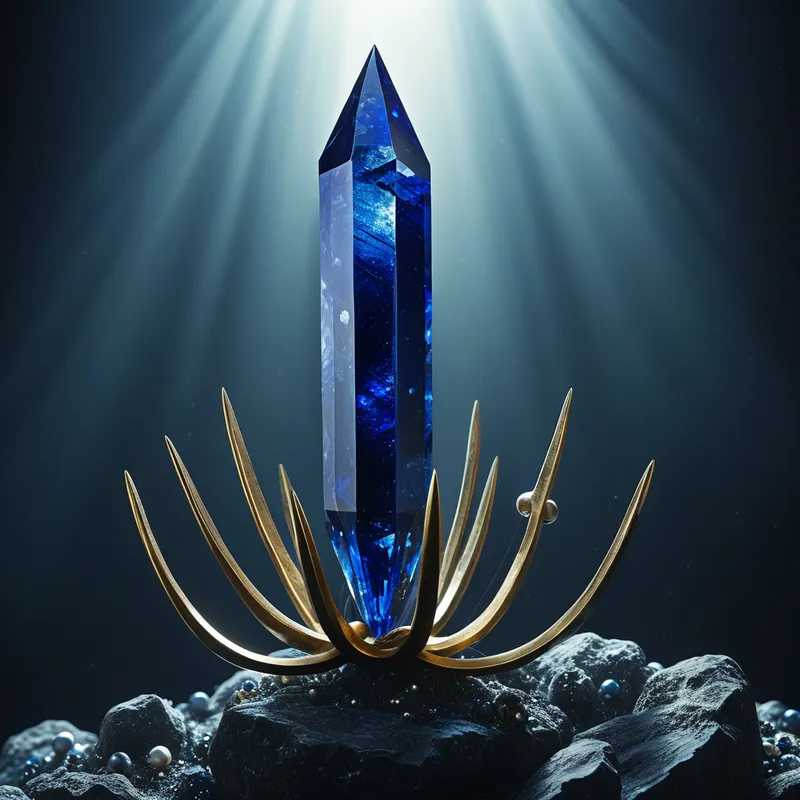
When the Trident appears in a modern dream, it rarely arrives with the full pageantry of Poseidon. It may manifest as a three-pronged tool, a strange weapon, a piece of coral, or simply an overwhelming sense of oceanic power. The dreamer is often in a life phase confronting raw, elemental forces within themselves: a tidal wave of grief, a drought of inspiration, or the foundational shaking of a lifequake—a divorce, a career collapse, a spiritual crisis.
Somatically, the dream may be accompanied by sensations of pressure, immersion, or trembling. Psychologically, it signals that the dreamer’s usual methods of control are insufficient. The ego is being presented with the need for a new kind of authority. To dream of finding a Trident suggests the nascent emergence of this inner sovereignty. To dream of wielding it, perhaps to calm a storm or part waters, indicates actively engaging this power to navigate a crisis. To dream of it being wrested away, or of being struck by it, points to a feeling of being overwhelmed by forces—emotional, instinctual, or circumstantial—that feel divine in their magnitude and indifference.
Alchemical Translation
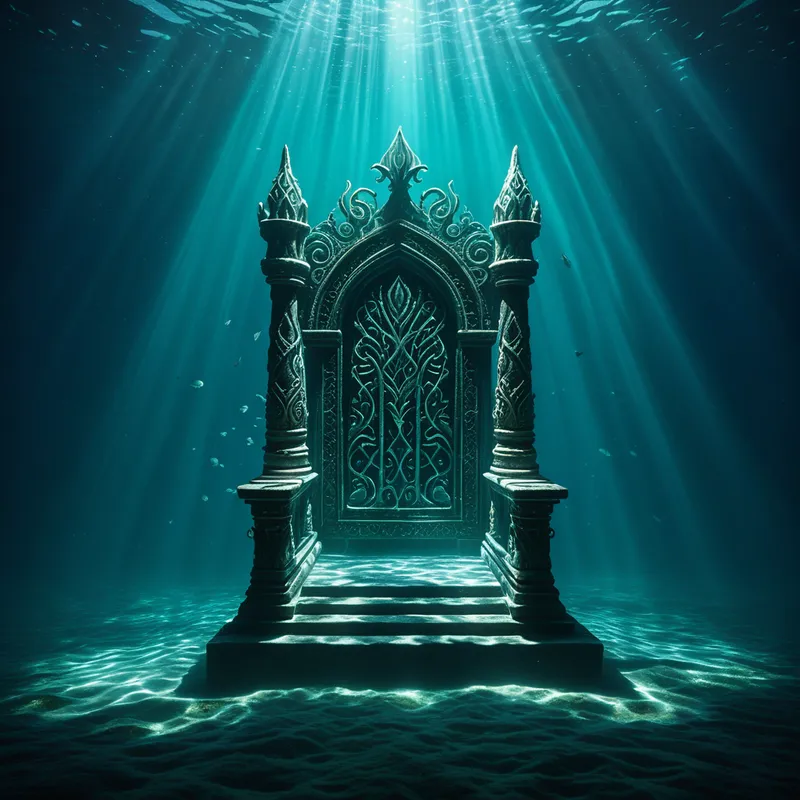
The myth of the Trident models the alchemical process of coagulatio: the bringing together of fluid, volatile elements into a solid, directed form. The journey is one of moving from being a subject of the inner sea to becoming its sovereign.
Individuation is not about calming the ocean, but learning to sail upon it, fish within it, and respect its tempests, using the Trident of conscious awareness as both rudder and harpoon.
The first step is the descent into the “Cyclopean forge”—the shadowy, one-eyed, focused work of confronting the raw, unintegrated aspects of the self. These are the brutal talents, the repressed angers, the deep creativities that seem monstrous. The forging of the personal “Trident” is the hard labor of integrating these shadow elements into a usable tool of the will.
Once forged, the Trident’s function is threefold, mirroring the psychic transmutation of the individual. To Strike the Earth is to make the unconscious conscious—to hit a dry, logical, or depressed state and release the fountain of feeling and vitality. To Stir the Waves is to agitate the status quo, both internally and externally, initiating necessary conflict or change. To Claim the Chariot is the ultimate goal: to harness the tremendous power of the deep instincts (the hippocampi) and direct them toward a destination of one’s own choosing. The individual no longer drowns in their emotions or flees from their power; they ride upon them, sovereign of their own vast and mysterious inner realm.
Associated Symbols
Explore related symbols from the CaleaDream lexicon: