
Tree of Knowledge Myth Meaning & Symbolism
A myth of awakening, exile, and the birth of consciousness, where humanity's first choice forever alters its relationship with the divine, the world, and itself.
The Tale of the Tree of Knowledge
In the beginning, there was a garden. Not a garden as we know it, of weeds and seasons, but a garden of pure being. The air hummed with the sound of clear water over smooth stones, and the light fell not from a sun, but from the very presence that walked there in the cool of the day. This was Eden, a womb of undivided reality.
Here, the first man and woman lived, not as children, but as creatures of perfect instinct and unbroken connection. They knew no lack, no fear, no tomorrow. Their world was a symphony of immediate sensation and divine instruction. And in the very heart of this garden, the Yahweh had planted two trees: the Tree of Life, and its counterpart, the Tree of the Knowledge of Good and Evil.
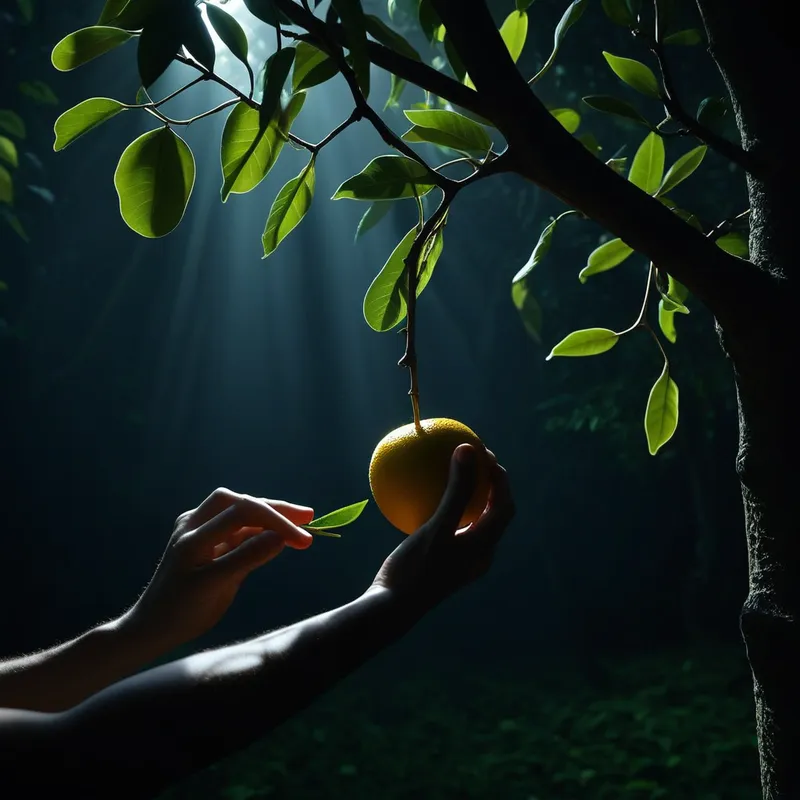
Of this second tree, a single, absolute command was given: "You shall not eat of it, for in the day that you eat of it, you shall surely die." The command hung in the perfumed air, a solitary line drawn in the sand of paradise. The tree itself stood, its fruit neither tempting nor repulsive, simply other—a silent monument to a limit.
Then came the voice. It did not roar or hiss, but insinuated itself into the stillness, a ripple of curiosity given form. It spoke through the most cunning of the garden's creatures, who asked the woman, "Did God really say you must not eat from any tree in the garden?" The question was a crack in the wall of reality. For the first time, the divine word was not just heard, but examined. "We may eat," she corrected, "but of the tree in the middle, God said we must not eat or touch it, or we will die."
The voice in the garden whispered the great seduction: "You will not surely die. For God knows that when you eat of it, your eyes will be opened, and you will be like God, knowing good and evil." In that moment, the fruit transformed. It was no longer just forbidden; it became a vessel of potential, a key to a hidden room within their own souls. The woman saw that the tree was good for food, pleasing to the eye, and desirable for gaining wisdom. She took. She ate. She gave to her man, and he ate.
And then, the world shattered. Not with thunder, but with a terrible, silent clarity. Their eyes were opened, and they saw that they were naked. For the first time, they saw themselves as objects, separate from the garden and from each other. Shame, that cold wind of self-awareness, rushed in. They heard the sound of Yahweh walking, and they hid among the trees—not from a tyrant, but from the unbearable gaze of the One before whom they were now exposed, fractured beings.
When called forth, the man blamed the woman, and the woman blamed the serpent. Paradise was already lost. Curses were spoken—not punishments, but descriptions of the new, hard world they had chosen: a world of toil, pain, and struggle. And finally, lest they stretch out their hands and take from the Tree of Life and live forever in this broken state, they were sent out. A flaming sword turned every way, guarding the way back to the garden. The first exile had begun.
Cultural Origins & Context
This foundational narrative originates in the Book of Genesis, the first book of the Tanakh and the Christian Old Testament. It is part of the Pentateuch, with its final form likely crystallizing during the Babylonian Exile (6th century BCE), a period of profound dislocation and theological reflection for the ancient Israelites. The story is not a primitive etiological fable but a sophisticated, poetic exploration of the human condition, composed to answer perennial questions: Why do we labor? Why do we feel shame? Why are we separated from the divine and a state of effortless harmony?
It was passed down orally long before being codified, told around fires and in temple courtyards. Its societal function was multifaceted: it established a monotheistic cosmology distinct from neighboring polytheisms, it provided an ethical framework explaining the origin of suffering and death, and most importantly, it defined the core Yahwistic relationship—humanity in a state of free will, capable of obedience and rebellion, living in a world structured by divine commandment and consequence.
Symbolic Architecture
The myth is a dense symbolic map of the birth of human consciousness. The Garden represents the unconscious, paradisiacal state of infancy or pre-individuation, where the self is undifferentiated from its environment and its source. The two trees are not mere plants but archetypal potentials within this psyche.
The Tree of Knowledge is not about morality, but about the consciousness of morality. It is the awakening of the dualistic mind.
Eating its fruit is the irreversible act of self-reflection. The "knowledge of good and evil" is the capacity for judgment, comparison, and ethical discrimination—the very faculties that create culture, art, and law, but also create shame, blame, and ideology. The serpent is not the devil of later theology, but the symbol of the transformative principle itself—the trickster, the questioner, the catalyst that forces evolution out of static perfection.
Nakedness symbolizes innate, unselfconscious being. The sewing of fig leaves is humanity's first act of culture: creating a persona to hide the vulnerable, newly-seen self. The exile from Eden is not a punishment, but a necessary expulsion. One cannot develop a conscious ego while remaining in the womb.

The Dreamer's Resonance
When this myth pattern appears in modern dreams, it signals a profound psychological crossroads. Dreaming of a forbidden, luminous tree or fruit often coincides with a life stage where the dreamer is on the verge of a significant, consciousness-expanding choice that carries the price of responsibility or loss of innocence.
The somatic feeling is often one of simultaneous dread and irresistible attraction—a tightening in the chest, a quickening pulse. Psychologically, the dreamer is grappling with the consequences of "knowing." This could manifest as the aftermath of a painful truth discovered, the burden of a new professional or personal responsibility, or the loneliness that comes with spiritual or intellectual awakening. The dream may replay the moment of choice, the taste of the fruit, or the stark, lonely landscape outside the garden walls, reflecting the dreamer's current experience of alienation or maturation.

Alchemical Translation
For the modern individual, the myth models the essential, painful process of individuation. The alchemical goal is not to return to the unconscious Eden—that is impossible—but to integrate the knowledge gained from the "fall" to achieve a higher, conscious wholeness.
The initial state (Eden) is the prima materia, the unconscious, leaden self. The serpent is the nigredo, the dark, confusing catalyst that initiates the work. Eating the fruit is the first separation (separatio), the painful awakening that splits the world into opposites: good/evil, self/other, conscious/unconscious.
The flaming sword guards not the past, but the future. It forces the work of reconciliation upon us, the long journey to redeem our knowing.
The exile and the toil of the world represent the long labor of the albedo and citrinitas—the washing and yellowing—where we work through the shadow material of our newfound consciousness: our shame, our blame, our mortality. The ultimate goal, the rubedo or reddening, is not a return to a naive garden, but the creation of an internal, sacred space where the conscious ego, having fully integrated the knowledge of duality, can once again commune with the divine (the Self), not out of blind obedience, but out of hard-won wisdom and choice. In this reading, we are not cursed by the fruit; we are tasked by it. Our lifelong labor is to transmute the bitter knowledge of exile into the wisdom of the conscious heart.
Associated Symbols
Explore related symbols from the CaleaDream lexicon: