Tower of Babel Builders Myth Meaning & Symbolism
A unified humanity builds a tower to reach heaven, provoking divine wrath that scatters them by confounding their single, shared language into a multitude.
The Tale of Tower of Babel Builders
In the beginning, after the great waters had receded, the whole earth was of one language and one speech. The children of men, multiplying, journeyed eastward and found a plain in the land of Shinar. They settled there, and the clay of [the earth](/myths/the-earth “Myth from Hindu culture.”/) was in their hands.
And they said to one another, their voices a single, harmonious stream, “Come, let us make bricks, and burn them thoroughly.” So they took brick for stone, and slime of bitumen for mortar. The kiln-fires burned day and night, a hundred hearths of ambition. The scent of baked earth and hot tar filled the air, and the plain echoed with the unified rhythm of their labor.
A new word was born among them, a word of fire and aspiration: “Tower.” They declared, their hearts swelling with a singular purpose, “Come, let us build us a city and a tower, whose top may reach unto heaven; and let us make us a name, lest we be scattered abroad upon the face of the whole earth.”
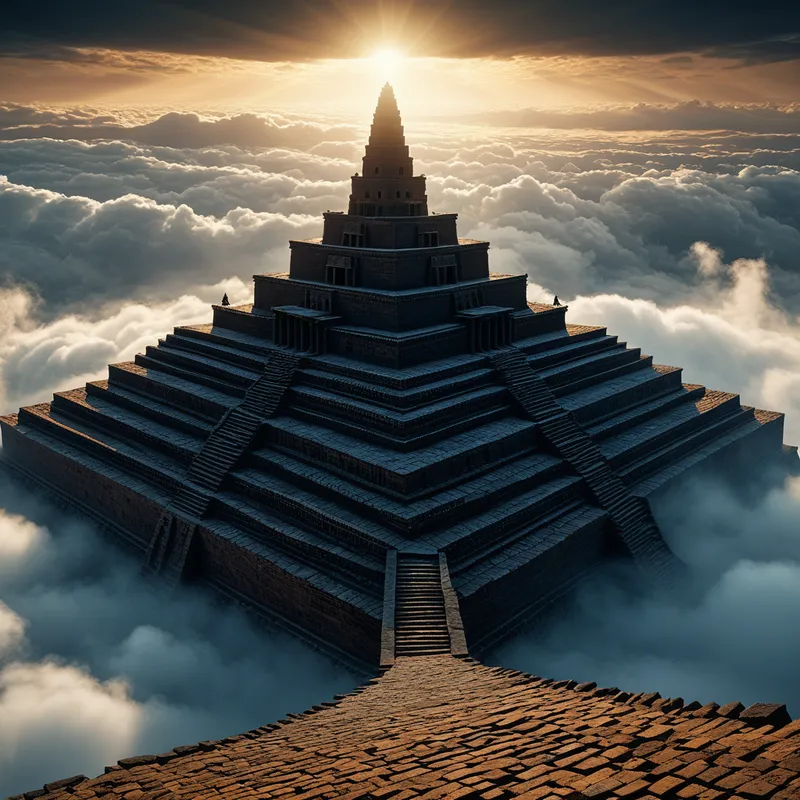
The foundation was laid, vast and deep. Course upon course rose from the plain, a monstrous [ziggurat](/myths/ziggurat “Myth from Mesopotamian culture.”/) of human making. [The spiral](/myths/the-spiral “Myth from Celtic culture.”/) ramp wound upward like a serpent climbing toward the sun. From the ground, the workers became specks, then shadows against the brick. From the heights, [the world](/myths/the-world “Myth from Tarot culture.”/) below flattened into a map of their dominion. [The wind](/myths/the-wind “Myth from Various culture.”/), which once carried their clear commands, now carried only the dry whisper of altitude. They looked not at each other, but ever upward, their gaze fixed on the next brick, the next course, the heaven they sought to claim.
But Yahweh came down to see the city and [the tower](/myths/the-tower “Myth from Tarot culture.”/) which the children of men built. And the Elohim said, “Behold, the people is one, and they have all one language; and this they begin to do: and now nothing will be restrained from them, which they have imagined to do.”
A silence fell, deeper than any before. It was not the silence of night, but the silence of a held breath before a storm. Then, a stirring not in the air, but in the very marrow of their understanding. The mason called for mortar, but [the word](/myths/the-word “Myth from Biblical culture.”/) that left his lips was a guttural, alien sound. The foreman gestured to [the summit](/myths/the-summit “Myth from Taoist culture.”/), but his hands described nonsense. The shared dream that had lived in their common tongue shattered into a thousand jagged fragments. Where there was unity, a cacophony erupted. Faces, once familiar, contorted in confusion and then in fear. The beautiful, terrible tower stood half-built, a monument to a shattered unity. They left off building the city. Yahweh scattered them abroad from thence upon the face of all the earth. And the place was called Babel, because there did Yahweh confound the language of all the earth.

Cultural Origins & Context
This narrative is found in the Book of Genesis (11:1-9), a foundational text of the Biblical tradition. It functions as an etiological myth—a story explaining the origin of a phenomenon—answering the profound question: why does humanity speak many languages? Its placement is critical, following the genealogies of Noah’s sons and preceding the call of Abraham. It serves as a bridge between the primeval history of all humankind and the particular history of the Israelite patriarchs.
Told and preserved by priestly and wisdom traditions, the myth served multiple societal functions. It explained the diversity of nations and tongues from a monotheistic perspective, attributing it to divine action rather than mere chance. It also established a theological boundary: the proper domain of humanity and the inviolable realm of the divine. The tower, likely modeled on the massive Mesopotamian ziggurats [the Israelites](/myths/the-israelites “Myth from Abrahamic culture.”/) would have known from exile, became a symbol of imperial, human-centric arrogance. The story warned against collective pride that seeks to erase the fundamental distinction between Creator and creation, promoting instead a posture of humility and recognition of divine sovereignty.
Symbolic Architecture
The [Tower of Babel](/symbols/tower-of-babel “Symbol: A symbol of human ambition, the pursuit of knowledge, and the consequences of overreaching.”/) is not merely a [story](/symbols/story “Symbol: The symbol of ‘Story’ represents the narrative woven through our lives, embodying experiences, lessons, and emotions that shape our identities.”/) about [language](/symbols/language “Symbol: Language symbolizes communication, understanding, and the complexities of expressing thoughts and emotions.”/). It is a master [symbol](/symbols/symbol “Symbol: A symbol can represent an idea, concept, or belief, serving as a powerful tool for communication and understanding.”/) of the [psyche](/myths/psyche “Myth from Greek culture.”/)’s encounter with its own limits and the [nature](/symbols/nature “Symbol: Nature symbolizes growth, connectivity, and the primal forces of existence.”/) of [human](/symbols/human “Symbol: The symbol of a human represents individuality, complexity of emotions, and social relationships.”/) [connection](/symbols/connection “Symbol: Connection symbolizes relationships, communication, and bonds among individuals.”/).
The tower is the ego’s monument, built from the bricks of a singular, unquestioned identity and mortared with the certainty of collective agreement.
The “one language” represents a state of unconscious unity—a psychic [condition](/symbols/condition “Symbol: Condition reflects the state of being, often focusing on physical, emotional, or situational aspects of life.”/) where [differentiation](/symbols/differentiation “Symbol: The process of distinguishing or separating parts of the self, emotions, or identity from a whole, often marking a developmental or psychological milestone.”/) has not yet occurred. It is the primal, paradisiacal state where thought and communication are seamless, but also where critical [consciousness](/symbols/consciousness “Symbol: Consciousness represents the state of awareness and perception, encompassing thoughts, feelings, and experiences.”/) and individual [identity](/symbols/identity “Symbol: Identity represents the sense of self, encompassing personal beliefs, cultural background, and social roles.”/) are dormant. The drive to “make a name for ourselves” and reach [heaven](/symbols/heaven “Symbol: A symbolic journey toward ultimate fulfillment, spiritual transcendence, or connection with the divine, often representing life’s highest aspirations.”/) symbolizes [the ego](/myths/the-ego “Myth from Jungian culture.”/)’s [inflation](/symbols/inflation “Symbol: A dream symbol representing feelings of diminishing value, loss of control, or expansion beyond sustainable limits in one’s life or psyche.”/), its desire to transcend all limits and become godlike, to achieve immortality through a [legacy](/symbols/legacy “Symbol: What one leaves behind for future generations, encompassing values, achievements, possessions, and memory.”/) of [stone](/symbols/stone “Symbol: In dreams, a stone often symbolizes strength, stability, and permanence, but it may also represent emotional burdens or obstacles that need to be acknowledged and processed.”/) and fame.
The divine intervention, the “confounding,” is not a petty [punishment](/symbols/punishment “Symbol: A dream symbol representing consequences for actions, often tied to guilt, societal rules, or internal moral conflicts.”/) but a necessary, if traumatic, act of differentiation. It is the psychic force that shatters the monolithic, inflated ego-complex for the sake of greater complexity.
The fall into many tongues is the birth of consciousness through the painful realization of the Other. It is the beginning of the long, arduous journey toward understanding that must now bridge genuine difference.
The scattered peoples represent the fragmented aspects of [the self](/myths/the-self “Myth from Jungian culture.”/)—the complexes, the subpersonalities, the disparate drives and talents that must be acknowledged and integrated. Babel is the archetypal [moment](/symbols/moment “Symbol: The symbol of a ‘moment’ embodies the significance of transient experiences that encapsulate emotional depth or pivotal transformations in life.”/) of alienation that makes [relationship](/symbols/relationship “Symbol: A representation of connections we have with others in our lives, often reflecting our emotional state.”/), and ultimately, a more profound reconciliation, possible.

The Dreamer’s Resonance
When this myth stirs in the modern dreamscape, it often signals a crisis of communication and a fragmentation of the Self. To dream of a towering, incomplete structure you are building with others, which then collapses into chaos or incomprehensible noise, points directly to the Babel complex.
Somatically, this may manifest as a tightness in the throat (the seat of expression), a feeling of being tongue-tied in a crucial situation, or a profound sense of isolation within a crowd. Psychologically, the dreamer is experiencing the rupture of a previously held, cohesive identity or project. This could be in a career, a relationship, a creative endeavor, or a spiritual belief system where once there was a “common language” and shared purpose. The dream presents the terrifying, yet necessary, disintegration of that false unity. It asks the dreamer to confront the “confounding” within: the inner voices that no longer agree, the conflicting desires, the realization that the simple, singular story they told themselves about their life is breaking apart. The dream is an initiation into the complexity of one’s own psyche.
Alchemical Translation
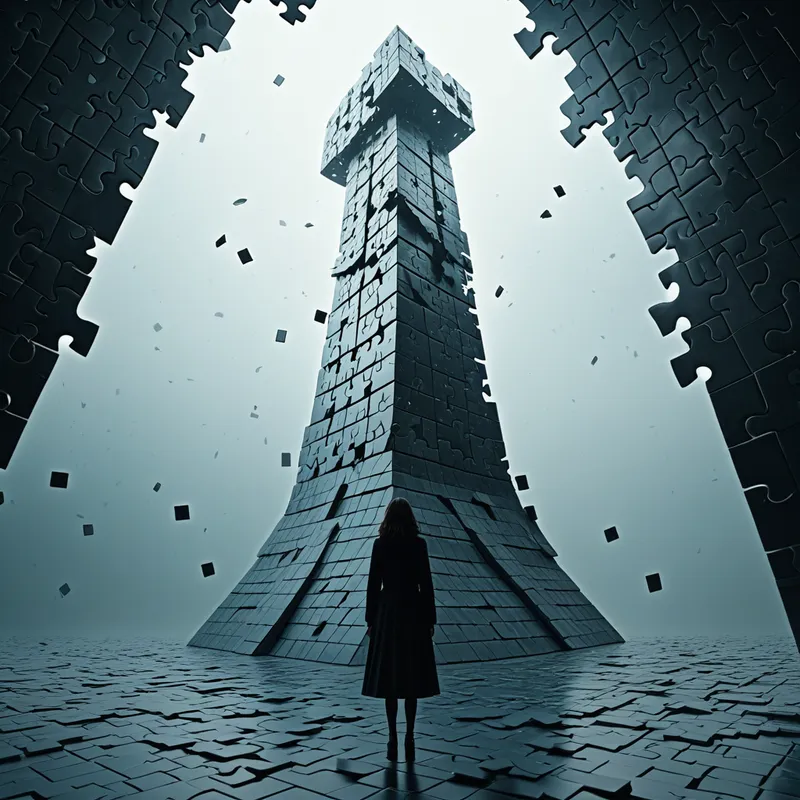
The alchemical process mirrored in the Babel myth is the [Nigredo](/myths/nigredo “Myth from Alchemical culture.”/), the blackening, the necessary dissolution that precedes any integration. The conscious, ego-driven project (the tower) must fail spectacularly for the work of individuation to truly begin.
The first, unified language represents the [prima materia](/myths/prima-materia “Myth from Alchemical culture.”/)—the undifferentiated, unconscious mass of the personality. The building ambition is the ego’s attempt to coagulate this material into a fixed, eternal form. The divine confounding is the archetypal catalyst that forces this rigid structure to break down into its constituent parts (the many languages, the scattered tribes).
The alchemical goal is not to return to the one language, but to become a polyglot of the soul—to understand and translate the many inner voices without demanding they all speak the same tongue.
The psychic transmutation occurs when the individual, having been scattered, stops trying to rebuild the old, monolithic tower. Instead, they begin the humble, lifelong work of building bridges between their inner fragments. They learn the vocabulary of their own shadow, the grammar of their anima or animus, the dialects of their inner child and critic. The city that was abandoned—the community of the self—can only be inhabited through this hard-won diplomacy. The “name” we ultimately make is not a towering monument to the ego, but a unique, complex signature woven from the reconciled diversity within. We reach not for a heaven of our own construction, but for a wholeness that includes our own confounding fragmentation. The curse of Babel, in the end, contains the seed of its own redemption: the call to truly listen, first within, and then, perhaps, to the world.
Associated Symbols
Explore related symbols from the CaleaDream lexicon: