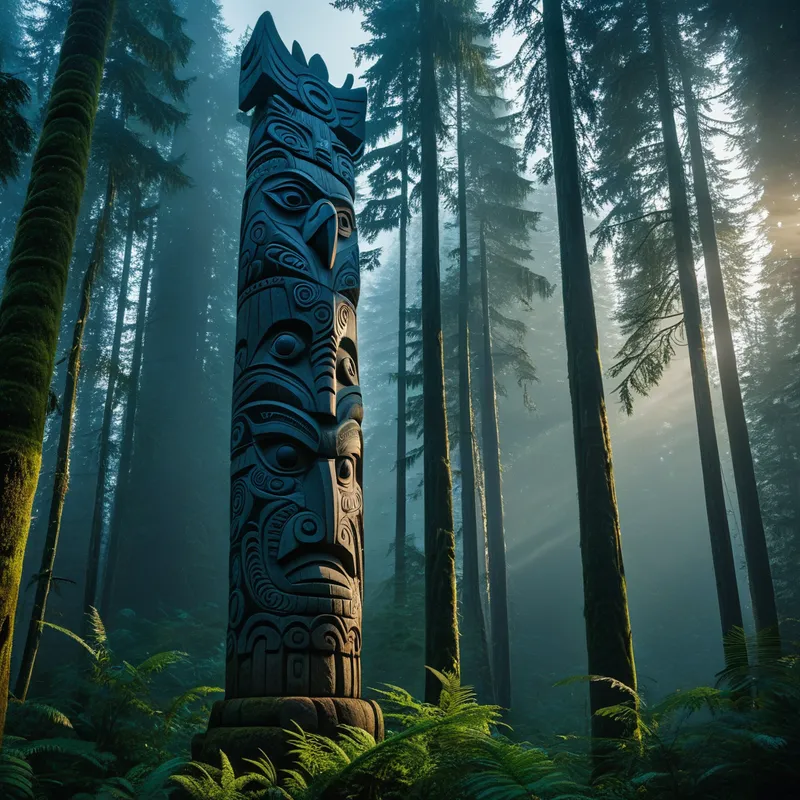
Totem Poles / Petroglyphs Myth Meaning & Symbolism
Ancestral stories carved in wood and stone, connecting the living to the spirit world, mapping lineage, and etching cosmic law into the land.
The Tale of Totem Poles / Petroglyphs
Listen. [The world](/myths/the-world “Myth from Tarot culture.”/) is not silent. It speaks in the groan of ancient cedar, in the sigh of wind over stone. Before the first story was spoken, it was waiting to be revealed.
In the beginning, there was the One Breath—the shared breath of the animal people, the plant people, the human people, and the [stone people](/myths/stone-people “Myth from Native American culture.”/). They lived in a world without separation, a shimmering web of relation. But as time wound on, the human people began to forget. They forgot the language of Wolf, the wisdom of Salmon, the laughter of [Raven](/myths/raven “Myth from Haida culture.”/). A great loneliness settled upon them, a cold silence where there once had been song.
Then, from the place where the mountains touch [the sky](/myths/the-sky “Myth from Persian culture.”/), a voice came. It was not one voice, but many, woven together—the voice of the First Ones. It spoke to a woman sitting by a river, her heart heavy with the silence. “The stories are not lost,” the voices whispered on the [water](/myths/water “Myth from Chinese culture.”/)‘s murmur. “They are sleeping in the bones of the land, in the skin of the trees. You must wake them. You must give them a body.”
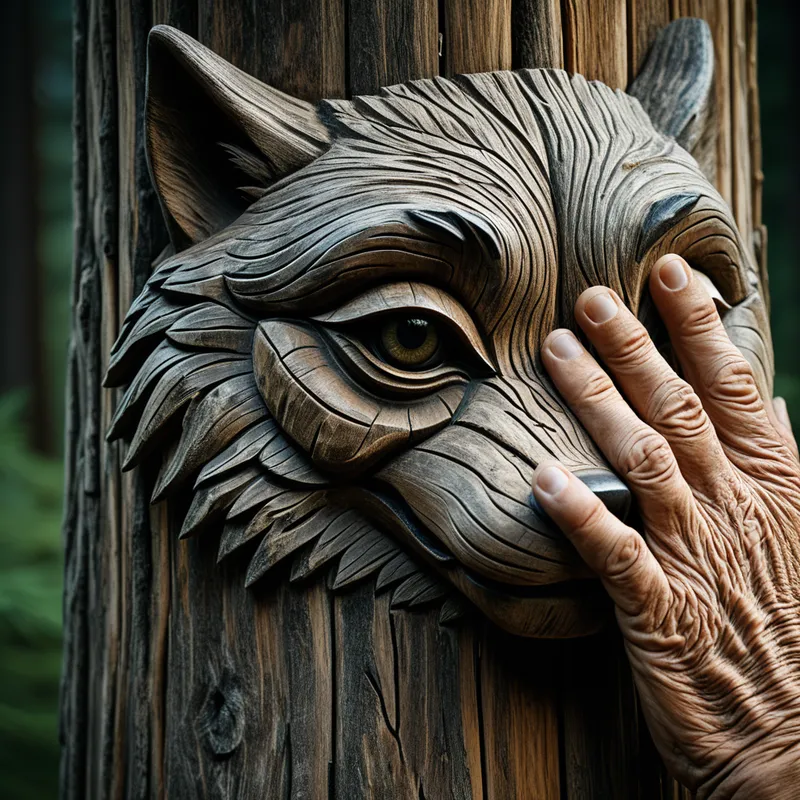
Guided by dreams, she went to a great cedar, a tree that had witnessed a thousand seasons. She placed her hands upon its bark and asked permission. The tree sighed, a long, deep sound, and offered itself. With tools of stone and bone, she began. She did not carve what she imagined, but what she remembered—or rather, what the tree remembered for her. The first shape to emerge from the wood was Raven, his beak open in a cry that brought light. Next came Bear, strength and introspection emerging from the grain. Then Wolf, the teacher of family. She stacked them, one upon the other, a ladder of memory reaching from [the earth](/myths/the-earth “Myth from Hindu culture.”/) toward the sky.
Meanwhile, by [the sea](/myths/the-sea “Myth from Greek culture.”/), a man troubled by visions was drawn to a vast, smooth cliff face beside the roaring ocean. In his dreams, the cliff pulsed with a hidden heartbeat. He dipped his fingers in ochre and charcoal, mixed with the fat of a sacred hunt. As his fingers met stone, they did not draw, but followed. Spirals appeared, tracing the path of the sun and [the moon](/myths/the-moon “Myth from Tarot culture.”/). A great whale breached across the rock. A handprint, his own and yet not his own, pressed itself into the narrative. He was not making marks; he was uncovering a map that had always been there—a map of migrations, of star paths, of the covenant between the people and the deep.
When the woman finished her pole and the man stepped back from his cliff, a change swept through the land. The people gathered. Looking upon the carved cedar, they felt the loneliness recede. The pole stood as a witness, a testament. They saw their clan, their history, their obligations staring back at them. At the cliff, they touched the petroglyphs and felt the stone hum with the memory of the first salmon run, [the law](/myths/the-law “Myth from Biblical culture.”/) of the tides, the warning of storms past. The silence was broken. The world was speaking again, through the hands of the people, in wood and in stone. The stories had found their bodies, and in doing so, gave the people back their soul.
Cultural Origins & Context
These are not singular myths from a single tribe, but a profound practice spanning continents—from the towering cedar poles of the Haida, Tlingit, and Kwakwaka’wakw nations, to the etched stone narratives of the Pueblo and the Numic peoples, to the pictographs of the Algonquian and beyond. The “myth” is the living act of creation itself.
The stories embodied in these forms are the legal documents, historical archives, and spiritual treaties of a people. A [totem pole](/myths/totem-pole “Myth from Pacific Northwest Indigenous culture.”/) might recount a clan’s origin, memorialize a chief, or witness a [potlatch](/myths/potlatch “Myth from Native American culture.”/). A petroglyph panel might mark a hunting ground, a celestial event, or a [vision quest](/myths/vision-quest “Myth from Native American culture.”/) site. They were not created by “artists” in a modern, individual sense, but by custodians acting under strict ritual protocols, often following fasting, dreaming, and prayer. The transmission was somatic and communal; one learned by doing, by listening to the elder and the material simultaneously. Their function was to anchor. They fixed fluid oral tradition in a tangible form, making the abstract relationships of kinship, ecology, and spirit irrevocably concrete and present for every generation.
Symbolic Architecture
At its core, this practice is an externalization of the world-[soul](/symbols/soul “Symbol: The soul represents the essence of a person, encompassing their spirit, identity, and connection to the universe.”/), an act of psychic archaeology. The [totem pole](/symbols/totem-pole “Symbol: A totem pole serves as a ceremonial monument that symbolizes the lineage, culture, and history of a tribe, often depicting animals and other figures with spiritual significance.”/) is a vertical [axis](/symbols/axis “Symbol: A central line or principle around which things revolve, representing stability, orientation, and the fundamental structure of reality or consciousness.”/)—the cosmic [axis](/symbols/axis “Symbol: A central line or principle around which things revolve, representing stability, orientation, and the fundamental structure of reality or consciousness.”/) mundi—mapping the layered [structure](/symbols/structure “Symbol: Structure in dreams often symbolizes stability, organization, and the framework of one’s life, reflecting how one perceives their environment and personal life.”/) of [reality](/symbols/reality “Symbol: Reality signifies the state of existence and perception, often reflecting one’s understanding of truth and life experiences.”/). From the foundational [earth](/symbols/earth “Symbol: The symbol of Earth often represents grounding, stability, and the physical realm, embodying a connection to nature and the innate support it provides.”/) (often represented by a bottom figure) through the realms of animal and [human](/symbols/human “Symbol: The symbol of a human represents individuality, complexity of emotions, and social relationships.”/) [community](/symbols/community “Symbol: Community in dreams symbolizes connection, support, and the need for belonging.”/), toward the celestial (the top figure, like [Thunderbird](/symbols/thunderbird “Symbol: A powerful mythological creature from various indigenous North American traditions, often depicted as a giant bird that creates thunder with its wings and lightning with its eyes.”/)). It is a physical diagram of belonging, showing the individual their precise place within a nested [hierarchy](/symbols/hierarchy “Symbol: A structured system of ranking or authority, often representing social order, power dynamics, and one’s position within groups or institutions.”/) of [family](/symbols/family “Symbol: The symbol of ‘family’ represents foundational relationships and emotional connections that shape an individual’s identity and personal development.”/), clan, and [cosmos](/symbols/cosmos “Symbol: The entire universe as an ordered, harmonious system, often representing the totality of existence, spiritual connection, and the unknown.”/).
The petroglyph is not an image on the rock, but the rock dreaming itself into visibility.
The petroglyph, conversely, is a horizontal [integration](/symbols/integration “Symbol: The process of unifying disparate parts of the self or experience into a cohesive whole, often representing psychological wholeness or resolution of internal conflict.”/). It is the land’s [memory](/symbols/memory “Symbol: Memory symbolizes the past, lessons learned, and the narratives we construct about our identities.”/) made manifest. [The spiral](/myths/the-spiral “Myth from Celtic culture.”/) is time, the [labyrinth](/symbols/labyrinth “Symbol: The labyrinth represents a complex journey, symbolizing the intricate path toward self-discovery and understanding one’s life’s direction.”/) is [journey](/symbols/journey “Symbol: A journey in dreams typically signifies adventure, growth, or a significant life transition.”/), the animal is [covenant](/symbols/covenant “Symbol: A binding agreement or sacred promise between parties, often carrying deep moral, spiritual, or social obligations and consequences.”/). Where the [pole](/symbols/pole “Symbol: A pole in dreams often symbolizes stability, support, or a point of reference in life.”/) reaches up, the rock carving goes in—into the [stone](/symbols/stone “Symbol: In dreams, a stone often symbolizes strength, stability, and permanence, but it may also represent emotional burdens or obstacles that need to be acknowledged and processed.”/), into the past, into [the law](/symbols/the-law “Symbol: Represents external rules, societal order, moral boundaries, and the tension between personal freedom and collective structure.”/) of the land itself. Psychologically, the [pole](/symbols/pole “Symbol: A pole in dreams often symbolizes stability, support, or a point of reference in life.”/) represents the structure of the conscious [psyche](/myths/psyche “Myth from Greek culture.”/): our identifiable roles, [lineage](/symbols/lineage “Symbol: Represents ancestral heritage, family connections, and the transmission of traits, values, and responsibilities across generations.”/), and social [persona](/symbols/persona “Symbol: The social mask or outward identity one presents to the world, often concealing the true self.”/), stacked and ordered. The petroglyph represents the contents of the [collective unconscious](/symbols/collective-unconscious “Symbol: The Collective Unconscious refers to the part of the unconscious mind shared among beings of the same species, embodying universal experiences and archetypes.”/): the ancient, primal patterns and archetypal memories etched into the very bedrock of the human [psyche](/myths/psyche “Myth from Greek culture.”/), waiting to be recognized.
The Dreamer’s Resonance
When these symbols surface in modern dreams, they signal a profound process of psychic re-membering. To dream of a totem pole, especially one where the faces are unfamiliar or shifting, often accompanies a life phase where one is questioning identity, heritage, and personal legacy. “Upon what foundation am I built? What ancestral strengths support me? What figure crowns my current striving?” The dream may be urging a conscious acknowledgment of the internal “clan” of archetypes that govern one’s behavior.
A dream of finding or touching petroglyphs points to a dialogue with the deep, impersonal layers of the psyche. It suggests the dreamer is brushing against a foundational, often non-verbal, truth—a personal or collective “first law.” This can feel like discovering an ancient, forgotten part of oneself that holds immense authority. The somatic sensation is often one of grounding, of a cool, solid certainty, or conversely, of awe at touching something eternally old and wise. It is the psyche inscribing its own bedrock.
Alchemical Translation
The alchemical process modeled here is the opus of making the unconscious conscious, of giving form to the formless. The modern individual lives in a state of psychic amnesia, cut off from internal lineage and the laws of their own soul. The myth instructs: first, you must listen to the material (the dream, the symptom, the longing) as the carver listened to the cedar. You ask permission to engage.
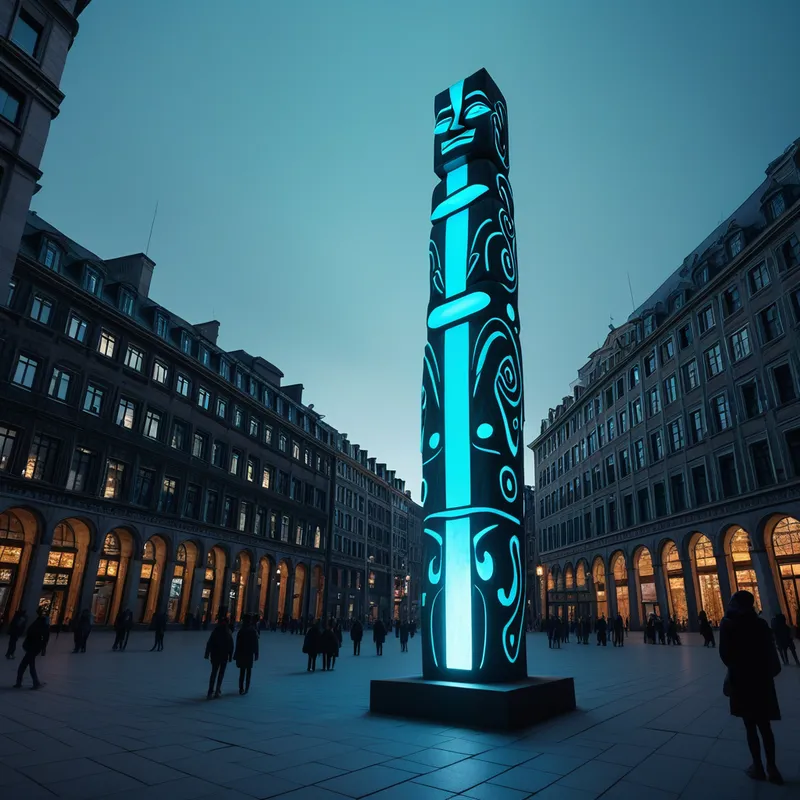
Then, you must begin the work of revelation, not invention. You carve away the superfluous—the false identities, the borrowed narratives—to find the authentic forms stacked within you. This is the construction of your personal “totem”: integrating the instinctual (animal) energies with the human and the spiritual into a coherent, vertical structure of Self.
Individuation is the process of becoming a living petroglyph: allowing the eternal patterns of the psyche to become legible through the unique medium of your one, mortal life.
Simultaneously, you must make your pilgrimage to the inner cliff-face—the resistant, ancient parts of your being. There, you patiently trace the patterns already there. You acknowledge the spirals of your complexes, the handprints of ancestors on your fate, the whale of your deep emotions. You do not paint over them; you consecrate them by seeing them. The [triumph](/myths/triumph “Myth from Roman culture.”/) is not conquest, but communion. The transformed psyche is one that has become a vessel of memory, a standing witness to its own depth, speaking the forgotten language of relation. It is no longer a lonely individual, but a living pole, a talking stone—a fully inhabited crossroads between time and eternity, earth and sky.
Associated Symbols
Explore related symbols from the CaleaDream lexicon: