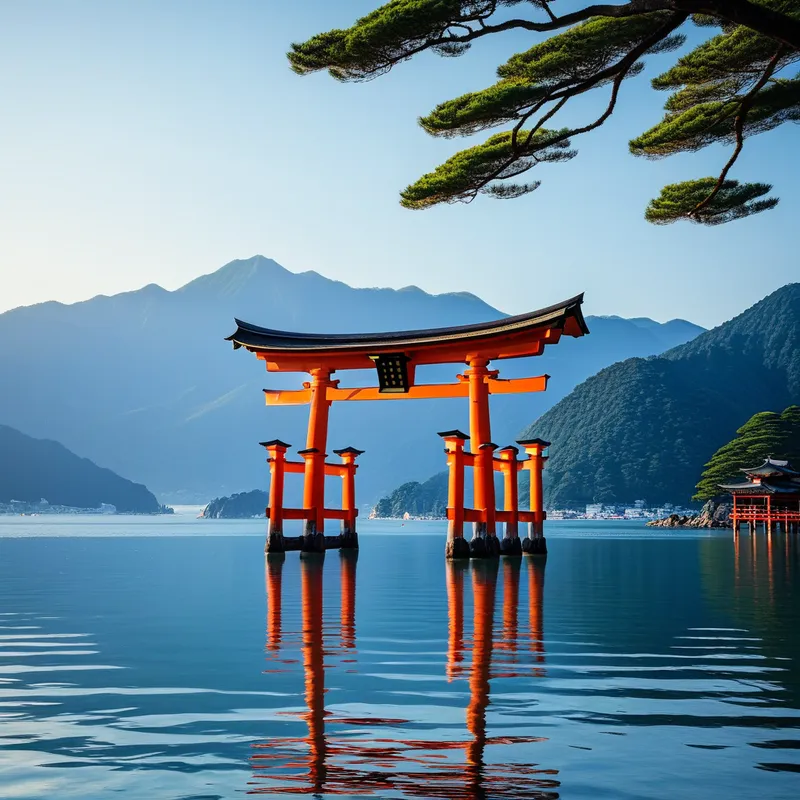
Torii Gates at Itsukushima Shrine Myth Meaning & Symbolism
A sacred gateway rises from the sea, marking the boundary between the mortal realm and the divine, where the kami of the island dwell in eternal, tidal grace.
The Tale of Torii Gates at Itsukushima Shrine
Listen, and let the salt air fill your lungs. Let the whisper of the Seto Inland Sea carry you to a time when the world was thinner, and the veil between realms was a shimmering curtain of mist. There is an island, Miyajima, where the mountains are the bones of the earth and the forests are the robes of the gods. It was so sacred that common feet were forbidden to tread upon its soil, for it was the dwelling place of the three kami daughters of the storm god Susano-o-no-Mikoto.
In the ancient days, the people from the shore would paddle their boats across the channel, their hearts full of reverence and fear. They could not land. They could only approach, singing prayers across the water, their offerings held aloft. They felt the presence—a mighty, feminine, and tidal force—radiating from the island’s heart. It was beauty so fierce it was terrifying; nature so pristine it felt like a divine thought made manifest. The kami were there, in the rustle of the ancient pines, in the crash of the wave on the rocky coast, in the silent depth of the primeval forest. But how does one approach such power? How does mortal reverence bridge the gap to immortal grace?
Then came a vision, not in a dream of sleep, but in the waking dream of a devout soul. A priest, perhaps guided by the kami themselves, saw the solution not as a barrier, but as a gateway. Not a wall to keep humanity out, but a marker to show the way in. The answer lay in the tide—the eternal breath of the sea, the pulse of the world.
And so, they built not upon the sacred earth, but upon the threshold itself. From the seabed, they raised massive pillars of camphor wood. Upon them, they set a great, sweeping lintel, painted the vibrant red of the rising sun and of lifeblood—the color that wards off evil and attracts the benevolent. They constructed the entire shrine complex upon pilings, so that at high tide, it would float, ethereal, upon the mirror of the sea. And before it all, they built the Great Torii.
See it now, as the first pilgrims did. As your boat draws near, the gate appears to rise directly from the waves, a monumental frame holding the island itself as its sacred picture. You pass through it, and in that moment, you are purified. You have crossed from the profane world into the sacred. The water beneath you is no longer just sea; it is the liminal plane. The gate is not a door you shut, but an eternal portal you acknowledge. At low tide, the sea draws back its silken cover, and you may walk on the revealed sand right up to the gate’s mighty feet, touching the barnacled pillars where the sea and earth meet. At high tide, the gate stands alone, a solitary, majestic sentinel in the aquamarine expanse, reflecting perfectly upon the still surface—a gateway in this world and the next. The conflict was distance; the resolution was a threshold. The rising action was the tide; the resolution is eternal, repeating with every breath of the moon.
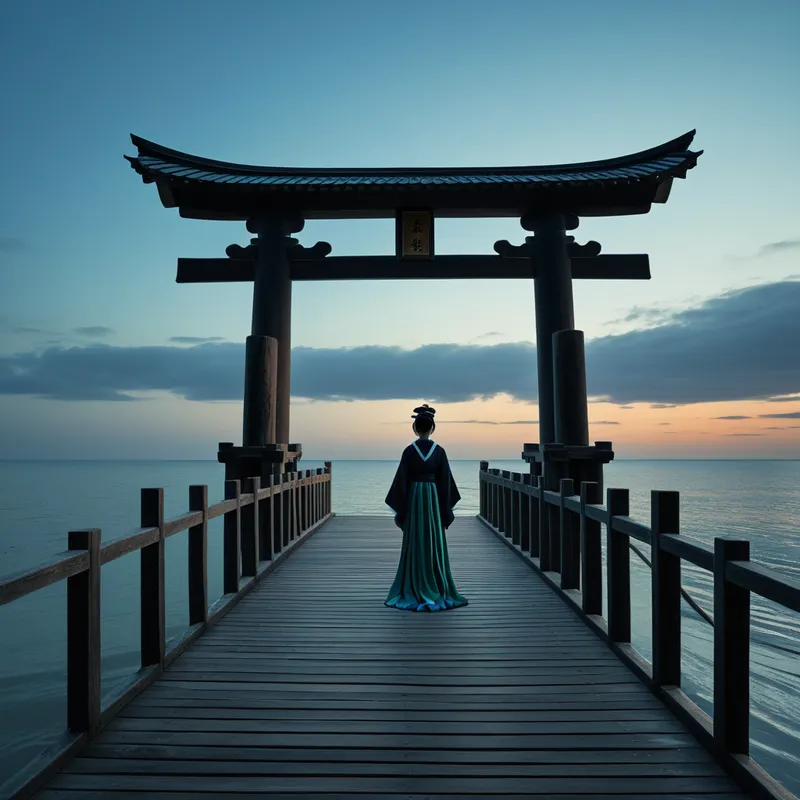
Cultural Origins & Context
The mythos of Itsukushima is not a single, codified narrative but a living tradition woven from Shinto principles, historical patronage, and layered symbolism. Its origins are attributed to the 6th century, but its legendary form was crystallized in the 12th century by the powerful warlord Taira no Kiyomori. He adopted the shrine as a family tutelary site, dedicating it to the Ichikishima-hime, Tagori-hime, and Tagitsu-hime, whom he believed granted him naval and political power.
The myth was passed down not merely by storytellers, but by ritual practice and architectural witness. The shrine priests were its custodians, and every pilgrim who sailed through the Torii became a participant in the story. Its societal function was multifaceted: it reinforced the Shinto concept of kegare (impurity) and the need for ritual separation from the sacred; it demonstrated the ideal of harmony between human creation and the natural world (mono no aware); and it served as a powerful symbol of the Heian court’s aesthetic and spiritual authority, blending Buddhist influences (the shrine complex includes a temple) with core Shinto animism.
Symbolic Architecture
The Torii gate is the myth’s central symbol, an architectural mandala representing the fundamental structure of a sacred encounter.
The gate does not ask if you are worthy; it asks if you are aware. It marks the moment you choose to see the world as numinous.
Psychologically, the Torii represents the threshold of consciousness. The “profane world” is the ego’s familiar territory—the dry land of daily identity, logic, and personal concerns. The “sacred island” is the realm of the Self—the vast, mysterious, and often intimidating totality of the psyche, home to archetypal forces (the kami). We cannot—and should not—live permanently in that overwhelming depth. But we must learn to approach it, to pay homage to it.
The tide is the symbolic representation of the unconscious’s rhythm. It is not static; it ebbs and flows. There are times when the gateway to the deeper self is submerged, mysterious, and only accessible by boat (through intuition, dreams, or art). These are the “high tide” periods of emotional or unconscious overwhelm. Then there are times of “low tide,” when the path is revealed, solid and walkable—moments of clarity, insight, and conscious integration where we can directly approach the foundations of our being.
The fact that the shrine is built over the water, not on the land, is critical. It represents a structure of consciousness that exists in the liminal space itself. It is not of the ego, nor is it lost in the unconscious. It is the psyche’s ability to create a stable platform for witnessing and relating to the depths without being swallowed by them.
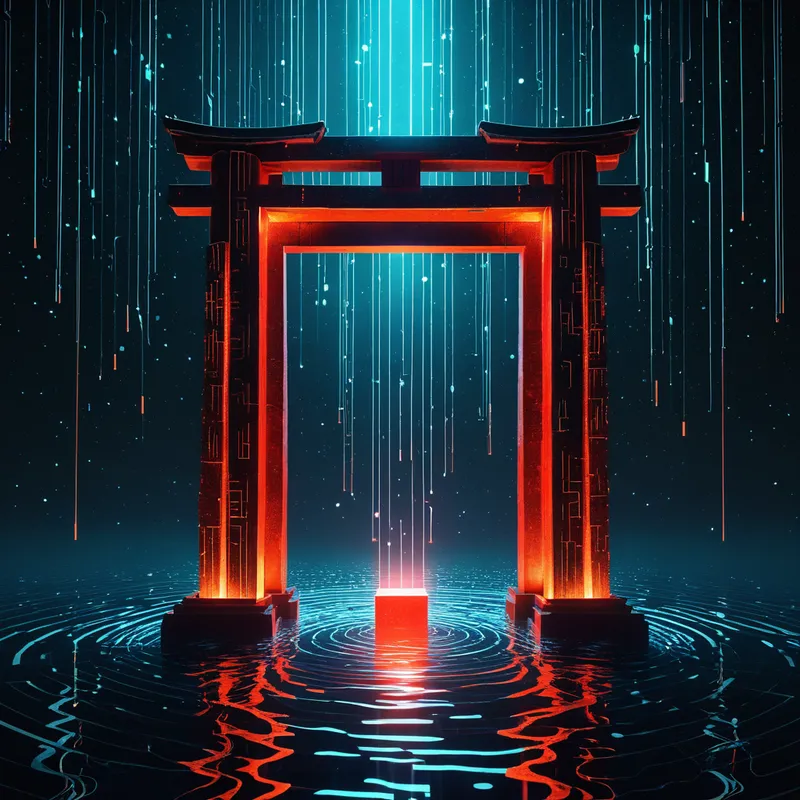
The Dreamer’s Resonance
When this myth surfaces in modern dreams, it rarely appears as a historical replica. Instead, one might dream of a vast, often floating or impossibly situated gateway. It could be a neon archway in a cityscape, a stone gate in a dense fog, or a simple doorframe standing alone in a field.
The somatic experience is often one of paused breath and focused attention at the threshold. The dreamer is compelled to stop and consider the act of passing through. This signals a psychological process of confronting a liminal state in waking life: a career change, the end of a relationship, a spiritual crisis, or the onset of a creative endeavor. The water level in the dream—whether the gate is dry, lapped by waves, or submerged—indicates the dreamer’s perceived accessibility to their own inner resources and unconscious material. A flooded, impassable gate suggests feeling overwhelmed by emotions or the unknown. A dry, approachable gate suggests a moment ripe for conscious exploration and integration.
The dream asks: What sacred, intimidating, or profoundly beautiful aspect of yourself or your life are you preparing to acknowledge? What ritual of attention must you perform before you cross?
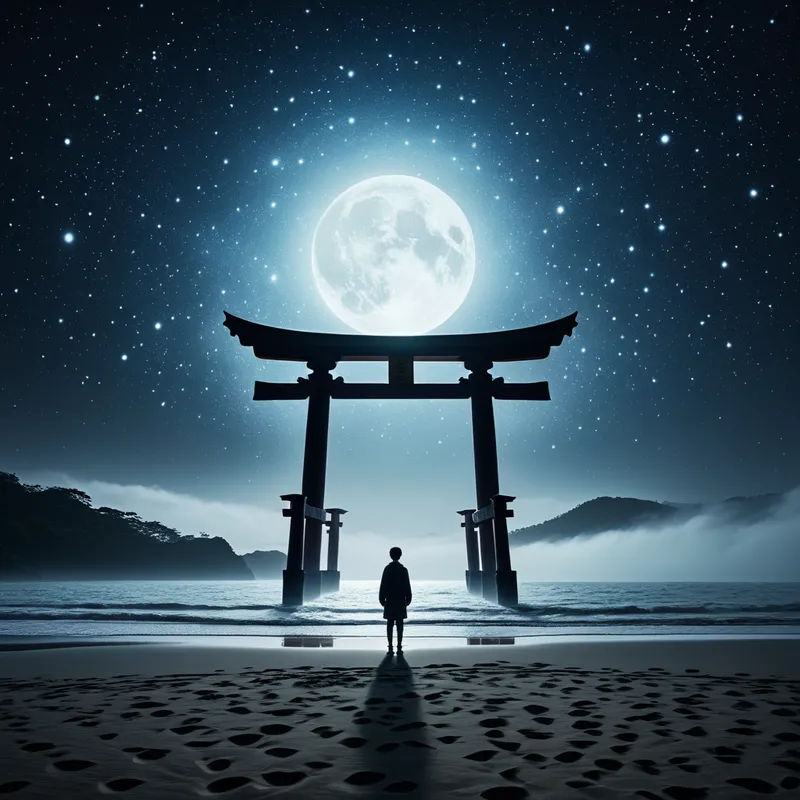
Alchemical Translation
The alchemical process modeled here is not the violent conquest of the hero, but the respectful transmutation of perception that leads to individuation. The base material is the leaden, mundane view of reality. The goal is the gold of experiencing the world as a sacred, interconnected whole.
Individuation is not about reaching the island, but about learning to build your shrine upon the tide. It is the conscious habitation of the threshold.
1. Nigredo (The Blackening): This is the initial recognition of separation—the feeling of being in the boat, distant from the island of the Self. It is a sense of spiritual longing, alienation, or the dullness of a life lived only on the “mainland” of ego.
2. Albedo (The Whitening): The vision of the Torii. This is the emergence of a symbol from the unconscious that clarifies the nature of the boundary. It is an insight, a synchronicity, or a dream image that reveals the structure of the transition needed. It whitens by providing form to the formless longing.
3. Citrinitas (The Yellowing): The act of constructing the shrine in the liminal space. This is the conscious work of building a practice—be it meditation, journaling, therapy, or art—that exists specifically to facilitate dialogue between the ego and the Self. It is the application of will to create a stable point of observation and reverence.
4. Rubedo (The Reddening): This is the vermilion of the gate itself, achieved through repeated ritual crossing. It is the embodied, lived experience of the threshold. Each time one consciously moves between states—between work and rest, logic and intuition, solitude and community—with awareness of the sacredness of the transition, the rubedo deepens. The final gold is not a static state on the island, but the perpetual, fluid grace of a life lived in rhythmic harmony with the rising and falling tides of one’s own being, always in sight of the majestic gate that reminds you: you are both the pilgrim and the shrine.
Associated Symbols
Explore related symbols from the CaleaDream lexicon: