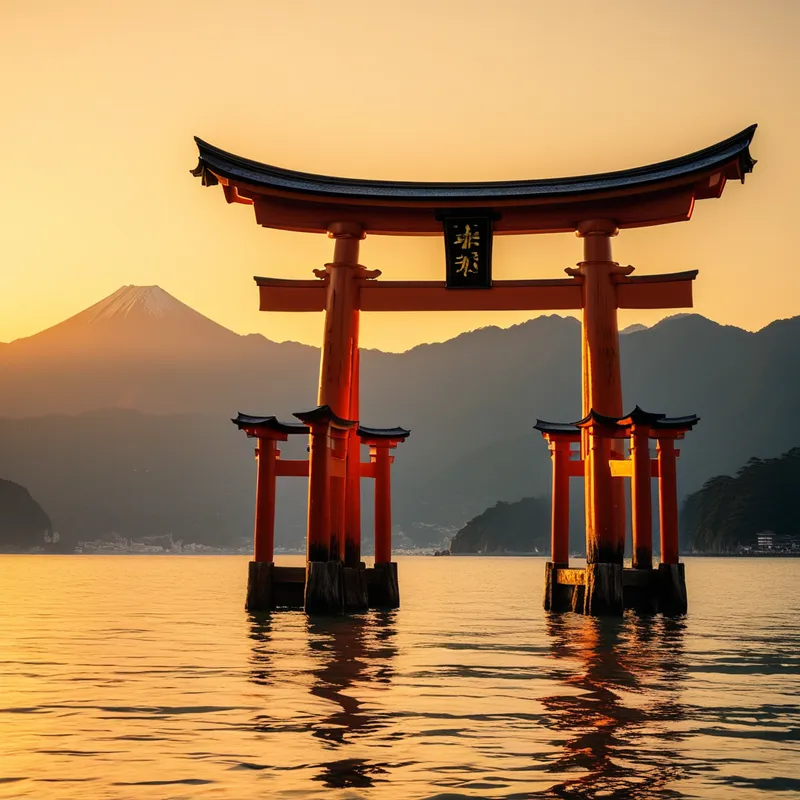
Torii Gate Myth Meaning & Symbolism
A sacred gateway born from divine intervention, marking the boundary between the profane and the sacred, the human realm and the dwelling of the kami.
The Tale of the Torii Gate
Listen, and let the mists of Kamiyo part. In a time when the world was still soft and the breath of the gods stirred the leaves of the ancient cryptomeria, there was a place where the realms brushed against one another. It was not a place of stone or map, but a feeling—a trembling in the air where the kami descended from Takamagahara.
The people knew this spot. They felt it as a chill on the skin, a silence deeper than the forest’s hush. They would bring offerings of rice and salt, laying them upon a simple rock, but the space remained… open. Unmarked. When the Amaterasu-Ōmikami sent her light through the canopy, it would pool there strangely. When the storm Susanoo raged, the winds would eddy and swirl in that same clearing. The boundary was potent but perilous; one could step from the world of men into the world of the divine without knowing, and be lost.
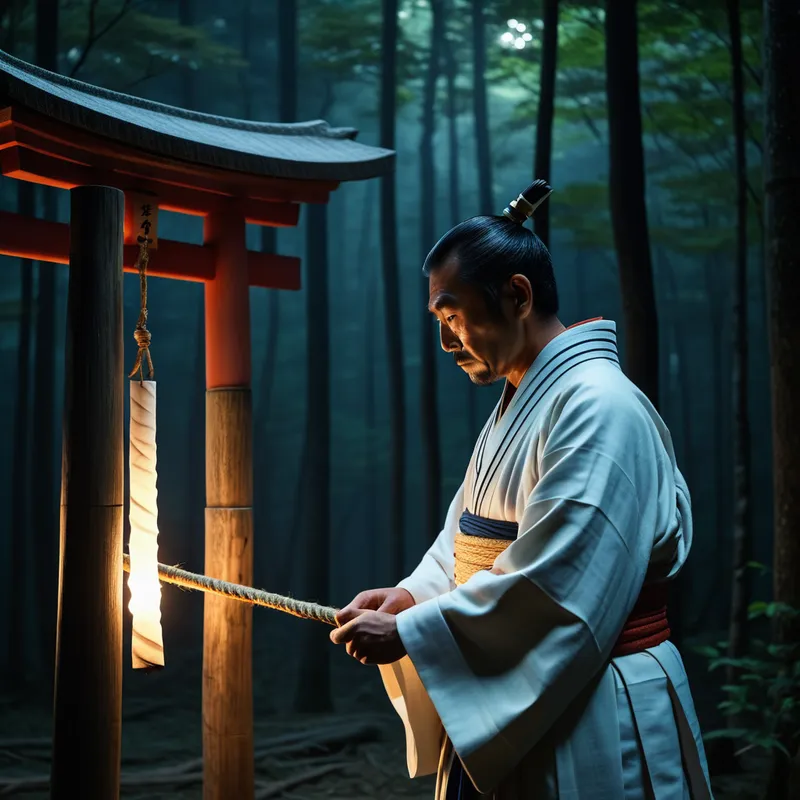
The people sought guidance from the kannushi. An elder, his face a map of years, listened to the whispers of the land. He fasted and purified himself in the icy river, donning white robes. For three nights, he sat in meditation at the trembling place, offering prayers and the clear note of a bell. On the third night, a vision came, not in a dream, but in the very substance of the air.
He saw a great perch. A bird, a celestial rooster, sent by Amaterasu herself, had alighted upon a towering wooden structure to crow at dawn and summon the sun from her cave. This structure was simple, profound: two pillars holding a crossbeam, and upon that beam, the sacred bird rested. It was a perch for the divine, a marker so clear that no soul could mistake its meaning. The message was not of barring, but of framing. It did not say “stop,” but “behold.”
With the first light, the elder arose. The village gathered. From the heart of the oldest cedar, they hewed two straight pillars. They shaped a lintel, and with solemn rites, they raised them in the sacred clearing. They did not build a wall or a door, but a gateway. They bound the posts with a sacred rope, a shimenawa, from which hung white paper lightning. They painted it the color of the life-giving sun and the vital blood: vermilion.
And as the last brushstroke dried, the trembling ceased. The air grew still, not empty, but full. The threshold was now visible. To pass beneath the lintel was to knowingly, willingly, step from the profane into the sacred. The gate did not hold the kami captive; it honored their passage and prepared the human heart for the encounter. The Torii was born—a perch for the gods, a guide for humanity, a silent poem written in wood and space between two worlds.
Cultural Origins & Context
The myth of the Torii Gate’s origin is woven into the very fabric of Shinto, Japan’s animistic heart. Unlike myths with a single canonical text, its story is told through ritual practice and architectural evolution. The earliest Torii were likely simple wooden constructions marking sacred groves (chinju no mori) or stones where kami were believed to dwell. The etymological link to “bird perch” (tori-i) is central, connecting it to the rooster whose crow heralded the return of Amaterasu from the Ama-no-Iwato, a foundational myth of light returning to the world.
These gates were not the grand, lacquered structures of later centuries but functional, spiritual signposts. They were maintained and replicated by local communities under the guidance of shrine priests, their form passed down not through scripture but through the embodied knowledge of carpenters and ritualists. Societally, the Torii functioned as the ultimate clarifier. In a worldview where the sacred (hare) and the everyday (ke) were in constant flux, the gate provided a definitive, physical moment of transition. It managed the profound Shinto concept of kegare (impurity), allowing for a conscious shedding of the mundane before engaging the divine.
Symbolic Architecture
At its core, the Torii is a monument to the liminal—the transformative space of the threshold. It is a symbol built from negative space; its power lies in the emptiness it frames.
The gate is not the barrier, but the recognition of the barrier. It makes the invisible boundary visible, and in doing so, grants us the choice to cross.
The two pillars represent duality: heaven and earth, sacred and profane, conscious and unconscious. The lintel that joins them symbolizes the transcendent function that bridges these opposites, creating a new, third space—the sacred path (sando). The vermilion color is alchemical, a protector against decay and evil spirits, but also a vibrator of life force, attracting the kami.
Psychologically, the Torii represents the ego’s necessary structure for encountering the numinous. The unprepared psyche, like the villager in the unmarked clearing, can be overwhelmed by direct contact with the unconscious (the realm of the kami). The Torii—as ritual, as mindfulness, as preparation—builds a stabilizing structure within the ego. It says, “Here begins something different. Prepare yourself. Purify your intention.” It allows the individual to approach the depths without being dissolved by them.
The Dreamer’s Resonance
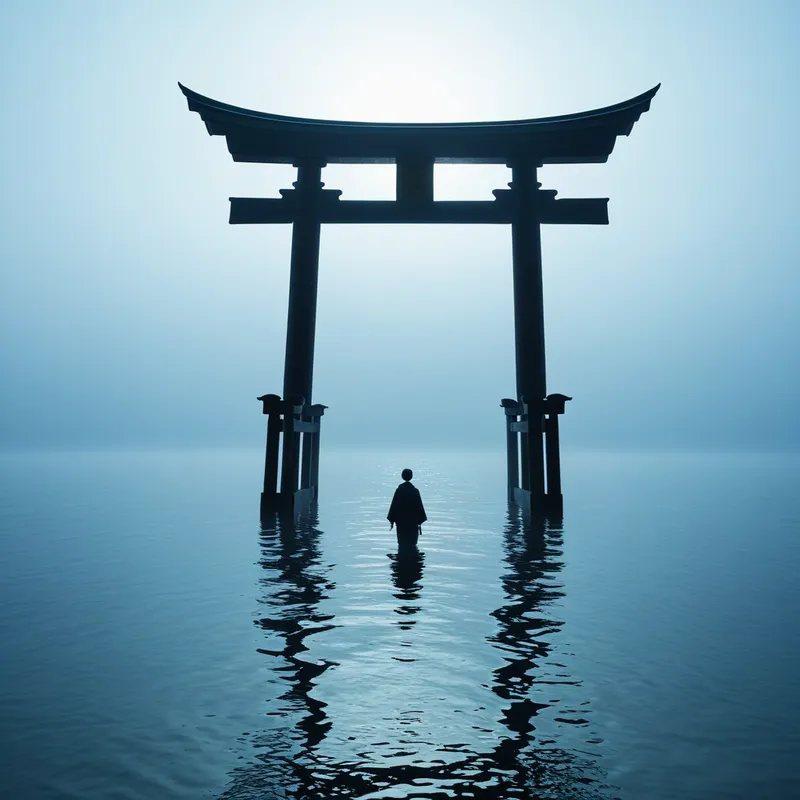
When a Torii Gate appears in a modern dream, it rarely signifies a literal visit to Japan. It manifests as the psyche’s own architecture for a looming transition. The dreamer may find themselves standing before it on a foggy beach, at the end of a city alley, or in the center of a familiar room that has suddenly become unfamiliar.
The somatic feeling is one of pregnant hesitation. There is often a mix of awe and anxiety. The water flowing beneath a gate like that at Itsukushima in the dream represents the fluid, emotional unconscious one must acknowledge before passing through. The act of pausing, bowing, or purifying oneself in the dream is crucial—it indicates the psyche’s innate knowledge that one cannot charge unchanged into a new phase of life. The gate demands respect for the process.
If the dreamer passes through easily, it can signal successful integration of a new consciousness or a readiness to accept a sacred aspect of the self. If the gate is blocked, impossibly tall, or if the dreamer turns away, it points to a resistance to a necessary, perhaps daunting, psychological or life transition. The Torii in a dream is the self-created marker for the boundary between who you have been and who you are being called to become.
Alchemical Translation
The myth of the Torii models the individuation process as a series of conscious thresholds. The modern individual does not live in a sacred grove, but the unconscious still presents its “trembling places”—moments of synchronicity, emotional upheavals, creative callings, or profound loss that signal a frontier.
First, we must recognize the clearing—the symptom, the recurring pattern, the longing. This is the elder’s perception. Then, we must erect our own gate. This is the conscious act of creating ritual: beginning therapy, committing to a journaling practice, setting a solemn intention, or simply pausing to acknowledge, “What is happening here is significant.” We build two pillars of awareness (observing the inner and outer reality) and cap them with the lintel of meaning-making.
Individuation is not the annihilation of the ego, but the construction of a Torii strong enough for the ego to stand at, and then walk through, to meet the Self.
Passing under this self-made gate is the act of voluntary engagement with the unconscious material. It is the analysis of the dream, the feeling of the repressed emotion, the writing of the poem. The vermilion paint is our sustained attention and respect, which protects the process from being corrupted by old defenses. On the other side, we do not find a final answer, but a path (the sando) leading deeper into the sacred precinct of the Self. Each new challenge, each new layer of complexity, requires the building of a new Torii, a new conscious threshold. Thus, the journey of becoming whole is an endless, sacred approach, marked again and again by the silent, elegant architecture of our own awakening.
Associated Symbols
Explore related symbols from the CaleaDream lexicon: