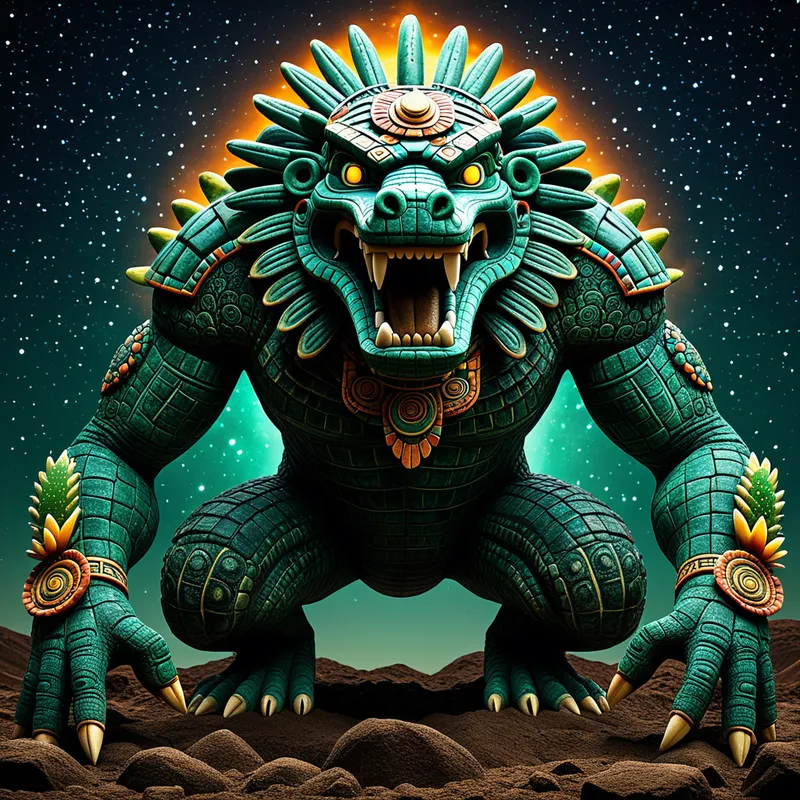
Tlaltecuhtli Earth Monster Myth Meaning & Symbolism
A primordial monster is dismembered by gods to create the world, becoming the living, hungry earth from which all life springs and to which it returns.
The Tale of Tlaltecuhtli Earth Monster
In the time before time, in the Nepantla, there was only the dark, star-salted water. And in that water, there was a hunger. It was not the hunger of a belly, but the hunger of a world waiting to be. This hunger had a form, a sound, a name: Tlaltecuhtli.
She was vast, a living landscape adrift in the primordial sea. Her skin was the rough hide of a crocodile, crusted with precious stones and knotted roots. At every joint—elbows, knees—a great maw gnashed, teeth of flint and obsidian. Her eyes were deep caves where primordial fires smoldered. She crawled through the endless waters, roaring with a need that shook the fabric of the void. She was loneliness made flesh, a being of pure, insatiable wanting.
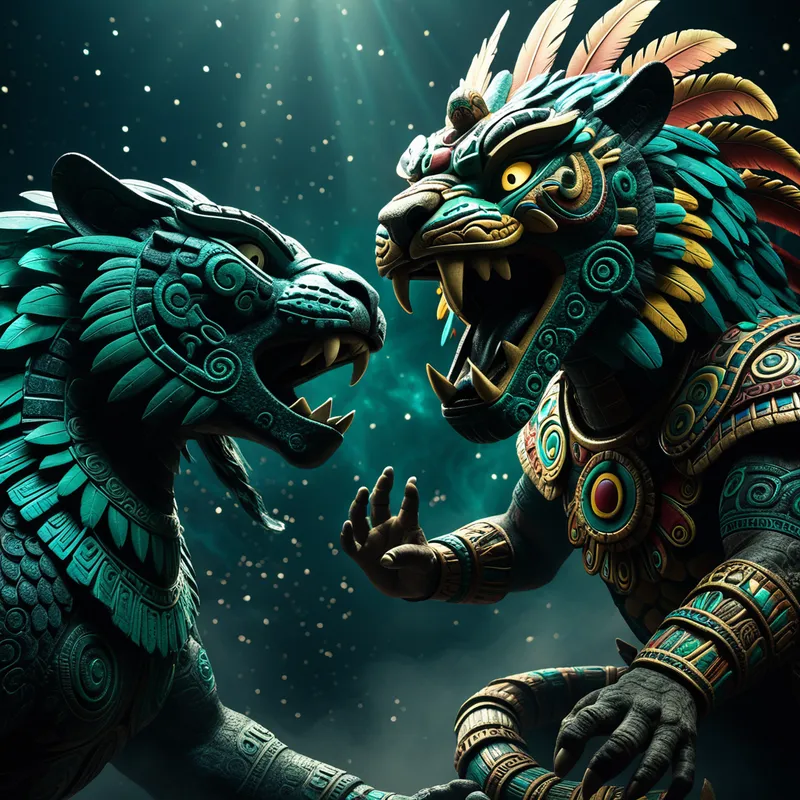
The gods looked down from their high place and saw this chaos. They saw that to make a world for the sun to cross and for life to take root, they needed a foundation. They needed the raw, terrible substance of Tlaltecuhtli. But she was mighty, and she would not be tamed. The great deities Quetzalcoatl and Tezcatlipoca took on the task. They transformed—one into a magnificent, coiling serpent of iridescent feathers, the other into a sleek, powerful jaguar, his coat the night sky, his foot a smoking obsidian mirror.
Down they plunged into the cold waters. The monster sensed them and her roars became thunder. The battle was cataclysmic. The jaguar seized one mighty limb, the serpent another. They pulled with the strength of cosmic winds and the certainty of fate. Tlaltecuhtli shrieked, a sound that tore at the silence of pre-creation. She fought, her maws snapping, her body a continent in revolt.
But the gods were relentless. With a final, terrible exertion, they tore her asunder. Her body broke. The sound was the first earthquake, the first mountain forming, the first river finding its bed. Her back they flung upward, and it became the sky, arching over all. Her lower half they cast down, and it became the earth—not a dead rock, but a living, feeling being. From her hair grew the forests, from her skin the grasses and plains, from her eyes the springs and deep wells. Her many mouths remained, now caves and chasms, forever hungry.
Yet her spirit was not placated. Her cries of agony echoed in the new silence. To soothe her, the other gods decreed that all things born of her body must return to her. From her flesh would come the fruits and maize; to her mouths would return all living things in death. Her heart, still beating, became the precious chalchihuatzin, the green jewel of life. And so, the world was made—a sacred, painful gift, born from a monstrous sacrifice, forever sustained by a reciprocal hunger.
Cultural Origins & Context
This myth was central to the Aztec worldview, recorded in post-Conquest texts like the Historia de los Mexicanos por sus pinturas and the Leyenda de los Soles. It was not a simple “story” but a foundational truth, explaining the nature of reality itself. It was likely preserved and transmitted by tlamatinime (wise ones) and illustrated in sacred codices.
Its societal function was profound. It justified the core Aztec practice of sacrifice. If the very earth was created from the dismemberment of a deity, and if that earth-being demanded sustenance (her cries for hearts and blood were said to continue as the night wind), then human offerings were not cruelty, but sacred reciprocity. They were feeding the wounded entity that sustained them, paying a cosmic debt to keep the sun moving and the world fertile. The myth established the earth not as inert matter, but as a sentient, divine, and demanding being—a concept that governed agriculture, warfare, and cosmology.
Symbolic Architecture
At its core, the myth of Tlaltecuhtli is about the paradoxical nature of creation: that it is always born of destruction, and that sustenance requires sacrifice. Tlaltecuhtli represents the undifferentiated, chaotic, and all-containing potential of the prima materia. She is the “world as womb,” but a womb that is also a devouring maw.
The first act of consciousness is to differentiate itself from the undifferentiated whole, an act that is always experienced by the whole as a violent rending.
Psychologically, Tlaltecuhtli symbolizes the Shadow on a cosmic scale—the terrifying, raw, and instinctual foundation of the psyche that must be confronted and integrated for the conscious world (the ego) to be built. The gods Quetzalcoatl and Tezcatlipoca represent complementary forces of order: culture and nature, light and dark, conscious strategy and unconscious instinct, working in tandem to perform the necessary, brutal act of structuring chaos. The dismemberment is not a murder, but a differentiation; from the one monstrous body, the manifold world is born.

The Dreamer’s Resonance
When this myth stirs in modern dreams, it often manifests not as a literal monster, but as a profound somatic and environmental experience. One may dream of the ground opening beneath them, not to swallow, but to reveal a deep, organic complexity within. They may dream their own body is a landscape—a mountain range for a spine, rivers for veins—feeling both immense and vulnerable.
This dream pattern signals a profound process of psychic re-formation. The dreamer is experiencing the “dismemberment” of an old, monolithic sense of self or a rigid worldview. It is the terrifying yet necessary breakdown of a previously whole-but-limiting identity (the “monolithic monster”) so that a richer, more complex, and life-sustaining inner world can be assembled from its parts. The hunger felt in the dream is the psyche’s raw, unmet need for this transformation. It is the call to sacrifice outdated ways of being to feed the growth of something new.

Alchemical Translation
The alchemical journey mirrored in this myth is the Nigredo, the descent into and confrontation with the massa confusa, the chaotic base matter of the soul. Tlaltecuhtli is that base matter—our unprocessed grief, rage, instinct, and primal need.
Individuation begins not with building a tower, but with the courageous, agonizing dissolution of the island upon which you stand.
The modern individual’s “alchemical translation” of this myth involves a conscious engagement with one’s own “monstrous” foundations. It is the process of allowing old, rigid structures of personality (defenses, complexes, self-images) to be “torn apart” by the interplay of conscious insight (Quetzalcoatl) and confronting the shadowy, fateful truths of one’s nature (Tezcatlipoca). The goal is not to slay the monster, but to transform one’s relationship to it. To see that one’s deepest wounds, hungers, and chaotic emotions are the very substance from which a fertile, resilient, and authentic life is built. The nourishment we offer—through honest self-reflection, creative expression, or accepting life’s necessary endings—becomes the sacrifice that heals the wounded earth within, allowing for continual rebirth.
Associated Symbols
Explore related symbols from the CaleaDream lexicon:
- Earth — The primary symbol of Tlaltecuhtli herself, representing the living, sentient, and demanding foundation of all existence, born from sacrifice.
- Sacrifice — The core dynamic of the myth; the necessary offering of life and energy to heal the wounded creator and sustain the created world.
- Monster — Tlaltecuhtli as the primordial, chaotic, and terrifying form that contains the raw material for all creation before it is differentiated.
- Mother — The earth as a generative but devouring maternal force, from whose body all life springs and to whose depths it must return.
- Dismemberment — The violent but creative act of separating the unified chaos into the distinct parts that form the ordered world and the individuated psyche.
- Hunger — The insatiable need of the primordial matter and the created earth, driving the cycle of life, consumption, death, and offering.
- Rebirth — The eternal promise of the myth; that from every return to the earth (every death, every ending) new life is inevitably generated.
- River — The flowing blood and life-essence of the dismembered goddess, now coursing through the landscape as waterways that nourish and connect.
- Mountain — The bones and flesh of Tlaltecuhtli raised skyward, representing stability, endurance, and the enduring presence of the primordial within the terrestrial.
- Cave — One of the many hungry maws of the Earth Monster, symbolizing entry into the dark, fertile, and dangerous depths of the earth and the unconscious.
- Heart — The still-beating core of Tlaltecuhtli, transformed into the precious jewel of life, representing the vital, sacred center that persists through transformation.
- Circle — The complete, inescapable cycle established by the myth: creation from destruction, life from death, feeding from being fed upon.