Tlaloc's Rain Rituals Myth Meaning & Symbolism
The story of the rain god Tlaloc, whose sacred rituals of weeping and sacrifice sustained the world, binding human life to the terrifying grace of water.
The Tale of Tlaloc’s Rain Rituals
Listen. The world was a dry bone, a cracked clay tablet under a white-hot sky. The maize stalks withered and whispered curses to the air. The children’s throats were parched flutes that could no longer sing. In the great city of Tenochtitlan, the canals grew shallow, revealing the mud’s desperate, gaping mouth. All eyes turned to the eastern mountains, to the mist-shrouded peaks where he dwelled: Tlaloc.
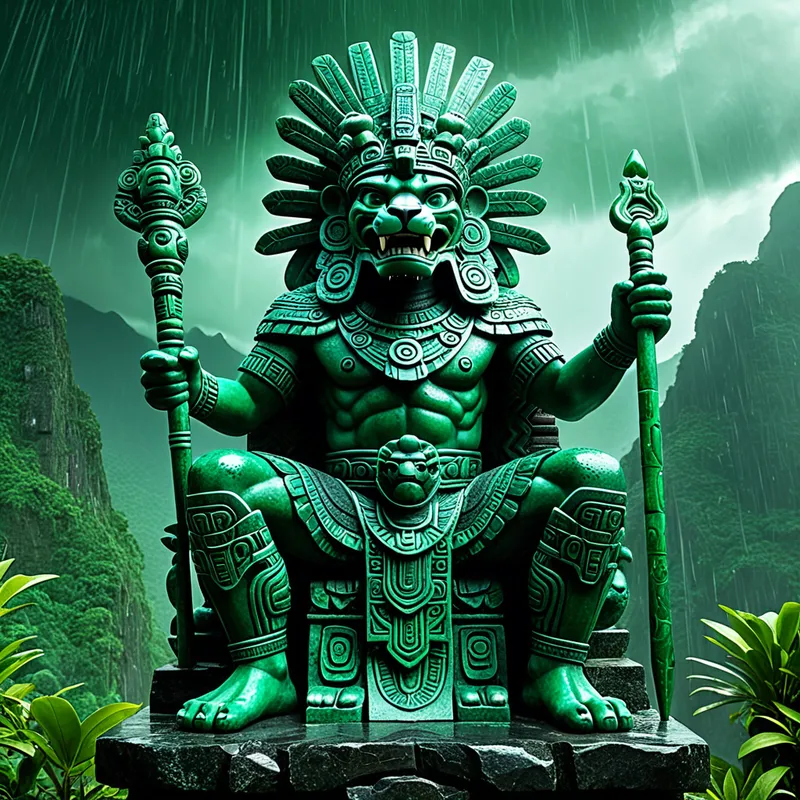
He was not a god of gentle showers. His realm was Tlalocan, a land of eternal spring, but the path to his bounty was paved with weeping. In his mountain caverns, where stalactites hung like the fangs of the earth, Tlaloc sat upon a throne of jade and obsidian. His eyes were vast, round pools, seeing all waters at once. His roar was the thunder that cracks the sky’s shell. In his hands, he held not a scepter, but four great jars.
In the first jar was the gentle rain that nourishes the seedling. In the second, the good rain that makes the maize grow tall and golden. In the third, the fierce rain that washes clean, the storm. And in the fourth… the fourth jar held the blight, the frost, the drought, and the hail. Which jar he chose to tip depended not on whim, but on a sacred exchange. Tlaloc required the most precious water of all: the tears of the living.
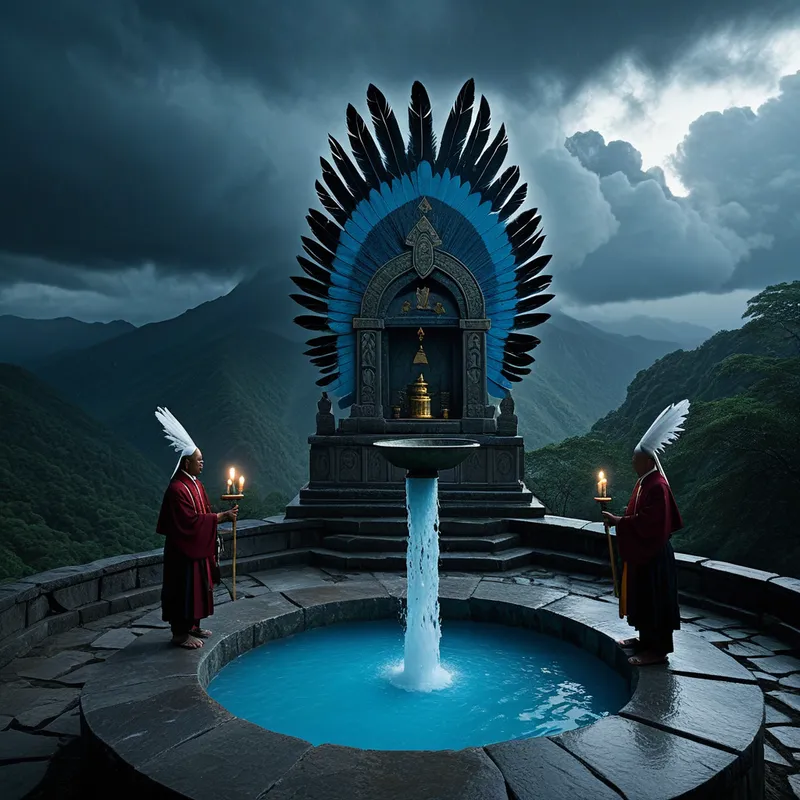
So the people climbed. The priests, faces painted with blue streaks of the sky’s veins, led the procession up the slopes of the sacred mountain. They carried with them the chosen ones: the children. Not as victims in chains, but as living vessels of the purest sorrow. Their tears were not of fear, but of a profound, ritualized grief, drawn forth by song and the sting of sacred sap. For the people knew a terrible truth: life is born from a pact with sorrow. The children’s weeping was the seed.
At the summit shrine, the air thin and sharp, the ritual unfolded. The priests offered not blood, but water—jade beads, blue-painted pottery, treasures the color of deep lakes. They burned copal incense, its smoke a prayer made visible, curling into the clouds. And the children wept. Their tears were caught in greenstone bowls, their sobs a wind that stirred the god’s domain.
In his cavern, Tlaloc heard. The sound of genuine, sacrificial weeping was a key that turned in the lock of the heavens. He would rise, his form a gathering of mists and dark potential. With a rumble that shook the very roots of the mountains, he would reach for the second jar—the jar of good rain. He would hurl its contents across the sky.
And then, it would come. Not a sprinkle, but a release. A torrential, life-giving deluge that would hammer the dry earth, fill the canals, swell the rivers, and seep into the waiting roots of the maize. The people below would lift their faces to the downpour, drinking it in, their own tears of relief mingling with the rain. The bone became flesh again. The clay tablet bloomed with green script. The pact was honored. The world lived, because it had learned how to weep.
Cultural Origins & Context
This was not a mere story told for entertainment; it was the operating system of a civilization built on a lake. The myth of Tlaloc’s rituals was central to the Aztec worldview, a people whose survival in the Valley of Mexico was a precarious balance between abundance and catastrophe. The myth was enacted, not just narrated, during the festival of Atlcahualo and other key points in the agricultural cycle.
The tellers of this myth were the tlamatinime (the wise ones) and the priests of Tlaloc’s cult, who maintained his shrines on mountaintops, places seen as the axis mundi connecting the earthly realm with the celestial waters. The myth served a stark societal function: it explained the necessity of a terrifying reciprocity. In a universe where the gods themselves had sacrificed to create the sun and move time, human sacrifice—particularly of those deemed sacred like children (the achcauhtli) or those who died by water—was the required sustenance for cosmic order. It framed suffering not as meaningless cruelty, but as the essential nutrient for collective survival, a theology of profound and unsettling responsibility.
Symbolic Architecture
At its core, the myth of Tlaloc is a profound allegory of the psyche’s relationship with the emotional and creative waters of the unconscious. Tlaloc himself is not a personal god but an elemental force, an archetype of the prima materia of life—water in all its dualistic potency.
The rain god does not give life; he is the condition for life, and his price is conscious engagement with sorrow.
The four jars represent the full spectrum of emotional and creative output: from gentle inspiration (nourishing rain) to prolific creation (good rain), to necessary destruction and cleansing (fierce storm), and finally, to creative block, depression, and psychic sterility (blight and drought). We do not get to choose only the gentle rain. To invoke the creative waters, we must accept the entire spectrum.
The ritual weeping is the critical symbol. It is not passive suffering, but active sacrifice—the conscious offering of one’s most refined emotional substance (tears) to a power greater than the ego. The children symbolize what is most innocent, potential-laden, and vulnerable within us. Their required tears signify that for the deep, unconscious wellsprings (Tlaloc) to release their fertility, the conscious self must first make a sacred offering of its own felt experience, its grief, its vulnerability. The mountain ascent is the journey of the ego toward the daunting heights of the unconscious, seeking a treaty with its overwhelming power.
The Dreamer’s Resonance
When this myth pattern stirs in the modern dreamer, it often manifests as dreams of elemental water in states of paradox or demand. One may dream of trying to fill a vessel that has no bottom, or of tears that turn to rain which then revives a dead garden. The somatic experience is one of pressure—a feeling of being both desiccated and dangerously full, of emotional dams threatening to break.
Psychologically, this signals a critical moment in the relationship between the ego and the emotional/unconscious self. The dreamer is in a state of “drought”—creative block, emotional numbness, or spiritual aridity. The unconscious (Tlaloc) is demanding its due: a genuine, sacrificial engagement with feeling. The ritual weeping in the myth translates to the dreamer’s need to consciously feel and honor their grief, sadness, or vulnerability—not to be rid of it, but to offer it as the necessary libation for renewal. To refuse is to risk the “fourth jar”: a descent into burnout, depression, or psychic emptiness.

Alchemical Translation
The alchemical process mirrored here is the solutio—the dissolution. In the laboratory of the soul, the solutio is not a gentle bathing but a terrifying drowning of the old, rigid forms of the personality so that a new composition can emerge.
Individuation requires a flood. The carefully constructed dam of the persona must be breached by the waters it was built to hold back.
The modern individual’s “mountain climb” is the courageous introspection required to face the inner Tlaloc—the vast, often frightening depth of one’s own emotional and creative potential. The “chosen children” are those precious, nascent parts of the self (new ideas, raw feelings, forgotten talents) that feel too vulnerable to expose. The “ritual weeping” is the act of vulnerability itself: allowing oneself to truly feel, to express authentic emotion, to sacrifice the ego’s need for control and invulnerability.
When this offering is made, the alchemical solutio occurs. The conscious mind is dissolved in the waters of the unconscious. This is not annihilation, but liquefaction—a return to a state of potential. From this flooded state, the “good rain” can fall: a renewed sense of purpose, authentic creativity, and emotional fertility that waters the entire psyche. The pact is internalized. One learns that personal wholeness, like the fertility of the Aztec world, depends on a sacred, ongoing exchange with the deep, sometimes terrifying, but ultimately life-giving waters within.
Associated Symbols
Explore related symbols from the CaleaDream lexicon: