Tlalocan Paradise Myth Meaning & Symbolism
A myth of souls who die by water, welcomed into Tlalocan's eternal green paradise by the weeping god Tlaloc, a story of grief transformed into abundance.
The Tale of Tlalocan Paradise
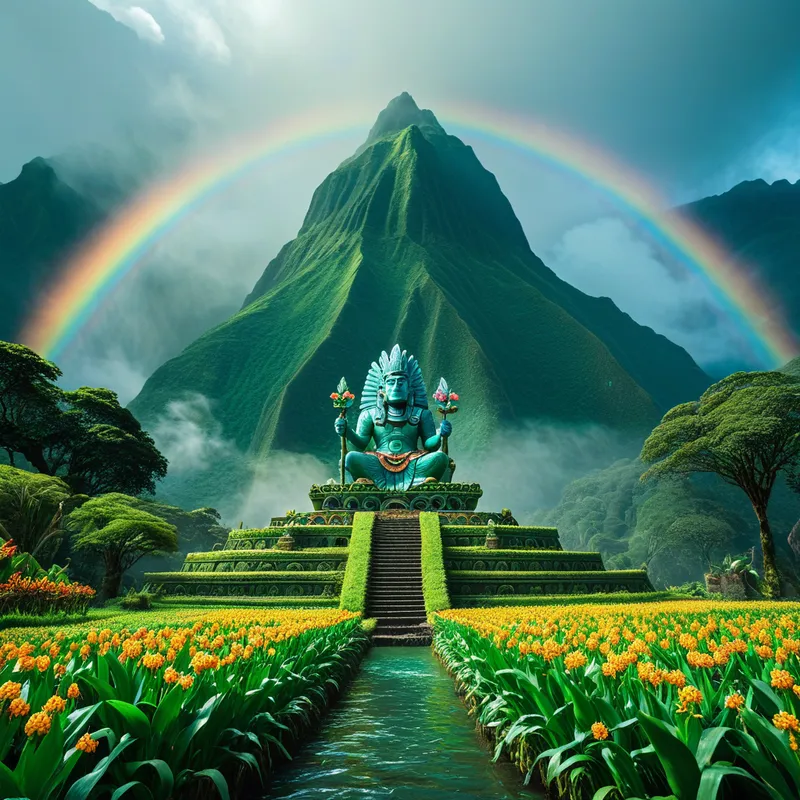
Listen. The world is dry. The earth cracks its lips, and the people lift their faces, parched and pleading, to the empty, burning sky. But the sky is not empty. In the highest eastern mountains, where the clouds are born from the breath of the earth, lies a realm of perpetual green. This is Tlalocan.
Its lord is Tlaloc, whose face is the colour of a storm-laden lake, whose eyes are great, round pools that see the sorrow of the world. He does not smile with joy, but with the deep, quiet solemnity of one who holds the gift of life and the necessity of death within his same, vast hands. In his court, the Tlaloque move like mist, their jars filled not with wine, but with the very essence of rain—each jar a different kind of storm, from the gentle drizzle to the sky-shattering deluge.
Now, when the lightning splits the oak, when the river rises in a sudden, swallowing embrace, when the damp chill enters the lungs and does not leave—these are not mere accidents. They are summons. The soul, torn from its earthly coil by the touch of water, does not descend into the sunless land of Mictlan. No. It begins a different journey.
Guided by the very element that claimed it, the soul travels for four years. It walks through ceaseless, soothing rain, along paths lined with glistening ferns. It hears, always, the distant, melodic call of birds it has never seen. The grief of its leaving is washed, slowly, by the journey itself. Finally, it stands before the great, verdant barrier of the eastern mountains. And the mountain opens—not a cave, but a gateway of cascading vines and blooming yolloxochitl.
The soul steps through. And there… there is no more hunger. No more thirst. No more ache of bone. The air is sweet with the scent of ripe fruit, of chocolate flowers, of damp earth. Maize grows in eternal, golden stands. Squash vines heavy with fruit crawl over arbours of jade. The soul is greeted not with fanfare, but with a profound, green silence. The Tlaloque approach, their faces serene. They offer ears of corn, ripe avocados, cups of frothing chocolate. They lead the soul to a house not of stone, but of living willow, by the side of a crystal stream.
And on his jade throne, Tlaloc watches. A single, gleaming tear—a drop of chalchihuitl, of sacred jade-water—tracks down his blue cheek. It is a tear for the pain of the parting, and a tear for the joy of the arrival. In Tlalocan, the sorrow of a death by water is alchemized into the very substance of eternal, flourishing life. The storm has passed. The soul is home, in the everlasting green.

Cultural Origins & Context
This vision of a watery paradise was not a mere folktale but a central pillar of the Mexica worldview, intricately woven into their cosmology, calendar, and social order. The concept of Tlalocan is preserved in the vivid descriptions of the 16th-century Florentine Codex, compiled by Bernardino de Sahagún from the accounts of Nahua elders. It was a myth recited by priests, painted in codices, and enacted in the very fate of individuals.
Societally, it served a critical function. It provided a specific, honourable destiny for those whose deaths were linked to Tlaloc’s domain: the drowned, those struck by lightning, those claimed by water-borne diseases, and later, those who suffered from ailments like leprosy or gout, which were associated with the god’s cold, damp nature. It even included those sacrificed to Tlaloc, often children whose tears were considered potent omens of rain. This differentiated them from the souls who undertook the harrowing journey through Mictlan. The myth thus organized death itself, offering a narrative of hope and specific, abundant reward for a particular kind of suffering, directly tying individual fate to the cosmic balance of a civilization dependent on agriculture and the precarious gift of rain.
Symbolic Architecture
At its core, Tlalocan is not merely a “happy [afterlife](/symbols/afterlife “Symbol: A symbolic journey beyond death, representing transition, the unknown, and ultimate questions about existence, purpose, and what follows life.”/).” It is a profound symbolic [statement](/symbols/statement “Symbol: A statement in a dream can symbolize the need to express one’s thoughts or beliefs, reflecting a desire for honesty or clarity.”/) about the [nature](/symbols/nature “Symbol: Nature symbolizes growth, connectivity, and the primal forces of existence.”/) of transformation, where the agent of [death](/symbols/death “Symbol: Symbolizes transformation, endings, and new beginnings; often associated with fear of the unknown.”/) becomes the medium of [rebirth](/symbols/rebirth “Symbol: A profound transformation where old aspects of self or life die, making way for new beginnings, growth, and renewal.”/).
The wound and the water that cleanses it are one. The force that dissolves the form is the same that nourishes the new growth.
Tlaloc himself embodies a profound [paradox](/symbols/paradox “Symbol: A contradictory yet true concept that challenges logic and perception, often representing unresolved tensions or profound truths.”/): the weeping god who brings [fertility](/symbols/fertility “Symbol: Symbolizes creation, growth, and abundance, often representing new beginnings, potential, and life force.”/). His tears, symbols of [grief](/symbols/grief “Symbol: A profound emotional response to loss, often manifesting as deep sorrow, yearning, and a sense of emptiness.”/), are literally the jewels (chalchihuitl) and the rain that make [life](/symbols/life “Symbol: The symbol of ‘Life’ represents a journey of growth, interconnectedness, and existential meaning, encompassing both the joys and challenges that define human experience.”/) possible. He represents the [archetype](/symbols/archetype “Symbol: A universal, primordial pattern or prototype in the collective unconscious that shapes human experience, behavior, and creative expression.”/) of the [Caregiver](/symbols/caregiver “Symbol: A spiritual or mythical figure representing nurturing, protection, and unconditional support, often embodying divine or archetypal parental energy.”/), but one whose nurture is inseparable from his [capacity](/symbols/capacity “Symbol: A measure of one’s potential, limits, or ability to contain, process, or achieve something, often reflecting self-assessment or external demands.”/) to enact necessary, often painful, endings. The four-[year](/symbols/year “Symbol: A unit of time measuring cycles, growth, and passage. Represents life stages, progress, and mortality.”/) [journey](/symbols/journey “Symbol: A journey in dreams typically signifies adventure, growth, or a significant life transition.”/) symbolizes a complete cycle of purification and preparation, aligning with the Mesoamerican cosmological importance of the four directions.
Tlalocan itself is the ultimate [symbol](/symbols/symbol “Symbol: A symbol can represent an idea, concept, or belief, serving as a powerful tool for communication and understanding.”/) of the psyche’s regenerative potential. It is the lush, inner [landscape](/symbols/landscape “Symbol: Landscapes in dreams are powerful symbols representing the dreamer’s emotional state, personal journey, and the broader context of life situations.”/) that can only be reached through immersion in the waters of the unconscious—through being claimed by a force greater than the ego. The eternal green represents a state of psychic life beyond conflict, where what was once a [source](/symbols/source “Symbol: The origin point of something, often representing beginnings, nourishment, or the fundamental cause behind phenomena.”/) of [trauma](/symbols/trauma “Symbol: A deeply distressing or disturbing experience that overwhelms the psyche, often manifesting in dreams as unresolved emotional wounds or psychological injury.”/) (watery death) has been fully integrated to become the [source](/symbols/source “Symbol: The origin point of something, often representing beginnings, nourishment, or the fundamental cause behind phenomena.”/) of perpetual nourishment and [peace](/symbols/peace “Symbol: Peace represents a state of tranquility and harmony, both internally and externally, often reflecting a desire for resolution and serenity in one’s life.”/).
The Dreamer’s Resonance
When this mythic pattern stirs in the modern unconscious, it often manifests in dreams of overwhelming, yet ultimately transformative, water. To dream of peaceful drowning, of walking into a welcoming ocean, or of a sudden, drenching rain that brings relief to a parched dreamscape, is to touch the Tlalocan complex.
Somatically, this can correlate with a process of release from a state of rigid, “dry” control—chronic anxiety, intellectual over-analysis, or emotional brittleness. The psyche is signalling a necessary dissolution. The “death by water” in the dream is the ego’s experience of surrendering to a deep emotional or intuitive process that feels threatening because it promises to change everything. The dreamer may be undergoing a profound grief, a creative block breaking open, or a depression that, while painful, is actually a soaking rain on a parched soul. The feeling upon waking may be one of eerie calm or sorrowful peace, pointing to the beginning of that four-year journey—the slow, often unconscious, integration of a life-altering experience.

Alchemical Translation
For the individual seeking wholeness, the myth of Tlalocan models the alchemical stage of solutio—dissolution. The conscious personality, identified with its achievements, defenses, and dry certainties, must be dissolved in the waters of the unconscious to be reborn.
Individuation does not avoid the flood; it learns to breathe within it, discovering that the water that seemed to threaten life is, in truth, its source.
The first, terrifying step is to acknowledge the “Tlaloc claim”—to recognize the areas of life where we are being overcome by a force we cannot control: a flood of emotion, a wave of grief, a storm of change. This is the lightning strike, the rising river. The heroic task here is not to fight the water, but to consent to the journey it initiates. The four-year pilgrimage is the patient work of therapy, reflection, art, or soulful introspection, where we allow the meaning of our suffering to slowly reveal itself.
Arriving in Tlalocan symbolizes the achievement of a new psychic equilibrium. The ego, once dissolved, reconstitutes itself in service to a deeper, more fertile Self. The individual discovers an inner abundance—creativity, compassion, wisdom—that flows directly from the very experiences that once felt annihilating. They become a custodian of their own green paradise, a caregiver to their own soul and, by extension, to others. They understand that their deepest wounds, once fully felt and traversed, can become the wellsprings of their greatest gifts.
Associated Symbols
Explore related symbols from the CaleaDream lexicon:
- Rain — The central agent and medium of the myth, representing both the destructive storm and the nourishing gift, the tears of the god and the blessing of life.
- Journey — The soul’s four-year passage through the rainy paths to Tlalocan, symbolizing the necessary process of purification and transition after a profound life-altering event.
- Rebirth — The core promise of Tlalocan, where death by water is not an end but a transformation into a state of eternal, flourishing vitality.
- Mountain — The eastern mountains that house Tlalocan, representing the lofty, inaccessible realm of the gods and the barrier between the mundane world and paradise.
- River — The pathway for many souls claimed by water, and the crystalline streams within Tlalocan, symbolizing the flow of destiny and the sustenance of the soul.
- Tree — The lush, eternal vegetation of the paradise, especially fruit trees and maize, representing life, abundance, and the rooted, stable peace of the afterlife.
- Grief — Embodied in Tlaloc’s tears and the sorrow of the earthly parting, which is alchemically transformed into the generative moisture of the paradise.
- Healing — The ultimate state of Tlalocan, where all sickness, hunger, and thirst cease, representing the soul’s recovery and restoration in a perfect environment.
- Spirit — The soul itself, specifically chosen and transformed by its association with water, moving from a mortal state to an eternal, blessed existence.
- Paradise — The mythic destination itself, Tlalocan, as the archetypal image of a perfect, abundant, and peaceful realm earned through a specific destiny.
- Tropical Paradise — A specific evocation of Tlalocan’s sensory reality: a warm, lush, verdant world overflowing with vibrant plant life and sweet waters.
- Flower — The yolloxochitl and countless other blooms of Tlalocan, representing beauty, fragrance, and the soul’s blossoming in its new, eternal home.