
Tlaloc Myth Meaning & Symbolism
The story of the ancient god of rain, whose tears of grief and joy water the world, demanding sacrifice to sustain the fragile covenant between humanity and the wild earth.
The Tale of Tlaloc
Hear now the voice of the mountain, the sigh of the cloud, the crack of the jar. In the time before time, when the world was a parched bone and the sky was a sheet of brass, there lived in the highest peaks, in the house of mist called Tlalocan, the great lord of all that is wet and green. His name was Tlaloc, and his face was the storm. His eyes were great rings of polished obsidian, seeing into the heart of every cloud. His teeth were the fangs of the jaguar-serpent, bared in the lightning’s flash. From his hands fell not blessings, but contracts.
He was a god of profound solitude, yet never alone. With him in Tlalocan dwelt the Tlaloque, his myriad helpers, small in stature but vast in power. Their joy was to hurl thunderbolts like stones and to shatter great jars of water against the mountainsides. Their grief was a silence that could wither empires. For Tlaloc’s realm was one of terrible duality: the life-giving shower and the soul-drowning flood, the gentle spring rain and the hurricane that uproots the world.
The people in the valleys below, the children of the Fifth Sun, knew this. They built their great city, Tenochtitlan, upon a lake, a testament to their need. And they knew the price. The priests would climb the rain-slicked steps of the Templo Mayor, their hearts heavy as stone. They would bring the most precious offerings: not gold, not jade, but life itself. The perfect corn, the green quetzal feathers, and sometimes—in years when the earth cracked and the children cried—the tears of children.
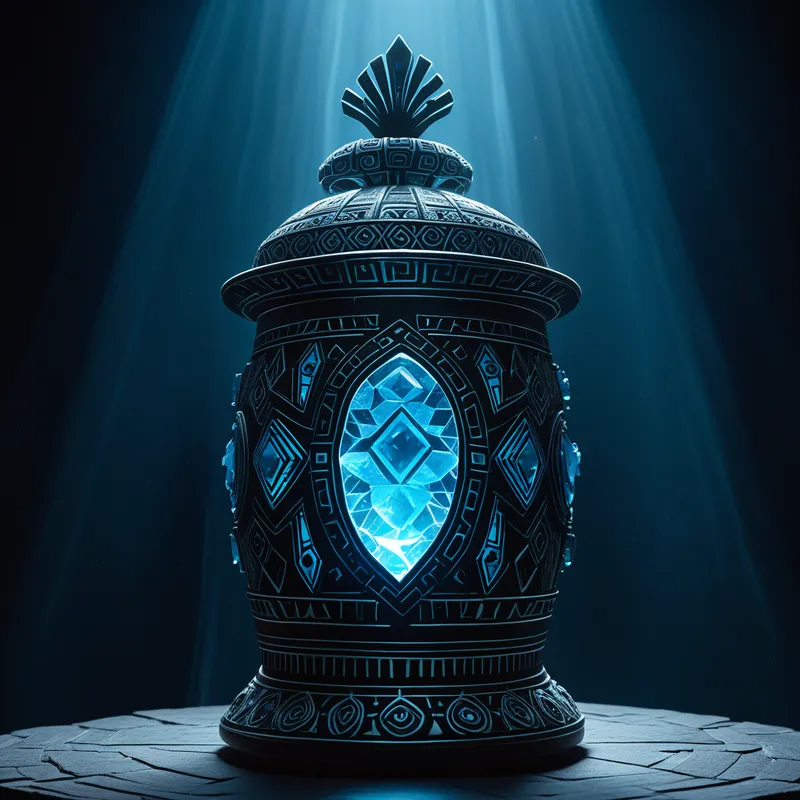
For only the tears of the innocent could speak a language the Storm Lord understood. They were the mirror of his own being. When the chosen ones wept, their tears were collected in sacred vessels. When the ceremony reached its zenith, under a sky taut with anticipation, the offering was given. And from Tlaloc’s obsidian eyes, a corresponding tear would fall. Then, the Tlaloque would stir from their sullen silence. A great crashing would echo in the mountains—the sound of a thousand jars breaking. And the rain would come. Not as a timid drizzle, but as a roaring, grateful, terrifying deluge, washing the altars clean and filling the canals to bursting. The maize would raise its green heads, the world would breathe again, and the fragile, awful covenant between earth and sky was renewed for another season.

Cultural Origins & Context
This was not a mere story for the Aztecs; it was a fundamental operating principle of reality, encoded in ritual, architecture, and the very calendar. The myth of Tlaloc permeated the Nahua cosmology, where the world existed in a precarious balance, sustained by reciprocal sacrifice (nextlahualli, “the debt payment”). Tlaloc was one of the oldest and most revered deities, predating the Aztec rise to power. His worship was likely inherited from the much earlier Teotihuacan culture.
The myth was passed down through generations by the tlamatinime (the wise ones, the philosophers) and enacted by the priesthood. It found its most potent expression in the dual architecture of the Templo Mayor, where Tlaloc’s shrine stood equal to that of Huitzilopochtli. This was a profound statement: the fertility of the earth (Tlaloc’s blue and white realm) was as vital to the empire’s survival as the political and military might of the sun (Huitzilopochtli’s red and black realm). The myth’s societal function was one of terrifying reassurance. It explained the capriciousness of weather and agricultural fortune, not as random chaos, but as a divine dialogue—a dialogue in which humanity had a direct, if somber, voice.
Symbolic Architecture
Tlaloc is not simply a “rain god.” He is the archetypal embodiment of the non-human, animate world—the wild, fecund, and utterly amoral force of Nature itself. His goggle-eyes symbolize a perception utterly alien to human concern; he sees the cyclical needs of the ecosystem, not the pleas of the individual. His serpent-jaguar fangs speak of a beauty intertwined with lethal power.
The offering demanded is not a bribe, but a symbolic enactment of a profound truth: that all life is sustained by the transformation of one life into another. The rain does not fall from kindness, but from a completed circuit of energy.
The children’s tears are the ultimate symbol. They represent the most vulnerable, unadulterated essence of life and feeling—the pure cost of existence. In accepting them, Tlaloc does not revel in cruelty, but acknowledges the sacrifice inherent in his own domain. The rain that follows is his reciprocal tear, the earth’s own emotional and physical release. The myth maps the psyche of the natural world as a being of profound, unconscious emotion, where grief and generosity are two sides of the same storm.
The Dreamer’s Resonance
When this myth stirs in the modern unconscious, it rarely appears as an Aztec deity. Instead, one dreams of overwhelming natural forces: being caught in a purifying, terrifying storm; of tears that become rivers; of a neglected houseplant that, when finally watered, grows with monstrous, beautiful speed until it cracks the walls.
To dream of Tlaloc’s pattern is to undergo a somatic process of emotional irrigation. It signals a psyche that has become arid, where feeling has been dammed up in the name of control or efficiency. The gathering storm in the dream is the pressure of these unmet emotions—sadness, rage, grief, even unexpressed joy—demanding release. The dream is the psyche’s own Tlaloque, beginning to smash the jars. The process can feel violent, chaotic, and frightening (the flood), but its ultimate purpose is fertility. It is the unconscious insisting that for new growth to occur, the old, hardened ground of the heart must be broken open and soaked through.

Alchemical Translation
For the individual, the alchemy of Tlaloc is the transmutation of emotional withholding into creative fertility. Our modern “Tlalocan” is often the sealed-off realm of the heart, where we store our unloved and unexpressed feelings. We fear the flood, so we impose a drought.
The myth instructs us that the rain—the nourishing, creative, life-giving force—will not come without a sacred offering. This is not a sacrifice of others, but of our own protective illusions. We must offer up our “inner child’s tears”—the genuine, vulnerable feeling we have deemed too costly, messy, or weak to acknowledge. This is the nextlahualli, the debt payment owed to our own wholeness.
The alchemical vessel is the conscious self that can hold this profound contradiction: that to be truly fertile, one must first consent to be shattered. The breaking of the jar is the breakdown of the persona that keeps us dry and safe.
When we consciously engage in this process—allowing grief its water, anger its thunder, joy its downpour—we perform the ritual. We cease trying to bribe life with superficial control and instead enter into a covenant with our own depths. The rain that follows is the creative surge: ideas germinate, compassion flows, and a deep, earthy vitality returns. We become, in a sense, both the priest making the offering and the god receiving it, completing the sacred circuit within ourselves. The storm is not an enemy to be weathered, but a vital, terrifying aspect of our own soul’s ecology, without which nothing truly green can ever grow.
Associated Symbols
Explore related symbols from the CaleaDream lexicon: