Tir na nÓg Myth Meaning & Symbolism
The tale of Oisín's journey to the timeless Otherworld and his tragic return, a profound meditation on love, loss, and the nature of mortal existence.
The Tale of Tir na nÓg
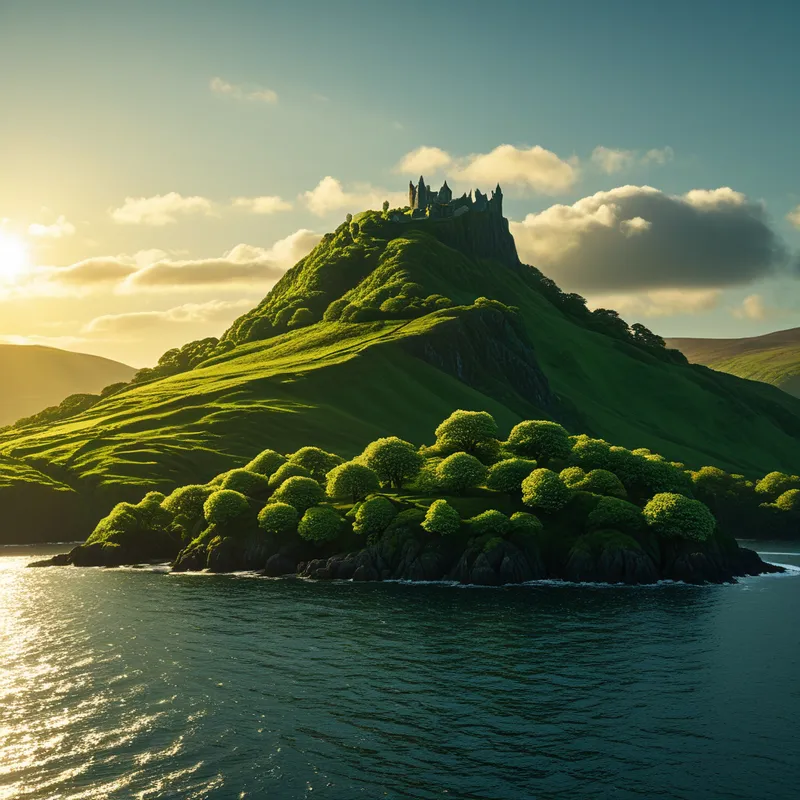
Hear now the story that is sung when the west wind carries the scent of apple blossom and [the sea](/myths/the-sea “Myth from Greek culture.”/) whispers of lands beyond the sunset. It begins not in [the world](/myths/the-world “Myth from Tarot culture.”/) of men, but on the misty shores of Éire, where the Fianna hunted. Their prince was [Oisín](/myths/oisn “Myth from Celtic culture.”/), son of the great leader Fionn mac Cumhaill, a man whose heart beat to the rhythm of the forest and the chase.
One day, as the Fianna rested, a vision approached across the plain. It was a woman riding a white horse, but such a woman as had never been seen. Her hair was the color of ripe wheat under a summer sun, her eyes like the deep pools of a forest. She wore a gown that seemed woven from dawn light itself. She was Niamh of the Golden Hair, daughter of the king of Tir na nÓg.
Her voice was the sound of a distant bell. “Oisín,” she said, “I have crossed the waves of wonder for you. I offer you love without end, and a land where time does not bite, where sorrow is unknown, where joy is as constant as the light. Come with me to the Land of the Young.”
And Oisín, looking into her eyes, saw not just a woman, but the promise of an eternal dawn. Without a backward glance, he mounted behind her on the white steed. Together, they turned toward the western sea. The horse did not swim; it galloped across the crests of the waves as if they were solid ground, leaving a path of shimmering foam. They passed through a silver mist, and when it cleared, Tir na nÓg lay before them.
Here, the air was sweet with the scent of perpetual blossoms. Trees bore fruit and flower simultaneously. The people were fair and radiant, their laughter like music. There was no winter, no decay, no shadow of death. Oisín and Niamh loved, feasted, and explored the wonders of the timeless realm. For Oisín, what felt like three weeks of bliss passed in this golden haze.
But a whisper began in his heart, a memory of the rough camaraderie of the Fianna, the taste of spring [water](/myths/water “Myth from Chinese culture.”/) from a crag, the proud face of his father. A homesickness, deep and somatic, took root. He told Niamh he must return, just for a day, to see his kin and walk the hills of Ireland once more. Grief clouded Niamh’s golden eyes. “If you set foot on the soil of mortal earth,” she warned, “the centuries you have missed will fall upon you in an instant. You will age and crumble. Stay with me.”
But the pull was too strong. She gave him the white horse, with one final, desperate command: “You must not dismount. You must not let your feet touch the ground.”
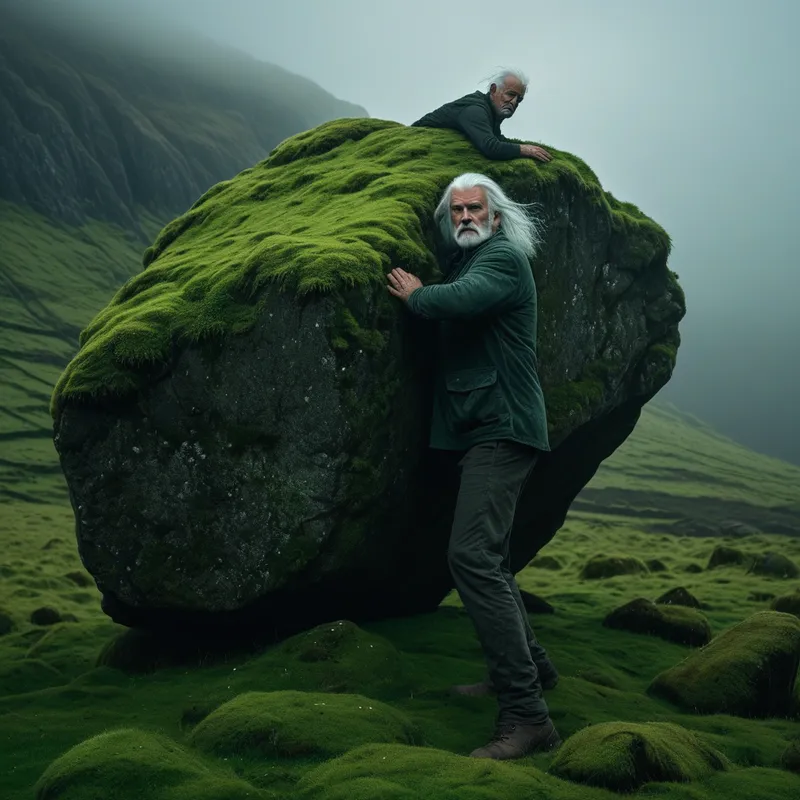
Oisín rode back across the sea. The Ireland he found was strange and small. The great fort of the Fianna was a ruin, overgrown with grass. The people he met were small-statured and spoke of the Fianna as giants from a forgotten age, a legend of three hundred years past. His heart shattered. In his despair, he saw a group of struggling men trying to lift a massive stone slab. Moved by his old warrior’s code, Oisín leaned from his saddle to help them. The girth broke. He tumbled from the horse.
The moment his body touched [the earth](/myths/the-earth “Myth from Hindu culture.”/) of Ireland, the spell of timelessness shattered. The three weeks of Tir na nÓg transformed into three hundred years of mortal time. Before the eyes of the terrified men, the young, radiant prince withered into an ancient, blind, and white-haired old man. The white horse gave a cry of sorrow and vanished back across the sea. Oisín, now a living relic of a lost world, had only time enough to tell his tale to Saint Patrick before the weight of those centuries claimed him, leaving only his story echoing through time.
Cultural Origins & Context
The story of Oisín and Tir na nÓg is a product of the rich, complex tapestry of Irish mythology, primarily preserved within the Fenian Cycle. These tales were not static scripture but fluid oral traditions, shaped and reshaped by filí and storytellers over centuries, likely reaching their current form in the late Middle Ages. The myth exists at a poignant crossroads: it is a pre-Christian Tuatha Dé Danann [Otherworld](/myths/otherworld “Myth from Celtic culture.”/) tale that was often recorded and possibly subtly altered by Christian scribes, like the monks who preserved the Book of the Dean of Lismore.
Its societal function was multifaceted. On one level, it was pure entertainment, a captivating adventure of love and loss. On another, it was a profound cosmological map. Tir na nÓg is one of many names for the Celtic Otherworld—a realm not of afterlife reward or punishment, but of parallel existence, accessible through mounds ([sídhe](/myths/sdhe “Myth from Celtic / Irish culture.”/)), across the western sea, or in moments of enchanted mist. The myth explained the human condition: our mortal fragility contrasted with an imagined perfection, and the immutable laws that govern the crossing between realms. It served as a narrative container for exploring themes of exile, the cost of paradise, and the bittersweet nature of memory and legend.
Symbolic Architecture
At its core, Tir na nÓg is not merely a place, but a state of [consciousness](/symbols/consciousness “Symbol: Consciousness represents the state of awareness and perception, encompassing thoughts, feelings, and experiences.”/). It represents the unconscious itself in its pristine, pre-personal form—a [realm](/symbols/realm “Symbol: The symbol of ‘Realm’ often signifies the boundaries of one’s consciousness, experiences, or emotional states, suggesting aspects of reality that are either explored or ignored.”/) of undifferentiated [bliss](/symbols/bliss “Symbol: A state of profound happiness and spiritual contentment, often representing fulfillment of desires or alignment with one’s true self.”/), where opposites like [youth](/symbols/youth “Symbol: Youth symbolizes vitality, potential, and the phase of life associated with growth and exploration.”/) and age, joy and sorrow, do not conflict. It is the [womb](/symbols/womb “Symbol: A symbol of origin, potential, and profound transformation, representing the beginning of life’s journey and the unconscious source of creation.”/) of potential, before the [dawn](/symbols/dawn “Symbol: The first light of day, symbolizing new beginnings, hope, and the transition from darkness to illumination.”/) of ego and the pain of temporal existence.
The Land of the Young is the soul’s memory of wholeness, a psychic territory where time, the great dissector, holds no sway.
Oisín is the nascent ego, the conscious self drawn out of the collective [human](/symbols/human “Symbol: The symbol of a human represents individuality, complexity of emotions, and social relationships.”/) experience (the Fianna) by an [anima](/symbols/anima “Symbol: The feminine archetype within the male unconscious, representing soul, creativity, and connection to the inner world.”/) figure, Niamh. She is the [soul](/symbols/soul “Symbol: The soul represents the essence of a person, encompassing their spirit, identity, and connection to the universe.”/)-[image](/symbols/image “Symbol: An image represents perception, memories, and the visual narratives we create in our minds.”/), the lure of the unconscious promising completion and an end to striving. His [journey](/symbols/journey “Symbol: A journey in dreams typically signifies adventure, growth, or a significant life transition.”/) is the initial, rapturous phase of introversion, where the individual is submerged in inner riches. The white horse is the transcendent function, the [vehicle](/symbols/vehicle “Symbol: Vehicles in dreams often symbolize the direction in life and the control one has over their journey, reflecting personal agency and decision-making.”/) that can bridge the worlds of consciousness and the unconscious.
The fatal return is the myth’s devastating psychological [truth](/symbols/truth “Symbol: Truth represents authenticity, honesty, and the quest for knowledge beyond mere appearances.”/). [The ego](/myths/the-ego “Myth from Jungian culture.”/) cannot remain in the unconscious [paradise](/symbols/paradise “Symbol: A perfect, blissful place or state of being, often representing ultimate fulfillment, harmony, and transcendence beyond ordinary reality.”/) without dissolving. It must return to the world of time, [effort](/symbols/effort “Symbol: Effort signifies the physical, mental, and emotional energy invested toward achieving goals and personal growth.”/), and [reality](/symbols/reality “Symbol: Reality signifies the state of existence and perception, often reflecting one’s understanding of truth and life experiences.”/)—the field where the boulder must be lifted. The breaking [saddle](/symbols/saddle “Symbol: A saddle represents the concept of guidance and support in one’s journey, often associated with control and desire for freedom.”/) girth is the failure of the transcendent function; [the ego](/myths/the-ego “Myth from Jungian culture.”/) cannot maintain its [connection](/symbols/connection “Symbol: Connection symbolizes relationships, communication, and bonds among individuals.”/) to the timeless once it re-engages with the temporal. The aging is the instantaneous recognition of all the [life](/symbols/life “Symbol: The symbol of ‘Life’ represents a journey of growth, interconnectedness, and existential meaning, encompassing both the joys and challenges that define human experience.”/)—the struggles, relationships, and integrations—that was avoided or missed during the blissful retreat. Oisín does not just grow old; he is confronted with the [shadow](/symbols/shadow “Symbol: The ‘shadow’ embodies the unconscious, repressed aspects of the self and often represents fears or hidden emotions.”/) of his own [absence](/symbols/absence “Symbol: The state of something missing, void, or not present. Often signifies loss, potential, or existential questioning.”/).
The Dreamer’s Resonance
When this myth pattern stirs in the modern [psyche](/myths/psyche “Myth from Greek culture.”/), it often manifests in dreams of paradoxical landscapes. One might dream of a breathtakingly beautiful vacation spot where they feel inexplicably anxious, or of meeting a captivating lover in a place where clocks are broken or tell no time. The somatic signature is key: a feeling of awe mixed with a deep, unplaceable dread, a sense of being “outside of time” in a way that feels unnerving, not liberating.
This dream signals a critical juncture in a psychological process. The dreamer may be in a state of prolonged avoidance, a “Tir na nÓg” of their own making—a depressive withdrawal, a fantasy life, an addiction, or a relationship that promises eternal bliss at the cost of engagement with the real world. The dream is the psyche’s warning: the idyllic state is becoming a prison. The call to “lift the boulder”—to face a mundane, difficult, but real responsibility—is imminent. The dream presents the choice Niamh offered: stay in the timeless illusion and risk psychic death, or return to the mortal world and face the devastating, aging truth of neglected life.
Alchemical Translation
The alchemical journey of this myth models the perilous path of individuation. The initial [nigredo](/myths/nigredo “Myth from Alchemical culture.”/), or descent, is Oisín’s willing ride into [the Otherworld](/myths/the-otherworld “Myth from Celtic culture.”/)—a necessary dissolution of the old Fianna identity in the waters of the unconscious. The albedo, the whitening, is his life with Niamh, a state of lunar reflection and purified, static beauty.
The true [rubedo](/myths/rubedo “Myth from Alchemical culture.”/), the reddening or culmination, however, is not in the paradise, but in the return and the dissolution. It is the caput mortuum, the “dead head” or worthless residue left in [the alembic](/myths/the-alembic “Myth from Alchemical culture.”/). Oisín’s aging body is that residue—the painful, visible evidence of the process.
The gold of this alchemy is not found in the Land of the Young, but in the story told by the old, blind man. The triumph is in the transmission of meaning, not the preservation of form.
For the modern individual, the myth instructs that timeless, unconscious bliss is not the goal. The goal is the conscious, time-bound integration of that bliss as memory and inspiration into a mortal life. We are all Oisín, tempted by inner and outer paradises that ask us to forsake our temporal journey. The alchemical work is to ride the white horse—to engage with the deep unconscious—but to do so with the conscious intent to return, to bring back not apples of immortality, but the story. We must learn to visit our personal Tir na nÓg without dismounting, to let its beauty inform our soul without allowing it to sever us from the earth where our boulders, heavy and real, await our strength. The final transmutation is the acceptance of mortality itself, not as a curse, but as the very field in which the singular, precious work of a human life is done.
Associated Symbols
Explore related symbols from the CaleaDream lexicon: