
Timun Mas Myth Meaning & Symbolism
A childless couple receives a magical golden cucumber seed, which births a daughter they must later protect from a ravenous giant with enchanted gifts.
The Tale of Timun Mas
Listen, and let the mists of Java part. In a time when the world was closer to the spirits, there lived an old, childless couple, Mbok Srini and her husband. Their hearts were fertile with love, but their home remained barren, an empty vessel echoing with the silence of no laughter. In her despair, Mbok Srini prayed to the keeper of the wild places, the one who walks the boundary between forest and field.
Her prayers were heard. From the emerald depths of the untamed woods emerged a mighty Buto Ijo, a giant whose skin was the color of rotting leaves and whose hunger was as vast as the sky. “I can give you a child,” he rumbled, his voice like stones grinding in a riverbed. “But when she turns seventeen, she returns to me. She will be my sustenance.” Desperation is a bitter root that makes even poison seem sweet. With a trembling hand, Mbok Srini agreed. The giant gave her a single, magical seed, glowing with an inner light.
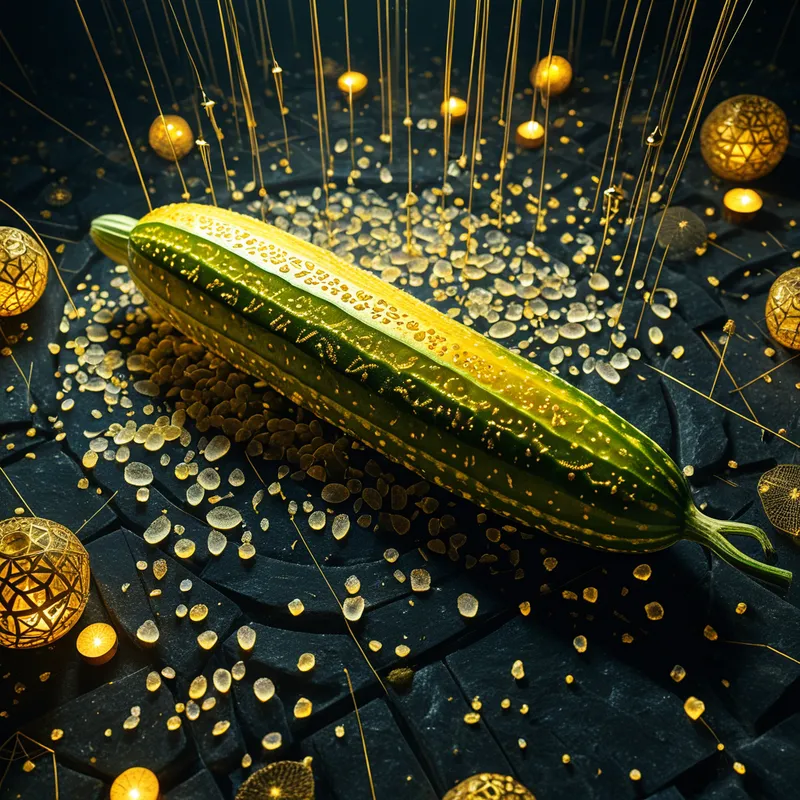
She planted it with tears and hope. From the earth sprang not a common vine, but one that bore a single, miraculous fruit: a cucumber of pure, shimmering gold. When it split open, there lay a beautiful baby girl, her skin as smooth as moonlight, her hair the color of ripe wheat. They named her Timun Mas, and their home filled with a joy they had never known.
But time is a river that flows only one way. The seasons turned, and the shadow of the promise grew long. On Timun Mas’s seventeenth birthday, the earth shook. The Buto Ijo had come to collect his due. His roar shattered the peace of the village. With a heart breaking into a thousand pieces, Mbok Srini thrust a small woven pouch into her daughter’s hands. “Run, my light! Run to the east! And when he is upon you, open this!” It contained four enchanted gifts from a wise hermit: a handful of salt, a cluster of needles, a block of fermented shrimp paste (terasi), and a single cucumber seed.
And so the chase began. Timun Mas, a flash of gold and fear, fled into the wild. The Buto Ijo, a mountain of hunger and fury, crashed after her, his breath hot on her neck. When his grasping fingers were mere inches away, she cast the salt behind her. It erupted into a vast, blinding salt sea, stinging the giant’s eyes and burning his throat. He drank it dry, his thirst only fueling his rage.
Again he gained. She threw the needles. They transformed into a dense, impenetrable bamboo forest, a thousand spears barring his path. With terrible strength, he snapped and crushed the bamboo, splinters flying like daggers.
Closer still. She flung the terasi. It became a boundless, bubbling swamp of thick, sucking mud, trapping his massive legs. With a groan that shook the trees, he wrestled himself free, now coated in foul, clinging mire.
His hand reached out, the end certain. In a final, desperate act, Timun Mas threw the last gift: the cucumber seed. It hit the ground and instantly, a vast golden cucumber vine erupted, wrapping around the giant, squeezing with the force of destiny itself. Trapped within the glowing tendrils, the Buto Ijo was pulled down, down into the earth, which swallowed him whole. The forest fell silent. From the spot where he vanished, a new, peaceful cucumber grove sprang to life. Timun Mas, reborn through her own cunning and her mother’s sacrificial love, returned home, the cycle of consumption broken forever.

Cultural Origins & Context
The myth of Timun Mas is a classic example of the dongeng or folktale, passed down orally through generations across the islands of Indonesia, with its heart in Java. Told by grandmothers (mbok) on moonlit verandas and by traveling storytellers in village markets, its primary function was twofold: entertainment and moral instruction. It belongs to a widespread cycle of “monster-bridegroom” or “threatened child” tales found globally, yet it is deeply localized. The enchanted objects—salt, needles, terasi, cucumber seeds—are not exotic magical items but humble, everyday staples of Javanese life and cuisine, grounding the supernatural in the familiar domestic sphere.
This anchoring in the domestic is key. The story served to subtly reinforce social values: the virtue of respecting parental sacrifice, the cleverness and resilience expected of the young (especially young women), and the ultimate triumph of cunning (akal) over brute strength. It also reflects an animistic worldview, where the natural world—from cucumbers to swamps—is alive with potential agency, capable of being an ally or an obstacle. The tale is a narrative vessel carrying the collective anxieties of an agrarian society—fear of infertility, of uncontrollable natural forces (embodied by the giant), and the hope that even the most vulnerable, with the right tools and wit, can navigate and survive a predatory world.
Symbolic Architecture
At its core, Timun Mas is a profound allegory of the psyche’s development and the perils of the unconscious. Timun Mas herself is the Divine Child, a precious consciousness born from a pact with a devouring force.
The child is always born from a negotiation with darkness, a promise made in the barren field of longing.
The Buto Ijo is not merely a monster; he is the incarnate Shadow and the archetypal Devouring Mother/Father in its most literal form. He represents the unconscious, instinctual psyche that demands to re-assimilate the differentiated ego (the individual child) back into its undifferentiated, primal state. The parents’ initial bargain symbolizes a universal psychological truth: our very existence, our emergence into consciousness, often feels contingent on a debt to some older, more primitive part of ourselves that will one day call that debt due—this is the crisis of adolescence, of midlife, of any major transition where the old self seeks to consume the new.
The four magical objects are the talismans of consciousness itself. Salt purifies and creates boundaries (the self separating from the non-self). Needles discriminate and analyze, creating complexity and obstacles to slow blind impulse. Terasi, a transformed, fermented substance, represents the sticky, ambiguous, and often unpleasant emotional complexes that can mire us. Finally, the Cucumber Seed is the seed of the self, which, when cast at the moment of ultimate threat, activates one’s own innate, life-giving nature to finally encapsulate and transform the devouring force. The giant isn’t killed; he is integrated, buried to become fertile ground for new growth.
The Dreamer’s Resonance
When this myth stirs in the modern dreamer, it signals a profound somatic and psychological process: the chase. To dream of being pursued by an insatiable, monstrous force is to feel the Buto Ijo of one’s own psyche in active pursuit. This could manifest as a crushing sense of obligation, a past trauma resurfacing, a consuming addiction, or the sheer weight of a life pattern that threatens to swallow one’s individuality.
The dreamer is Timun Mas in these moments. The somatic experience is one of adrenaline, breathlessness, and a frantic search for resources. Psychologically, this is the ego in a state of emergency, fleeing the contents of the unconscious that have broken their bonds and are demanding recognition. The dream may not provide the enchanted pouch, but the feeling of flight itself is the first act of resistance. This dream pattern asks the dreamer: What ancient promise have you forgotten? What part of you have you agreed to feed to a hunger that can never be satisfied? The chase is the psyche’s brutal, necessary method of forcing movement and resourcefulness where there has been stagnation or compliance.

Alchemical Translation
The journey of Timun Mas is a perfect map for the alchemical process of individuation. It begins in Nigredo, the blackening: the barrenness of the couple, the despair that leads to a pact with a shadowy force. The birth of Timun Mas is the Albedo, the whitening: the emergence of a pure, distinct consciousness from the golden vessel.
The central, lengthy ordeal is the Citrinitas, the yellowing or the confrontation. This is the arduous work of the analysis, the running, the successive throwing of one’s tools against the pursuing shadow. Each object represents a psychological function being tested and deployed: sensory boundary-setting (salt), intellectual discernment (needles), engagement with murky emotions (terasi).
The final, saving seed is not thrown at the giant, but for oneself. Salvation lies in activating one’s own core nature, not in defeating the other.
The culmination is the Rubedo, the reddening or completion. The giant is not slain but transmuted. He is drawn into the earth by the very essence of the self (the cucumber vine) and becomes the foundation for new life. The devouring complex is integrated, its raw energy converted into fertile ground for the psyche. Timun Mas returns home, but she is no longer the innocent child given by a giant. She is a self-created woman, forged in flight and cunning. She has paid her debt not with her flesh, but with her transformation, achieving a wholeness where the conscious self and the once-devouring unconscious now exist in a new, generative relationship.
Associated Symbols
Explore related symbols from the CaleaDream lexicon:
- Child — The nascent consciousness, born from a pact with darkness, representing pure potential and the object of both protection and consumption.
- Forest — The realm of the untamed unconscious, where the Buto Ijo dwells and the transformative chase takes place, symbolizing both danger and the source of magical aid.
- Seed — The core of potential and identity; the magical gift that both creates Timun Mas and ultimately saves her by activating her own innate, life-giving power.
- Giant — The archetypal devouring force, the shadow aspect of the psyche that demands the sacrifice of individual consciousness to sate its primal hunger.
- Mother — Represents both the nurturing force that protects the child and the one who, out of deep longing, makes the fateful bargain with the devouring unconscious.
- Journey — The forced flight from the consuming past, a harrowing but necessary process of differentiation and self-discovery that cannot be avoided.
- Sacrifice — The central tension of the myth: the initial sacrifice of the future child, and the ultimate sacrifice of the old, devouring identity to create new growth.
- Rebirth — Timun Mas’s survival is not a mere escape but a true rebirth, as the giant is transformed into fertile ground, signifying the integration of shadow.
- Fear — The primal engine of the narrative, the somatic and emotional experience of being pursued by an aspect of oneself that feels utterly annihilating.
- Cunning — The hero’s weapon, represented by the enchanted gifts; the application of intellect, resourcefulness, and cultural wisdom to navigate existential threat.
- Earth — The womb from which Timun Mas is born and the tomb which integrates the giant, symbolizing the grounding, cyclical nature of psychological transformation.
- Gift — The enchanted objects in the pouch, representing the resources—both internal and inherited—that the psyche can deploy in its struggle for autonomy.