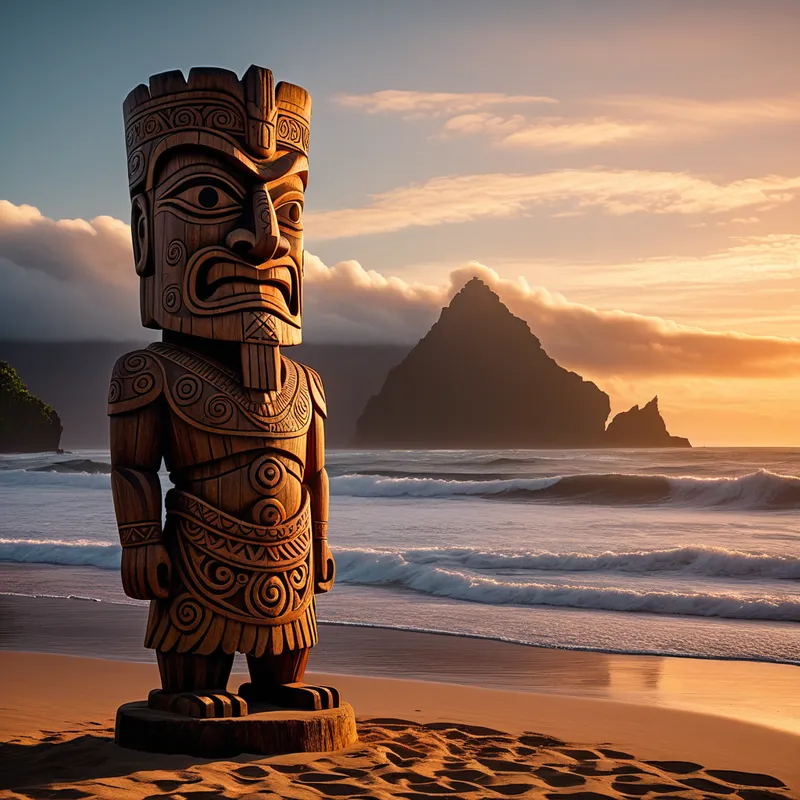
Tiki Myth Meaning & Symbolism
The story of Tiki, the first man shaped from earth by the gods, embodying the primal human journey from clay to consciousness.
The Tale of Tiki
In the time before time, when the world was a canvas of wet clay and whispering winds, the great expanse of Te Kore began to stir. From the deep, silent womb of potential, the gods emerged—Ranginui and Papatūānuku locked in a tight embrace, their children dreaming in the darkness between them. But our story does not begin with their separation. It begins in the quiet that followed, when the creative impulse turned its gaze not to the heavens or the seas, but to the very soil underfoot.
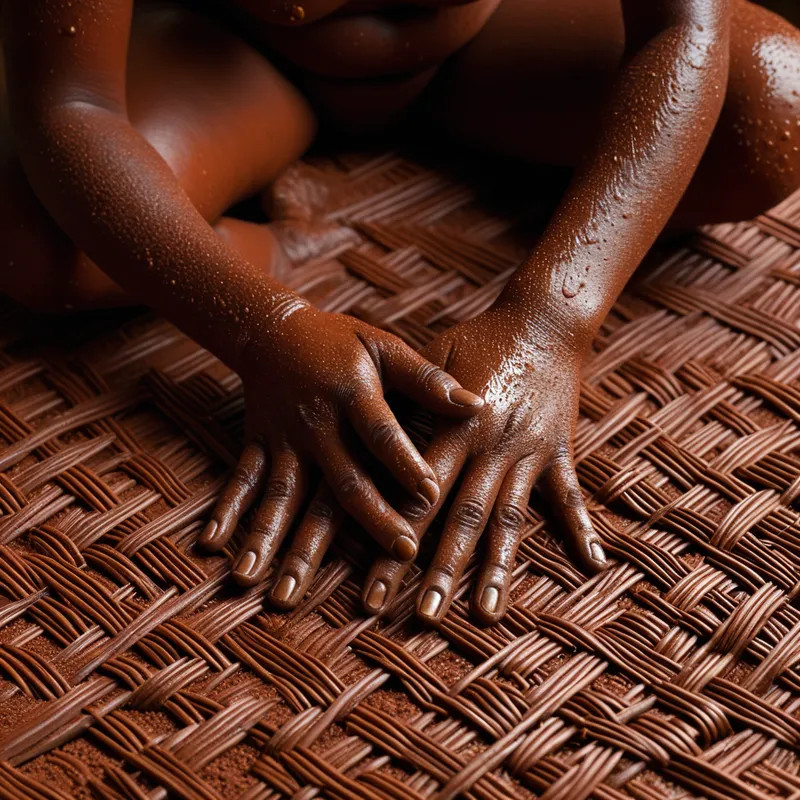
The god Tāne, he who clothed the earth in forests, walked upon the bare, red earth of Hawaiki. He felt the grit between his toes, cool and fecund. A longing arose in him, a desire for a companion who could walk this beautiful world, who could feel the sun and know the rain, who could give a name to the wonder. He knelt, and with hands that could lift the sky, he gathered the dark, moist soil. He mixed it with the dew of dawn and the salt spray of the breaking sea.
He shaped a form. A head, to hold dreams. A torso, to contain breath. Limbs, to move upon the land. The figure lay inert, a beautiful sculpture of earth. Tāne bent close and breathed—not the wind of storms, but the gentle mana of life itself, the sacred breath of hau ora. Into the nostrils of the clay man, he whispered the first spark.
The earth shuddered. The clay chest rose. Eyes of dark stone opened, seeing the green world for the first time. The man sat up, fragments of sacred soil falling from his shoulders. He looked at his maker, then at his own hands, turning them over in the new light. He was alone, yet connected to all things—the earth of his body, the water in his veins, the air in his lungs, the divine fire in his spirit. Tāne named him Tiki, the first, the model, the image of the gods made walkable. And Tiki stood, unsteady on newborn legs, and took his first step onto the shore of existence, the first footprint on the sands of time, a silent testament that the universe now had a witness.
Cultural Origins & Context
The narrative of Tiki is not a single, monolithic myth but a foundational pattern woven throughout the vast Polynesian diaspora, from Aotearoa (New Zealand) to the Marquesas, Rapa Nui (Easter Island), and Hawaiʻi. As a concept, Tiki is polymorphous: he is the first man created by Tāne (as in many Māori traditions), a progenitor god himself, or a general term for deified ancestors and their stylized representations. This story was the bedrock of origin chants (whakapapa) recited by priests (tohunga) and learned storytellers. It was not mere entertainment; it was a sacred map of identity.
Its societal function was profound. To know that the first human was shaped from the red earth of Hawaiki was to know one’s literal and spiritual genealogy, connecting every individual directly to the land (whenua) and the gods. The myth established the human condition: we are of the earth, animated by divine breath, and thus hold a unique responsibility as caretakers and participants in the cosmic order. The carved wooden and stone tiki figures found across Polynesia are not idols but waka—vessels and focal points for this ancestral connection, making the myth tangible in daily and ritual life.
Symbolic Architecture
At its core, the myth of Tiki is an allegory for the emergence of consciousness from the unconscious, of form from the formless. Tiki is the Self made manifest.
The first human is not born, but crafted—a deliberate act of imagination that pulls identity from the primal mud of potential.
The red earth symbolizes the chthonic unconscious, the fertile but undifferentiated ground of being from which our distinct form is sculpted. The act of shaping by Tāne represents the organizing, structuring principle of the psyche—the ego, or the conscious mind, beginning to delineate itself from the mass. The divine breath (hau ora) is the infusion of spirit, of mana—the vital energy that transforms a psychological complex into a living, aware entity. Tiki’s first look at his own hands is the dawn of self-reflection, the moment the ego recognizes itself as a separate entity capable of action and witness in the world.
The Dreamer’s Resonance
When this myth stirs in the modern dreamscape, it often signals a profound process of (re)formation. To dream of shaping clay or earth into a human form, or of being made of clay oneself, points to a somatic and psychological rebirth. The dreamer may be in a phase where the old identity has dissolved back into “clay”—feelings of depression, stagnation, or a loss of purpose. The dream is the psyche’s workshop.
The somatic sensation is often one of heaviness, dampness, or being molded—a deep, bodily awareness of transformation at the most fundamental level. Psychologically, this is the process of the ego being re-fashioned from more authentic, grounded materials. It asks the dreamer: What parts of you feel inert, awaiting the animating breath? From what primal aspects of your own experience (your personal “red earth”) must you now sculpt your new form? It is a dream of returning to the origin to begin again, not as an infant, but as a conscious creator of one’s own life.
Alchemical Translation
The alchemical journey mirrored in Tiki’s story is the opus of individuation, starting with the nigredo—the black, fertile earth, the state of confused potential and dark night of the soul. The shaping hands represent the albedo, the washing and separating, where one begins to distinguish what is truly “self” from the undifferentiated mass of influences, expectations, and inherited patterns.
To be breathed into life is to accept the terrifying gift of autonomy—the divine spark that makes you responsible for your own existence.
The infusion of the divine breath is the citrinitas, the yellowing or awakening of a spiritual dimension within the personal psyche. Finally, Tiki standing and walking embodies the rubedo, the reddening or completion—the fully embodied, conscious individual who can now walk their own path, grounded in their essential nature and animated by a personal sense of purpose. For the modern individual, the myth does not call for a literal search for ancestral gods, but for the internal Tāne—the creative, formative will within. It is an invitation to consciously shape one’s character from the raw material of one’s deepest experiences and truths, and then to courageously breathe the life of intention and action into that form, stepping forward as the first and only author of your own becoming.
Associated Symbols
Explore related symbols from the CaleaDream lexicon: