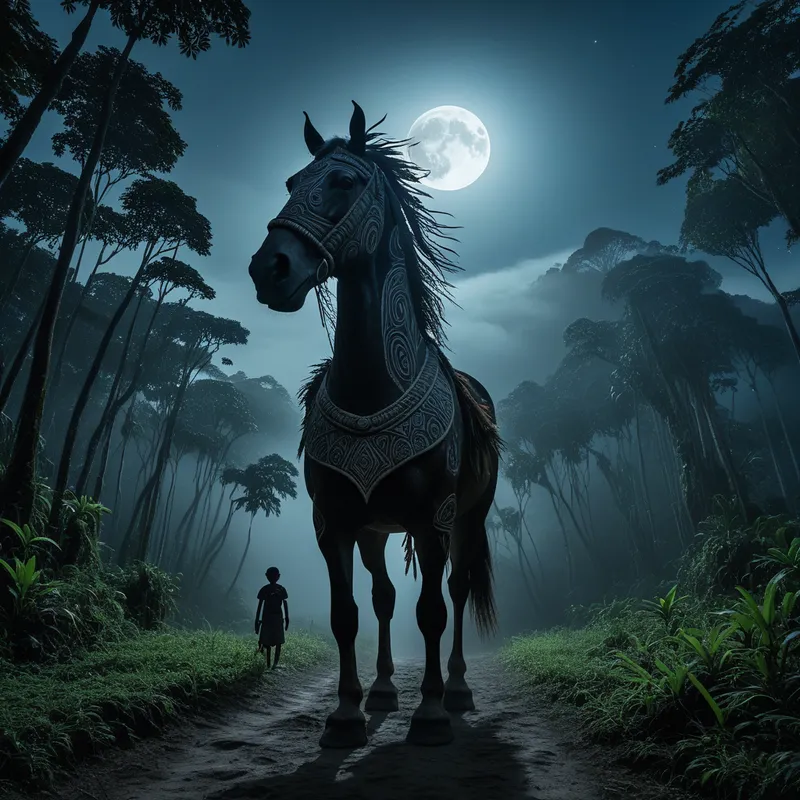
Tikbalang Myth Meaning & Symbolism
A towering creature of the forest crossroads, the Tikbalang tests travelers with illusions, guiding those who can master their fear toward true direction.
The Tale of Tikbalang
Listen, and let the humid night air carry the tale. In the deep, primeval heart of the islands, where the balete trees weave cathedrals of root and vine, the paths do not always obey the sun. Here, in the liminal hour when day bleeds into dusk, the very crossroads breathe. And from that breath, he manifests.
He is a creature of impossible anatomy, a blasphemy of form that is also a terrible truth. From the waist down, he is all powerful, sinewy horse—hooves that can crack stone, legs that can outrun the wind. But his torso is that of a muscular man, and his head… his head is that of a stallion, with eyes that hold the deep, knowing darkness of the forest itself. This is the Tikbalang. He does not hunt for meat, but for confusion.
A traveler, perhaps a farmer returning late from a distant field or a youth seeking a new village, approaches a fork in the trail. The light is failing. A chill, unrelated to the tropical air, touches their neck. The path ahead seems to shift, just slightly. The familiar landmarks—that distinctive rock, that lightning-struck trunk—now appear on the left when they should be on the right. The traveler quickens their pace, but the destination recedes. The forest closes in, the sounds of crickets and night birds warping into whispers. They are running now, heart hammering against their ribs, but every turn leads back to the same moss-covered stone, the same mocking fork in the path.
Then, they see him. A colossal shadow detaches itself from a giant tree. He stands, not attacking, but observing, his horse-head tilted with an intelligence that is profoundly unsettling. He may mimic the voice of a loved one, calling from the wrong direction. He may simply stand, a living monument to disorientation. The panic is the point. It is the fertile ground where his illusion grows.
But the old stories whisper a secret, passed from lola to apo. If you feel the world twisting, if the path betrays you, do not run. Stop. Find your center. And with deliberate courage, turn your barong inside out. Or, command your very self: ask to see his true form. In that moment of conscious inversion, of demanding truth over appearance, the spell shatters. The Tikbalang may let out a sound—a whinny that is also a laugh—and vanish. The path snaps back into its true alignment. The traveler is not merely un-lost; they are found, having passed a test they never knew they were taking.

Cultural Origins & Context
The myth of the Tikbalang is born from the intimate geography of the Philippine archipelago. This is a world of dense, mountainous jungles, labyrinthine river systems, and islands within islands. Before modern maps, navigation was a knowledge written in the body—the slant of light through certain trees, the sound of a particular stream, the feel of a trail underfoot. To become lost was not merely an inconvenience; it was a potentially fatal severance from community and sustenance.
As such, the Tikbalang is a folkloric embodiment of that very real, existential fear. Stories of him were told not as mere campfire scares, but as vital pedagogical tools. Elders and parents used the tale to warn children against wandering too far, to instruct travelers to be mindful and respectful of the forest, which was seen as a living entity with its own rules. The myth served a societal function of boundary-setting, teaching respect for the wild, untamed spaces that lay just beyond the cleared fields and villages. It personified the chaos of nature as a conscious, trickster intelligence, making the unknown knowable, even if it remained terrifying. It was passed down orally, its details shifting from region to region, but its core purpose—to explain disorientation and teach a method of psychic reorientation—remained constant.
Symbolic Architecture
Psychologically, the Tikbalang is the archetypal guardian of the threshold. He does not reside in the deep wilderness or the safe village, but precisely at the crossroads—the point of decision, transition, and potential transformation. His hybrid form symbolizes the conflict inherent in such moments: the powerful, instinctual drive of the “horse” (our animalistic fears, impulses, and raw energy) fused with the cunning, strategic “human” mind that can overthink and deceive itself.
The Tikbalang is not the danger of the path, but the manifestation of the confusion that arises when we are confronted by our own inner compass’s failure.
His trick—reversing landmarks, making the familiar strange—is a perfect metaphor for psychological disorientation. During life transitions (a career change, a relationship ending, a spiritual crisis), the old internal maps no longer work. What once brought security now feels alien. The Tikbalang represents this felt sense of the world itself betraying you. The “inside-out garment” is the brilliant symbolic solution: an act of conscious paradox. To invert your clothing is to perform an external ritual that signals an internal shift. It means willingly embracing the opposite, looking at your situation from a radically different perspective, or turning your attention inward to find the way forward.
The Dreamer’s Resonance
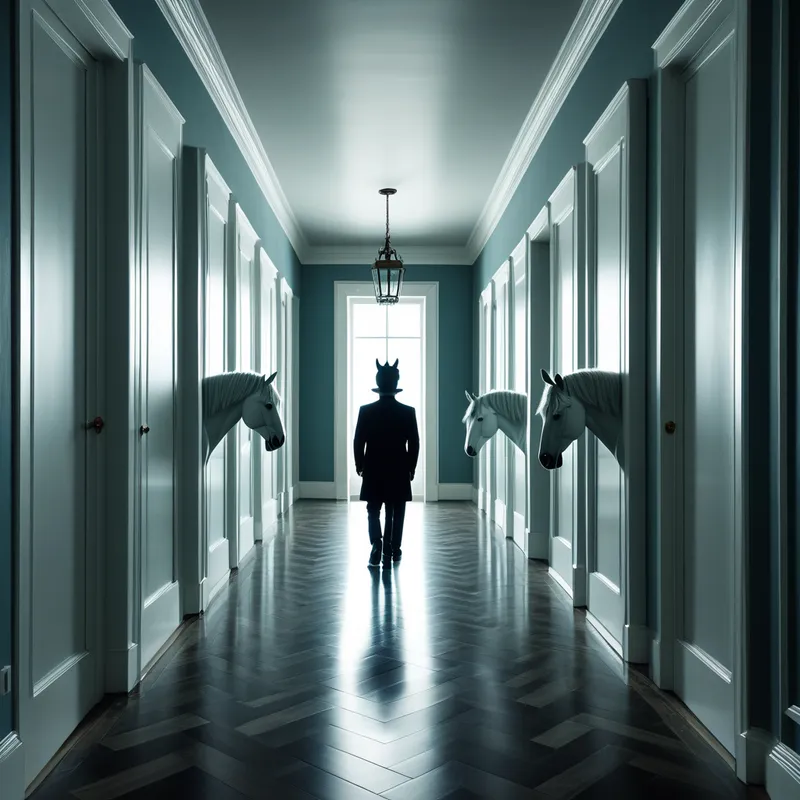
When the Tikbalang gallops into modern dreams, he heralds a state of profound psychic disorientation. The dreamer may find themselves in a maze of identical hallways, on a train that never stops at their station, or in their own home where the rooms have rearranged themselves. The somatic feeling is one of rising panic, a frantic search for a logic that has dissolved.
This dream pattern signifies that the dreamer is at a critical crossroads in their waking life, but is attempting to navigate it using outdated or ego-driven maps. The Tikbalang-dream is the psyche’s dramatic enactment of this deadlock. The creature’s appearance is the embodiment of the “shadow” aspect of this transition—the chaotic, frightening, and seemingly irrational force that blocks progress. The dream is an invitation, albeit a terrifying one, to stop the frantic outward search. The confrontation with the Tikbalang is the confrontation with the need to change one’s mode of consciousness. The dream asks: What in your life needs to be “turned inside out”? What assumption must you invert to find your true direction?
Alchemical Translation
In the alchemical vessel of individuation, the encounter with the Tikbalang represents the crucial nigredo stage—the blackening, the dissolution, the utter confusion where all prior certainties melt into chaos. This is not a mistake on the journey to the Self, but its essential first step. The ego, with its carefully planned routes and familiar landmarks, is rendered useless. One is symbolically “lost in the forest” of the unconscious.
The triumph over the Tikbalang is not a defeat of an external monster, but the integration of the trickster energy within. One masters disorientation by accepting its lesson.
The act of turning the garment inside out is the alchemical operatio—the conscious, willed operation that begins transmutation. It is the decision to engage with the paradox, to embrace the shadow, and to seek guidance not from external signs but from an inverted, inner authority. By mastering the trick of the crossroads, the individual does not simply return to the old path. They are fundamentally altered. They have integrated a piece of the wild, chaotic trickster, gaining its wisdom: that true direction is often found not by following the map, but by reorienting the mapmaker. The Tikbalang, once a source of fear, becomes an internalized guardian of thresholds, reminding the integrated Self that every point of confusion is a potential point of profound re-creation.
Associated Symbols
Explore related symbols from the CaleaDream lexicon:
- Forest — The dense, unconscious mind where logic fails and primal instincts reign, serving as the Tikbalang’s sacred domain and the stage for the journey of disorientation.
- Crossroads — The literal and psychological point of decision and transition where the Tikbalang holds court, representing life’s critical junctures and the paralysis of choice.
- Horse — The raw, powerful, and instinctual energy embodied in the Tikbalang’s lower half, symbolizing untamed fear, libido, and the force that can carry one wildly off course.
- Journey — The core narrative of the myth, representing the soul’s passage through confusion and the necessary ordeal required to find one’s true direction.
- Chaos — The primary state invoked by the Tikbalang’s illusions, representing the dissolution of old orders that must precede any genuine psychological transformation.
- Trickster — The essential archetype of the Tikbalang, a boundary-crosser who uses confusion and inversion to disrupt egoic certainty and force a deeper wisdom.
- Shadow — The Tikbalang as the personified psychological shadow, the frightening, rejected aspect of the self that must be confronted at the crossroads of growth.
- Fear — The primary tool and product of the Tikbalang’s magic, representing the somatic and emotional experience that must be faced and mastered to break the spell.
- Key — The symbolic act of turning one’s garment inside out or demanding truth, representing the paradoxical action or insight that unlocks the prison of disorientation.
- Door — Each path at the haunted crossroads, representing the multiple, often deceptive, possibilities presented during a life transition or psychological crisis.
- Mirror — The Tikbalang’s illusion acts as a distorting mirror to the traveler’s psyche, reflecting back their own internal confusion and misplaced trust in external landmarks.