
Thumbelina Myth Meaning & Symbolism
A tiny woman, born from a seed, endures a perilous odyssey through a world too large before finding her true kingdom with the flower prince.
The Tale of Thumbelina
Listen, and I will tell you of a woman born not of womb, but of longing.
In a time when wishes still held weight, there lived a woman whose heart ached with a silent, hollow space. She went to a wise woman, who gave her a single grain of barley. “Plant this,” she was told. And so she did, with a tear and a hope whispered into the dark soil. From that seed, born of earth and desire, sprouted not a stalk, but a tulip. And within its velvet petals, smaller than a thumb, lay a perfect, living girl. She was named Thumbelina.
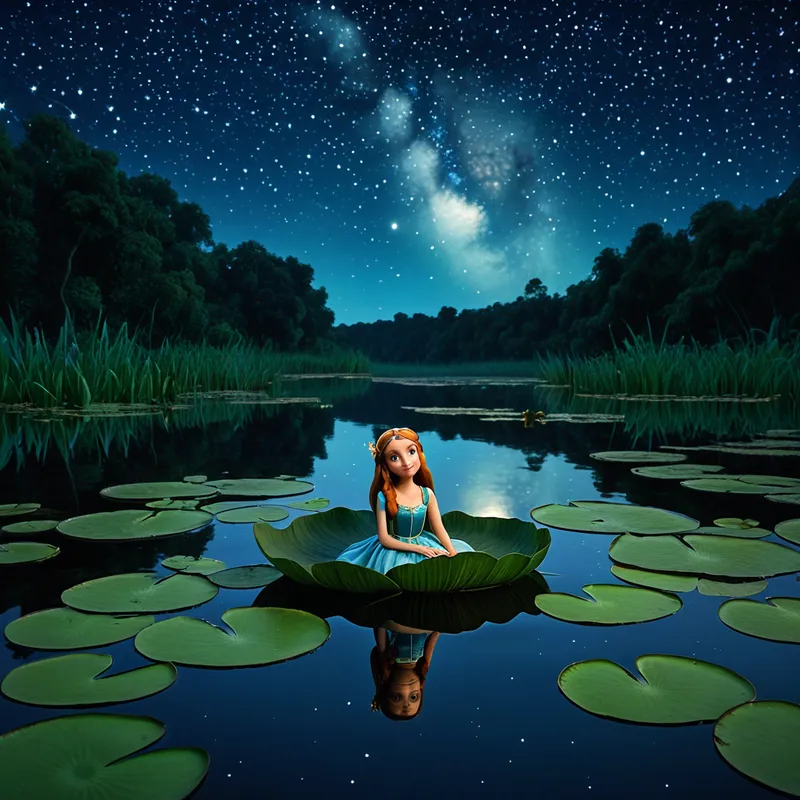
Her cradle was a polished walnut shell, her mattress violet petals, her blanket a rose leaf. She rowed in a tulip-petal boat with white horsehair oars, singing with a voice so soft it was like the ringing of a crystal bell. But [the world](/myths/the-world “Myth from Tarot culture.”/) was a giant’s realm. A motherly toad, seeing a bride for her son, stole Thumbelina from her windowsill and placed her on a broad lily pad in [the river](/myths/the-river “Myth from Buddhist culture.”/)’s center, a green prison in a world of [water](/myths/water “Myth from Chinese culture.”/). Fish, taking pity, gnawed the stalk and set her adrift.
Thus began her odyssey. She floated, a tiny queen of a leaf-throne, through sun and storm. A mayfly courted her, but his kin declared her too ugly, too heavy, too other. Abandoned, she passed a summer alone in the whispering forest, weaving a bed from grass blades, drinking dew from flower cups. Winter’s cruel breath came. She stumbled, freezing, to the door of a field mouse, who took her in for a price: stories and housework. The mouse’s neighbor, a mole in his velvet black coat, admired her singing. “Marry him,” urged the mouse. “He is rich, his tunnels are deep and safe from the world.” But Thumbelina’s soul recoiled from the eternal dark, from a life buried away from the sun and [the sky](/myths/the-sky “Myth from Persian culture.”/).
In the tunnel, she found a swallow, frozen and thought dead. All winter, she tended the great bird, wrapping it in wool and whispering warmth. When spring returned, so did [the swallow](/myths/the-swallow “Myth from Greek culture.”/)’s heart. It offered her escape on its strong back. They flew over lands green and warm, until they came to a kingdom of flowers. And there, in the heart of a luminous blossom, stood a man her own size, with a crown of petals and wings of light. He was the Flower Prince. “You are like us,” he said. “Will you be our queen?” And he gave her a new name: Maia. For Thumbelina was the name given by the large world; Maia was her true name, known only in her true home. She was given a pair of wings, and at last, she belonged.
Cultural Origins & Context
The tale of Thumbelina, or “Tommelise” as she was first named, springs from the rich oral and literary tradition of 19th-century European fairy tales, specifically crystallized by the Danish storyteller Hans Christian Andersen. Unlike older folk tales passed down anonymously through generations, Andersen’s stories are authored, yet they tap deeply into the universal well of folklore. Thumbelina was published in 1835, a product of a Romantic era fascinated with the miniature, the natural world, and the isolated individual.
Its societal function was multifaceted. For children, it was a thrilling adventure of the small against the large. For the adults of Andersen’s time, it resonated as an allegory of social mobility and finding one’s rightful place—a tiny, seemingly insignificant being navigating a society of toads, beetles, mice, and moles, each representing different strata and values (bourgeois practicality, blind tradition, material comfort over light). It was a story told at hearthsides and read in parlors, a moral compass pointing not toward grandeur, but toward authenticity and spiritual kinship. It validated the feeling of being out of scale with one’s surroundings, offering the hope of a kingdom where one’s size—one’s essential nature—is not a deficit, but the prerequisite for belonging.
Symbolic Architecture
Thumbelina is the archetypal [puer aeternus](/symbols/puer-aeternus “Symbol: The eternal youth archetype representing perpetual adolescence, divine child energy, and resistance to mature adulthood.”/) (eternal [child](/symbols/child “Symbol: The child symbolizes innocence, vulnerability, and potential growth, often representing the dreamer’s inner child or unresolved issues from childhood.”/)) in feminine form, a [soul](/symbols/soul “Symbol: The soul represents the essence of a person, encompassing their spirit, identity, and connection to the universe.”/)-[consciousness](/symbols/consciousness “Symbol: Consciousness represents the state of awareness and perception, encompassing thoughts, feelings, and experiences.”/) born from a psychic seed planted in the fertile darkness of the unconscious (the planted barleycorn). Her entire [journey](/symbols/journey “Symbol: A journey in dreams typically signifies adventure, growth, or a significant life transition.”/) is a map of [the ego](/myths/the-ego “Myth from Jungian culture.”/)’s early development, forced into a world for which it is not initially equipped.
The central trauma is not violence, but scale: to be born into a world where you do not fit, where every chair is a cliff, every friend a potential captor.
The suitors—the Toad, the [Beetle](/symbols/beetle “Symbol: The beetle symbolizes transformation, resilience, and the ability to adapt to one’s environment, often reflecting personal growth and survival instincts.”/), the Mole—are not mere villains. They represent compelling, yet ultimately soul-crushing, [life](/symbols/life “Symbol: The symbol of ‘Life’ represents a journey of growth, interconnectedness, and existential meaning, encompassing both the joys and challenges that define human experience.”/) potentials: a life of instinctual bondage (Toad), a life judged and rejected by superficial society (Beetle), and a life of secure, respectable, yet lightless materialism (Mole). Each offers a kind of belonging, but at the cost of her innate [nature](/symbols/nature “Symbol: Nature symbolizes growth, connectivity, and the primal forces of existence.”/), her [connection](/symbols/connection “Symbol: Connection symbolizes relationships, communication, and bonds among individuals.”/) to air and flowers. The swallow is the critical [psychopomp](/myths/psychopomp “Myth from Greek culture.”/) figure. It is the instinct for transcendence, for [migration](/symbols/migration “Symbol: A journey of movement from one place to another, often representing transition, adaptation, or seeking new opportunities.”/) toward a warmer psychic climate. By tending the “dead” swallow, she nurtures her own dormant [capacity](/symbols/capacity “Symbol: A measure of one’s potential, limits, or ability to contain, process, or achieve something, often reflecting self-assessment or external demands.”/) for [flight](/symbols/flight “Symbol: Flight symbolizes freedom, escape, and the pursuit of one’s aspirations, reflecting a desire to transcend limitations.”/), for [connection](/symbols/connection “Symbol: Connection symbolizes relationships, communication, and bonds among individuals.”/) to the spiritual (air) [realm](/symbols/realm “Symbol: The symbol of ‘Realm’ often signifies the boundaries of one’s consciousness, experiences, or emotional states, suggesting aspects of reality that are either explored or ignored.”/). The Flower [Prince](/symbols/prince “Symbol: A prince symbolizes nobility, leadership, and aspiration, often representing potential or personal authority.”/) is not a romantic [savior](/symbols/savior “Symbol: A figure representing rescue, redemption, or deliverance from crisis, often embodying hope and external intervention in times of need.”/), but the [symbol](/symbols/symbol “Symbol: A symbol can represent an idea, concept, or belief, serving as a powerful tool for communication and understanding.”/) of the [animus](/symbols/animus “Symbol: In Jungian psychology, the masculine inner personality in a woman’s unconscious, representing logic, action, and spiritual guidance.”/) in its highest form: the [partner](/symbols/partner “Symbol: In dreams, the symbol of a ‘partner’ often represents intimacy, connection, and the dynamics of personal relationships, reflecting one’s desires and fears surrounding companionship.”/) who recognizes and names her true Self. He gives her wings—the permanent [integration](/symbols/integration “Symbol: The process of unifying disparate parts of the self or experience into a cohesive whole, often representing psychological wholeness or resolution of internal conflict.”/) of that transcendent function.
The Dreamer’s Resonance
When this myth stirs in modern dreams, it often manifests as profound somatic experiences of being too small, too fragile, or trapped in spaces that are grotesquely oversized. One may dream of being lost in gigantic, empty rooms, of furniture that towers like cliffs, or of being given tasks with tools too large to handle. This is the [psyche](/myths/psyche “Myth from Greek culture.”/) signaling a state of acute alienation, where the ego feels infantilized, insignificant, and ill-equipped for the demands of the outer world—be it a career, a relationship, or society’s expectations.
Conversely, the dream may present captivating yet oppressive enclosures: being kept in a gilded cage, a beautifully appointed dollhouse, or a comfortable but windowless basement. These are the moles’ tunnels of the soul—situations of material safety or relational convenience that nonetheless stifle growth and light. The emotional tone is key: a deep, resonant sorrow for a lost “somewhere else,” coupled with a visceral claustrophobia. The psyche is working through the tension between the security of the known, diminished state and the terrifying, unknown call to find its proper scale, its true kingdom.
Alchemical Translation
The alchemical process modeled here is the opus contra naturam—the work against one’s initial, imposed nature. Thumbelina begins as materia prima, the primal substance (the seed) full of potential but without form suited to her world. Her journey is a series of [separatio](/myths/separatio “Myth from Alchemical culture.”/) and mortificatio: she is repeatedly separated from “homes” (the walnut shell, the toad’s river, the beetle’s flower) and undergoes symbolic deaths (abandonment, winter’s freeze).
The alchemical vessel is not a flask, but the lily pad and the tunnel: the transitional, liminal spaces where transformation is forced by containment.
Her tending of the swallow is the crucial stage of albedo, the whitening. It is selfless service to a seemingly dead, instinctual part of the psyche (the migratory bird, the connection to spirit). By warming it, she warms her own cold, dormant potential for flight. The flight itself is sublimatio—being raised from the earthy, chthonic realm (the mouse’s house, the mole’s tunnel) to the aerial realm of spirit and true vision.
The final transmutation is not into gold, but into a winged being with a true name. The conjunctio with the Flower Prince represents the integration of the conscious personality (Thumbelina) with its guiding, spiritual counterpart (the animus). She is no longer a seed, or a wanderer, but a queen in her own domain. For the modern individual, the myth charts the path from feeling fundamentally out-of-place—the eternal orphan—to the conscious realization and embodiment of one’s unique essence. It teaches that the kingdom is not found by growing larger to fit the world, but by finding the world where you are, finally, the perfect size.
Associated Symbols
Explore related symbols from the CaleaDream lexicon: