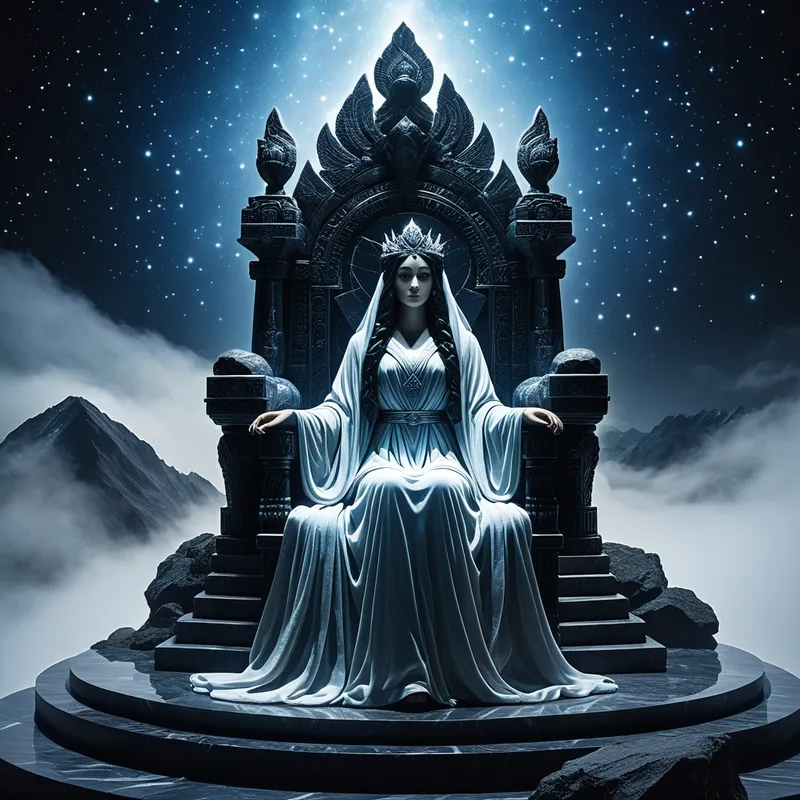
Throne of Memory Myth Meaning & Symbolism
The myth of the throne of Mnemosyne, goddess of memory, explores the sacred source of art, identity, and the deep remembering that precedes true wisdom.
The Tale of the Throne of Memory
Before the songs of heroes, before the first city was raised from stone, there was the silence of the unremembered world. In that primal age, the earth heaved with raw power, and the sky was a blank slate. But in the high, lonely places where the air grows thin and time itself seems to slow, a presence took root. Not with a thunderclap, but with the slow, sure pressure of a mountain’s birth.
This was the domain of Mnemosyne. While her brothers and sisters warred and loved and ruled, she held herself apart, a figure of profound stillness. Her palace was not of gold or marble, but of the very substance of the past. It was said to rest upon the highest peak, where the earth meets the vault of heaven, a place accessible only to those whose hearts were pure of deceit and whose minds yearned not for power, but for truth.
At its heart stood her throne. It was not merely a seat, but an altar and a wellspring. Fashioned from polished obsidian that drank the starlight and veined marble that held the echo of the sea, it was a monument to duration. To sit upon it—a privilege granted to none but the goddess herself and, in the rarest of whispers, to the most desperate and worthy of mortals—was to be immersed in the river of all that had ever been. Not as a chaotic flood, but as a vast, ordered, living tapestry.
The myth tells of a poet, his name lost to the very memory he sought. His world was one of fleeting moments, his songs beautiful but hollow, echoing in the courtyards of kings and then fading. Tormented by this impermanence, he undertook the ultimate pilgrimage. He climbed for nine days and nine nights, past the tree line, through the realm of chilling mists, his body failing but his spirit a single, burning question: What is the source?
When he finally collapsed upon the sacred plateau, it was not a grand hall he found, but an austere, open space under the infinite sky. And there, upon the Throne, sat Mnemosyne. She did not speak with a mortal tongue. Instead, she opened the gates of remembrance. The poet was not told a story; he was made to remember. He recalled the birth of the rivers, the first cry of a newborn creature, the precise feeling of sunlight on the first morning. He remembered the sorrows of forgotten kings and the joys of nameless shepherds. He did not learn art; he remembered that he already knew it, in its pure, primordial form.
He descended, not with a scroll or a tablet, but with a soul now resonant as a bell struck once at the dawn of time. And from him flowed the hymns that would found traditions, the verses that would define a people. He became a vessel, not for his own small life, but for the Memory of the world itself, gifted from the Throne.

Cultural Origins & Context
The figure of Mnemosyne and her symbolic seat are foundational to the Greek understanding of creativity and identity. As a Titan, she belongs to the oldest stratum of divine beings, those who embody fundamental, impersonal powers—in her case, the faculty of Memory itself. Her myth was not a popular tale told in the marketplace but a sacred doctrine preserved by poets, priests, and philosophers.
Her primary role in recorded myth is as the mother of the nine Muses, born from her union with Zeus. This genealogy is everything. It posits that all artistic and intellectual inspiration (the Muses) springs directly from the deep, structural memory of the world (Mnemosyne). The throne, then, is the symbolic locus of this generative power. It was a metaphysical concept more than a literal object, referenced in the esoteric traditions of Orphism and other mystery cults, where remembering one’s divine origin was the key to salvation.
In a society that valued kleos (glory, the thing that is heard), memory was the only true immortality. The throne was the ultimate guarantor of that immortality. It functioned as the divine archive, the sacred source from which all true narration flows, ensuring that what is worthy is not lost to the abyss of Lethe.
Symbolic Architecture
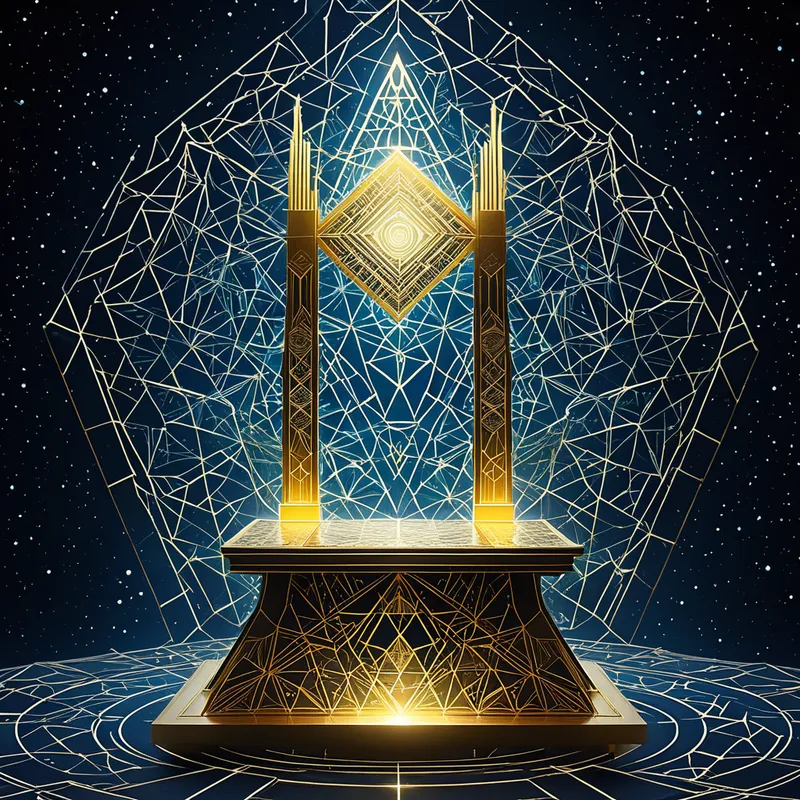
The Throne of Memory is not a relic of the past; it is an active symbol of the psyche’s deepest layer. It represents the objective psyche, the transpersonal ground of being that contains the archetypal patterns and the historical imprint of all human experience. It is the seat of what Carl Jung termed the collective unconscious.
The Throne is not about recalling what you ate for breakfast; it is about remembering what it is to be human, in the fullest, most primordial sense.
The climb to the throne symbolizes the arduous journey inward, past the personal and the temporal, to confront the bedrock of the Self. The poet’s hollow art represents a life lived on the surface, from the ego alone. His ascent is a crisis of meaning, a necessary nekya (descent to the underworld, but here, an ascent to the heights) to recover his authentic voice. Mnemosyne herself is the archetype of the Wise Woman, the anima in her most spiritual aspect, who grants access not to new information, but to ancient knowing. The throne, as an object, symbolizes order, structure, and permanence—it is the stable axis around which the chaos of experience can coalesce into meaningful form (art, wisdom, identity).
The Dreamer’s Resonance
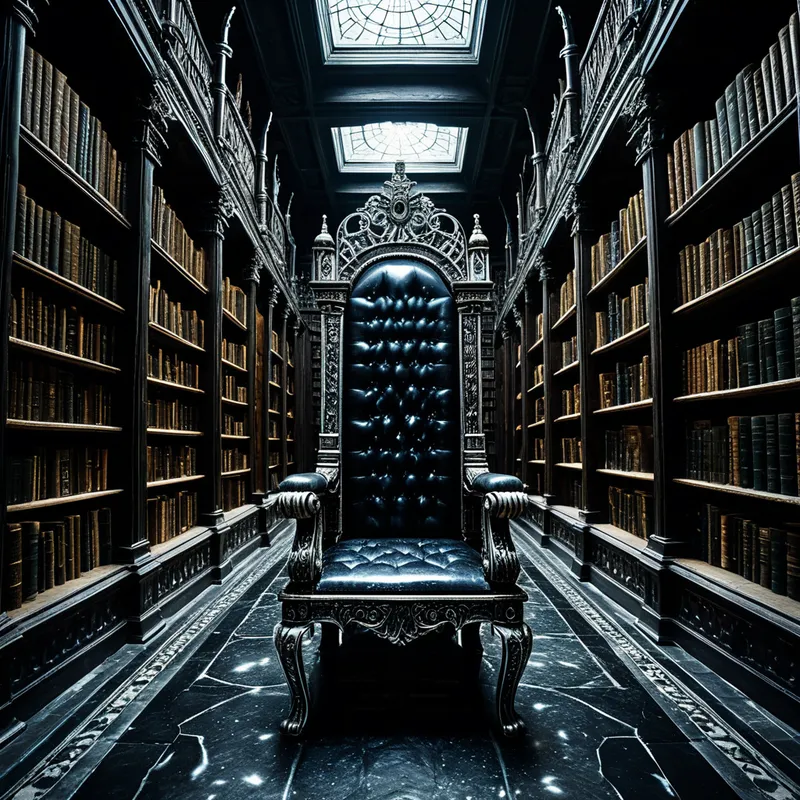
When this myth stirs in the modern unconscious, it often manifests in dreams of profound searching and discovery. One might dream of finding a hidden room in a familiar house, containing an old, majestic chair or a vast, silent library with a central seat. There is a palpable sense of awe, gravity, and solitude.
Somatically, the dreamer may awaken with a feeling of expansion in the chest or a deep, resonant calm, as if a fundamental tension has been released. Psychologically, this dream pattern emerges during transitions where one’s old identity or creative source feels depleted. It signals a process of re-sourcing—a call to move beyond personal memory (autobiography) and tap into the transpersonal. The “throne” in the dream is the Self offering its own authority. The conflict is the ego’s fear of being dissolved in this vaster memory. To approach the throne is to consent to being re-membered, put back together from a deeper blueprint than the one life has provided.
Alchemical Translation
The myth models the alchemical opus of individuation—the process of becoming who one fundamentally is. The initial state is the “base metal” of the poet: skilled but soulless, identified with the persona. The ascensio (ascent) is the nigredo, the dark night of the soul, where one confronts the emptiness of a life without connection to the source.
The throne is the lapis philosophorum, the philosopher’s stone. It is the immutable point within the psyche where all contradiction is held and all experience is redeemed into meaning.
Sitting upon the Throne of Memory is the albedo, the whitening. It is not an act of will, but of surrender to a remembering that comes from beyond the ego. One is cleansed in the waters of Mnemosyne, recalling not personal history, but archetypal truth. The poet’s return, now a true vessel, represents the rubedo, the reddening. The gold of the Self, retrieved from the heights, is brought back and incarnated into the world as authentic creation. The individual is no longer just themselves; they are a voice for the timeless. Their art, their decisions, their very presence becomes an expression of that deep, remembered wisdom, completing the cycle of psychic transmutation from isolated fragment to integrated, sovereign whole.
Associated Symbols
Explore related symbols from the CaleaDream lexicon: