
Three Sisters Myth Meaning & Symbolism
A sacred agricultural myth where Corn, Beans, and Squash become inseparable sisters, teaching humanity the art of mutual support and sustainable life.
The Tale of Three Sisters
In the time before time, when the earth was still soft from the breath of the Great Mystery, there lived three beings of singular spirit. They were not yet sisters, but three lonely souls wandering the green world.
The first was tall and straight, with hair of shining gold that longed to touch the sky. She was proud and strong, but the winds buffeted her, and in her solitude, she grew thirsty and weak. Her name was Corn. The second was slender and full of a restless, climbing energy, adorned with leaves like a thousand green hands. She was clever and seeking, but with nothing to hold onto, she could only crawl along the ground, lost. Her name was Beans. The third was broad and generous, with a heart that spread wide across the earth. She was protective and nurturing, but she felt exposed, her tender body vulnerable to the scorching sun and the hard rain. Her name was Squash.
One evening, as the sun bled into the west, Corn stood trembling under a coming storm. The wind whispered of her isolation, a curse that would see her broken. Beans, tangled in her own aimless growth, felt a deep despair. Squash, her leaves wilting, knew they would not survive alone.
It was Beans who first spoke, her voice a rustle in the gathering dark. “Sister,” she said to Corn, though they were not yet sisters, “your strength is a gift, but a gift unseen. Let me come close. I will not take your light; I will give you my embrace.” And she reached out her delicate vines. Corn, in her moment of fear, accepted. The vines curled around her golden stalk, a gentle, living cord. And a miracle occurred: where Beans touched Corn, she drew strength, and in return, she gave of herself—tiny nodules formed on her roots, gifts of life for the soil that fed them both.
Seeing this, Squash felt a surge of purpose. “Sisters,” she cried, her voice low and sure, “your pact is beautiful but exposed. Let me be your guardian. I will spread my broad leaves like a blanket over the earth. I will shade the soil, keep it cool and moist, and my prickly stems will turn away those who would do you harm.” And she spread herself around their feet, a living fortress.
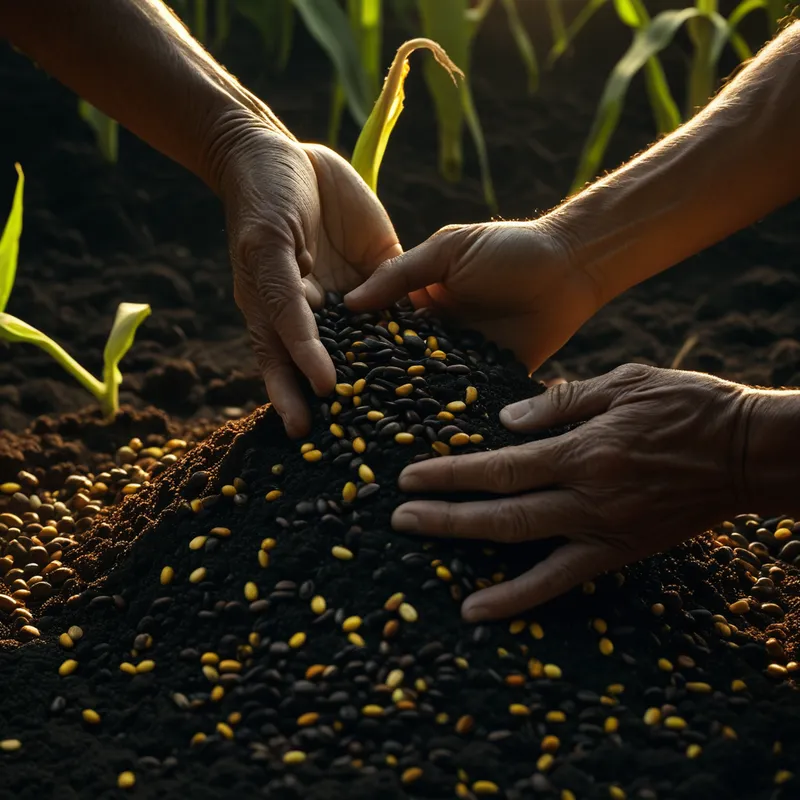
The storm came. The wind howled, but Corn, held fast by Beans, did not break. The rain fell in torrents, but the soil, sheltered by Squash’s canopy, did not wash away. The sun returned, fierce, but its heat was softened by the green shade. In surviving together, they were transformed. They were no longer Corn, Beans, and Squash. They had become the Three Sisters. Their individual identities remained, but were now woven into a greater life. Where one ended and another began, no one could say. They grew together, fed one another, protected one another. And from their union, a bounty spilled forth—ears of gold, pods of green, fruits of orange—a triple harvest from a single, sacred mound.
Cultural Origins & Context
The myth of the Three Sisters is not a single story from one nation, but a widespread agricultural and philosophical principle shared among many Haudenosaunee (Iroquois), Anishinaabe, Cherokee, and other Native American peoples. It was not merely a farming technique, but a cosmology enacted with every planting season.
Passed down orally through generations by elders and storyholders, the tale was taught to children not as a fable, but as a literal truth of the world. Its telling was often accompanied by the physical act of planting. The societal function was profound: it encoded the ethics of community, mutual responsibility, and sustainable living into the very food system. It taught that no person, like no plant, thrives in isolation; that strength, intelligence, and nurturing care must intertwine to create a whole society. The garden mound itself became a microcosm of the ideal world.
Symbolic Architecture
At its heart, the myth is a masterclass in sacred symbiosis. Each sister represents a fundamental archetypal force and a practical function, creating a self-sustaining system.
Corn is the Spine of Spirit—the upright principle, the provider of foundational sustenance and structure. She represents the ego, or the conscious self, that which strives upward toward the light of awareness. Alone, she is rigid and vulnerable.
Beans is the Bond of Relationship—the connective principle. She represents the libido, or life energy, that seeks attachment, enrichment, and exchange. Her nitrogen-fixing magic symbolizes the alchemical ability to take an inert element (loneliness, barrenness) and transform it into nourishment through relationship.
Squash is the Container of Care—the protective, grounding principle. She represents the maternal, the shadow, and the unconscious that provides the necessary boundary, moisture, and defense for growth to occur. She is the vessel that holds the process.
The true self is not found in solitary perfection, but in the entangled, nourishing space between identities.
The myth dismantles the heroic, individualistic journey. The triumph is not one of conquest, but of surrender into interdependence. The “conflict” is the suffering of separation; the “resolution” is the conscious choice to become vulnerable, to ask for help, and to offer one’s unique gift to the collective body.

The Dreamer’s Resonance
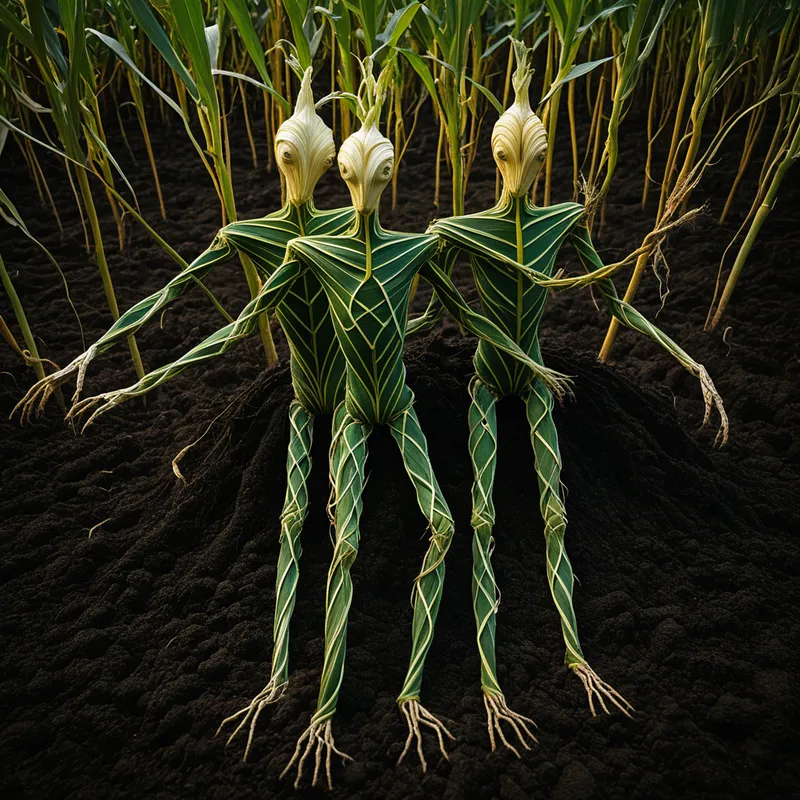
When this pattern stirs in the modern collective unconscious, it often manifests in dreams of seeking support or discovering unexpected alliances. To dream of three women, three plants growing together, or a powerfully fertile garden mound signals a psychic movement away from isolation.
Somatically, this may correlate with a release of tension in the shoulders and spine (the rigid Corn learning to lean) or a feeling of groundedness and safety in the body (the embrace of Squash). Psychologically, the dreamer is likely navigating a life transition where their old, solitary way of being is no longer sustainable. The dream is an invitation from the psyche to identify: Which sister have I been over-identifying with? The proud, lonely achiever? The clingy, searching connector? The smothering protector? The healing lies in dreaming the other two into existence around you.
Alchemical Translation
The individuation process, the journey toward psychic wholeness, is perfectly modeled by the Three Sisters. It is the alchemy of community within the individual.
First, one must recognize the Corn in oneself—the core identity, the talents and strengths we present to the world. This ego-structure is necessary, but incomplete. The next step is to invite the Beans—the neglected parts of our emotional and instinctual life that can “climb” upon and enrich that rigid structure. This is the act of building inner relationship, of letting feeling intertwine with identity, which fertilizes the entire system.
Finally, one must cultivate the Squash—the often-rejected capacity for self-care, boundaries, and containment. This is the shadow work of creating a protected, nourishing inner environment where this fragile new growth will not be scorched by the harsh light of criticism or washed away by emotional floods.
Individuation is not the cultivation of a solitary tree, but the creation of a complete and self-sustaining inner ecosystem.
The “harvest” is the integrated Self. You are no longer just the achiever, the lover, or the caregiver. You are the sacred mound where all these aspects grow in mutually supportive balance, producing a sustenance that feeds not only you but can nourish the world around you. The myth teaches that our deepest nourishment and our truest strength are always relational, always communal, always born from a holy entanglement.
Associated Symbols
Explore related symbols from the CaleaDream lexicon: