Thoth's Lost Books Myth Meaning & Symbolism
A myth of the god Thoth hiding his books of ultimate power to protect the cosmic order, a story of wisdom's burden and the price of forbidden knowledge.
The Tale of Thoth's Lost Books
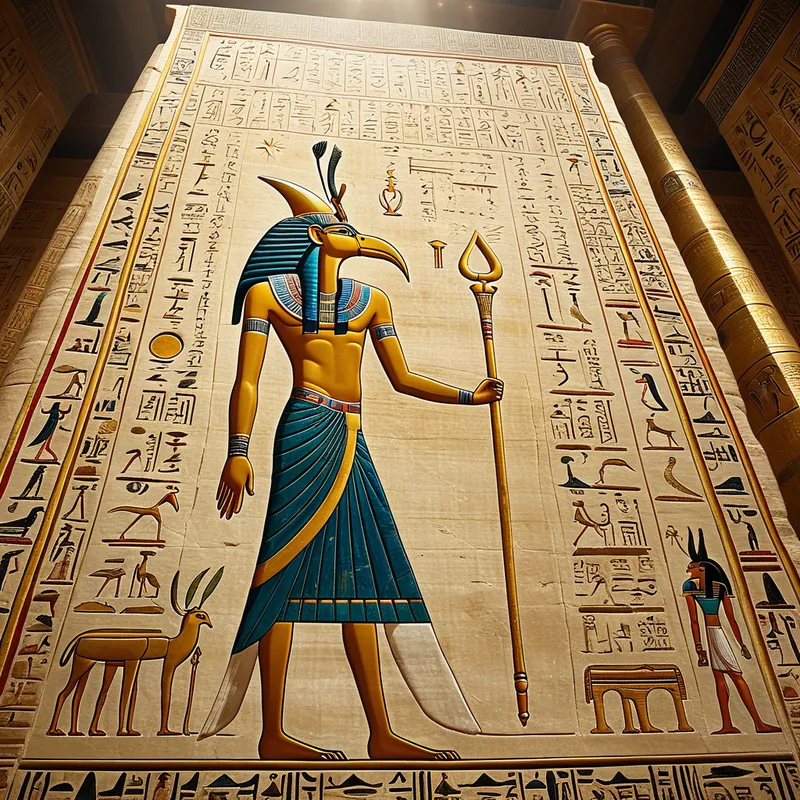
Listen, and hear a tale not of sand and sun, but of ink and shadow, of words that could bend the spine of the world. It begins in the silence before the first dawn, in the Nun. From that silence, the mind of the cosmos took form: Thoth, the ibis-headed, the measurer, the scribe of the gods. With the stroke of his reed pen, reality itself was written into being. But his greatest work was not the sky or the river. It was a collection of forty-two books.
These were not mere scrolls. They were vessels. Within them slept the true names of all things, the secret pathways of the stars, the spells to command the winds, to understand the speech of animals, to gaze into the heart of the sun god Ra himself, and—most perilous of all—to enchant the gods, the dead, and the earth. This was knowledge so potent it vibrated with a sound only the soul could hear. Thoth, in his wisdom, knew such power must not walk freely in the world of men. It would unmake the delicate Ma'at, the sacred balance.
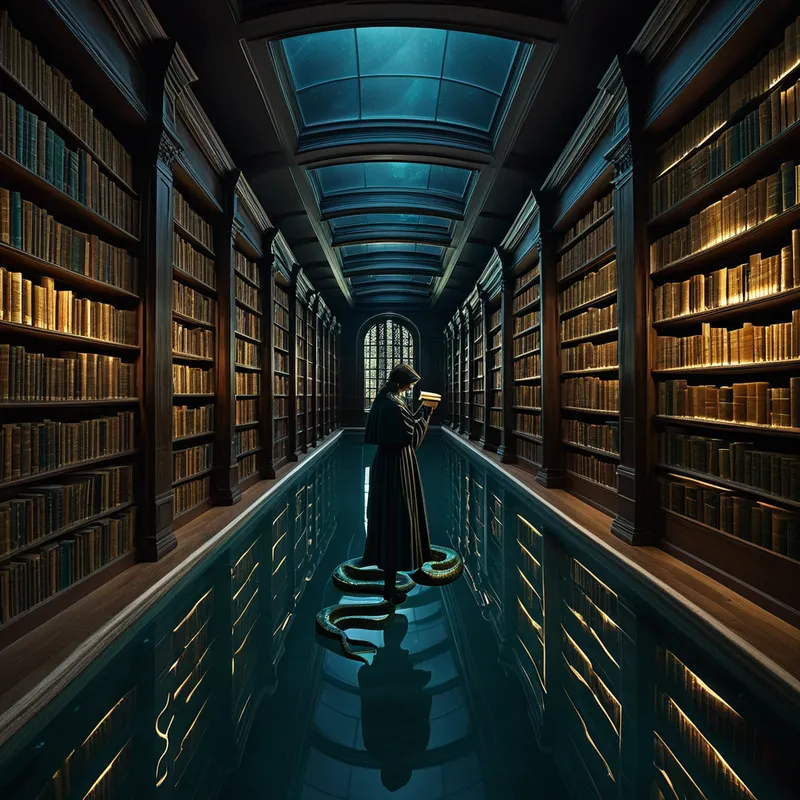
So, he performed the first and greatest act of hiding. With a heavy heart, he gathered his luminous books. He did not burn them, for wisdom cannot be destroyed, only transformed. Instead, he took them to the edge of creation. Some say he sealed them in a crypt of black iron, hidden beneath the Benben stone. Others whisper he cast them into the deep, dark waters of the Nile, where they were guarded by serpents of emerald and obsidian, creatures woven from the very spells they protected.
The tale then leaps across dynasties, to a time of mortal kings. A prince named Neferkaptah, learned and proud, heard rumors of this lost library of god-magic. His desire became a fire in his bones. He sought, he questioned, he sacrificed. Finally, a phantom priest, a ghost of a forgotten temple, revealed the location: a casket within a casket within a casket, resting in the heart of the river, encircled by a serpent that could not be killed by any blade of man.
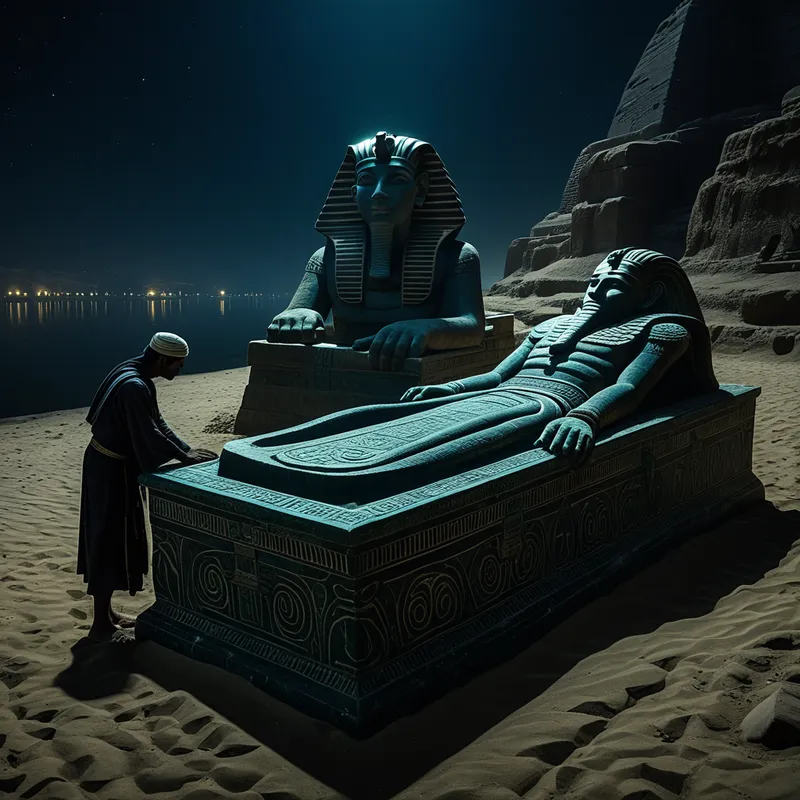
Neferkaptah, using lesser magics, crafted a great wall of sand to part the waters. He faced the serpent, not with force, but with cunning and sleep-spells. He reached the caskets, broke their seals, and beheld the books. Their light seared his eyes; their knowledge flooded his mind like a second Nile. He read aloud a single spell, and the sky darkened at his command. He had won. But as he turned, the tale twists. His young son, playing nearby, fell into the river and drowned. In his grief, Neferkaptah used a spell from the very book to draw his son's Ka back for a moment of farewell. Then his wife, in her despair, took her own life. He restored her, too, briefly. Finally, bound by love and loss, Neferkaptah placed the book of power upon his own chest and lay down between his wife and son, joining them in death. The books were buried with him, lost once more, their cost written not in ink, but in blood and silence.
Cultural Origins & Context
This myth comes to us primarily from a Demotic Egyptian narrative known as "Setne Khamwas and the Book of Thoth," a story cycle from the Ptolemaic period, though its roots are undoubtedly far older. It was not a temple liturgy but a popular tale, told in homes and courts, a gripping yarn of adventure with a profound moral core. It functioned as cultural software, encoding essential Egyptian values. At its heart is the principle of Ma'at—the cosmic balance. The story teaches that knowledge, especially divine knowledge (heka, magic), is not a neutral tool. It is a sacred force with an inherent moral weight and consequence. The myth served as a warning against hubris, against the mortal desire to possess god-like power without god-like wisdom and responsibility. It reassured that the cosmic order is protected, that some boundaries—between mortal and divine, between life and death—are maintained by the gods for the good of all creation.
Symbolic Architecture
The Lost Books are the ultimate symbol of the numinous—the terrifying and fascinating mystery at the root of existence. Thoth, as the scribe, represents the organizing principle of consciousness itself, the Logos that structures chaos into cosmos.
The books are not hidden from us out of spite, but because we are not yet the container that can hold their light without being consumed.
The act of hiding is not an act of theft, but of sacred guardianship. It is the ego’s necessary encounter with the fact that the totality of the Self (the unconscious, the divine) cannot be fully assimilated; it must remain partially transcendent, a guiding mystery. Prince Neferkaptah is the archetype of the brilliant, driven ego, the conscious mind that believes it can, through intellect and willpower (his "lesser magics"), seize the treasures of the unconscious. His tragic success illustrates the peril of inflation—the psychic state where the ego, having touched a fragment of transpersonal power, believes it is the source of that power. The subsequent loss of his family symbolizes the inevitable collapse of a personality built on such an unstable foundation; the personal relationships and human connections (the "son," the "wife") are sacrificed to the monomaniacal pursuit.
The Dreamer's Resonance
When this myth stirs in the modern dreamer, it often manifests as dreams of discovering hidden rooms, secret libraries, or encrypted files containing world-altering information. There may be a potent, forbidden book the dreamer feels compelled to open, or a sense of being on the verge of a monumental discovery that is both thrilling and terrifying. Somatically, this can feel like a buzzing in the crown of the head, a pressure behind the eyes, or a tightness in the chest—the body registering an influx of psychic energy it is struggling to integrate.
Psychologically, this dream pattern signals a critical encounter with what Jung called "treasure hard to attain." The dreamer is grappling with an emerging complex of knowledge or insight from the unconscious that feels overwhelmingly powerful. This could be a nascent creative vision, a psychological truth about one's history, or a spiritual awakening. The conflict in the dream mirrors the inner conflict: the ego's desire to possess and use this energy versus the deeper Self's protective mechanisms that may "hide" the full force of this knowledge until the ego is strong enough, humble enough, to receive it without identifying with it.
Alchemical Translation
The myth of Thoth's Lost Books is a precise map of the individuation process, specifically the stage of coniunctio (the sacred marriage) and its inherent perils. The alchemical goal is not merely to find the philosopher's stone (the Books), but to undergo the transmutation necessary to be in right relationship with it.
The true magic is not in reading the book, but in becoming the temple in which it could safely reside.
Neferkaptah's journey is the nigredo, the blackening. His conscious pursuit (the quest) leads to a confrontation with the shadow (the serpent guardian) and a seeming victory. But this victory brings not illumination, but the mortificatio—the death of his old world (his family, his former life). This is the essential, painful dissolution. The ego's ambitious project dies. In the alchemical retelling, this death is not the end, but the prerequisite for the albedo, the whitening. Had Neferkaptah survived, the loss would have been the crucible for a new consciousness—one that understands wisdom as stewardship, not possession; that sees power as a covenant with the whole, not a tool for the self.
For us, the modern alchemist, the myth instructs: when we encounter profound inner knowledge, we must not rush to "use" it for personal gain, status, or escape. We must first build the inner temenos (sacred space)—through humility, ethical reflection, and integration of our own humanity. The Books are always there, hidden in the depths of our own Nile. The work is not to drag them into the harsh sun of ego-consciousness, but to learn the language of the depths, to respect the guardian serpents of our own resistance, and to let the knowledge transform us from within, at a pace the soul can bear. In doing so, we don't become Thoth, but we fulfill our role within his great, balanced design.
Associated Symbols
Explore related symbols from the CaleaDream lexicon: