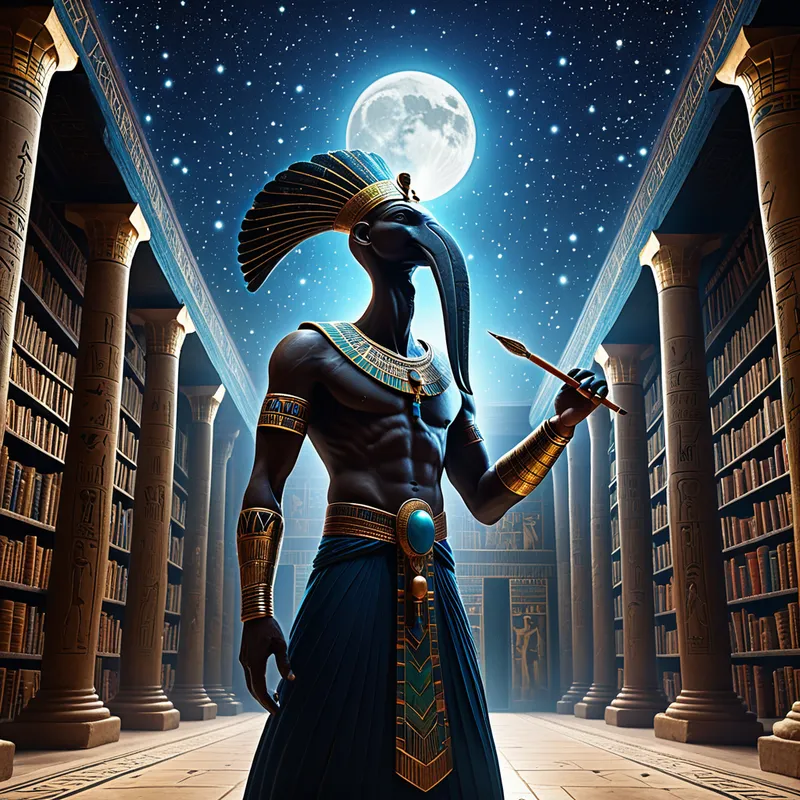
Thoth as Ibis Myth Meaning & Symbolism
The myth of Thoth manifesting as the ibis, a sacred bird whose form embodies the divine marriage of celestial wisdom and earthly scribal craft.
The Tale of Thoth as Ibis
Before the first sunrise etched its gold upon the eastern sands, there was only the silent, dark expanse of Nun. In that timeless deep, a thought stirred—a vibration seeking form, a word longing for a tongue. It was the mind of Thoth, unborn, yet all-knowing.
He perceived the coming struggle. The great sun god Khepri would soon roll the solar disk from the waters, but order was fragile. Chaos, the serpent Apep, coiled in the depths, waiting to devour the light and return all to silent, wordless void. The cosmos would need a scribe, a measurer, a voice to speak the laws that would hold creation fast.
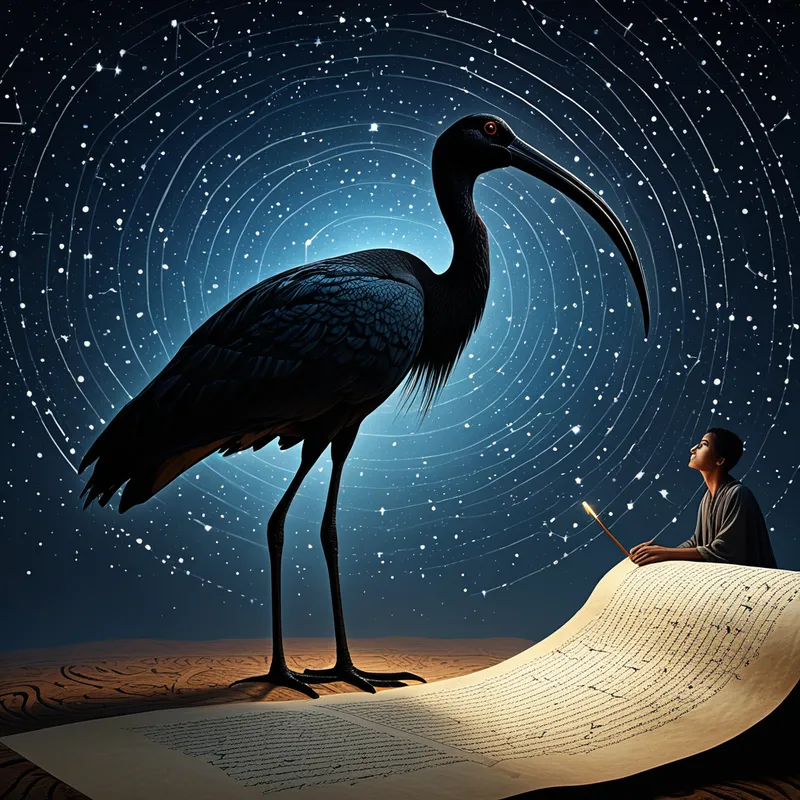
So Thoth, the self-created, chose his vessel. He did not take the form of a mighty lion or a coiled serpent. From the reedy marshes where the waters of Nun still kissed the newborn earth, he drew forth the essence of the ibis. He became the bird with the crescent-moon curve of a beak, a living hieroglyph for the heart and the mind. His feathers were the grey of twilight and the white of the moon’s pure light. His legs, long and stilt-like, allowed him to stride between the watery deep of the unconscious and the solid ground of manifest reality.
With his first step onto the primordial mound, the act of writing began. His beak, that precise, probing instrument, became his stylus. Where he pecked at the mud, symbols appeared—the first sacred words. He spoke the names of things, and by naming them, he gave them stability and truth. He calculated the passage of the stars and the phases of the moon, weaving time itself into a measurable tapestry. When the sun god Ra sailed his barque across the sky, it was Thoth-as-Ibis who stood at the prow, his silent vigilance and recorded spells protecting the light from the chaos that slithered below.
In the great hall of Ma'at, his role was supreme. When a soul stood trembling before the scales, it was the feather of the ibis—the Shu-feather of Truth—that was placed upon the golden balance. And it was Thoth, ibis-headed, who stood as scribe of the gods, recording the verdict for all eternity. His form was a silent testament: true power lies not in the roar, but in the precise stroke that separates truth from falsehood, order from chaos, the enduring word from the forgotten whisper.

Cultural Origins & Context
The veneration of Thoth in his ibis form is not a singular myth from one papyrus, but a pervasive theological reality woven into the fabric of ancient Egyptian civilization for millennia. His origins are prehistoric, likely emerging from the observation of the sacred ibis (Threskiornis aethiopicus) in the Nile ecosystem. The bird’s seasonal appearances, its methodical foraging in the fertile mud (mirroring the act of writing), and the crescent shape of its beak (echoing the moon) made it a natural hierophany—a manifestation of the sacred.
This myth was passed down not as a bedtime story, but as a foundational truth embedded in temple ritual, funerary texts like the Book of the Dead, and the daily practice of the scribal class. The priests of Thoth were the scholars, astronomers, physicians, and bureaucrats. For them, Thoth-as-Ibis was the divine patron who sanctified their work. To write was to participate in his mythic act of creation; to calculate was to emulate his ordering of the cosmos. Millions of ibises were mummified and offered at his cult centers, like Hermopolis Magna, creating a tangible, physical link between the people and this god of abstract intellect.
Symbolic Architecture
The ibis is not merely Thoth’s animal; it is the symbolic architecture of his consciousness. Every physical attribute maps to a psychic function.
The long, curved beak is the ultimate symbol of discrimination. It probes the murky waters (the unconscious, the unknown) and selects with precision only what is nourishing (knowledge, truth). It is the active intellect, the tool that separates, defines, and articulates.
The beak of the ibis does not consume chaos; it translates it. It is the divine instrument that turns the formless potential of the deep into the legible script of reality.
The bird’s habitat, wading between water and land, embodies the god’s role as mediator. Thoth mediates between light and dark (as a moon god complementing the sun), between gods and humans (as divine scribe and messenger), and between life and death (as recorder in the Hall of Judgment). Psychologically, this represents the ego’s necessary function: to stand at the threshold between the unconscious (the watery deep) and conscious reality (the solid earth), translating the raw material of instincts and images into communicable form.
The ibis’s connection to the moon ties Thoth to cycles, measurement, and the hidden, reflective light of the night. This is the wisdom that comes not from the blazing, obvious light of the sun (consciousness), but from the subtle, intuitive illumination that reveals patterns, rhythms, and the shadowed aspects of the self.
The Dreamer's Resonance
When the form of the ibis, or the presence of a scribal god, glides into modern dreams, it often signals a critical moment of psychic differentiation. The dreamer is not in a battle of brute force, but in a process of meticulous inner work.
Somnially, this may manifest as finding a strange, elegant feather that feels heavy with importance; encountering a silent, watchful bird in a library or a marsh; or struggling to inscribe words on a surface that keeps changing. The somatic sensation is often one of focused tension—a pressure in the head, a tightness in the hand—the body mirroring the effort to “get it down,” to articulate what has been formless.
Psychologically, this marks the ego’s attempt to mediate a conflict or integrate a complex emotion. It is the self trying to “write the record” of an internal experience, to bring order to inner chaos. The ibis-dream appears when unconscious contents (the waters of Nun) are rising and demand to be named, measured, and understood, rather than merely felt or feared. The danger, mirrored in the myth, is that without this scribal function, the serpent of chaos—anxiety, dissociation, meaninglessness—will swallow the nascent light of awareness.
Alchemical Translation
The myth of Thoth-as-Ibis is a precise manual for the alchemy of consciousness, a map for the individuation journey. The prima materia, the base matter for this transmutation, is the undifferentiated chaos of our inner world—the swirl of emotions, conflicting impulses, and half-formed thoughts.
The Calcinatio (Heating/Drying): This is the focused, probing heat of the ibis’s discriminating beak. It is the often-painful process of self-examination, where we apply the fire of our attention to our own murky depths. We must “wade in” and sift through the mud of our experiences, rejecting the trivial and identifying the core truths.
The Solutio (Dissolving): The ibis stands in the water. To write the self, one must first allow the self to be dissolved—to let go of rigid identities and confront the fluid, unknown aspects of the psyche. This is the moon-governed phase of reflection and receptivity.
The Coagulatio (Solidifying): This is the act of inscription itself. The insights gained from the Solutio are given form. Through journaling, art, dialogue, or simply clear thought, the liquid wisdom is “coagulated” into something tangible: a realization, a decision, a creative work, a new personal law.
The ultimate creation is not a thing, but a capacity: the sovereign ability to inscribe the narrative of one’s own soul, to weigh one’s own heart against the feather of inner truth, and to record a verdict of self-acceptance.
The triumph of Thoth is not a victory over an external enemy, but the eternal, vigilant establishment of an inner Ma'at. To embody the Ibis is to become the scribe of your own existence, transforming the chaotic whispers of the deep into the sacred, enduring text of a conscious life.
Associated Symbols
Explore related symbols from the CaleaDream lexicon: