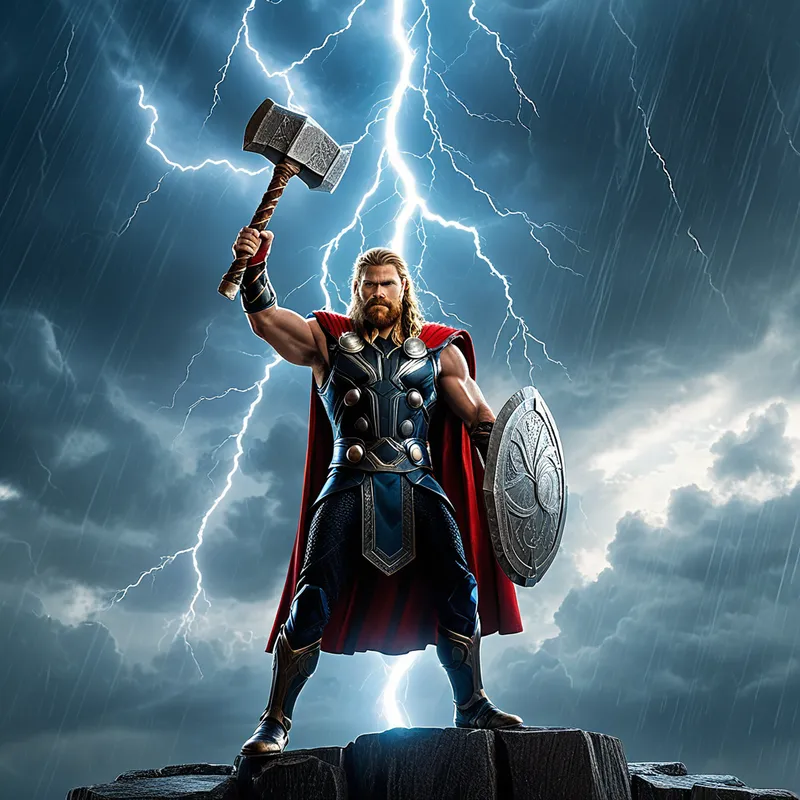
Thor's Mjölnir Myth Meaning & Symbolism
A tale of a god's stolen hammer, a humiliating bargain, and the fiery reforging that birthed a weapon of protection and a symbol of sacred power.
The Tale of Thor’s Mjölnir
Hear now the tale of the Thunderer’s might, and the day the very heart of Asgard was silenced. It begins not with a roar, but with a theft, in the deep, dreaming hours when even the gods slumber.
Thor, son of Odin, awoke to a silence that chilled his bones. Gone was the familiar, comforting weight at his bedside. [Mjölnir](/myths/mjlnir “Myth from Norse culture.”/), the grinder, the crusher, the defender of the realms, was stolen. Without it, the thunder slept in the clouds. The [Jötnar](/myths/jtnar “Myth from Norse culture.”/) would soon scent this weakness like blood in the [water](/myths/water “Myth from Chinese culture.”/). Panic, cold and sharp, swept through the golden halls.
The culprit was the crafty giant Thrym, who had buried the hammer eight leagues deep beneath [the earth](/myths/the-earth “Myth from Hindu culture.”/). His price for its return was no treasure of gold, but a cruelty designed to break a god’s spirit: the hand of the goddess [Frigg](/myths/frigg “Myth from Norse culture.”/) in marriage. Laughter died in Asgard. Despair took its seat at the table.
Then Loki, silver-tongued and quick as thought, saw a path woven from humiliation. “There is one way,” he said, his voice a sly whisper. “We must dress Thor not as a warrior, but as a bride.” The hall fell utterly silent. Thor’s roar of refusal shook the rafters, but the gaze of Odin was heavy with the fate of all things. For the sake of the worlds, the Thunderer must swallow his pride.
They dressed him in Frigg’s finest linen and lace, hid his fierce eyes behind a veil, and placed a bridal crown upon his red hair. His great hands, which could level mountains, were gloved and meekly folded. Loki, disguised as a handmaiden, accompanied him, their chariot rumbling not with thunder, but with the tension of a coiled spring.
In Jötunheim, Thrym’s hall was a cavern of ice and boasting. The giant king stared, love-struck by his towering bride. The feast began. Thor, the “bride,” devoured an entire ox, eight salmon, and drained three barrels of mead. Thrym stared, bewildered. Loki’s whisper was swift: “Frigg has not eaten for eight nights, so great was her longing for Jötunheim.”
Foolish Thrym, his heart swelling, commanded the bridal price be brought forth to honor his new wife. His servants strained to carry the heavy cloth bundle into the hall. When they laid Mjölnir upon the bride’s lap, [the world](/myths/the-world “Myth from Tarot culture.”/) held its breath.
Then, [the veil](/myths/the-veil “Myth from Various culture.”/) was torn away. The linen shred. Thor’s eyes blazed with the fury of a trapped storm finally unleashed. His fingers closed around the familiar haft. The first swing was not just a blow; it was the return of the world’s axis. Thrym’s skull was the first to meet the grinder, and his kin soon followed, until the hall of the giant was a tomb of ice and silence. The hammer was home. The thunder returned, louder and more righteous than ever before.
Cultural Origins & Context
This myth, preserved primarily in the 13th-century Poetic Edda poem “Þrymskviða” (Thrym’s Poem), is a narrative that would have resonated in the fire-lit halls of the Viking Age. It was not scripture, but living story—a saga told by skalds to a community whose worldview was framed by a constant, tangible struggle against chaos, represented by the harsh sea, the bitter cold, and rival clans. The gods were not distant moral paragons but powerful, flawed kin who faced problems akin to human ones: theft, bargaining, and the defense of the homeland.
The function of such a tale was multifaceted. On one level, it was pure, thrilling entertainment, a comedy of errors with a cathartic, violent payoff. On a deeper, societal level, it reinforced core values. It illustrated that the protection of the community (Asgard and, by extension, the village) sometimes requires immense personal sacrifice and cunning strategy, not just brute force. The myth also validated the sacred role of the warrior (Thor) as the essential bulwark against annihilation, while humorously exploring the tensions of gender roles and social expectation—the mightiest god brought low by playing a feminine part, only to reclaim his power explosively.
Symbolic Architecture
Mjölnir is far more than a [weapon](/symbols/weapon “Symbol: A weapon in dreams often symbolizes power, aggression, and the need for protection or defense.”/); it is the symbolic embodiment of divine, creative force applied as protective power. It is the tool that shapes, defines, and defends [reality](/symbols/reality “Symbol: Reality signifies the state of existence and perception, often reflecting one’s understanding of truth and life experiences.”/) against the encroaching formlessness of [chaos](/symbols/chaos “Symbol: In Arts & Music, chaos represents raw creative potential, uncontrolled expression, and the breakdown of order to forge new artistic forms.”/). Its theft represents a profound psychic [crisis](/symbols/crisis “Symbol: A crisis symbolizes turmoil, urgent challenges, and the need for immediate resolution or change.”/): the [loss](/symbols/loss “Symbol: Loss often symbolizes change, grief, and transformation in dreams, representing the emotional or psychological detachment from something or someone significant.”/) of one’s defining power, agency, and [purpose](/symbols/purpose “Symbol: Purpose signifies direction, meaning, and intention in life, often reflecting personal ambitions and core values.”/).
The hero’s journey is not always outward. Sometimes, the deepest quest is into the humiliation of the self, to reclaim the fragment of soul buried in the shadowlands.
Thor’s cross-dressing is the myth’s brilliant alchemical core. To recover his power, the archetypal Masculine (focused, assertive, protective) must temporarily integrate its opposite—the guise of the Feminine (receptive, veiled, strategic). This is not a negation, but a necessary descent. [The ego](/myths/the-ego “Myth from Jungian culture.”/) (Thor) must be humbled, must wear a disguise that feels like a lie, to navigate the territory of the [trickster](/symbols/trickster “Symbol: A boundary-crossing archetype representing chaos, transformation, and the subversion of norms through cunning and humor.”/) (Loki, the unconscious mind) and the giant (the [shadow](/symbols/shadow “Symbol: The ‘shadow’ embodies the unconscious, repressed aspects of the self and often represents fears or hidden emotions.”/), the repressed challenge). The hammer is only restored when it is placed in the “[bride](/symbols/bride “Symbol: A bride symbolizes new beginnings, commitment, and the transition into a partnership or a new phase in life.”/)’s” lap—a symbolic [reunion](/symbols/reunion “Symbol: A reunion symbolizes reconnection, healing, and the revival of past relationships and experiences.”/) of the masculine principle of [action](/symbols/action “Symbol: Action in dreams represents the drive for agency, motivation, and the ability to take control of situations in waking life.”/) with the feminine principle of [vessel](/symbols/vessel “Symbol: A container or structure that holds, transports, or protects something essential, representing the self, emotions, or life journey.”/) and [gestation](/symbols/gestation “Symbol: A period of development and preparation before a significant birth or emergence, symbolizing potential, transformation, and the journey toward manifestation.”/). True power is reclaimed only after this perilous [integration](/symbols/integration “Symbol: The process of unifying disparate parts of the self or experience into a cohesive whole, often representing psychological wholeness or resolution of internal conflict.”/).
The Dreamer’s Resonance
When this myth pattern stirs in the modern dreamer, it signals a profound process of reclaiming personal authority. Dreaming of a lost or stolen tool of great power—a weapon, a key, a unique instrument—mirrors Thor’s crisis. The dream ego feels neutered, ineffective, its will blocked.
Somatically, this may manifest as a literal feeling of weakness, a “loss of one’s grip” on life, or a deep-seated anxiety that one is defenseless. Psychologically, the “Thrym” figure in the dream—the boss, the partner, the faceless institution—represents the externalized form of an internal surrender. The dream may then guide the dreamer through absurd or humiliating scenarios: being naked in a boardroom, speaking in a forgotten language, performing a menial task one is overqualified for. This is the “bridal dress” sequence. The unconscious is forcing a confrontation with disowned parts of [the self](/myths/the-self “Myth from Jungian culture.”/)—vulnerability, passivity, cunning—that must be acknowledged and worn, however uncomfortably, to proceed. The resolution comes not by avoiding the humiliation, but by moving through it until the “hammer” is placed back in one’s hands, symbolizing the imminent recovery of agency.
Alchemical Translation
The individuation process modeled here is the reforging of the will. We all experience periods where our foundational power—our ability to effect change, to set boundaries, to create—seems stolen by circumstance, depression, or trauma. The myth instructs us not to charge blindly after it (Thor’s initial rage is futile).
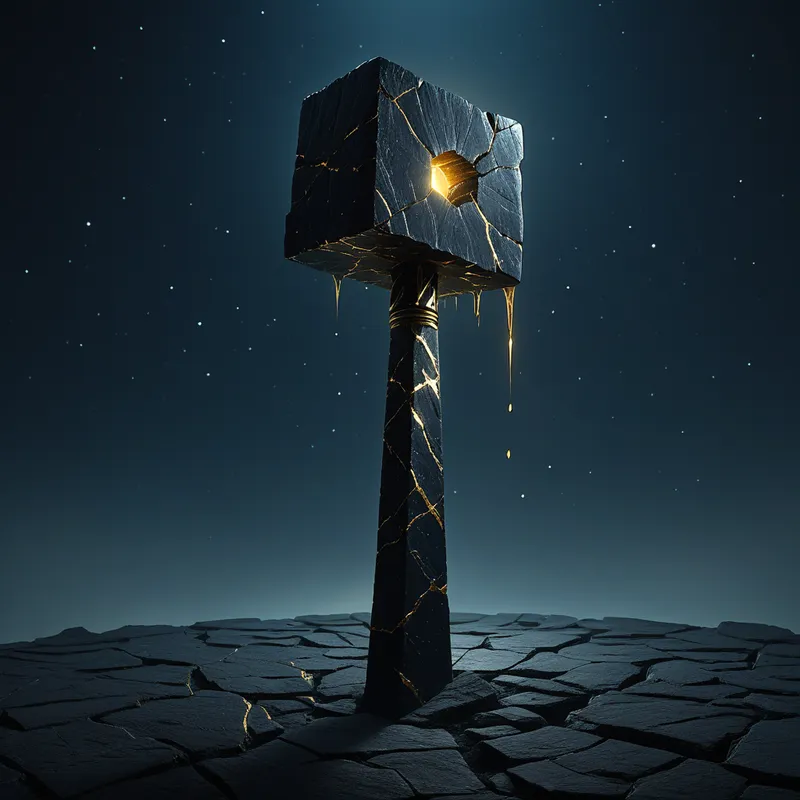
The flaw in the hammer’s haft is the mark of the authentic self; perfection is sterile, but the slightly imperfect tool fits only the hand that forged it through trial.
First, we must accept the “disguise.” This is the conscious engagement with our perceived weaknesses, our vulnerabilities, the parts of ourselves we deem unheroic. We must listen to the Loki within—our intuition and cunning—to navigate the shadowy bargain. This stage feels like a betrayal of the ego’s self-image. Yet, it is precisely this adaptive flexibility that allows us to enter the giant’s hall (the problematic complex) and sit at the table.
The final, crucial act is not negotiation, but recognition and seizing. The restored power is not given; it is placed before us, and we must be ready to shed the disguise and grasp it. The psychic transmutation is complete when the reclaimed power is no longer the brute, uncontextualized force of the ego, but a more conscious, integrated strength. It is a hammer that can both destroy threats and hallow sacred space—a will that can say “no” to chaos and “yes” to meaning, forged in the fires of necessary humiliation.
Associated Symbols
Explore related symbols from the CaleaDream lexicon: