Thor's Chariot Myth Meaning & Symbolism
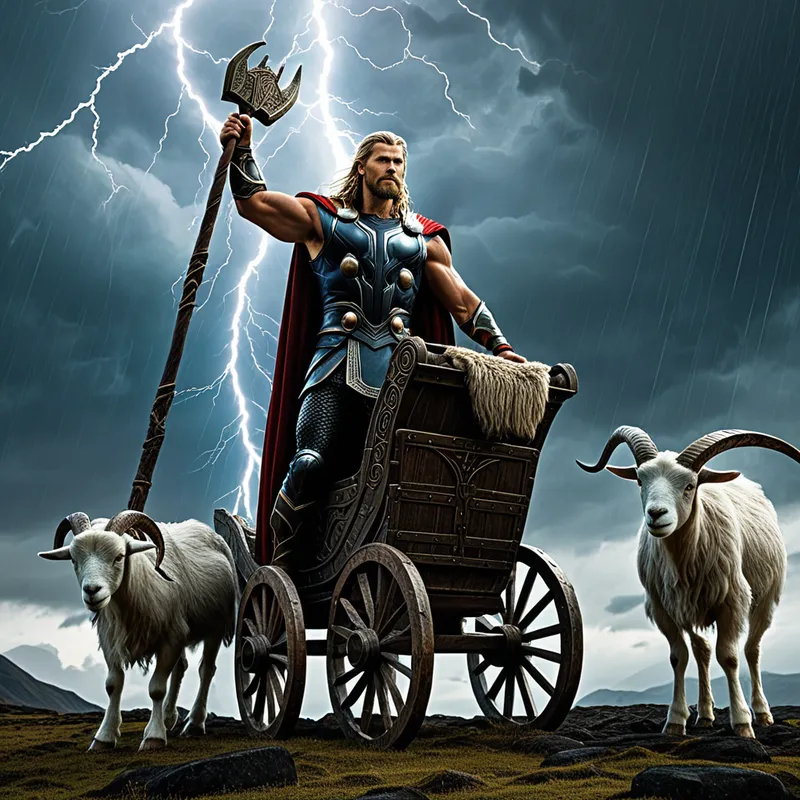
The god Thor rides a chariot drawn by goats across the stormy sky, a symbol of raw power harnessed for the sacred duty of protecting the worlds.
The Tale of Thor’s Chariot
Hear now the rumble from the edge of [the world](/myths/the-world “Myth from Tarot culture.”/), a sound that begins in the deep bones of the mountains and climbs into the belly of [the sky](/myths/the-sky “Myth from Persian culture.”/). It is not just sound, but the very feeling of weight and motion—the grinding of celestial wheels on the road of the clouds. This is the journey of Thor, son of Odin, and this is the tale of his chariot.
His hall, Bilskirnir, thrums with the presence of the protector. But his true domain is the wild sky between the worlds. For his journey, he does not walk. He rides. From its stable of storm-wind comes his chariot, a masterwork of bronze and iron, its wheels not of wood, but forged from the essence of thunder itself. And before it, harnessed with straps of toughest leather and divine will, stand his goats: Tanngrisnir and Tanngnjóstr. Their eyes flash like lightning; their breath is [the mist](/myths/the-mist “Myth from Celtic culture.”/) before the downpour. They are not mere beasts, but forces of nature bound to a purpose.
Thor heaves his mighty hammer, [Mjölnir](/myths/mjlnir “Myth from Norse culture.”/), into [the chariot](/myths/the-chariot “Myth from Tarot culture.”/) and takes the reins. With a shout that shakes the rafters of the world, they are away. The goats leap, and the chariot groans into motion. This is the rising action—the ascent. They tear across the vault of Asgard, leaving trails of fractured cloud. They race over [Midgard](/myths/midgard “Myth from Norse culture.”/), and below, mortals look up, hearing the cacophony and knowing it is their guardian passing by, holding back the chaos that gnaws at the roots of [Yggdrasil](/myths/yggdrasil “Myth from Global/Universal culture.”/).
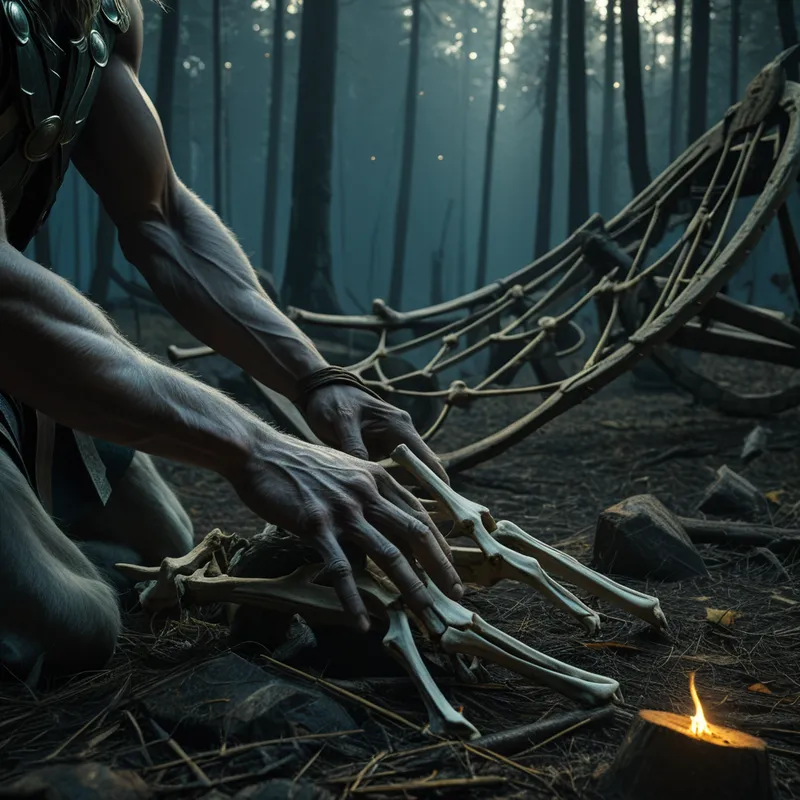
But the myth holds a sacred, terrible intimacy. In his travels, Thor would often feast with mortals or giants. And when provisions ran low, he would perform a rite of both sustenance and sacrifice. He would slaughter his own goats, [Tanngrisnir and Tanngnjóstr](/myths/tanngrisnir-and-tanngnjstr “Myth from Norse culture.”/), and feast upon their flesh with his companions. A single command accompanied this act: break no bone, and leave the remains whole upon the hides. The feast done, Thor would take the hides, lay out the bones with care, and raise his hammer high. With a crack of divine power, he would hallow the remains. The goats would shudder back to life, whole and hale, ready to be harnessed once more. This was the cycle: destruction and renewal, death and resurrection, all contained within the sacred duty of the journey.
The resolution is not an end, but an eternal return. The chariot’s path is a circle, a boundary drawn in thunder around the ordered worlds. Each journey reaffirms [the law](/myths/the-law “Myth from Biblical culture.”/): that raw, devouring power can be, must be, harnessed. It is the sound of order being enforced, not with silence, but with a roar that echoes from the high halls to the deepest valleys, a promise written in lightning across the anxious sky.
Cultural Origins & Context
This myth, like most of our Norse Eddas, was not scripture, but story—lived, told, and reshaped in the firelight of the long northern winter. It was carried by skalds and poets, finding its most enduring form in the 13th-century Prose Edda of Snorri Sturluson. For the Viking Age Norse, Thor was not a distant, philosophical god, but the accessible, formidable defender of the common world. His chariot explained the phenomenon they lived with: the terrifying, life-giving thunderstorm.
Societally, the myth functioned on multiple levels. It was a cosmological model, explaining the weather’s fury as the movement of a divine protector. It reinforced cultural values of resilience, resourcefulness (as seen in the goat ritual), and the necessity of using strength for communal good. The chariot, a vehicle of war and mobility, mirrored the [Vikings](/myths/vikings “Myth from Norse culture.”/)’ own relationship with ships—vessels that harnessed the dangerous sea for travel, trade, and expansion. Most profoundly, it illustrated a core tenet of the Norse worldview: that order (ørlög) is not a default state, but a constant, active achievement against encroaching chaos, requiring repeated, forceful action.
Symbolic Architecture
At its [heart](/symbols/heart “Symbol: The heart symbolizes love, emotion, and the core of one’s existence, representing deep connections with others and self.”/), Thor’s [chariot](/symbols/chariot “Symbol: The chariot signifies control, direction, and power in one’s journey through life.”/) is a supreme [symbol](/symbols/symbol “Symbol: A symbol can represent an idea, concept, or belief, serving as a powerful tool for communication and understanding.”/) of harnessed potency. The god himself represents untamed [strength](/symbols/strength “Symbol: ‘Strength’ symbolizes resilience, courage, and the ability to overcome challenges.”/) and righteous [fury](/symbols/fury “Symbol: An intense, overwhelming rage that consumes the dreamer, often representing suppressed anger or a primal emotional eruption.”/)—the raw psychic [energy](/symbols/energy “Symbol: Energy symbolizes vitality, motivation, and the drive that fuels actions and ambitions.”/) of [the Self](/myths/the-self “Myth from Jungian culture.”/). The goats, creatures of the [mountain](/symbols/mountain “Symbol: Mountains often symbolize challenges, aspirations, and the journey toward self-discovery and enlightenment.”/), symbolize primal instinct, [fertility](/symbols/fertility “Symbol: Symbolizes creation, growth, and abundance, often representing new beginnings, potential, and life force.”/), and the capricious, consuming forces of [nature](/symbols/nature “Symbol: Nature symbolizes growth, connectivity, and the primal forces of existence.”/). The [chariot](/symbols/chariot “Symbol: The chariot signifies control, direction, and power in one’s journey through life.”/) is the [vehicle](/symbols/vehicle “Symbol: Vehicles in dreams often symbolize the direction in life and the control one has over their journey, reflecting personal agency and decision-making.”/) of [consciousness](/symbols/consciousness “Symbol: Consciousness represents the state of awareness and perception, encompassing thoughts, feelings, and experiences.”/), the constructed ego, the disciplined will that yokes these powerful, animalistic drives to a transcendent [purpose](/symbols/purpose “Symbol: Purpose signifies direction, meaning, and intention in life, often reflecting personal ambitions and core values.”/).
The hero’s task is not to eliminate his beasts, but to learn the sacred ritual of driving them.
The [ritual](/symbols/ritual “Symbol: Rituals signify structured, meaningful actions carried out regularly, reflecting cultural beliefs and emotional needs.”/) slaughter and resurrection of the goats is the myth’s psychological [keystone](/symbols/keystone “Symbol: The central wedge-shaped stone at the apex of an arch, holding all other stones in place through compression and balance.”/). It represents the necessary, painful cycle of [integration](/symbols/integration “Symbol: The process of unifying disparate parts of the self or experience into a cohesive whole, often representing psychological wholeness or resolution of internal conflict.”/). To use one’s deep instincts (the goats) for a [journey](/symbols/journey “Symbol: A journey in dreams typically signifies adventure, growth, or a significant life transition.”/) ([life](/symbols/life “Symbol: The symbol of ‘Life’ represents a journey of growth, interconnectedness, and existential meaning, encompassing both the joys and challenges that define human experience.”/)’s purpose), one must first “break them down” or consume them—that is, consciously engage with them, understand their nature, even temporarily exhaust them. The taboo against breaking the bones is crucial: the core [structure](/symbols/structure “Symbol: Structure in dreams often symbolizes stability, organization, and the framework of one’s life, reflecting how one perceives their environment and personal life.”/), the essential [pattern](/symbols/pattern “Symbol: A ‘Pattern’ in dreams often signifies the underlying structure of experiences and thoughts, representing both order and the repetitiveness of life’s situations.”/) of the instinct, must be preserved. Then, through a sacred act (the hallowing with Mjölnir, the symbol of focused will and transformative power), the instinct is resurrected—not as a wild, external force, but as a revitalized, integrated part of the self, ready to serve the [journey](/symbols/journey “Symbol: A journey in dreams typically signifies adventure, growth, or a significant life transition.”/) once more.
The Dreamer’s Resonance
When the image of Thor’s chariot thunders into modern dreams, it signals a powerful somatic and psychological process: the struggle to contain and direct overwhelming force. The dreamer may be experiencing surges of raw emotion—anger, passion, ambition, or creative energy—that feel chaotic and threatening to their sense of control.
The chariot in the dream might be out of control, the goats bolting, or the wheels coming off. This reflects [the ego](/myths/the-ego “Myth from Jungian culture.”/)’s fear of being overrun by unconscious contents. Alternatively, the dreamer might be trying to repair the chariot or reassemble the goats, indicating an active, if arduous, process of psychic integration. The somatic resonance is often felt as tension—a clenching in the hands (holding reins), a tightness in the shoulders (bearing a burden), or a rumbling in the gut (the churning of primal energy). The dream is an archetypal snapshot of the Self insisting that this powerful energy must not be suppressed, but mastered and given a direction worthy of its strength.
Alchemical Translation
The myth of Thor’s chariot is a perfect allegory for the alchemical process of individuation—the Jungian journey toward psychic wholeness. The [prima materia](/myths/prima-materia “Myth from Alchemical culture.”/), the base matter, is the individual’s unrefined, potent life force (Thor’s brute strength and the goats’ wildness). The chariot-building is the coagulatio stage: giving form and structure (the ego, a life path, a code of ethics) to this formless power.
The repeated feast and resurrection cycle is the central mortificatio and sublimatio. The ego must regularly “die” in its rigid form by confronting and temporarily dissolving into the instinctual realm (eating the goats). This is a sacrifice of certainty. Then, through the application of the transcendent function (symbolized by Mjölnir), a new, more resilient consciousness is resurrected, having integrated a piece of its own shadow.
The lightning is not meant to shatter the self, but to illuminate the path it must travel.
The ultimate goal is not to reach a destination, but to perfect the driving. The individuated Self becomes the skilled charioteer, no longer terrified of the goats’ power, but in a dynamic, respectful partnership with them. The thunderous journey across the inner sky becomes the ongoing act of creating and maintaining personal order and meaning, protecting one’s inner Midgard from the giants of neurosis, apathy, and fragmentation. One learns that true power lies not in the absence of the storm, but in the ability to ride it.
Associated Symbols
Explore related symbols from the CaleaDream lexicon: