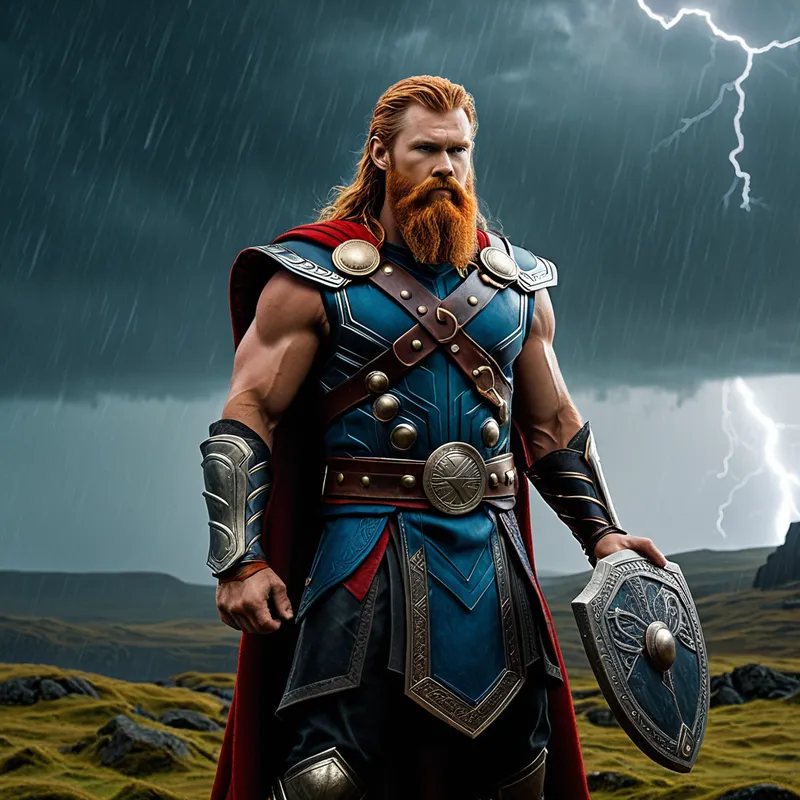
Thor's Belt of Strength Myth Meaning & Symbolism
The tale of Thor's divine belt, Megingjörð, a symbol of the power that emerges when one's inner nature is fully embraced and girded for the world.
The Tale of Thor’s Belt of Strength
Hark, and listen to [the wind](/myths/the-wind “Myth from Various culture.”/) that howls from the north, from the land where [the world](/myths/the-world “Myth from Tarot culture.”/)-tree [Yggdrasil](/myths/yggdrasil “Myth from Global/Universal culture.”/) groans under the weight of nine realms. In the high halls of Asgard, where the golden roof of [Valhalla](/myths/valhalla “Myth from Germanic culture.”/) gleams, there lived the Thunderer, Thor. His might was the rumble in the mountain, the crack that splits [the sky](/myths/the-sky “Myth from Persian culture.”/). Yet, for all his divine fury, there were foes whose scale dwarfed even his godly frame—ancient giants, serpents that encircled [the world](/myths/the-world “Myth from Tarot culture.”/), forces of primal chaos that sought to unmake order.
Thor’s heart was a forge-fire, burning with the need to protect. But his hands, though they gripped the mighty hammer [Mjölnir](/myths/mjlnir “Myth from Norse culture.”/), sometimes knew the bitter taste of strain. He was strength incarnate, yet strength, he knew in his marrow, was not a static [thing](/myths/thing “Myth from Norse culture.”/). It was a relationship, a covenant between will and world.
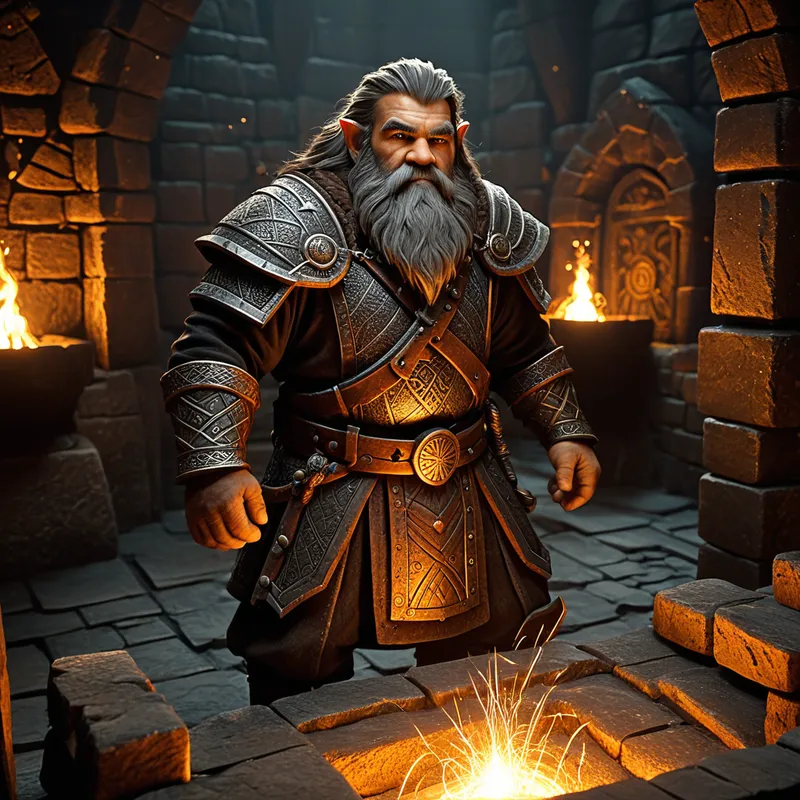
It is said the solution was born not in the shining spires of Asgard, but in the deep, resonant dark. In the smithies of the dvergr, the dwarf-lords, whose hammers beat time to the heart of the world. From them came wonders: Odin’s spear, [Freyr](/myths/freyr “Myth from Norse culture.”/)’s ship, Thor’s own hammer. And for the Thunderer, they wrought a girdle of a different kind.
They called it Megingjörð. It was no mere strip of leather. It was a work of profound craft, thick as a sea-serpent’s hide, fastened with a clasp of iron that held the patience of mountains. It did not grant strength from without, as a cup grants mead. No. When Thor fastened it about his waist, drawing the buckle tight with a sound like settling stone, it performed a deeper magic. It gathered him. It focused the scattered lightning of his being into a single, directed storm. It was the act of girding oneself, of pulling one’s own vastness into a form capable of action.
And so, when the giant Hrungnir threatened the gods with a heart and head of stone, Thor did not merely reach for his hammer. First, he reached for the belt. The scene was not one of sudden, explosive power, but of solemn preparation. In the quiet before the storm, he clasped Megingjörð. One could feel the air thicken, the very fibers of his being drawing taut, integrating. Then, and only then, did he take up Mjölnir. The battle that followed shook the roots of Yggdrasil, but its foundation was laid in that moment of intentional girding. The belt was the covenant made visible, the declaration that his strength was ready, focused, and utterly his to wield.
Cultural Origins & Context
This myth, like most of the Norse corpus, survives in the Poetic Edda and the later Prose Edda. These were not holy texts, but repositories of lore, recorded in Iceland centuries after the pre-Christian belief system had faded. They are echoes of a world where myth was not abstract philosophy, but a lived reality intertwined with survival, honor, and the harsh beauty of the North Atlantic world.
The stories of Thor were the stories of the common person writ large. He was the god of the farmers, the sailors, the fighters—the one who faced the tangible threats: frost, famine, and encroaching enemies. His belt, Megingjörð, reflects a profoundly practical, yet deeply symbolic, worldview. Strength was not a theoretical virtue; it was the essential currency of life. It needed to be reliable, accessible, and prepared. The myth would have been told in longhouses, its rhythm matching the crackle of the fire, serving as both entertainment and a template for existential readiness. It taught that even the mightiest must consciously prepare their inner resources for the struggles of a world that is, by nature, adversarial and awe-inspiring.
Symbolic Architecture
At its core, Megingjörð is an archetypal [symbol](/symbols/symbol “Symbol: A symbol can represent an idea, concept, or belief, serving as a powerful tool for communication and understanding.”/) of [integration](/symbols/integration “Symbol: The process of unifying disparate parts of the self or experience into a cohesive whole, often representing psychological wholeness or resolution of internal conflict.”/) and contained potential. It represents the crucial psychological step between possessing a quality and being able to wield it effectively in the world.
The belt is not the source of power, but the vessel that makes power usable. It turns raw, undifferentiated force into focused, intentional strength.
Thor’s divine [strength](/symbols/strength “Symbol: ‘Strength’ symbolizes resilience, courage, and the ability to overcome challenges.”/) is his innate [nature](/symbols/nature “Symbol: Nature symbolizes growth, connectivity, and the primal forces of existence.”/), his archetypal essence as the [Hero](/symbols/hero “Symbol: A hero embodies strength, courage, and the ability to overcome significant challenges.”/). Yet, without the belt, this [strength](/symbols/strength “Symbol: ‘Strength’ symbolizes resilience, courage, and the ability to overcome challenges.”/) risks being diffuse, reactive, or even self-defeating. The act of fastening the belt is a [ritual](/symbols/ritual “Symbol: Rituals signify structured, meaningful actions carried out regularly, reflecting cultural beliefs and emotional needs.”/) of self-possession. Psychologically, it symbolizes [the ego](/myths/the-ego “Myth from Jungian culture.”/)’s [role](/symbols/role “Symbol: The concept of ‘role’ in dreams often reflects one’s identity or how individuals perceive their place within various social structures.”/) in organizing and directing the vast, often chaotic, energies of the unconscious. It is the [moment](/symbols/moment “Symbol: The symbol of a ‘moment’ embodies the significance of transient experiences that encapsulate emotional depth or pivotal transformations in life.”/) of centering, of pulling oneself together before a challenge. The belt is a [boundary](/symbols/boundary “Symbol: A conceptual or physical limit defining separation, protection, or identity between entities, spaces, or states of being.”/) that defines [the self](/myths/the-self “Myth from Jungian culture.”/), creating a container strong enough to hold one’s own potency without being shattered by it. In this, it shares symbolic kinship with the [knight](/symbols/knight “Symbol: The knight symbolizes honor, chivalry, and the pursuit of noble causes, reflecting the ideal of the noble warrior.”/)’s girding of his sword, the athlete’s pre-[competition](/symbols/competition “Symbol: Competition in dreams often symbolizes conflict, ambition, and the drive to succeed, reflecting personal goals and challenges.”/) [ritual](/symbols/ritual “Symbol: Rituals signify structured, meaningful actions carried out regularly, reflecting cultural beliefs and emotional needs.”/), or the quiet [breath](/symbols/breath “Symbol: Breath symbolizes life, vitality, and the connection between the physical and spiritual realms.”/) taken before a difficult [conversation](/symbols/conversation “Symbol: A conversation in a dream often symbolizes the need for communication and understanding, both with oneself and others.”/).
The Dreamer’s Resonance
When this mythic pattern stirs in the modern unconscious, it often manifests in dreams of preparation, girding, or discovering potent tools. A dreamer might find themselves fastening a strange, powerful belt before a trial, or searching frantically for one. They may dream of their torso being wrapped in bands of light or constricting energy.
Somatically, this can correlate with a felt sense in the waking world—a tightening in the solar plexus, a need to “gird one’s loins,” or a feeling of being emotionally or spiritually “unbelted,” scattered and ineffective. The dream is signaling a critical phase of psychological process: the individual is being called to integrate a new strength or face a looming challenge, but the conscious ego feels unprepared. The dream of the belt is the [psyche](/myths/psyche “Myth from Greek culture.”/)’s own workshop, forging the tool of containment. It is an invitation to consciously engage in that act of self-gathering, to recognize an inner resource that is present but not yet fully operationalized.

Alchemical Translation
The journey of individuation, the alchemy of the soul, is not merely about discovering one’s hidden gold (the Self). It is about learning to wear it, to embody it in the leaden world of everyday reality. Thor’s myth provides a precise model for this stage of psychic transmutation.
First, there is the [prima materia](/myths/prima-materia “Myth from Alchemical culture.”/): the raw, thunderous potential of the individual’s authentic nature—their passions, talents, and deep instincts. This can feel overwhelming, even dangerous, like unharnessed lightning. The ego, in its undeveloped state, may try to deny this power or let it erupt uncontrollably.
The alchemical fire is the confrontation with the giant—the life challenge, the inner shadow, or the outer obstacle that demands more of us than we believe we have. This crisis forces the issue.
The forging of Megingjörð is the opus, the great work. It is the conscious, disciplined process of creating a structure—a practice, a commitment, a philosophy, a ritual—that can contain and focus one’s innate power.
This is the creation of a psychic container. For the modern individual, this might be the daily discipline that supports a creative gift, the therapeutic work that integrates trauma into strength, or the ethical framework that guides powerful ambition. It is the “buckling on” of responsibility for one’s own capacity.
Finally, the wielder, now girded, takes up the hammer—the focused action in the world. The strength is no less potent, but it is now directed, sustainable, and truly one’s own. The myth teaches that our greatest struggles are not just tests of what we have, but crucibles for forging [the vessel](/myths/the-vessel “Myth from Alchemical culture.”/) that will allow us to carry it. We do not find our strength ready-made; we gird it into being.
Associated Symbols
Explore related symbols from the CaleaDream lexicon: