Thor's Belt Megingjörð Myth Meaning & Symbolism
A myth of the god Thor and his magical belt, a story of harnessing raw power through sacrifice and discipline to protect the cosmos.
The Tale of Thor’s Belt Megingjörð
Hear now the tale of the Thunderer’s might, not of the hammer that splits [the sky](/myths/the-sky “Myth from Persian culture.”/), but of the girdle that girds his soul. In the days when the frost of [Niflheim](/myths/niflheim “Myth from Norse culture.”/) gnawed at the roots of the [Yggdrasil](/myths/yggdrasil “Myth from Global/Universal culture.”/), and the fire of [Muspelheim](/myths/muspelheim “Myth from Norse culture.”/) licked at its boughs, the Aesir gods walked with a watchful step. For in the shadows, the [Jötnar](/myths/jtnar “Myth from Norse culture.”/) stirred, their forms as vast as mountains, their hunger as deep as [the void](/myths/the-void “Myth from Buddhist culture.”/).
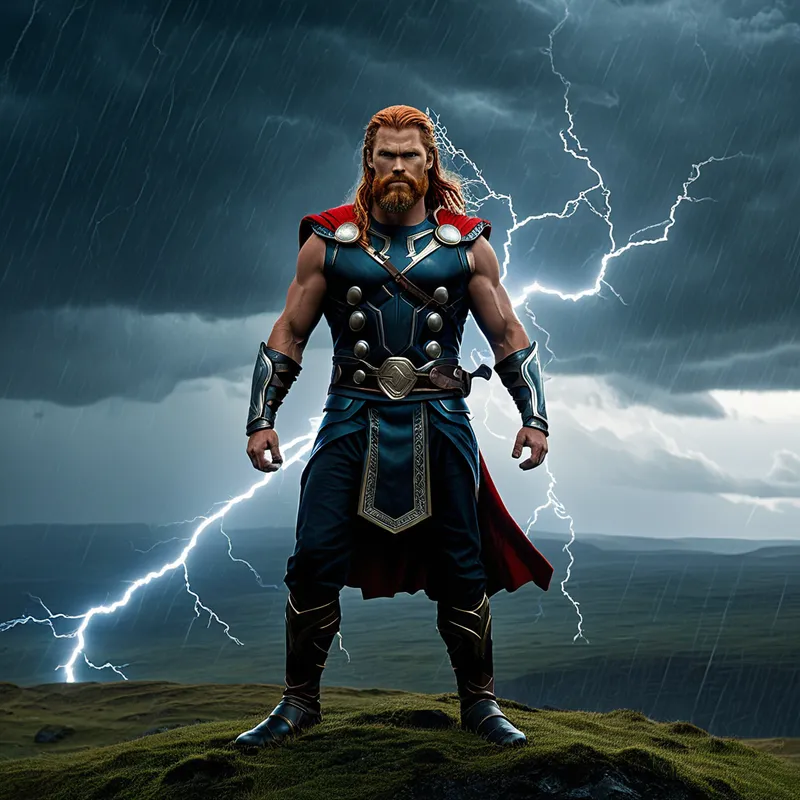
Among them stood Thor, son of Odin, his hair and beard the color of a dying sun. His strength was a wild, untamed river, enough to shake the foundations of Ásgarðr with a single stride. Yet, in the silent councils by the Well of Urd, a truth was whispered: raw fury was not enough. The enemies to come would not be felled by rage alone, but by power honed, focused, and bound to a purpose greater than [the self](/myths/the-self “Myth from Jungian culture.”/).
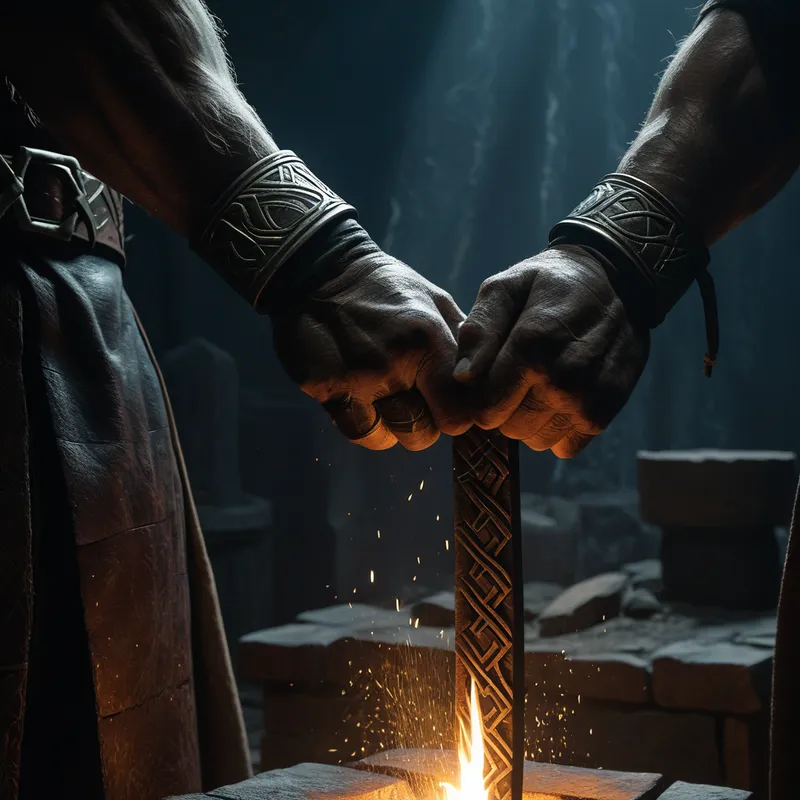
Thor journeyed not to a battlefield, but to a place of making. He went to the forges deep within [the earth](/myths/the-earth “Myth from Hindu culture.”/), where the dwarven masters, sons of Ymir, worked their silent magic. He brought not threats, but an offering—a piece of his own unbound potential, a measure of his chaotic essence. “Craft for me,” he rumbled, his voice like stones grinding, “not a weapon to destroy, but a vessel to contain. A girdle to double the strength I possess, to turn [the flood](/myths/the-flood “Myth from Biblical culture.”/) into a directed torrent.”
[The dwarves](/myths/the-dwarves “Myth from Norse culture.”/) took the offering, a substance both tangible and ethereal. They worked the leather of a beast that never was, tanned in the tears of the [Norns](/myths/norns “Myth from Nordic culture.”/). They carved [runes](/myths/runes “Myth from Norse culture.”/) not of conquest, but of channeling: Ansuz for divine breath made will, Uruz for the primal strength of the aurochs, Thurisaz for the thorn that protects. They named it Megingjörð.
When Thor first clasped its buckle—a simple, profound act—the change was not of show, but of substance. The wild light in his eyes did not dim, but found a lens. The tremors in his limbs did not cease, but became a resonant hum. He did not merely grow larger; he became denser, a concentration of cosmic force. The belt was a covenant: a sacrifice of limitless, scattering power for the sake of a strength that could be wielded, a strength that could shoulder the weight of [the world](/myths/the-world “Myth from Tarot culture.”/). With Megingjörð and his iron gloves Járngreipr, he could lift [Mjölnir](/myths/mjlnir “Myth from Norse culture.”/), not just to smash, but to sanctify, to hallow, to defend. He became the bulwark, the steadfast one, his might now a deliberate shield for the Nine Realms.
Cultural Origins & Context
The myth of Megingjörð is woven into the Poetic Edda and elaborated in the Prose Edda of Snorri Sturluson. It was not a standalone fable but an integral piece of Thor’s divine toolkit, recited by skalds alongside tales of his fishing for the [Midgard Serpent](/myths/midgard-serpent “Myth from Norse culture.”/) or his journey to Jötunheimr.
In the Viking Age, this was more than a story of a god’s accessory. It functioned as a narrative model for a society that prized strength but lived under constant threat—from [the sea](/myths/the-sea “Myth from Greek culture.”/), from rivals, from the encroaching winter. Strength alone led to recklessness and death. True power, the myth taught, came from binding that strength with discipline (the belt) and skill (the gloves) to a communal purpose. Thor was the god of the common free man, the farmer, and the warrior. His need for Megingjörð reflected their own reality: survival depended not on unfettered aggression, but on the focused application of one’s capacities, bound by oath, custom, and necessity.
Symbolic Architecture
At its core, Megingjörð is an archetypal [symbol](/symbols/symbol “Symbol: A symbol can represent an idea, concept, or belief, serving as a powerful tool for communication and understanding.”/) of containment for the sake of potency. It represents the crucial psychological move from possessing a quality to consciously wielding it.
The ego is not the source of power, but its steward. True strength emerges when the unconscious torrent is consented to, named, and girded by conscious will.
Thor’s raw, doubling [strength](/symbols/strength “Symbol: ‘Strength’ symbolizes resilience, courage, and the ability to overcome challenges.”/) is the undifferentiated power of the unconscious Self—overwhelming, chaotic, and potentially destructive. The belt is the function of the conscious ego that does not block this power but forms a [vessel](/symbols/vessel “Symbol: A container or structure that holds, transports, or protects something essential, representing the self, emotions, or life journey.”/) for it. [The runes](/myths/the-runes “Myth from Norse culture.”/) etched upon it signify [the logos](/myths/the-logos “Myth from Biblical culture.”/), the [word](/symbols/word “Symbol: Words in dreams often represent communication, expression, and the power of language in shaping our realities.”/), [the law](/symbols/the-law “Symbol: Represents external rules, societal order, moral boundaries, and the tension between personal freedom and collective structure.”/)—the structures of culture, morality, and personal integrity that transform blind force into directed [action](/symbols/action “Symbol: Action in dreams represents the drive for agency, motivation, and the ability to take control of situations in waking life.”/). Without this girding, the [hero](/symbols/hero “Symbol: A hero embodies strength, courage, and the ability to overcome significant challenges.”/) is a [danger](/symbols/danger “Symbol: The symbol of ‘Danger’ often indicates a sense of threat or instability, calling for caution and awareness.”/) to himself and his world; with it, he becomes a protector, a pillar. The myth beautifully inverts the common [notion](/symbols/notion “Symbol: A notion symbolizes an idea or belief that occupies one’s thoughts or consciousness.”/) that power is increased by adding something external. Instead, power is doubled by incorporating a limiting principle.
The Dreamer’s Resonance
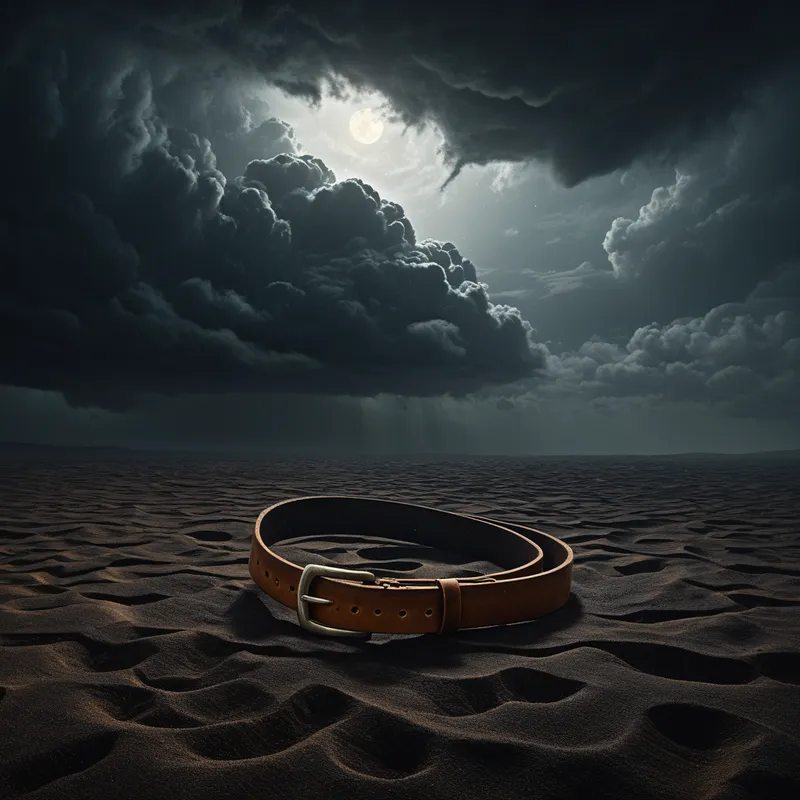
When the symbol of Megingjörð or its essence arises in modern dreams, it often signals a critical phase in the dreamer’s relationship with their own innate power. This may manifest as dreaming of a simple belt that feels immensely significant, of trying to fasten something that keeps coming undone, or of feeling a surge of capacity when donning a piece of clothing or armor.
Psychologically, this is the somatic and emotional process of integrating a shadow aspect of strength—perhaps a rage that has been feared, a creative passion that feels too intense, or a personal authority that feels arrogant. The dreamer is in the “forge,” where this raw material of the [psyche](/myths/psyche “Myth from Greek culture.”/) is being worked upon. The struggle to “buckle the belt” reflects the conscious effort to accept responsibility for this power, to channel it into life-building, protective, or creative acts rather than letting it leak out as anxiety, aggression, or passive collapse. It is the dream-ego preparing to shoulder a greater burden of identity and action.
Alchemical Translation
The alchemical process mirrored in this myth is coagulatio—the making solid, the embodiment. The [prima materia](/myths/prima-materia “Myth from Alchemical culture.”/) is Thor’s unbound, volatile strength (akin to the chaotic massa confusa). The conscious sacrifice of this state to [the dwarven smiths](/myths/the-dwarven-smiths “Myth from Norse culture.”/) (the transformative, shaping forces of the deep unconscious) initiates the work. The belt itself is the lapis, [the philosopher’s stone](/myths/the-philosophers-stone “Myth from Alchemical culture.”/), not as a external object, but as an achieved state of the personality.
Individuation is not about becoming a god, but about becoming girded—willingly accepting the limitations that make focused action and true protection possible.
For the modern individual, the “Megingjörð operation” asks: What is your raw, untamed power? Is it an emotional intensity, an intellectual fervor, a spiritual longing? Where does it spill out uncontrollably, causing chaos? The alchemical translation involves seeking your own “runes”—the personal principles, practices, and commitments that can act as a girdle. This could be a creative discipline, an ethical code, a therapeutic practice, or a physical regimen. By consciously applying this containing form, you do not halve your strength; you double its usable, world-engaging potency. You move from being subject to your own inner storms to becoming the Thunderer who can ride them, harnessing their energy to hallow your own world and defend what you hold sacred. The ultimate [triumph](/myths/triumph “Myth from Roman culture.”/) is not in the unleashing, but in the sacred binding.
Associated Symbols
Explore related symbols from the CaleaDream lexicon: