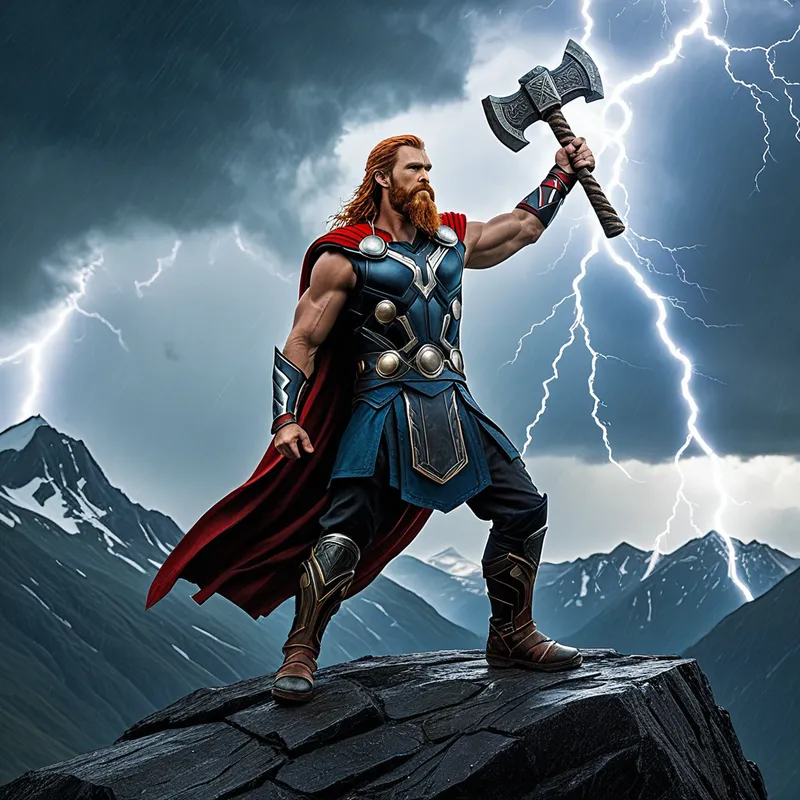
Thor Myth Meaning & Symbolism
The story of the thunder god who defends the ordered world through raw strength and righteous fury, embodying the psyche's struggle against chaos.
The Tale of Thor
Hear now the crack of the sky and the groan of the earth. In the days when the world was young and raw, when the great tree Yggdrasil shuddered with the footsteps of giants, there lived the Thunderer. His name was Thor, son of Odin, and his voice was the storm.
He dwelt in the hall of Bilskirnir, the greatest of halls, and his chariot was drawn across the heavens by two goats, Tanngrisnir and Tanngnjóstr. But his heart was not for feasting alone. His eye was ever eastward, toward Jötunheimr, where the frost-giants plotted the downfall of gods and men. For the giants were the ancient chaos, the howling void that sought to swallow the ordered light of Asgard and the warm hearths of Midgard.
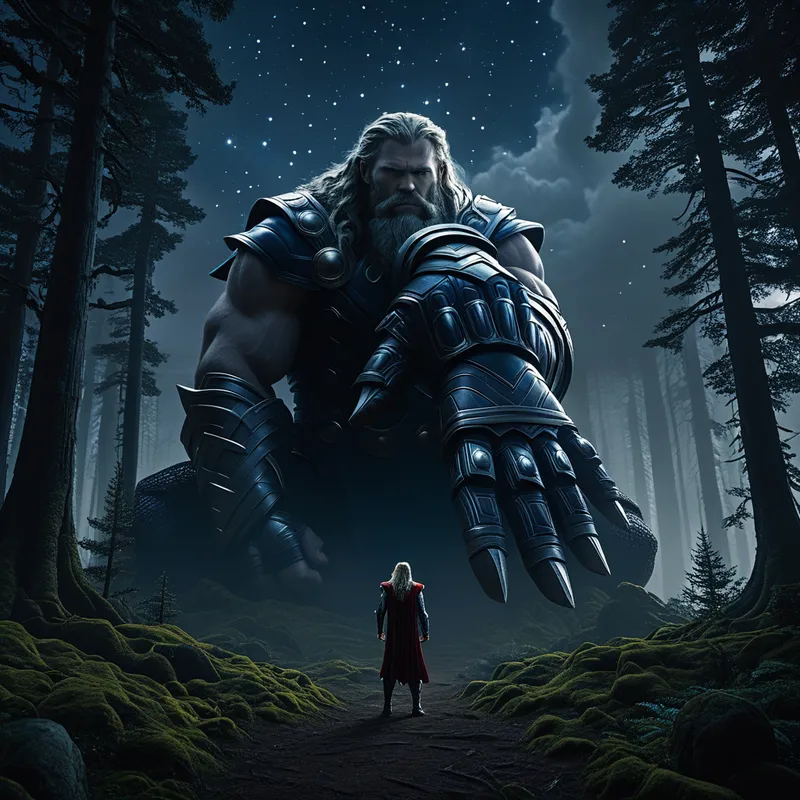
One day, the giant-king Útgarða-Loki sent a challenge, wrapped in deceit. Thor, with his servant Þjálfi and the cunning Loki, journeyed into the vast, whispering forests and over mountains of grinding ice. In the deep woods, they found a hall so vast its doorway was a cave. They slept within an antechamber, but the night was shattered by terrible tremors and roars that shook the very stones.
At dawn, Thor stepped out to find the source: a sleeping giant of such scale that the “hall” had been but his leather glove. This was Skrýmir. Enraged, Thor raised his hammer, Mjölnir, and struck the giant’s forehead three times with force to split mountains. Each time, Skrýmir merely stirred, asking if a leaf had fallen on him. It was the first taste of a profound humiliation, a lesson in scale and illusion.
They journeyed on to the giant’s fortress, Útgarðr. There, the lord of the place set them impossible contests. Loki, who could eat faster than any, lost an eating race against Fire itself. Þjálfi, fleet of foot, lost a race against Thought. Then came Thor’s trials. He was dared to drain a drinking horn, but after three mighty gulps that strained the oceans, the level had barely fallen—for the horn’s other end was in the sea. He was dared to lift a grey cat from the floor, but heaving with all his divine might, he could only raise one paw—for the cat was the Midgard Serpent in disguise. Finally, he was dared to wrestle an old crone, and was brought to one knee—for she was Old Age, whom none can conquer.
They left in shame, their strength made a mockery. But as they crossed the border from that land of illusions, Útgarða-Loki’s voice boomed after them, revealing the truth. The drinking horn had been connected to the ocean. The cat was the world-encircling serpent, and Thor’s effort had made it tremble, causing tides. The old crone was Elli herself. Their failures were, in truth, acts of world-shaking power, hidden by glamour and trickery. Thor’s rage flared, pure and hot, and he turned to smash the fortress, but it had vanished into mist and mountain. Only the echo of the giant’s laughter remained, and the Thunderer’s lesson: that the world’s true tests are often not of muscle, but of perception.
Cultural Origins & Context
These tales did not spring from parchment, but from the longfire’s glow in the great halls of the Viking Age, from the 8th to the 11th centuries. They were the living breath of a people whose world was bounded by the treacherous sea, the unforgiving forest, and the long, dark winter. The myths of Thor were not abstract theology; they were a psychological and social compass. Skalds, the poet-historians, were the keepers of these stories, weaving them into complex poetic forms like the Poetic Edda, later codified in 13th-century Iceland by Snorri Sturluson in the Prose Edda.
Thor was the god of the common free farmer, the warrior, the settler. While Odin sought mystical knowledge and the fickle favor of kings, Thor was the steadfast defender of the homestead, the innangard. His battles against the giants were the mythic parallel to humanity’s daily struggle to carve order (örlög) from the wild, chaotic útgard. His myths served to validate the use of righteous force, to explain the terrifying yet fertile power of the storm, and to model a kind of heroic perseverance that was direct, honorable, and deeply physical in a world where survival was never guaranteed.
Symbolic Architecture
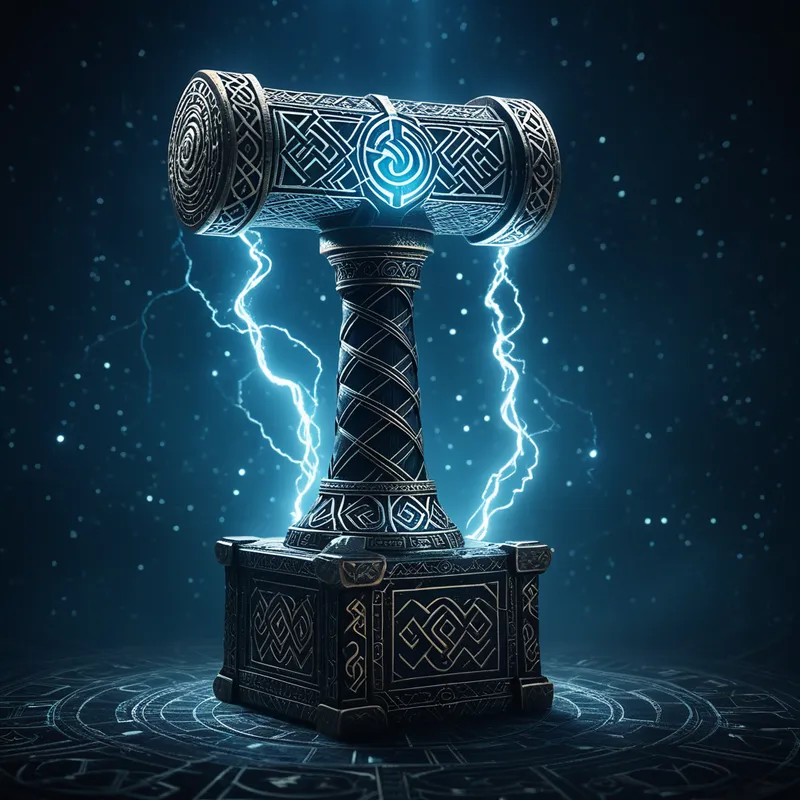
Thor is the archetype of the conscious ego in its raw, formative state. He is the “I” that stands against the overwhelming, formless “Not-I.” His hammer, Mjölnir, is not merely a weapon; it is the instrument of differentiation, the force that defines a boundary, makes a mark, and says “here, not there.” It is the thunderclap of consciousness asserting itself against the murky silence of the unconscious, represented by the giants and the deep, ancient waters where the Midgard Serpent lurks.
The giant is the unconscious content that threatens to engulf the ego; the hammer is the focused will that names it, confronts it, and—for a time—holds it at bay.
His journey to Útgarðr is a masterful depiction of the ego’s inflation and subsequent humiliation. Thor, the embodiment of brute strength, believes his power is absolute. The contests reveal that the raw power of the ego is useless against the fundamental, impersonal processes of nature (the sea, the serpent, Old Age). His “failure” is, paradoxically, his initiation into a more nuanced reality. The ego must learn that its strength is not for conquering the infinite, but for protecting the finite, sacred space of the conscious self and its community.
The Dreamer’s Resonance
When the figure of Thor storms into modern dreams, it often signals a somatic and psychological process of mobilization. The dreamer may be feeling invaded, threatened by chaotic external forces or by an upwelling of unprocessed, “giant”-sized emotion from within. The Thor energy manifests as a powerful somatic urge—a clenched fist, a surge of adrenaline, a need to act, to push back, to set a firm boundary.
Dreams of wielding a potent tool or weapon, of confronting a monstrously large or vague opponent, or of feeling a righteous, cleansing fury point to this archetype activating. The psychological process is one of ego-defense and consolidation. The psyche is mustering its resources to prevent a dissolution of the self. However, if the dream ends in frustration—the hammer is too heavy, the blows have no effect—it mirrors Thor’s humiliation and indicates that the dreamer’s conscious, forceful approach is failing. The challenge is not to be met with greater force, but with greater awareness, cunning, or acceptance of a larger, more mysterious order of reality.
Alchemical Translation
The alchemical journey modeled by Thor’s myth is the transmutation of brute force into conscious, protective power. It begins in the nigredo, the blackening: the chaotic threat from the realm of giants, the shadowy unconscious. Thor’s initial response is the prima materia of the psyche—pure, undifferentiated instinct and rage.
His humiliating journey to Útgarðr represents the crucial stage of mortificatio—the death of the ego’s inflation. His certainty is shattered by illusion. This painful dissolution is necessary. The ego must be “broken down” to be rebuilt with greater wisdom.
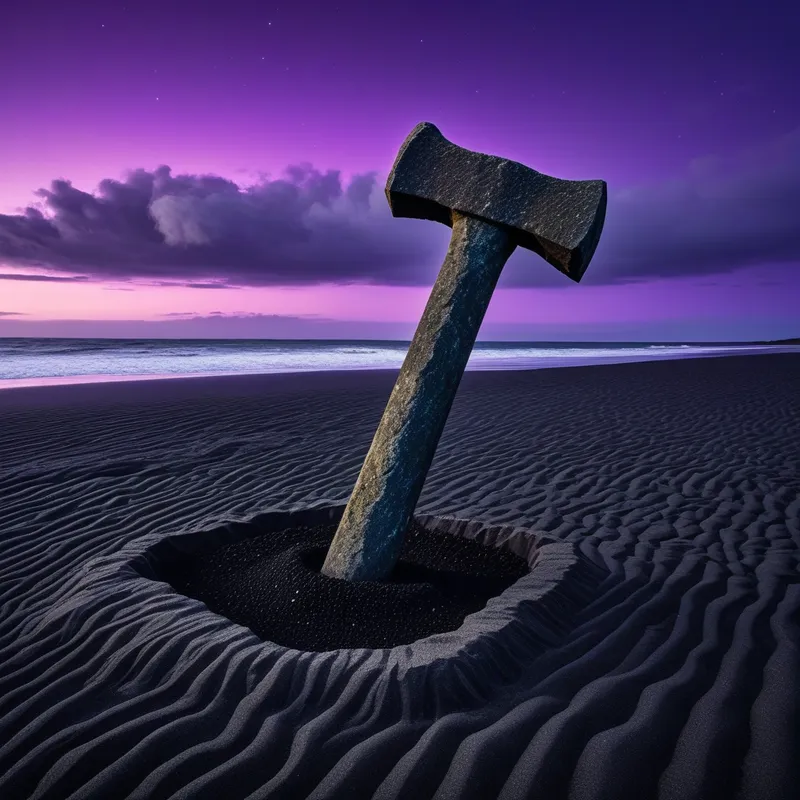
The hammer that fails to crush the giant’s skull becomes the tool that forges a more resilient self, one that knows its limits as well as its strength.
The final stage is not a victory over chaos, but a sacred truce born of recognition. Thor learns that his true function is not to eradicate the sea (the unconscious) or the serpent (the deepest, most primal shadow), but to engage with it, to make it tremble and thus acknowledge his presence. His strength is alchemized from a tool of conquest into a tool of guardianship. For the modern individual, this translates to the process of individuation where one learns to harness the tremendous energy of one’s anger, will, and vitality not to dominate the inner and outer worlds, but to create and maintain a sacred, bounded space—a Bilskirnir of the soul—where consciousness can safely reside and grow, ever watchful on the borders where order meets the eternal, creative chaos.
Associated Symbols
Explore related symbols from the CaleaDream lexicon:
- Strong
- Weather
- Might
- Electric
- Force
- Anger
- Athletic
- Thor’s Hammer (Mjölnir)
- Thunderstorm
- Studded Boots
- Rain Boots
- Chopping Wood
- Electric Pulse
- Electric Storm
- Thunder Clap
- Meteorological Phenomenon
- Lightning
- Severe Weather Alert
- Thunderstorm Sky
- Celestial Storm
- Storm Cloud
- Dazzling Aurora
- Volatile Weather Changes
- Thunderhead
- Extreme Sports Gear
- Fiery Spirit of Competition
- Distant Thunder
- Thunderstorm Clouds
- Wooden Club
- Thunderstorm Drumming
- Echoing Thunder
- Thunderstorm Gathering
- Susanoo Storm
- Electric Shock
- Thunder
- Voltage
- Thunderclap