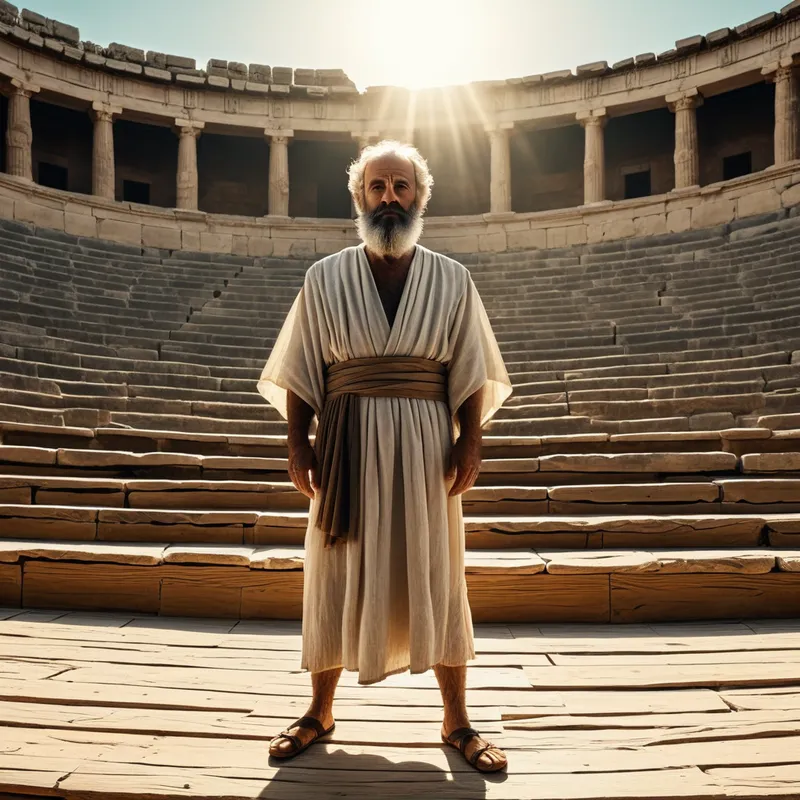
Thespis Myth Meaning & Symbolism
The story of the man who first stepped from the ritual chorus to speak as another, creating the actor and the space for the individual soul.
The Tale of Thespis
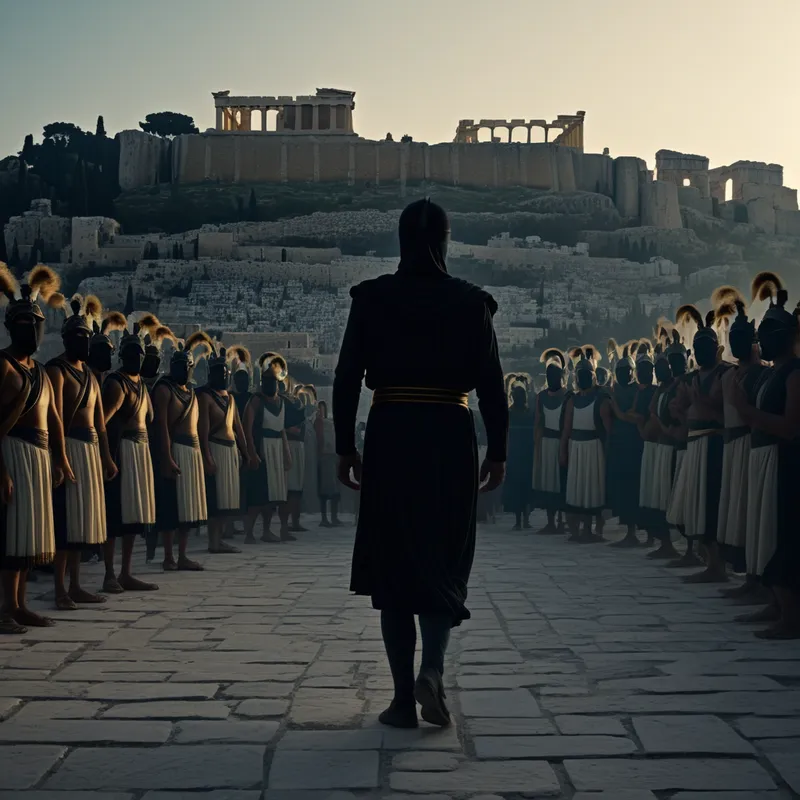
Let the clamor of the marketplace fade. Let the dust of the Athenian road settle. Come, gather close at the foot of the Acropolis, where the air is thick with the scent of crushed ivy and spilled wine. It is the time of the Great Dionysia. The sun beats down upon the Theatre of Dionysus, a bowl of stone waiting to be filled with sound. For generations, it has been filled with one sound only: the unified voice of the choros. Fifty men, moving as one beast, singing as one breath, telling the old, old stories of gods and kings. Their faces are hidden behind identical masks, their bodies swathed in identical robes. They are not men; they are an instrument, a vessel for the god.
But on this day, as the dithyramb reaches its fever pitch, a fracture appears in the perfect unity. From the swirling, chanting circle, one figure steps out. He is no taller, no grander than the others, yet his separation is a seismic crack in [the world](/myths/the-world “Myth from Tarot culture.”/). The music stumbles. The dance falters. A thousand eyes, citizen and foreigner, slave and archon, lock onto him. He turns to face them, and in his hand, he holds not the thyrsus of the devotee, but a mask unlike [the chorus](/myths/the-chorus “Myth from Theater culture.”/)’s uniform visage. It is the face of a hero, or perhaps a grieving king.
He lifts it, and as it settles over his own, a silence falls so profound you can hear the rustle of a distant olive grove. Then, he speaks.
But the voice is not his own. It is deeper, older, freighted with a sorrow that belongs to the mythic past. He is no longer Thespis, son of Themion. He is [Oedipus](/myths/oedipus “Myth from Greek culture.”/), blind and wandering. He questions the chorus. He argues with the air where a god might stand. He weeps for a fate that is not his, yet in that moment, becomes utterly his. He has done the unthinkable: he has broken the “we” to become an “I,” and in doing so, has invented a “thou.” He has created dialogue where there was only monologue. He has carved a space for the individual soul to stand before the collective and the divine, and in that space, drama is born.
Cultural Origins & Context
The figure of Thespis is shrouded in [the mist](/myths/the-mist “Myth from Celtic culture.”/) between history and foundational myth. He is credited by ancient sources like Aristotle and the Parian Chronicle with being the “first actor” (hypokrites), who, in 534 BC, transformed the choral dithyramb into tragedy by stepping out to engage in dialogue. This was not mere entertainment; it was a radical religious and social innovation occurring within the sacred context of the Dionysian festival.
The myth of Thespis functions as an etiological story—a tale explaining the origin of a fundamental cultural artifact: the theater. It marks the moment ritual became art, possession became portrayal, and collective ecstasy became individual characterization. Thespis is said to have traveled with a cart, a portable stage, bringing his new art to demes across Attica, symbolizing the spread of this new technology of [the self](/myths/the-self “Myth from Jungian culture.”/). The story was passed down by historians and philosophers who saw in him the progenitor of the Athenian stage, which would become [the crucible](/myths/the-crucible “Myth from Alchemical culture.”/) for examining fate, [justice](/myths/justice “Myth from Tarot culture.”/), and the human condition.
Symbolic Architecture
At its core, the myth of Thespis is about the [birth](/symbols/birth “Symbol: Birth symbolizes new beginnings, transformation, and the potential for growth and development.”/) of [consciousness](/symbols/consciousness “Symbol: Consciousness represents the state of awareness and perception, encompassing thoughts, feelings, and experiences.”/) from within the unconscious collective. The [chorus](/symbols/chorus “Symbol: A chorus in dreams symbolizes unity, collaboration, and the harmony of diverse voices contributing to a greater whole.”/) represents the undifferentiated [psyche](/myths/psyche “Myth from Greek culture.”/)—the shared cultural [memory](/symbols/memory “Symbol: Memory symbolizes the past, lessons learned, and the narratives we construct about our identities.”/), the instinctual responses, the voice of the tribe and the gods. It is the dream itself, swirling and impersonal.
Thespis’s step is the ego’s first, trembling emergence from the maternal waters of the collective unconscious. To don the mask is not to hide, but to consciously select a face from the myriad potentials within.
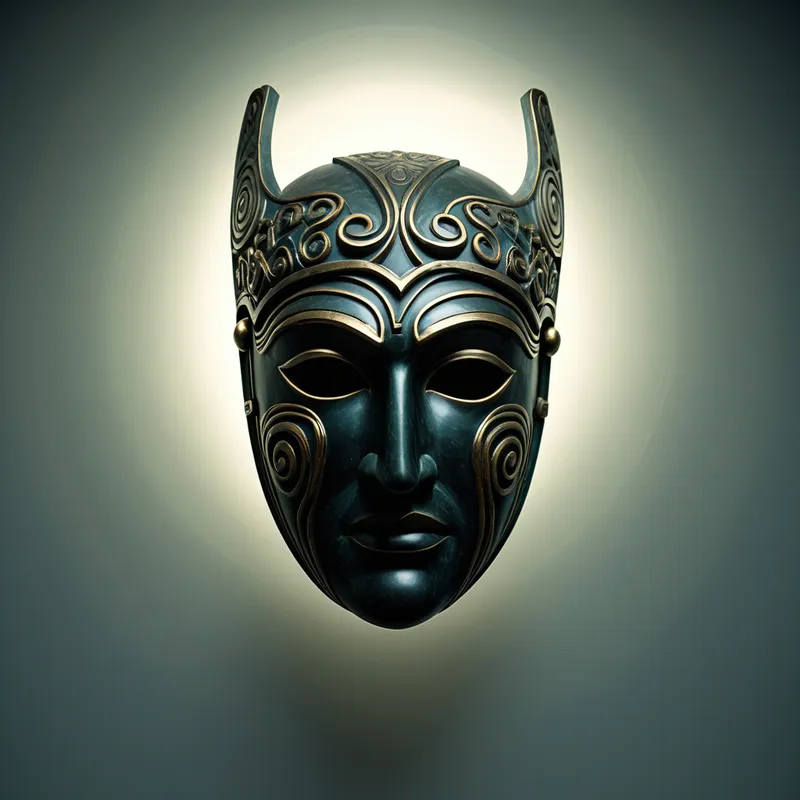
[The mask](/myths/the-mask “Myth from Various culture.”/) (prosopon) is the central [symbol](/symbols/symbol “Symbol: A symbol can represent an idea, concept, or belief, serving as a powerful tool for communication and understanding.”/). It is the [persona](/symbols/persona “Symbol: The social mask or outward identity one presents to the world, often concealing the true self.”/), but in its primal, theatrical form. Thespis does not become the [hero](/symbols/hero “Symbol: A hero embodies strength, courage, and the ability to overcome significant challenges.”/); he speaks for him. He creates a sacred [distance](/symbols/distance “Symbol: Distance in dreams often symbolizes emotional separation, unattainable goals, or the need for personal space and reflection.”/), a “as if” [space](/symbols/space “Symbol: Dreaming of ‘Space’ often symbolizes the vastness of potential, personal freedom, or feelings of isolation and exploration in one’s life.”/). This is the genesis of symbolic thought—the [ability](/symbols/ability “Symbol: In dreams, ‘ability’ often denotes a recognition of skills or potential that one possesses, whether acknowledged or suppressed.”/) to hold an [identity](/symbols/identity “Symbol: Identity represents the sense of self, encompassing personal beliefs, cultural background, and social roles.”/) separate from one’s own, to explore it, and then to return. The [wagon](/symbols/wagon “Symbol: A wagon in dreams often symbolizes the journey of life, progress towards goals, and the burdens we carry along the way.”/) he travels in is the mobile <abbr title=“The sacred space, the “seeing place” of the theater”>theatron, representing the need to carry this new psychic [space](/symbols/space “Symbol: Dreaming of ‘Space’ often symbolizes the vastness of potential, personal freedom, or feelings of isolation and exploration in one’s life.”/) within oneself, independent of fixed temples or traditions.
The Dreamer’s Resonance
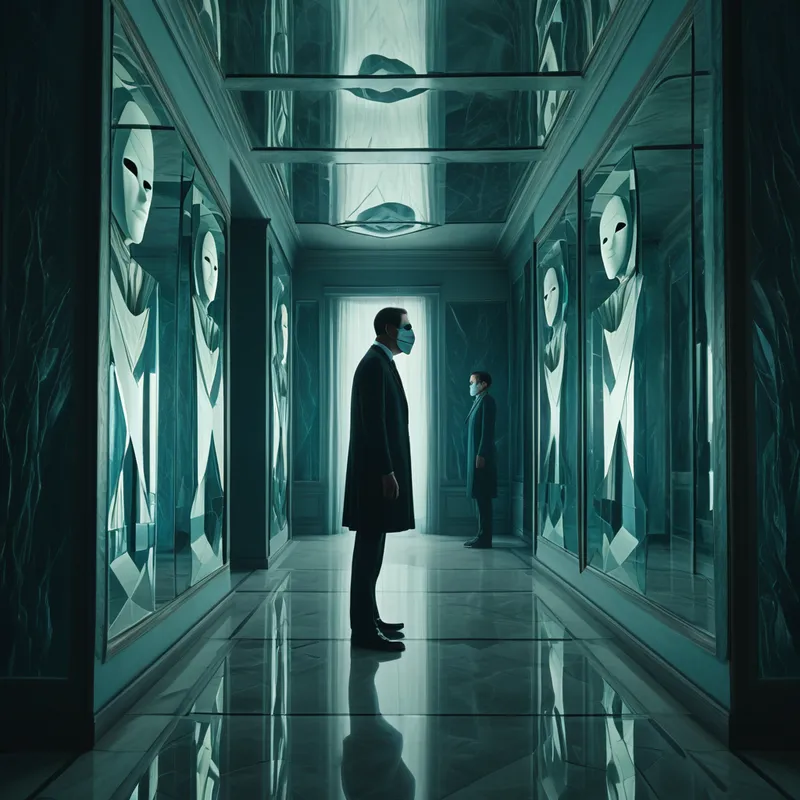
When this mythic pattern stirs in the modern dreamer, it often manifests as dreams of sudden, startling self-assertion within a conformist group. You may dream of speaking a shocking truth in a silent boardroom, singing a solo when you are meant to be part of the choir, or finally voicing a long-held grievance to a family that operates as a single unit.
Somatically, this can feel like a lurch in the chest, a cracking of the voice, or the sensation of stepping off a solid platform into empty space. Psychologically, it is the process of differentiation. The “chorus” in the dream represents the internalized pressures of family, society, or outdated self-concepts. The act of stepping forward is the psyche’s imperative to claim a distinct voice, to acknowledge a complex facet of the self that doesn’t fit the collective narrative. The anxiety in the dream mirrors Thespis’s risk: the fear of exile, of ridicule, of breaking a sacred, unspoken rule for the terrifying prize of authentic expression.
Alchemical Translation
The alchemical journey modeled by Thespis is the individuation process in its creative, heroic phase. The [prima materia](/myths/prima-materia “Myth from Alchemical culture.”/) is the undifferentiated mass of the choral psyche—our inherited traumas, cultural assumptions, and unconscious identifications.
The [separatio](/myths/separatio “Myth from Alchemical culture.”/) is that fateful step out of the circle. It is the conscious decision to no longer be solely defined by the chorus of internal voices saying “we are this” or “we believe that.” The mask represents the [persona](/myths/persona “Myth from Greek culture.”/), but its conscious adoption is an alchemical operation. We are not our mask, but we must wear one to engage with the world. Thespis teaches us to choose it with intention, to try on different aspects of the self (the victim, the hero, the tyrant, [the fool](/myths/the-fool “Myth from Tarot culture.”/)) in the safe vas of our own introspection or therapy.
The ultimate transmutation is not in permanently becoming the mask, but in returning to the chorus changed, having integrated the knowledge gained from behind it. The individual actor returns to the collective, but now he carries a secret: the multiplicity of selves within the one.
The [triumph](/myths/triumph “Myth from Roman culture.”/) is the creation of the orchestra, the dancing circle that is now empty between the actor and the chorus. This space is the transcendent function—the psychic field where dialogue between [the ego](/myths/the-ego “Myth from Jungian culture.”/) and the unconscious, the individual and the collective, can occur. It is the stage where the drama of our own lives becomes conscious, meaningful, and ultimately, transformative. We are all Thespis, stepping onto the empty stage of our own becoming, mask in hand, ready to give voice to the first, fragile word of our own unique myth.
Associated Symbols
Explore related symbols from the CaleaDream lexicon: