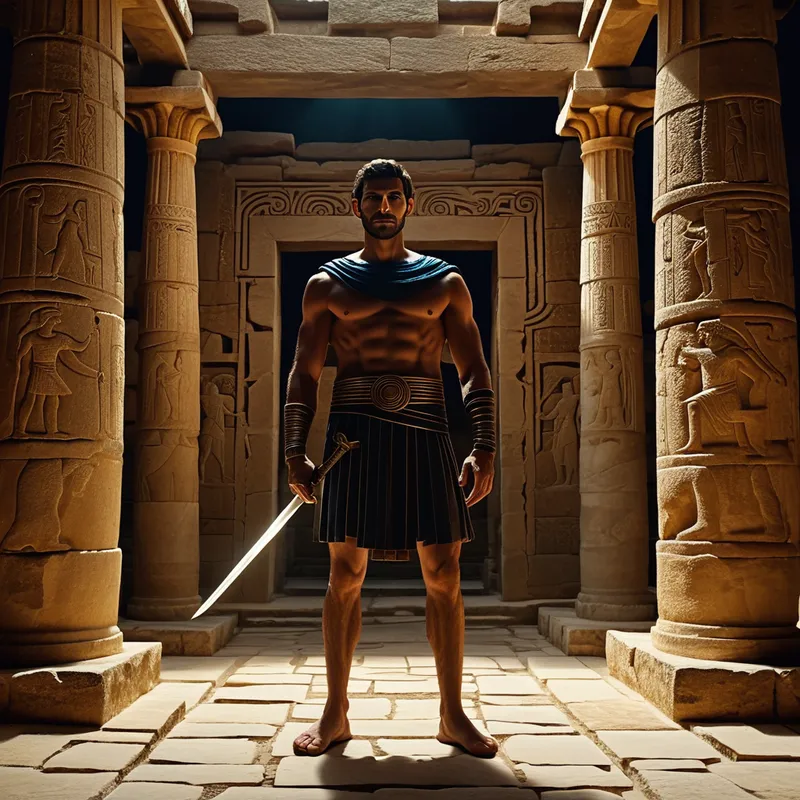
Theseus navigating the Labyrin Myth Meaning & Symbolism
A hero descends into a maze of stone and shadow, armed with a thread, to face the monstrous half-man within and reclaim his people's future.
The Tale of Theseus navigating the Labyrin
Hear now the tale of the descent, of the hero who walked where light fears to tread. The air in Knossos was thick with salt and sorrow, for every ninth year the black-sailed ship returned, its hold empty save for the dread of Athens. Fourteen youths, seven of each kind, chosen by cruel lot, were delivered to King Minos as tribute, a blood-price for a son slain long ago. Their fate was not the slave’s block, but the stone gullet of the Labyrinth, and the thing that waited at its heart.
Theseus, son of Poseidon and heir to Athens, stepped forward. “I go as the seventh son,” he declared, his voice cutting the mournful air. “Not by lot, but by will.” He boarded the ship, its sails black as a promise of death. In the court of Minos, a different fire met him—the gaze of Ariadne. She saw not a sacrifice, but a sword. That night, in secret, she came to him. In her hands was a ball of thread, finer than spider-silk but strong as fate. “Fasten this to the lintel of the gate,” she whispered, her words a map in the dark. “Unwind it as you go. It will be your memory made tangible, your path back from forgetting.”
At dawn, the great doors of the Labyrinth groaned open. The air that sighed out was cold, stale, smelling of wet stone and something older, a musk of hay and blood. Theseus tied the thread, and stepped into the maze. The world of sun and sky died behind him. Walls of fitted stone rose high, twisting left and right, corridors branching into darkness, every surface identical, a geometry of madness devised by Daedalus. The only sound was the scuff of his sandals, the whisper of the unraveling thread, and the thunder of his own heart. Deeper he went, the thread a trembling lifeline, a golden nerve connecting him to a world he could no longer see.
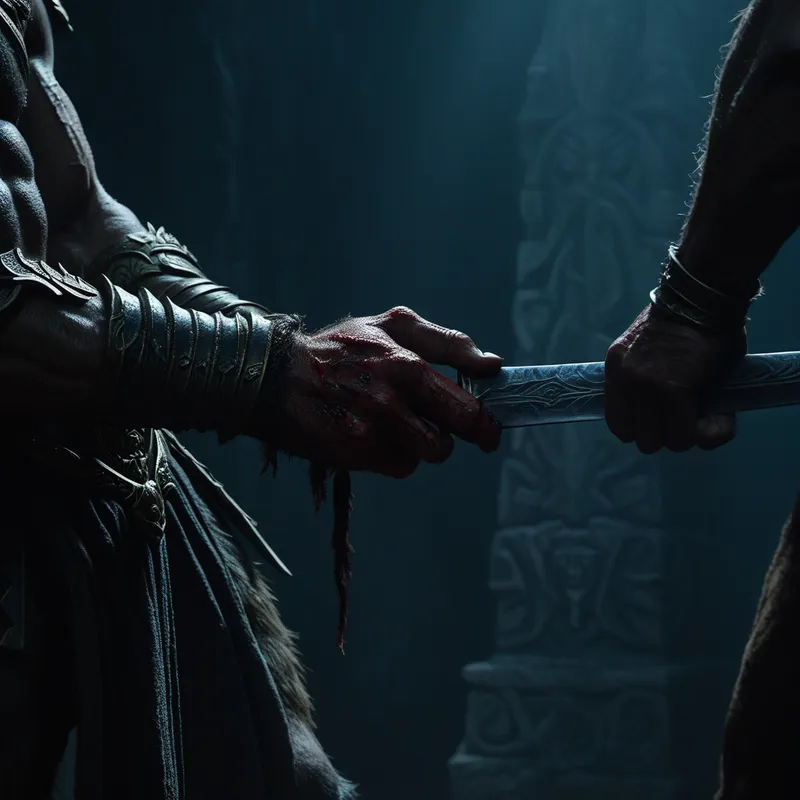
Then, he heard it. Not a roar, but a low, shuddering breath. Then the scrape of a hoof on stone. He turned a final corner and beheld the chamber at the world’s end. There, in a nest of bones bleached white, stood the Minotaur. It was vast, a mountain of muscle and coarse hair, its head a bull’s, but in its eyes flickered a terrible, trapped intelligence—the ghost of the man it might have been. No words passed between them, only a recognition of purpose. Theseus charged. The beast lunged. It was not a battle of skill, but of raw survival in that stinking pit. Theseus dodged the goring horns, feeling their wind, and with a cry that echoed up the stone throat of the Labyrinth, he drove his blade home. The Minotaur fell with a sound that was almost a sigh.
Silence, deeper than before, flooded the chamber. Then, with hands that shook not from fear but from the enormity of the act, Theseus took up the thread. He followed the golden line back through the winding intestines of stone, past the mocking silence of a thousand false turns, until he saw a sliver of daylight. He emerged, blinking, into the world, the survivors trailing behind him, the thread coiled once more in his hand—a spiral of experience, of descent and return.
Cultural Origins & Context
This core narrative is one of the most enduring from the Minoan and later Mycenaean cultural matrix of the Aegean Bronze Age. It was not a singular, fixed text but a living oral tradition, told and retold by bards for centuries before being crystallized in the works of later poets and historians like Hesiod, Sophocles, and Ovid. Its societal function was multifaceted. On one level, it served as a foundational aetiological myth for Athenian identity, explaining their historical (or perceived) dominance over Minoan Crete. It framed Athens as the cunning, civilized hero overcoming a monstrous, archaic power.
On a deeper, ritual level, the myth echoes initiation rites and katabasis narratives found across cultures. The tribute of youths mirrors practices of offering and passage, while the Labyrinth itself may be a mythic memory of the vast, complex palaces of Knossos, which to later Greeks seemed like impenetrable mazes. The story was a cultural container for anxieties about sacrifice, the monstrous potential of unchecked desire (born from Pasiphaë’s transgression), and the absolute necessity of cunning (metis) and external aid (Ariadne’s thread) to navigate impossible crises.
Symbolic Architecture
The Labyrinth is not merely a prison; it is the ultimate symbol of the psyche’s hidden, convoluted structure. It represents the unconscious mind in its totality—a place of infinite potential and paralyzing confusion, where logic fails and instinct reigns.
The Minotaur is not a foreign monster, but the native inhabitant of the maze. It is the embodied shadow, the half-human result of a royal transgression, a primal energy (the bull) fused with human lineage and then imprisoned in darkness.
Theseus represents the nascent ego-consciousness, the part of the self that says “I am” and must venture into the unknown to establish its sovereignty. His voluntary descent marks the heroic, yet necessary, engagement with the inner darkness that others would simply feed with sacrifices.
Ariadne’s thread is the symbol of relatedness and conscious connection. It is intuition, love, memory, or the therapeutic alliance—any lifeline of meaning that prevents the ego from being utterly dissolved in the chaos of the unconscious. It is not brute force, but subtle, persistent connection that enables the journey.
The slaying is not a glorification of violence, but an allegory for confrontation and integration. The ego does not befriend the Minotaur; it faces its destructive, devouring aspect. This act is a psychic necessity, the “slaying” of an autonomous complex that consumes vitality. The hero does not exit unchanged; he carries the knowledge of the beast within him.
The Dreamer’s Resonance
When this myth pattern stirs in modern dreams, the dreamer is navigating a profound process of disorientation and inner seeking. Dreaming of being lost in a maze or complex building signals a feeling of being trapped in a mental or life situation with no clear solution—a career path, a relationship dynamic, or a creative block. The walls of the dream-labyrinth are the constraints of one’s own perceived limitations and unconscious defenses.
To dream of a monstrous, hybrid creature waiting at the center is to encounter one’s own shadow material in its most potent, frightening, and compelling form. This is not a casual nightmare, but a sacred dream of confrontation. The somatic experience is often one of dread, a tightening in the chest, a cold sweat—the body registering the psyche’s preparation for a monumental encounter.
Finding or being given a thread, a string of light, or a guiding voice in such a dream is a crucial sign of emerging consciousness. It indicates that somewhere within the dreamer’s psyche, a resource—perhaps a forgotten talent, a supportive internal figure, or a nascent insight—is offering a way to navigate the complexity. The dream is modeling the process of finding a coherent thread through chaos.
Alchemical Translation
The myth of Theseus is a perfect map for the individuation process. The initial state is one of collective suffering: Athens passively sacrifices its youth. This is the unexamined life, where psychic energy (the youths) is routinely fed to an unconscious complex (the Minotaur) without challenge.
The alchemical work begins with the hero’s voluntarius descensus—the voluntary descent. In psychological terms, this is the courageous decision to engage in self-analysis, to enter therapy, or to consciously face a deep-seated fear or pattern. It is the ego choosing to meet the shadow on its own ground.
Ariadne’s thread represents the soror mystica, the helping other, or the transcendent function—that which connects the conscious mind to the unconscious without being swallowed by it. In alchemy, this is the guiding principle that prevents the solutio (dissolution in the unconscious) from becoming permanent psychosis. It is the thread of continuous awareness.
The confrontation in the cella (the central chamber) is the nigredo, the blackening. It is the darkest moment of the opus, where the base material (the shadow) is faced in its raw, terrifying form. The “slaying” is the separatio and mortificatio—the necessary breaking apart and “killing” of an old, autonomous psychic structure so that its energy can be freed.
Emerging from the Labyrinth, thread in hand, is the albedo, the whitening, and the beginning of integration. The hero returns to the world, but he is no longer the same. He has seen the center of himself. The thread, now coiled, is the integrated experience—the knowledge that the path into the deepest self exists, and that one can trace it back to light. The myth teaches that wholeness is not achieved by staying in the sunlit court, but by braving the maze, confronting the minotaur of our own making, and using the golden thread of consciousness to find our way home, transformed.
Associated Symbols
Explore related symbols from the CaleaDream lexicon: