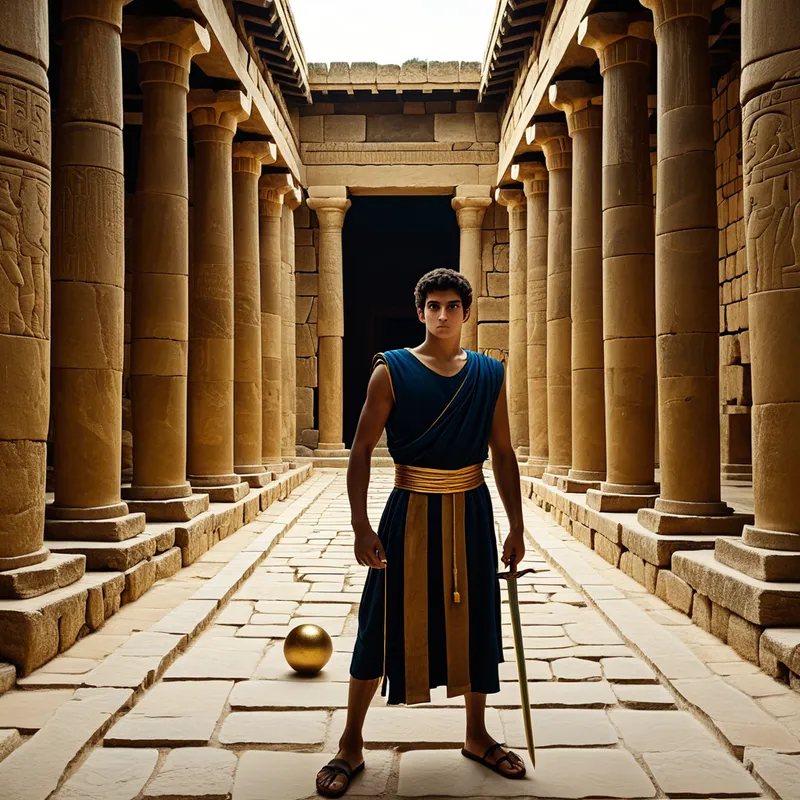
Theseus and the Labyrinth Myth Meaning & Symbolism
A hero enters a monstrous maze to face a beast born of shame, guided by love and a thread of consciousness to reclaim his kingdom and his soul.
The Tale of Theseus and the Labyrinth
Hear now the tale of a debt written in blood and stone, of a king’s shame given flesh, and the son who walked into the belly of a beast to end it.
From the sun-drenched cliffs of Athens, a ship with black sails cuts a mournful path across the wine-dark sea. It carries a cargo not of trade, but of tribute: seven youths and seven maidens, bound for the island kingdom of Crete. Every nine years, this payment is made to King Minos, to sate the hunger of his… son. For deep beneath the palace of Knossos lies the Labyrinth, a prison of such cunning design that none who enter find the exit. And at its center dwells the Minotaur, Asterion, a creature of rage and sorrow, feeding on the flesh of the sacrificed.
But this time, among the Athenian youths strides a prince with fire in his eyes: Theseus. Son of King Aegeus, he has volunteered himself, swearing to his father that if he succeeds, he will return with white sails of triumph. In Crete, the air is thick with salt and fear. Yet, in the court of Minos, a different fire is kindled. Ariadne, the king’s daughter, sees the Athenian prince and is struck as if by Eros’s arrow. She cannot bear the thought of his death in the dark.
In secret, she comes to him. In her hands, she holds salvation: a simple ball of thread. “Fasten this to the lintel of the gate,” she whispers, her voice a tremor in the palace night. “Unwind it as you go. It will be your guide back from the maze that has none.” She also gives him a sword, its edge hungry for the monstrous.
The next dawn, the great bronze doors of the Labyrinth groan open. Theseus steps into the swallowing dark. The air is cold, stale, smelling of earth and old terror. The passages twist, turn, double back upon themselves; the very walls seem to breathe and shift, disorienting the mind. The only sound is the scuff of his sandals and the whisper of the thread paying out behind him, a slender tether to the world of light. Deeper and deeper he descends, the weight of the stone pressing down, until he reaches the silent, awful center.
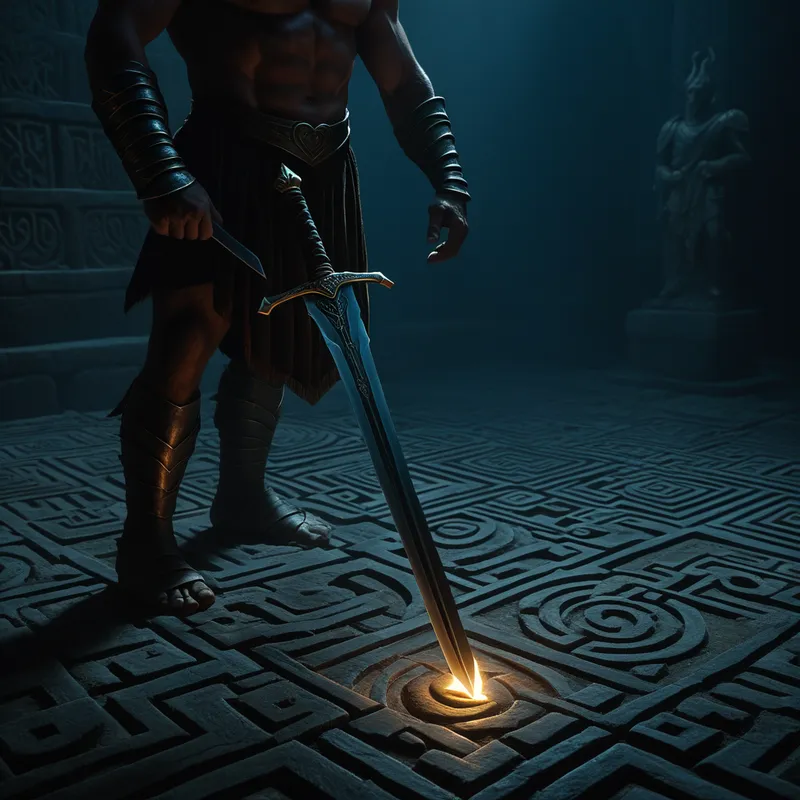
There, in a chamber littered with bones, it waits. The Minotaur is not merely a beast; it is a tragedy standing on two legs, a powerful torso crowned with the great, horned head of a bull, its eyes holding a terrible, trapped intelligence. With a roar that shakes dust from the ceiling, it charges. Theseus meets it, a dance of death in the absolute dark. The struggle is brutal, primal. Finally, with Ariadne’s sword, he strikes the killing blow. The monster falls, its breath leaving in a final, shuddering sigh.
Now, the thread. His lifeline, glowing faintly in the oppressive black. Hand over hand, heart pounding with the aftermath of violence and the desperate need for the sky, he follows the slender guide back through the winding insanity of the maze. He emerges, bloodied and triumphant, into the blinding Cretan sun, pulling the thread of his destiny taut behind him. With Ariadne and the spared Athenians, he flees, setting sail for home—but in the storm of his triumph, he forgets his father’s plea. The sails remain black. Old Aegeus, watching from the cliffs of Athens, sees the dark shape on the horizon and, believing his son dead, hurls himself into the sea that now bears his name. Victory is etched with the salt of grief.
Cultural Origins & Context
This myth is a foundational narrative of Athenian identity, emerging from the complex historical and cultural tensions between Minoan Crete and the rising mainland power of Mycenaean and later Classical Greece. The story, as we have it, was crystallized in the works of later writers like Plutarch, but its roots are far older, echoing in the art and oral traditions of the Late Bronze Age.
Functionally, it served multiple purposes. It was a aition, an explanatory myth, for the historical Athenian tribute to Crete (perhaps reflecting a period of Minoan dominance). It established Theseus as the great unifying hero-king of Attica, a founder of democratic institutions in the Athenian self-image. The tale was performed, not read—shared by bards in symposia and public festivals, reinforcing ideals of civic duty, cunning intelligence (metis), and the triumph of civilized order (Athens) over chaotic, archaic monstrosity (the Minotaur). It was a story told to define who the Athenians were: not victims, but heroes who confronted their darkest obligations and emerged, though scarred, as masters of their own fate.
Symbolic Architecture
The Labyrinth is not merely a prison; it is the ultimate symbol of the unconscious psyche. It is a constructed chaos, a map of the disoriented mind, where logic fails and instinct reigns. To enter voluntarily is to embark on the heroic journey into the self.
The Minotaur is the shadow made flesh, the unacceptable hybrid born from a king’s broken oath and a queen’s transgressive desire. It is not external evil, but the internalized result of denied shame, rage, and primal instinct that must be fed with periodic sacrifices of one’s vitality or potential.
Theseus represents the conscious ego, the part of the psyche that must descend into this complexity with a purpose. He is will and identity. Ariadne’s thread is the supreme symbol of connection—the thread of consciousness, of memory, of love, of the analytical clue that prevents the ego from being utterly lost in the morass of the unconscious. The sword is the discriminating function, the ability to make decisive cuts, to differentiate self from not-self.
The tragic coda, the forgotten white sails and Aegeus’s suicide, is crucial. It signifies that the confrontation with the shadow is never clean. Integration costs. The old king (the old order of the self) must die for the new, initiated self to fully reign. Triumph is always alloyed with loss.
The Dreamer’s Resonance
When the pattern of this myth stirs in modern dreams, the dreamer is at a critical juncture of inner confrontation. Dreaming of being lost in a maze or complex building signals a feeling of being trapped by life’s complexities, by a problem with no clear solution. The somatic experience is often one of anxiety, breathlessness, and a frantic searching.
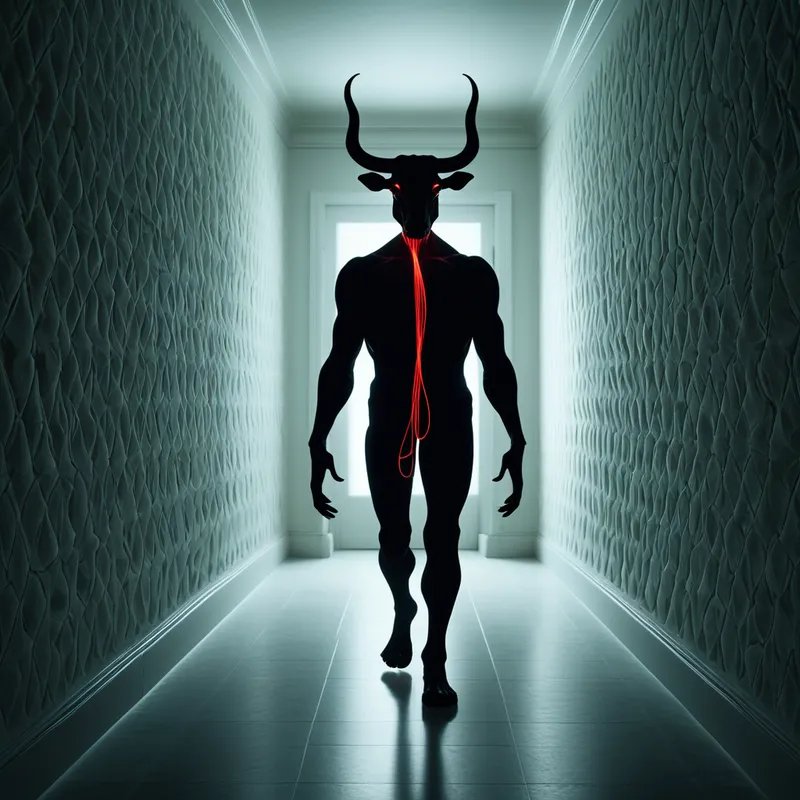
If the Minotaur appears, it is the dream-ego coming face-to-face with a repressed aspect of the self that feels monstrous—perhaps a buried rage, a “beastly” appetite, a source of deep shame or inherited family trauma. The beast is often both terrifying and pitiable. The dream may recur until the dreamer, like Theseus, stops fleeing and turns to face it. Finding or holding a thread, a string, or a cord in such a dream is a profoundly positive sign: it indicates the nascent emergence of a guiding insight, a therapeutic connection, or a creative intuition that can lead back to integration. The dream is the psyche’s ritual enactment of a necessary descent, preparing the conscious mind for the work of acknowledgment and integration.
Alchemical Translation
In the alchemy of the soul, the myth models the process of individuation. The prima materia, the base matter to be transmuted, is the chaotic, unconscious complex (the Labyrinth with the Minotaur at its heart). The hero’s journey is the opus itself.
The descent (nigredo) is the confrontation with the shadow, a darkening and putrefaction of the old, naive ego. The slaying is not destruction, but a radical differentiation—the conscious mind must “kill” its identification with and possession by the autonomous shadow complex.
Ariadne’s thread represents the synchronicity and guiding wisdom of the anima (or animus), the soul-image that connects conscious and unconscious. It is the loving, relational function that makes the perilous work navigable. The return (albedo), following the thread, is the assimilation of the insight gained, leading to a cleansing and illumination.
The final, painful step is the death of Aegeus (rubedo), the reddening. The old patriarchal authority, the outdated structure of the self that could not comprehend the journey, must fall away. The new king—the more conscious, integrated Self—can only assume the throne after this sacrifice. The individual is no longer a tribute to their inner monster, but the sovereign of their own labyrinthine soul, having transmuted the beast’s raw power into regal authority. The maze is not destroyed; it is mastered, and in mastering it, one discovers it was also the architecture of one’s own wholeness.
Associated Symbols
Explore related symbols from the CaleaDream lexicon: