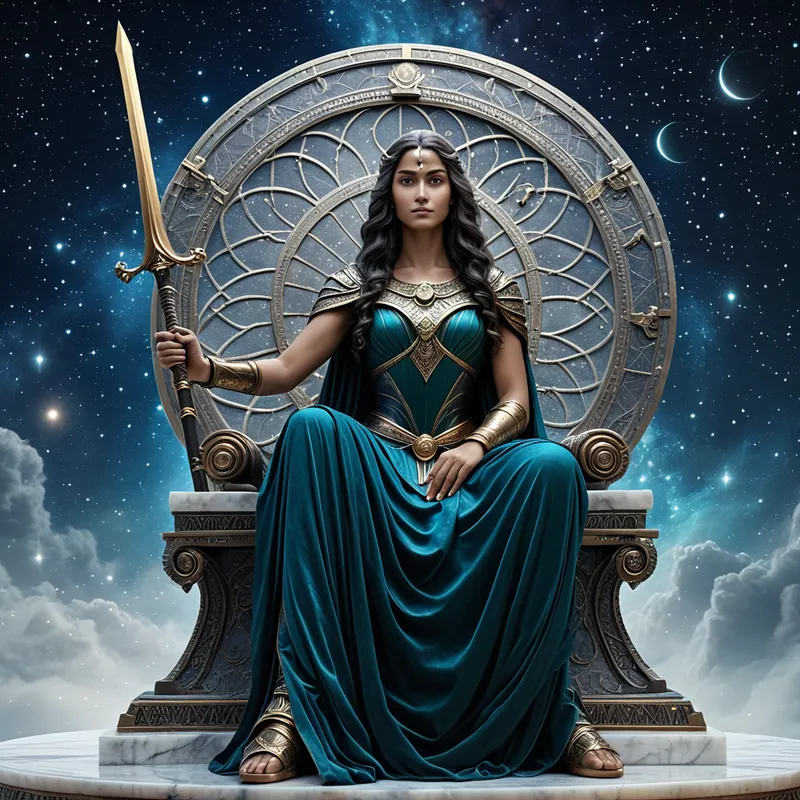
Themis Myth Meaning & Symbolism
The Titaness of divine law, who embodies cosmic order, prophetic counsel, and the unshakeable scales of justice, mothering the Fates and the Seasons.
The Tale of Themis
Before the first city, before the first law was carved in stone, there was a silence at the heart of the world—a deep, listening silence. From this silence, born of the primordial Ouranos and the fertile Gaia, she arose. Not with thunder, but with a presence like the settling of a mountain. Her name was Themis.
She was there when the Titans ruled in brutal splendor, and she watched, her gaze clear and unblinking. When the great war shook the foundations of the cosmos, and the young Olympians wrested power from their forebears, Themis did not fight. She stood in the eye of the storm, a pillar of something older than conflict: Order.
The new king, Zeus, whose lightning was wild and will untamed, came to her. He found her seated beside the spring that flowed from the world’s root, her fingers tracing patterns in the water that were not ripples, but destinies. He, the master of power, sought the mistress of principle. “Counsel me,” he said, his voice still echoing with recent thunder. “How shall I rule, so that this reign does not fall as the last one did?”
Themis looked at him, and in her eyes, he saw not submission, but the immutable law of consequence. She spoke, and her voice was the sound of stone settling, of seasons turning. She taught him the rites that please the earth, the assemblies that bind mortals, the sacred hospitality that turns strangers into guests. She became his first advisor, his second conscience. From their union, a new kind of divinity was born: the Horai—Eunomia (Good Order), Dike (Justice), and Eirene (Peace)—and the mighty Moirai, the Fates themselves. She did not command the threads of life; she birthed the weavers.
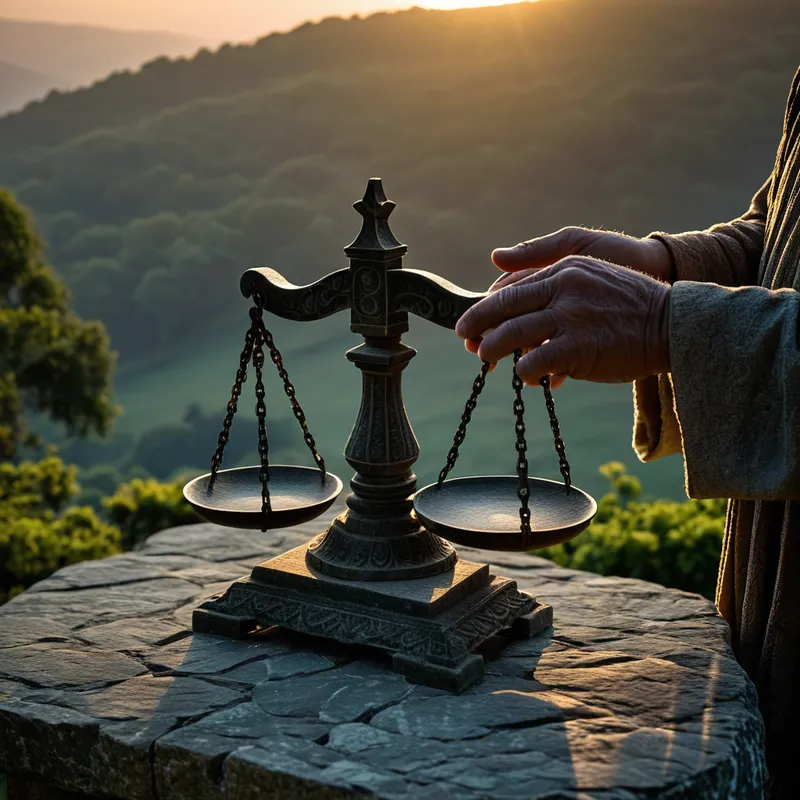
Her most sacred tool was not a weapon, but a measure. In a hall of polished obsidian, under a ceiling painted with the fixed stars, she would bring forth her scales. Not to punish, but to perceive. She would place a claim in one pan, a counter-claim in the other, and wait. The air would grow still. The balance would find its own truth, its pointer hovering toward the weight of rightness. Her sword was ever-present, but sheathed—a reminder that discernment precedes action, that true justice is an act of precise, unwavering vision.
Cultural Origins & Context
The figure of Themis originates from the earliest layers of Greek religious thought, a pre-Olympian deity absorbed into the canonical pantheon. She represents a fundamental shift from chthonic, earth-based powers to the conceptual framework of civilization. Her worship was not centered on grand temples filled with pleas, but was intrinsic to the function of the state itself. She was the divine embodiment of themistes—the unwritten, divinely ordained rules and precedents that formed the bedrock of early Greek law and social conduct.
Her myths were passed down not as isolated adventure stories, but as foundational chapters in the cosmological poetry of Hesiod’s Theogony and embedded in the works of later writers like Aeschylus and Pindar. She functioned as the crucial link between the raw, generative chaos of the Titans and the structured, if tumultuous, order of the Olympian era. In societal terms, Themis presided over the assembly (agora), over oaths, and over prophecy—particularly at the oracular site of Delphi, which she was said to have guarded before Apollo. Her presence sanctified human attempts to create order, reminding them that their laws were mere reflections of a cosmic principle.
Symbolic Architecture
Themis is not justice as retribution, but justice as the fundamental architecture of reality. She symbolizes the innate, often invisible, ordering principle that underlies both the cosmos and the human soul.
The scales do not create balance; they reveal the balance that already exists in the truth of a situation.
Her primary symbols are a lexicon of cosmic law. The Scales represent equitable measure, the necessity of weighing all factors, and the objective equilibrium that exists beyond personal desire. The Sword symbolizes the cutting power of discernment—the ability to sever illusion from truth and to enact the decisions revealed by the scales. Her Blindfold (a later Roman addition via Justitia) signifies the impartiality of true justice, which must be deaf to pleas of status or wealth.
Psychologically, Themis represents the superordinate function of the Self in individuation. She is the inner authority that transcends the inner tyrant (the unchecked Zeus complex) or the inner victim. She is the voice that says, “Regardless of your power or your fear, this is what is. This is the right order of things.” She governs the internal court where we weigh our actions against our values, our desires against our duties.
The Dreamer’s Resonance
When the archetype of Themis stirs in the modern unconscious, it often manifests in dreams of profound assessment and existential re-ordering.
A dreamer may find themselves in a vast, silent library or a sterile, modern courtroom, tasked with weighing two identical-looking yet profoundly different objects. There is a somatic feeling of immense responsibility and quiet focus. The conflict is not with a monster, but with ambiguity itself. Another common motif is discovering a forgotten, perfectly balanced set of scales in an attic or basement—a relic of an inner truth the dreamer has neglected.
These dreams signal a psychological process where the psyche is attempting to restore equilibrium. It is often a call to adjudicate an internal conflict that has been allowed to fester: a moral dilemma, a life path decision, or the need to balance competing aspects of the self (work vs. home, logic vs. intuition, self vs. other). The Themis dream arrives when the cost of imbalance—anxiety, guilt, a sense of life being “off-kilter”—has become too great to ignore. It is the soul’s own judiciary coming into session.

Alchemical Translation
The alchemical process mirrored in the myth of Themis is not the solve (dissolution) or the coagula (coagulation), but the sacred separatio—the careful, deliberate separation of the pure from the impure, the essential from the dross. This is the work of discernment, the core of psychic transmutation.
For the modern individual, the “struggle” is the often painful act of applying her scales to one’s own life. It requires deposing the inner tyrant who rules by whim and the inner rebel who rejects all structure. One must sit in Themis’s seat, becoming both judge and supplicant. This means weighing a comfortable lie against a difficult truth, a familiar pain against the risk of change, the expectations of others against the call of one’s own Self.
The triumph is not victory in battle, but the achievement of inner sovereignty through impeccable judgment.
The “child” of this union between our conscious will (Zeus) and our inner law (Themis) is a new, authentic order—the Horai and Moirai of our personal destiny. We give birth to our own capacities for Good Order (a life structured by meaning), Justice (right relationship with ourselves and the world), and Peace (the inner stillness that comes from integrity). We acknowledge our own Fates not as external punishments, but as the natural outcomes of choices weighed in the balance of our deepest truth. To integrate Themis is to become the author and guardian of one’s own cosmic order, ruling not by force, but by the unwavering measure of what is right.
Associated Symbols
Explore related symbols from the CaleaDream lexicon:
- Exact
- Order
- Fairly
- Bill
- Court
- Proper
- Correct
- Internet
- Mean
- Lawyer
- Balance
- Traditional
- Scale
- Brake
- Clipboard
- Balancing Acts
- Fortune Cookie
- Judge’s Gavel
- Accountant’s Calculator
- Referee Whistle
- Emotion Wheel
- Seesaw
- Symbolic Chapter
- Silken measuring tape
- Measuring Cups
- Cooking Thermometer
- Strainer
- Kitchen Scale
- Measuring Spoon
- Calculating Scale
- Dreamy Ruler
- Meeting Agenda
- City Hall
- Balanced Scale
- Balancing Scales
- Scale of Justice
- Parallelogram
- Haetae Guardian
- Yarmulke Cap
- Equations
- Thermodynamic Equilibrium
- The Statute
- Social Contract
- Social Norms
- Legal System
- Courtroom
- Justice
- Subpoena
- Social Order
- Legal Obligation
- Public Trust
- The Principle
- Constitution
- Predicate
- Nuance
- Homeostasis
- Equity
- Invoice
- Sanction
- Equilibrium
- Right
- Contracting
- Perpendicular
- Imbalance
- Endolymph
- Mild