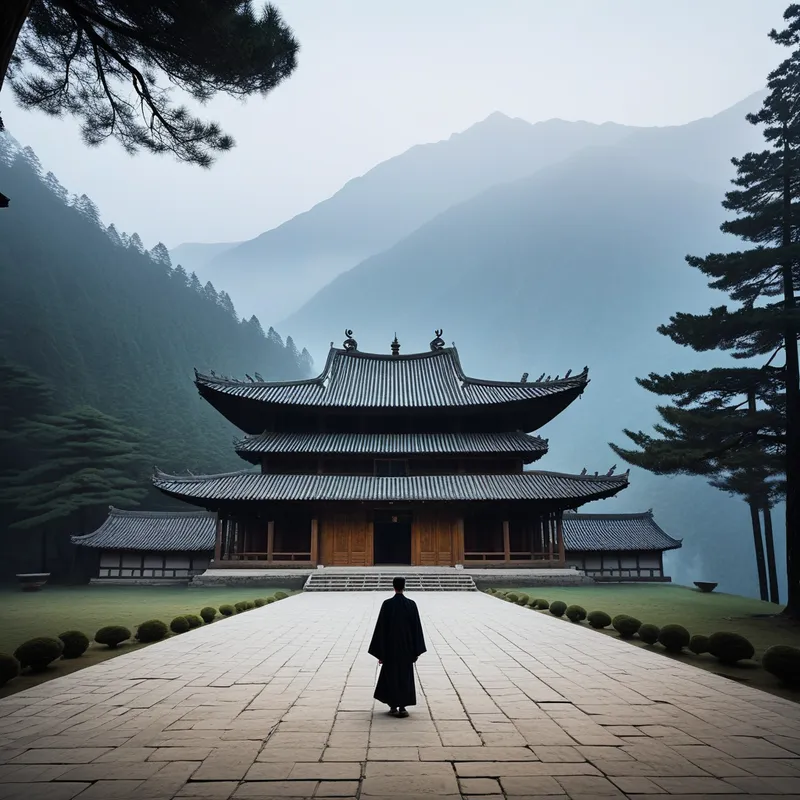
The Zen Monastery Myth Meaning & Symbolism
A mythic journey into a monastery where the ultimate teaching is silence, and the final gatekeeper is the seeker's own reflection.
The Tale of The Zen Monastery
Listen. There is a place that exists only when you cease to look for it. It is said to perch on the [Vulture Peak](/myths/vulture-peak “Myth from Buddhist culture.”/) of the mind, where the air is so thin it carries no sound, and [the mist](/myths/the-mist “Myth from Celtic culture.”/) is the breath of forgotten questions.
For a lifetime, or perhaps a hundred lifetimes, a seeker climbed. He had consumed the sutras like food and worn the robes of a dozen schools, yet a splinter of longing remained in his heart. He sought the legendary Monastery of Unborn Silence, where the true Dharma was said to be transmitted without words. His feet bled on the stone path, his mind ached with koans, but he climbed.
At last, through a veil of cloud, he saw it: not a palace, but a severe harmony of wood and paper, of sweeping roofs that caught the moonlight and wide, empty verandas. The great gate was not locked, but stood open to a vast, raked gravel courtyard. There was no one. The silence was not an absence, but a presence—a thick, listening quiet.
For days, he sat in the courtyard, waiting for a teacher. He practiced his meditation, recited his understandings. Only [the wind](/myths/the-wind “Myth from Various culture.”/) answered, stirring a single bell. Despair began to coil within him. Had he come all this way to find an empty shell?
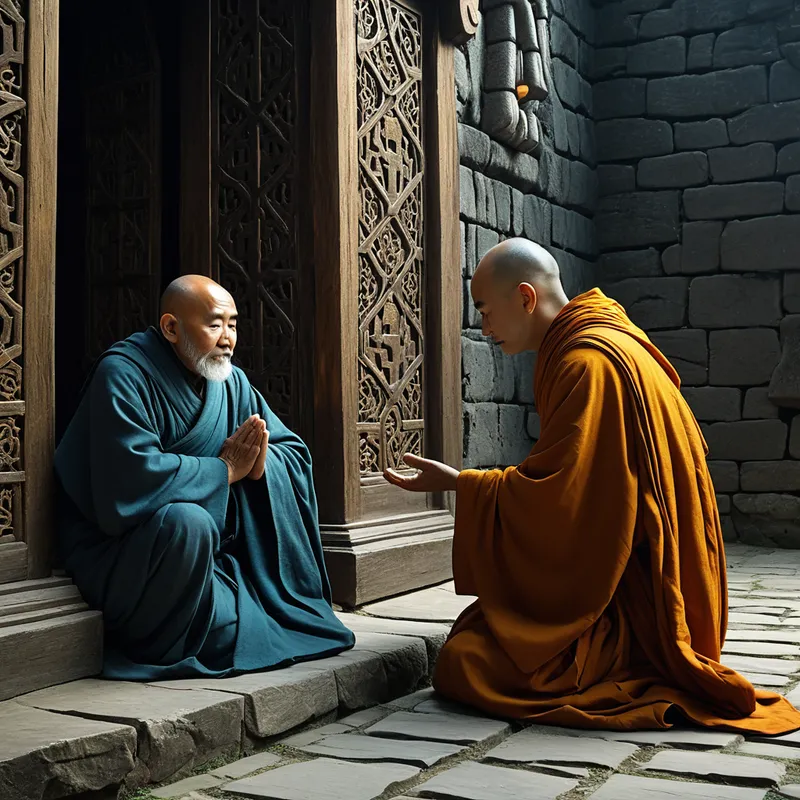
Then, an old monk appeared, as if materialized from the grain of the wood. His eyes were pools of still [water](/myths/water “Myth from Chinese culture.”/). Without a word, he began raking the gravel into perfect, flowing lines. The seeker rushed to him, spilling his history, his insights, his burning need. The monk raked. Finally, the seeker fell to his knees and cried, “Master, please! Admit me! Teach me the great truth!”
The old monk stopped. He did not look at the seeker, but at the patterns in the stones. He spoke his first and only words: “The gate is open. You have been standing in the courtyard for a week. What are you waiting for?”
The seeker was stunned. “But… where is the abbot? The hall of teachings? The ceremony?”
A faint smile touched the monk’s lips. He pointed a bony finger not toward the main hall, but directly at the seeker’s own chest. Then, he resumed raking.
In that moment, the myth says, the monastery dissolved. Or rather, it became. The mountains were its walls, [the sky](/myths/the-sky “Myth from Persian culture.”/) its roof, the seeker’s own breath the bell that called him to sit. The teacher was the gravel, the silence, the pointing finger, and the aching void inside his own question. He had not found a monastery. He had stumbled into the architecture of his own seeking, and the only one who could grant admission was the one knocking at the gate.
Cultural Origins & Context
This is not a singular myth with a fixed text, but a pervasive narrative pattern woven through the Zen tradition, crystallized in countless teaching stories, koans, and mondo. It functions as a meta-koan—a story about the futility of seeking stories. It emerged from the historical Chan monasteries of Tang Dynasty China, where the radical, anti-scholastic ethos of masters like Bodhidharma and Linji gave rise to tales that deliberately subverted institutional piety.
Told by masters to disciples, often at the moment the student was most entrenched in intellectual seeking, its societal function was therapeutic and deconstructive. It served as a narrative koan designed to break the disciple’s [projection](/myths/projection “Myth from Alchemical culture.”/) of enlightenment as an external place, person, or formula. The myth preserved the core Zen insistence that “the treasure is in your own house,” while dramatizing the painful, comic journey of forgetting and remembering that fact.
Symbolic Architecture
The [monastery](/symbols/monastery “Symbol: A monastery represents a space of solitude, spiritual dedication, and community life, often linked to contemplation and religious devotion.”/) is not a building, but a living [symbol](/symbols/symbol “Symbol: A symbol can represent an idea, concept, or belief, serving as a powerful tool for communication and understanding.”/) of the structured, seeking mind itself. Every element is psychic [architecture](/symbols/architecture “Symbol: Architecture in dreams often signifies structure, stability, and the framing of personal identity or life’s journey.”/).
The endless climb represents the arduous [path](/symbols/path “Symbol: The ‘path’ symbolizes a journey, choices, and the direction one’s life is taking, often representing individual growth and exploration.”/) of spiritual accumulation—[knowledge](/symbols/knowledge “Symbol: Knowledge symbolizes learning, understanding, and wisdom, embodying the acquisition of information and enlightenment.”/), [virtue](/symbols/virtue “Symbol: A moral excellence or quality considered good, often representing inner character, ethical principles, or spiritual ideals in dreams.”/), technique. The open gate symbolizes the ever-present accessibility of [Buddha](/symbols/buddha “Symbol: The image of Buddha embodies spiritual enlightenment, peace, and a quest for inner truth.”/)-[nature](/symbols/nature “Symbol: Nature symbolizes growth, connectivity, and the primal forces of existence.”/), which requires no special admission because it is our fundamental ground. The empty [courtyard](/symbols/courtyard “Symbol: A courtyard in dreams represents a space of safety, reflection, and personal growth, often indicating the need for introspection.”/) is the mind stripped of concepts, the fertile void of potential. The raking monk is the [activity](/symbols/activity “Symbol: Activity in dreams often represents the dynamic aspects of life and can indicate movement, progress, and engagement with personal or societal responsibilities.”/) of the unconscious, ordering the [psyche](/myths/psyche “Myth from Greek culture.”/) (the [gravel](/symbols/gravel “Symbol: Gravel in dreams can represent a rough path, ground that is unstable, or obstacles that need to be navigated carefully.”/)) into meaningful, yet impermanent, patterns without attachment to [outcome](/symbols/outcome “Symbol: Outcome symbolizes the results of actions or decisions, often reflecting hopes, fears, and the consequences of choices.”/).
The ultimate teacher is not a person, but the shock of realizing you have been conversing with your own reflection in a mirror you believed was a window.
The [seeker](/symbols/seeker “Symbol: A person actively searching for meaning, truth, or a higher purpose, often representing the dreamer’s own quest for identity or fulfillment.”/)’s desperate plea for external validation is [the ego](/myths/the-ego “Myth from Jungian culture.”/)’s final, tragicomic stand. The pointing [finger](/symbols/finger “Symbol: Fingers often symbolize communication, action, and the way we point towards or indicate interests and desires.”/) is the [moment](/symbols/moment “Symbol: The symbol of a ‘moment’ embodies the significance of transient experiences that encapsulate emotional depth or pivotal transformations in life.”/) of [kensho](/myths/kensho “Myth from Buddhist culture.”/), where the [direction](/symbols/direction “Symbol: Direction in dreams often relates to life choices, guidance, and the path one is following, emphasizing the importance of navigation in personal journeys.”/) of seeking reverses [inward](/symbols/inward “Symbol: A journey toward self-awareness, introspection, and the exploration of one’s inner world, thoughts, and unconscious mind.”/). The [dissolution](/symbols/dissolution “Symbol: The process of breaking down, dispersing, or losing form, often representing transformation, release, or the end of a state of being.”/) of the monastery is the collapse of the dualistic [framework](/symbols/framework “Symbol: Represents the underlying structure of one’s identity, emotions, or life. It signifies the mental or emotional scaffolding that supports or confines the self.”/)—[seeker](/symbols/seeker “Symbol: A person actively searching for meaning, truth, or a higher purpose, often representing the dreamer’s own quest for identity or fulfillment.”/) vs. sought, inside vs. outside—revealing the non-dual [reality](/symbols/reality “Symbol: Reality signifies the state of existence and perception, often reflecting one’s understanding of truth and life experiences.”/) that was always the [case](/symbols/case “Symbol: A case often signifies containment, protection of personal matters, and the need for organization in one’s life.”/).
The Dreamer’s Resonance
When this myth stirs in the modern unconscious, it often manifests in dreams of seeking: endless bureaucratic halls where no office holds the right form, libraries with indecipherable books, or arriving at a crucial event only to find you are in the wrong building. The somatic feeling is one of profound frustration laced with a strange, eerie familiarity.
Psychologically, this signals a critical impasse in the dreamer’s development. The conscious ego has diligently followed a map—for career, relationship, self-improvement—only to find the promised destination empty. The dream is not a failure, but a necessary disillusionment. It is the psyche forcing a confrontation with the projection of wholeness onto an external structure (a job title, a partner, a spiritual label). The anxiety and disorientation are the death throes of an outdated seeking strategy. The dreamer is being prepared, often painfully, to turn the seeking faculty back upon itself, to become the source of the authority they have been begging from empty courtyards.
Alchemical Translation
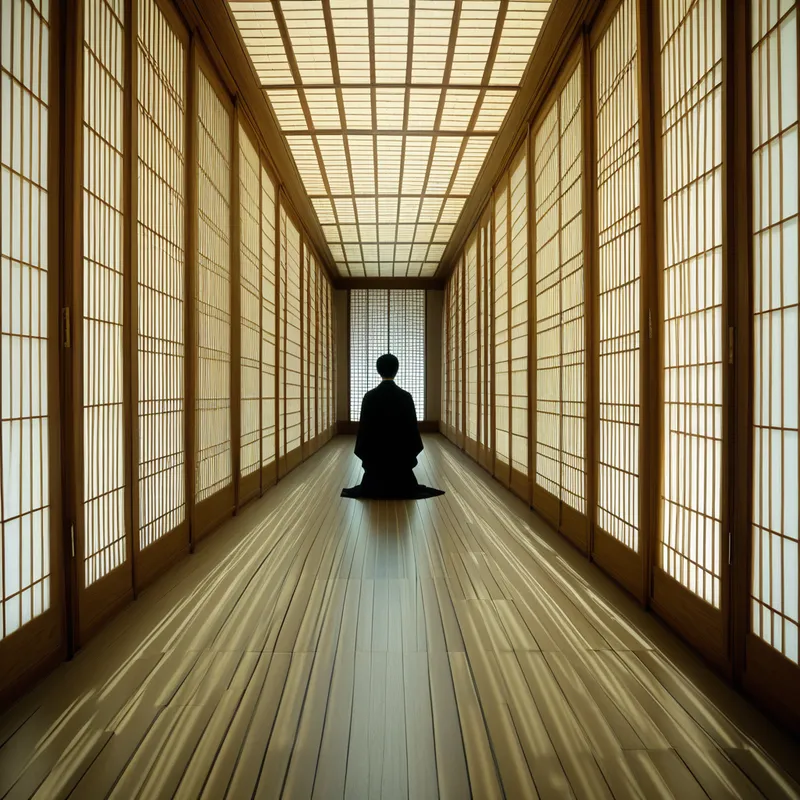
The myth models the alchemical [solve et coagula](/myths/solve-et-coagula “Myth from Alchemical culture.”/)—dissolve and coagulate—applied to the psyche. The seeker’s carefully constructed spiritual identity (the coagulated [persona](/myths/persona “Myth from Greek culture.”/) of “the devout student”) must be dissolved in the acid of the empty courtyard. The ego’s project of attainment is deconstructed, not through failure, but through the absurd realization of its own premises.
The transmutation occurs when the energy bound in seeking is released, falling back into the psyche like rain onto parched earth, where it can nourish the roots of being rather than the branches of becoming.
The “treasure” is not found; it is recognized as the substance of the seeker. The final stage, the coagulation, is not the building of a new, better spiritual ego. It is the natural, integrated functioning of a person who has stopped trying to “enter” their own life. The raking of the gravel continues—work is done, life is lived—but it is no longer a means to an end. It is the expression of the realized ground. The modern individual, amidst digital noise and existential seeking, is invited by this myth to stop trying to download the answer and instead become aware of the one who is asking the question. In that pause, in that turning of the light inward, the entire search ends where it began: at home.
Associated Symbols
Explore related symbols from the CaleaDream lexicon: