
The Yellow Springs Underworld
The Yellow Springs is the Taoist underworld, a subterranean realm where souls journey after death to face judgment and purification.
The Tale of The Yellow Springs Underworld
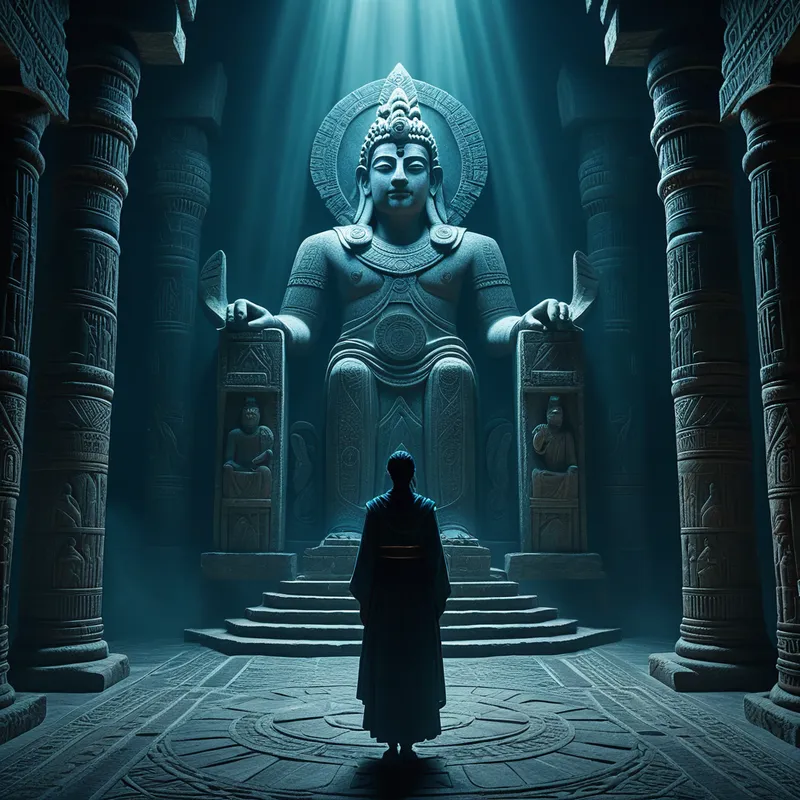
The journey begins not with a final breath, but with a descent. The soul, newly untethered from the warmth of the sun and the solidity of [the earth](/myths/the-earth “Myth from Hindu culture.”/), finds itself drawn downward, pulled by a gravity not of matter but of consequence. It passes through layers of soil and stone, the light of the living world fading into a deep, permanent twilight. The air grows cool and damp, carrying the faint, mineral scent of deep earth and running [water](/myths/water “Myth from Chinese culture.”/). This is the entrance to the Yellow Springs, the Huangquan, a vast, shadowed dominion beneath the feet of the living.
Here, the landscape is one of somber bureaucracy and profound transformation. The soul is met not by a single fearsome deity, but by a complex administration of the dead. It is led before the tribunals of the Ten Yama Kings, each presiding over a specific court in the multi-layered bureaucracy of [the underworld](/myths/the-underworld “Myth from Greek culture.”/). The soul’s earthly life is not merely reviewed; it is made manifest. In the Court of Mirror-Kings, every action, word, and hidden intention is reflected back with unbearable clarity. There is no deception here, for the soul stands naked before its own record, compiled by infernal clerks from the moment of its birth.
Judgment is precise and inescapable. For some souls, the path leads to temporary realms of torment—purgatorial landscapes where specific karmic debts are purified through symbolic suffering. Others may face lengthy sojourns in gloomy, twilight cities, awaiting their next turn in the wheel of existence. Yet, this is not a finale of eternal damnation, but a phase in a cyclical process. The ultimate authority overseeing this vast apparatus is often seen as Dongyue Dadi, the Great Emperor of the Eastern Peak, who governs both the fortunes of the living and the fate of the dead, embodying the seamless connection between the two realms.
The journey through the Yellow Springs is arduous, but it is not without hope or endpoint. After the period of judgment and requisite purification, the soul is brought to the final stage before the Naihe Bridge that spans a dark, churning river. Here, the soul is given a broth of forgetfulness by the goddess Meng Po. To drink is to let the weight of the past life—its joys, sorrows, shames, and identities—dissolve into oblivion. Only then, stripped clean of its former self, is the soul ready to be returned to the wheel of [samsara](/myths/samsara “Myth from Buddhist culture.”/), to be reborn into [the world](/myths/the-world “Myth from Tarot culture.”/) of the living, carrying only the essence of its refined [karma](/myths/karma “Myth from Hindu culture.”/) forward into a new existence.
Cultural Origins & Context
The concept of the Yellow Springs (Huangquan) is ancient, its roots reaching deep into the pre-imperial soil of Chinese thought. Early textual references, such as in the Zuo Zhuan, speak of it simply as a dark, subterranean destination for the dead, a place of no return. It was a neutral, if somber, post-mortem space, not yet systematized into a moral courtroom. This early view reflects a foundational Chinese reverence for ancestors and the need for a concrete, if shadowy, location where they resided.
The transformation of this vague [underworld](/myths/underworld “Myth from Greek culture.”/) into the elaborate bureaucratic realm of Taoist and popular belief was a gradual alchemy, catalyzed by several streams. The indigenous Chinese bureaucratic model, so effective in governing the empire, provided the perfect template for administering the afterlife—if the living world required records, magistrates, and courts, surely the cosmos did as well. The arrival and integration of Buddhist cosmology during the Han and Tang dynasties was the other crucial element. Buddhist concepts of karma, samsara, and multilayered hells (Naraka) fused with the native Yellow Springs, giving it a new purpose: moral retribution and purification. The Ten Yama Kings, originally derived from the Buddhist Dikpalas (guardians of directions), became the judges of this synthesized underworld.
Thus, the Yellow Springs as we understand it is a profound syncretic achievement. It is a Taoist-Buddhist-Confucian amalgam where ancestral veneration, bureaucratic order, karmic law, and the cyclical Taoist view of transformation coexist. It served a vital social and psychological function: it was a cosmic mirror to the imperial state, reinforcing social morality through the promise of posthumous accounting, while also providing a structured, comprehensible narrative for the terrifying mystery of [death](/myths/death “Myth from Tarot culture.”/).
Symbolic Architecture
The [architecture](/symbols/architecture “Symbol: Architecture in dreams often signifies structure, stability, and the framing of personal identity or life’s journey.”/) of the Yellow Springs is not mere fantasy; it is a precise symbolic map of the [psyche](/myths/psyche “Myth from Greek culture.”/)’s confrontation with its own totality. Each feature is a stage in the [soul](/symbols/soul “Symbol: The soul represents the essence of a person, encompassing their spirit, identity, and connection to the universe.”/)’s confrontation with the [shadow](/symbols/shadow “Symbol: The ‘shadow’ embodies the unconscious, repressed aspects of the self and often represents fears or hidden emotions.”/).
The Ten Courts of Yama represent the fragmentation of a monolithic fear of death into a process of specific, addressable moral audits. One does not face a singular, terrifying judgment, but a series of hearings, each focusing on a different aspect of life—deceit, cruelty, filial impiety. This bureaucratization of the afterlife makes the incomprehensible comprehensible, and the unbearable, procedural.
The Mirrors of the Courts are perhaps the most psychologically potent symbols. They represent the moment of radical self-honesty, where the persona constructed for the world is dissolved. The soul does not see what it pretended to be, but what it was—the composite of all actions, seen and unseen. This is the underworld as the realm of absolute, unforgiving consciousness.
The Naihe Bridge and Meng Po’s Broth symbolize the essential paradox of cyclical existence. To be reborn, one must forget; to evolve, one must relinquish the identity formed from past experience. This forgetfulness is not a tragedy but a necessity. It is the psyche’s own merciful dissolution of the ego, allowing the essential shen (spirit) to continue its journey unburdened by the accumulated scars and stories of a single lifetime.
The Yellow Springs, therefore, is an [interior](/symbols/interior “Symbol: The interior symbolizes one’s inner self, thoughts, and emotions, often reflecting personal growth, vulnerabilities, and secrets.”/) [landscape](/symbols/landscape “Symbol: Landscapes in dreams are powerful symbols representing the dreamer’s emotional state, personal journey, and the broader context of life situations.”/). Its descent is [the ego](/myths/the-ego “Myth from Jungian culture.”/)’s [journey](/symbols/journey “Symbol: A journey in dreams typically signifies adventure, growth, or a significant life transition.”/) into the unconscious; its courts are the confrontation with repressed [guilt](/symbols/guilt “Symbol: A painful emotional state arising from a perceived violation of moral or social standards, often tied to actions or inactions.”/) and unlived [life](/symbols/life “Symbol: The symbol of ‘Life’ represents a journey of growth, interconnectedness, and existential meaning, encompassing both the joys and challenges that define human experience.”/); its [river](/symbols/river “Symbol: A river often symbolizes the flow of emotions, the passage of time, and life’s journey, reflecting transitions and movement in one’s life.”/) of forgetfulness is the [dissolution](/symbols/dissolution “Symbol: The process of breaking down, dispersing, or losing form, often representing transformation, release, or the end of a state of being.”/) of the conscious [personality](/symbols/personality “Symbol: Personality in dreams often symbolizes the traits and characteristics of the dreamer, reflecting how they perceive themselves and how they believe they are perceived by others.”/) back into the fertile, amorphous ground of the psyche from which new [consciousness](/symbols/consciousness “Symbol: Consciousness represents the state of awareness and perception, encompassing thoughts, feelings, and experiences.”/) can spring.
The Dreamer’s Resonance
When the imagery of the Yellow Springs arises in the modern dreamer or seeker, it rarely appears as a literal Taoist hell. Instead, it manifests as the psyche’s innate process of moral and existential reckoning. To dream of descending into basement levels, forgotten subways, or labyrinthine government buildings is to walk the halls of one’s personal Huangquan. These are spaces where the records of our life are kept, where we are called to account not by external gods, but by the internalized voices of conscience, culture, and forgotten oaths.
The dream figure of the stern judge or faceless bureaucrat is a manifestation of the Judgmental Voice, the inner critic that holds the ledger of our failures and compromises. The terrifying or sadistic demons of myth translate into the raw, unprocessed emotions of Shame, Guilt, and Rage that torment us when we refuse to face them in waking life. The journey through these dream-courts is the psyche’s attempt at self-regulation, forcing a review of where we have been false, where we have harmed, and where we have failed our own potential.
Conversely, to successfully navigate this dream underworld, to present one’s case and receive a verdict, is an experience of profound psychological integration. It represents moving from being a victim of unconscious guilt to becoming an accountable author of one’s own story. The eventual emergence, or the drinking from a cup of clear water (Meng Po’s Broth in disguise), signifies a readiness to let go of an old self-narrative, an old wound, or a fixed identity, making space for a form of psychic Rebirth. The Yellow Springs in the soul is not a prison, but a purgatorial workshop where the dross of the personality is burned away in the fires of honest reflection.

Alchemical Translation
In the inner laboratory of Taoist alchemy, the Yellow Springs is not a place to be avoided, but a crucial stage to be consciously traversed. [The adept](/myths/the-adept “Myth from Alchemical culture.”/) seeks not to escape death, but to undergo it voluntarily and consciously while still alive—a symbolic death of the ego. This is the neidan (internal alchemy) process of “returning to the root.”
The descent into the Yellow Springs is the practice of sinking the qi and the attention into the lower dantian, the field of elixir below the navel. It is a turning away from the outward, scattered consciousness (the world of the living) and a journey into the dark, watery, foundational depths of one’s own being. This is where the unrefined aspects of the self—the karmic sediments, the latent passions—are stored.
The judgment before the Yama Kings becomes the internal audit of introspection and confession, not to a priest, but to the void itself. The adept reviews their thoughts, actions, and attachments, allowing each to be “seen” and dissolved in the light of pure awareness. The demonic guards become the fierce energies of one’s own suppressed vitality, which must be faced and transmuted, not fought.
The final rebirth is the alchemical goal: the creation of the immortal “yang spirit” or “diamond body.” The soul that has drunk Meng Po’s broth in the allegory is the adept who has achieved wuji—the state of no-polarity, no-identity. From this fertile void, a new, integrated consciousness is born, one that carries wisdom but is not bound by the personal history of the old self. The Yellow Springs process, therefore, is the alchemical solve et coagula: the dissolution of the profane self in the waters of the underworld, followed by the coagulation of a sacred, timeless self.
Associated Symbols
Explore related symbols from the CaleaDream lexicon:
- Mirror — The unflinching reflector of truth in the courts of the dead, representing radical self-honesty and the dissolution of the [persona](/myths/persona “Myth from Greek culture.”/).
- River — The dark, churning flow that souls must cross, symbolizing the transition between states of being and the passage of time that carries all things toward transformation.
- Bridge — The Naihe Bridge, the final span between the realm of judgment and the gate to rebirth, representing the critical threshold of letting go.
- Cup — [The vessel](/myths/the-vessel “Myth from Alchemical culture.”/) of Meng Po’s Broth of Forgetfulness, holding the potent draught of oblivion necessary for renewal and the release of past identity.
- Judgmental Voice — The internalized authority of the Ten Yama Kings, manifesting as conscience, cultural superego, and the relentless inner critic.
- Rebirth — The ultimate purpose of [the underworld journey](/myths/the-underworld-journey “Myth from Various culture.”/), representing the cyclical return to life with refined essence, the core promise of the Taoist wheel of existence.
- Descent — The fundamental movement into the Yellow Springs, symbolizing the necessary journey into the depths of the unconscious, [the shadow](/myths/the-shadow “Myth from Jungian culture.”/), and the foundational self.
- Shadow — The totality of the repressed, unseen, and unacknowledged aspects of [the self](/myths/the-self “Myth from Jungian culture.”/) that are brought to light and confronted in the underworld courts.
- Record — The celestial ledger of deeds, the karmic account book that objectively documents a life, representing inescapable cause and effect.
- Forgetfulness — Not as loss, but as alchemical dissolution; the necessary release of autobiographical memory to achieve purity and readiness for a new beginning.