The Yellow River Myth Meaning & Symbolism
A myth of a world-shattering flood, a hero's sacrifice, and the river's taming, symbolizing the primal struggle between chaos and human order.
The Tale of The Yellow River
In the time before time was measured, when [the sky](/myths/the-sky “Myth from Persian culture.”/) was closer and [the earth](/myths/the-earth “Myth from Hindu culture.”/) was soft, a great sorrow befell [the world](/myths/the-world “Myth from Tarot culture.”/). The Shangdi looked down and saw not reverence in the hearts of men, but corruption. In his divine wrath, he unleashed the waters of the heavens. But the catastrophe was not from rain alone.
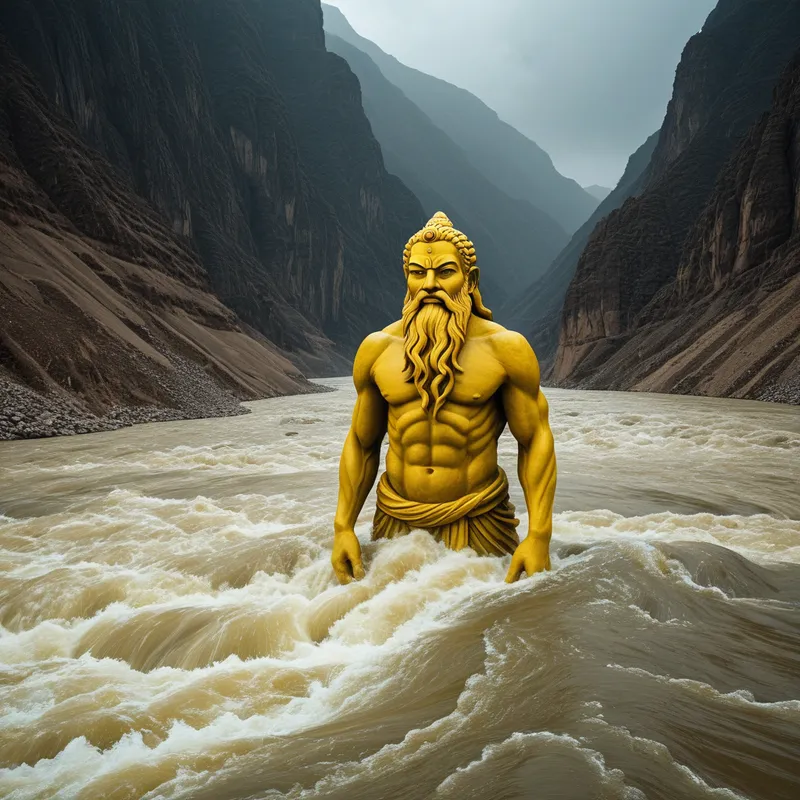
Deep in the Kunlun Mountains, where the pillars of the sky meet the bones of the earth, the Hebo, the god of the [Yellow River](/myths/yellow-river “Myth from Chinese culture.”/), stirred from his long slumber. His heart, mirroring the turmoil above, swelled with a chaotic rage. He broke his banks, not with clear [water](/myths/water “Myth from Chinese culture.”/), but with a churning, roaring tide of yellow silt—the very essence of the primal earth made liquid and wild. The fertile plains of the Central Lands vanished beneath a hungry, ocher sea. Villages were swallowed, sacred mountains became islands, and the cries of the people were lost in the thunder of [the flood](/myths/the-flood “Myth from Biblical culture.”/).
For generations, kings and heroes tried to stem the tide. Gun stole the Xirang from heaven, building dikes and walls to contain Hebo’s anger. But a river god cannot be caged; he must be understood. The walls burst, the silt rose higher, and Gun paid for his defiance with his life.
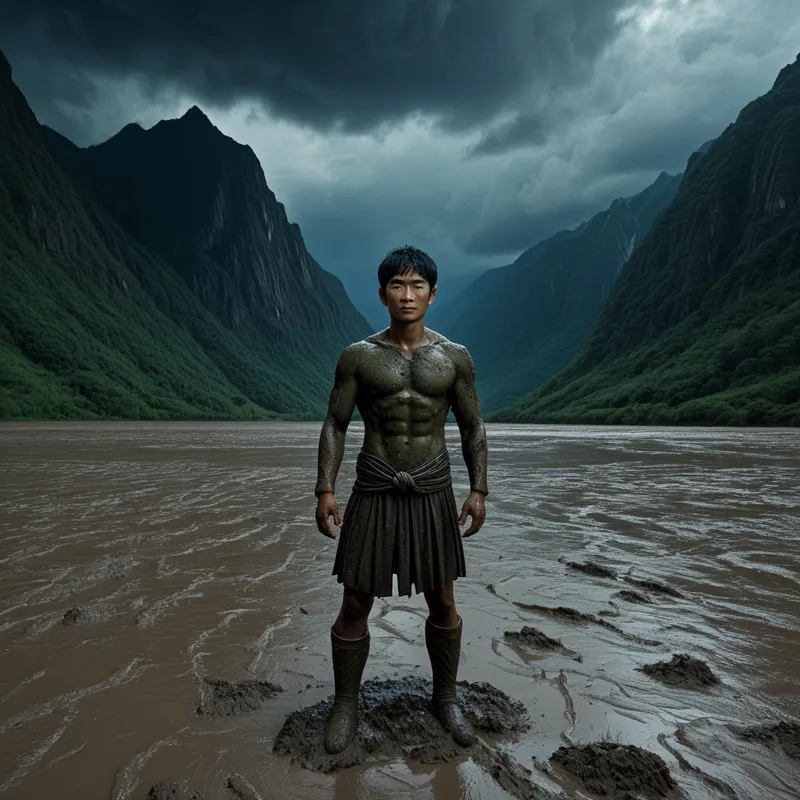
From his sacrifice, however, grew the solution. From Gun’s body—or in some tellings, from his enduring will—came his son, Yu. Yu was shaped by the flood. He did not seek to steal from heaven, but to listen to the earth. He walked. For thirteen years, he walked the length of the drowning world, his feet cracking with callouses, his body lean from travel. He did not command the people; he passed among them, learning the lay of the land, the secret paths of the waters, and the temperament of the furious Hebo.
Yu saw that [the river](/myths/the-river “Myth from Buddhist culture.”/) was not an enemy to be defeated, but a great, wounded dragon that needed guidance. Instead of building walls, he took up his digging tool. With the labor of thousands who believed in his vision, he cut channels. He opened passes through mountains to give [the dragon](/myths/the-dragon “Myth from Chinese culture.”/) a path to [the sea](/myths/the-sea “Myth from Greek culture.”/). He created a vast network of conduits, a sacred anatomy for the land, allowing the waters to flow with the earth, not against it.
They say he passed the door of his own home three times in those thirteen years. Once, he heard the cry of his newborn son. His men stopped, but Yu did not turn. “The flood waits for no man,” he whispered, his voice as rough as the river stone, and walked on. His sacrifice was not of blood, but of time, of kinship, of every personal desire. He became a living tool of cosmic order.
Finally, at a place where the land bottlenecked the dragon’s rage, Yu cut the final, greatest channel. With a roar that shook the heavens, the Yellow River found its new course. The chaotic, drowning silt settled, revealing vast plains of incredible fertility—the gift of Hebo, finally appeased. The river, now a tamed but mighty artery, flowed to the sea. And where Yu’s feet had trodden, a civilization was born, not from conquest, but from profound, enduring care.
Cultural Origins & Context
This is not a single myth, but the bedrock of Chinese cultural identity. The story of [the Great Flood](/myths/the-great-flood “Myth from Biblical culture.”/) and Yu’s taming of the Yellow River is central to the foundational histories, such as the Shangshu and the Shiji. It functioned as the primordial “origin story” for the Xia dynasty, which Yu was said to have founded, legitimizing rulership through the virtue of flood control—the ultimate act of public welfare.
Passed down by historians, poets, and village elders, the tale served a crucial societal function. It explained the very landscape: why the river was yellow and prone to flooding, and why certain mountain passes existed. More importantly, it established the core Confucian ideal of the virtuous ruler: one who labors for the people, who sacrifices personal comfort for public order, and who works with the natural world through understanding and effort, rather than attempting to dominate it through brute force. The river’s management became a metaphor for statecraft itself.
Symbolic Architecture
The Yellow [River](/symbols/river “Symbol: A river often symbolizes the flow of emotions, the passage of time, and life’s journey, reflecting transitions and movement in one’s life.”/) here is the ultimate [symbol](/symbols/symbol “Symbol: A symbol can represent an idea, concept, or belief, serving as a powerful tool for communication and understanding.”/) of the untamed, creative-destructive force of [nature](/symbols/nature “Symbol: Nature symbolizes growth, connectivity, and the primal forces of existence.”/) and, by extension, the unconscious [psyche](/myths/psyche “Myth from Greek culture.”/). It is not merely [water](/symbols/water “Symbol: Water symbolizes the subconscious mind, emotions, and the flow of life, representing both cleansing and creation.”/); it is the yellow [earth](/symbols/earth “Symbol: The symbol of Earth often represents grounding, stability, and the physical realm, embodying a connection to nature and the innate support it provides.”/) in liquid form—the raw, primal [material](/symbols/material “Symbol: Material signifies the tangible aspects of life, often representing physical resources, desires, and the physical world’s influence on our existence.”/) of [life](/symbols/life “Symbol: The symbol of ‘Life’ represents a journey of growth, interconnectedness, and existential meaning, encompassing both the joys and challenges that define human experience.”/) itself, both nourishing and suffocating.
The flood is the unintegrated Self, a torrent of potential that manifests first as catastrophic chaos before it can be channeled into life-giving form.
Gun represents [the ego](/myths/the-ego “Myth from Jungian culture.”/)‘s initial, heroic but flawed [response](/symbols/response “Symbol: Response in dreams symbolizes how one reacts to situations, often reflecting the subconscious mind’s processing of events.”/) to a psychic [crisis](/symbols/crisis “Symbol: A crisis symbolizes turmoil, urgent challenges, and the need for immediate resolution or change.”/): repression. He builds walls (defenses) and uses stolen magic (intellectualization, quick fixes) to contain the unconscious. This always fails, and [the ego](/myths/the-ego “Myth from Jungian culture.”/) must undergo a symbolic [death](/symbols/death “Symbol: Symbolizes transformation, endings, and new beginnings; often associated with fear of the unknown.”/). Yu represents the next stage: the conscious [attitude](/symbols/attitude “Symbol: Attitude symbolizes one’s mental state, perception, and posture towards life, influencing emotions and actions significantly.”/) born from the sacrificed ego. His long [journey](/symbols/journey “Symbol: A journey in dreams typically signifies adventure, growth, or a significant life transition.”/) is the process of acknowledgment—walking the full [terrain](/symbols/terrain “Symbol: Terrain in dreams often represents the landscape of one’s life, including challenges, opportunities, and feelings about one’s current circumstances.”/) of one’s inner [landscape](/symbols/landscape “Symbol: Landscapes in dreams are powerful symbols representing the dreamer’s emotional state, personal journey, and the broader context of life situations.”/), feeling its contours, and respecting its power. His tools are not weapons, but channels: the directed focus of [consciousness](/symbols/consciousness “Symbol: Consciousness represents the state of awareness and perception, encompassing thoughts, feelings, and experiences.”/) creating pathways for psychic [energy](/symbols/energy “Symbol: Energy symbolizes vitality, motivation, and the drive that fuels actions and ambitions.”/) to flow toward a goal (individuation).
The Dreamer’s Resonance
To dream of a great, muddy, or yellow flood is to experience a direct resonance with this myth. Somatically, it may feel like being overwhelmed by a rising tide of emotion—anger, grief, or a formless anxiety that threatens to dissolve one’s sense of order. The water is not clear; it is laden with the “silt” of unprocessed history, familial patterns, or instinctual drives.
Psychologically, this dream signals that a containment strategy (Gun’s walls) has failed. The unconscious is erupting, demanding attention. The dreamer is in the “flood plain” of their life. The critical question the dream poses is not “How do I stop this?” but “Where is this water trying to go? What ancient course is blocked?” The dream is an invitation to become Yu: to begin the long, patient, and often lonely work of surveying one’s inner world, identifying the blockages (repressed traumas, unlived potentials), and beginning the laborious task of creating conscious channels—through therapy, artistic expression, or deep reflection—to guide this powerful energy.
Alchemical Translation
The alchemical process modeled here is the transformation of [prima materia](/myths/prima-materia “Myth from Alchemical culture.”/)—the chaotic, base substance of the soul—into the philosophical gold of an integrated personality. The yellow silt is the prima materia: the messy, earthy, and often despised aspects of oneself.
The work of Yu is the opus of individuation: the sustained, humble labor of differentiating the self from the unconscious flood, creating an ego that serves as a bank for the river, not a dam against it.
First, the [nigredo](/myths/nigredo “Myth from Alchemical culture.”/): the blackening, the flood of despair and chaos that destroys the old, rigid order. This is Gun’s failure and death. Then, the albedo: the whitening, represented by Yu’s relentless, clarifying journey of observation and understanding. He brings consciousness to the chaos. Finally, the [rubedo](/myths/rubedo “Myth from Alchemical culture.”/): the reddening, the culmination of the work. This is not Yu’s personal [triumph](/myths/triumph “Myth from Roman culture.”/), but the resulting fertility of the plains—the new life, creativity, and stability that emerge when the psychic energy is properly aligned. The modern individual undergoes this transmutation whenever they face a personal deluge—a crisis of meaning, a breakdown of identity—and choose not to flee or fight blindly, but to engage in the slow, careful work of self-knowledge, channeling raw pain or confusion into the fertile ground of a more authentic life. The river never becomes “safe,” but it becomes sacred, the central, flowing heart of one’s being.
Associated Symbols
Explore related symbols from the CaleaDream lexicon: